


Learn how to start a jewelry business in 2026 with a six-step framework covering niche selection, branding, sourcing, store setup, marketing, and scaling.
Published:
October 16, 2026
Author:
Yi Cui
Most jewelry business guides assume you want to make jewelry by hand. In 2026, more successful jewelry entrepreneurs design brands than bend wire. Here's the dropshipping-first playbook.
The landscape of jewelry entrepreneurship has fundamentally shifted. The global jewelry market is projected to reach $578.45 billion by 2033, with digital channels now accounting for up to 30% of total purchases [1] [2]. This growth is not driven by traditional brick-and-mortar jewelers. It is being led by a new wave of creator economy brands, influencers, and agile ecommerce operators who understand that modern consumers buy the brand story as much as the product itself. Platform maturity, low-MOQ private-label manufacturing, and social commerce have converged to make 2026 the most accessible entry point in the history of the jewelry industry.
This guide provides a complete, model-agnostic roadmap to help you choose your path and execute a profitable jewelry launch. Whether you are a content creator looking to monetize your audience, a side-hustler building a second income stream, or a small ecommerce operator expanding into a new category, the framework here applies.
The jewelry sector is currently fashion's fastest-growing category by unit sales, expanding at nearly four times the rate of clothing [3]. The global market, valued at approximately $381.54 billion in 2025, is being reshaped by three converging forces: demand for personalization, a shift toward sustainable and ethical sourcing, and the rapid expansion of direct-to-consumer (DTC) channels [1]. Branded jewelry sales are significantly outpacing non-branded segments, growing at 8.3% annually and now comprising 25% of the total market [3].
The online jewelry market is growing even faster than the broader category, projected to reach $85.7 billion in 2026 at a CAGR of 13.8% through 2032 [2]. Self-purchasing has become a major driver, with jewelry "self-gifts" up 58% since 2021 as consumers increasingly buy pieces to mark personal milestones rather than waiting for someone else to gift them [3].
The biggest threat to a new jewelry business isn't competition. It's underdifferentiation. The market is not saturated; it is same-ified. Scroll through any jewelry marketplace and you will find thousands of stores selling identical wholesale pieces with no brand story, no distinct aesthetic, and no reason for a customer to return. The opportunity in 2026 is not to find a gap in the product catalog. It is to build a brand that a specific customer genuinely connects with.

Selecting the right niche dictates your pricing strategy, sourcing model, and target audience. The most successful new brands focus on a specific aesthetic and customer rather than trying to appeal to everyone. Broad appeal is a strategy for companies with seven-figure marketing budgets. For a new founder, specificity is your competitive advantage.
Here is an honest breakdown of the five primary niches, with the data that matters for your launch decision.
| Niche | Avg. Price Point | Sourcing Fit | Audience | Difficulty to Brand | 2026 Trend Signal |
|---|---|---|---|---|---|
| Minimalist / Everyday | $40 - $120 | Private Label / Dropship | Gen Z and Millennials | Medium | High (Stacking and Layering) |
| Statement / Bold Fashion | $30 - $80 | Wholesale / Dropship | Trend-focused shoppers | Low | Medium (Event-driven) |
| Fine Jewelry (Solid Gold / Diamonds) | $300 - $2,000+ | Private Label / Artisan | High-income professionals | High | High (Lab-grown growth) |
| Fashion / Trend | $15 - $50 | Dropship | Gen Z / TikTok users | Low | High (Fast turnover) |
| Personalized / Custom | $50 - $150 | Private Label / Artisan | Gifters and self-purchasers | Medium | Very High |
Branvas Niche-Fit Note: In our experience at Branvas, minimalist and personalized niches consistently convert best for first-time brand founders. The audience is clear, the price point is accessible, and the catalog depth exists to build a cohesive collection from day one. Personalized jewelry is particularly compelling right now: the global personalized jewelry market was valued at $38.6 billion in 2025 and is projected to reach $81.4 billion by 2034 [5].

We often see founders skip brand development entirely and go straight to products. It's the single most common reason their store fails to gain traction, even with good traffic. Your brand is the asset. The jewelry is just the monetization mechanism.
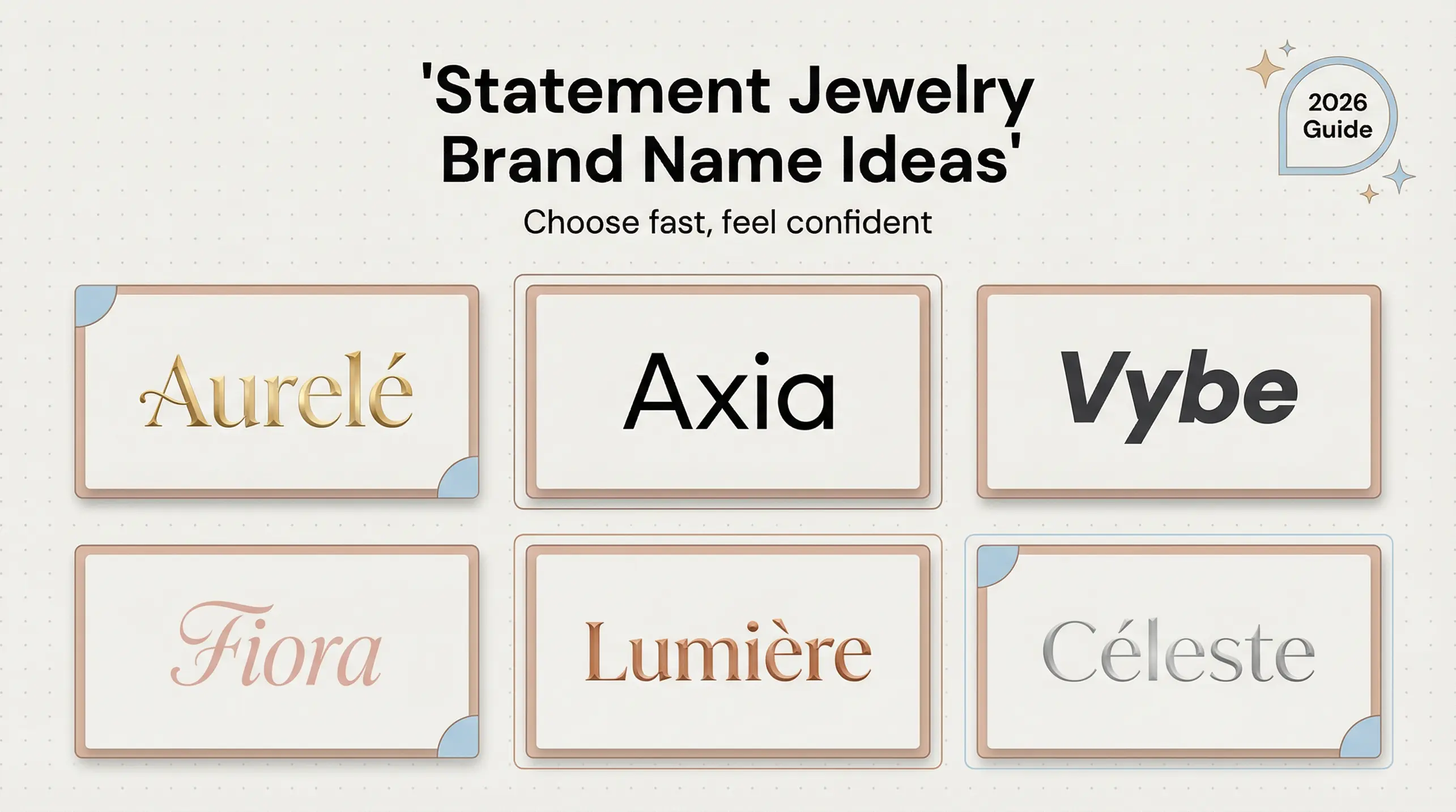
Brand Naming
A strong brand name does not need to be clever. It needs to be memorable, searchable, and aligned with your aesthetic. The Branvas Brand Name Formula provides a reliable structure: [Emotion/Value] + [Identity Word] + optional [Modifier]. Here are three worked examples:
Define Your Target Customer
Before selecting a single product, build a specific buyer persona. Here is a worked example:
Elena, 28, a marketing manager in a mid-sized city, earning $85,000 per year. She shops at Aritzia and Madewell, follows mid-tier lifestyle influencers on TikTok and Instagram, and wants her jewelry to signal effortless, quiet luxury without the designer price tag. She is not buying for events. She is buying to feel put-together on a Tuesday. She wants pieces that layer, that photograph well, and that she can wear to both a board meeting and a weekend brunch.
Positioning Statement
Once you have your customer, lock in your positioning using this formula: "For [audience], [Brand Name] is the [category] brand that [unique promise], unlike [generic alternative] which [weakness]."
Worked example: "For young female professionals, Aurel Studio is the demi-fine jewelry brand that delivers tarnish-free everyday elegance, unlike fast-fashion retailers which sell disposable pieces that turn skin green."
Aesthetic and Visual Identity
Create a mood board before you design anything. Pull 20 to 30 images from Pinterest and Instagram that represent the world your brand inhabits. Not just jewelry images. Include interiors, fashion, food, and travel imagery that reflects the emotional register of your brand. From this, extract your color palette (2 to 3 primary colors), your typography direction (serif for heritage, sans-serif for modern), and your photography aesthetic.

Your sourcing model determines your capital requirements, profit margins, and daily operations. There is no universally "best" model. There is only the model that fits your goals, resources, and risk tolerance.
Handmade jewelry gives you absolute control over every design decision and an authentic maker story that no private-label brand can replicate.
Pros: Maximum differentiation, story-driven marketing, premium pricing potential, and a genuine craft narrative that resonates with a specific buyer.
Cons: It does not scale easily. Every hour you spend making jewelry is an hour you are not spending on marketing, customer service, or brand building. Inventory risk is significant because unsold handmade pieces represent sunk labor costs, not just material costs.
When it wins: Hyper-niche markets such as heritage metalwork, complex beadwork, or culturally specific craft traditions. Ultra-premium price points ($300 per piece and above). Businesses where the maker is the brand and the craft is the product.
If your goal is a scalable ecommerce brand, handmade is rarely the right starting point.
Wholesale means purchasing finished jewelry from a distributor or manufacturer at a discount and reselling it under your own store.
Pros: Faster launch timeline than handmade, access to established product lines with proven demand.
Cons: Low differentiation. You are selling the exact same SKUs as hundreds of other retailers. High minimum order quantities (MOQs) tie up capital. There is no brand exclusivity, meaning a competitor can stock the same pieces tomorrow.
When it works: Boutique retail environments where curation and in-store experience provide the differentiation. Multi-brand resellers with an established local customer base.
Dropshipping means listing products in your store that are shipped directly from a supplier to your customer, with no inventory held on your end.
Pros: Zero inventory holding costs, extremely fast launch timeline, and very low capital requirements.
Cons: No brand control. Long shipping times, particularly from overseas suppliers, create a poor customer experience. Quality inconsistency is common and difficult to manage at scale.
Unbranded dropshipping is dying. Branded dropshipping, where you private-label the product and control the packaging, is growing. The distinction matters enormously.
Private label means working with a manufacturer to produce jewelry that carries your brand name, your packaging, and your identity. Not the factory's.
Pros: Your brand name on the product and packaging. Low MOQs with the right partner. Fast time to market. Blind shipping, meaning your customer only ever sees your brand. Total margin control.
Cons: Requires finding a reliable manufacturing partner and some upfront investment in brand assets such as custom packaging and logo application.
Private label is what every major DTC jewelry brand you admire is doing. The difference in 2026 is that access to it is no longer limited to funded companies. This is exactly the model Branvas was built for: how it works. Private-label jewelry with your brand, your packaging, fulfilled and shipped blind so your customers only see you. Browse the Branvas catalog to see what a curated private-label collection looks like in practice.
| Model | Startup Cost | Time to First Sale | Brand Control | Scalability | Best For |
|---|---|---|---|---|---|
| Handmade | $1,000 - $5,000 | 4-8 Weeks | Absolute | Low | Artisans and Hobbyists |
| Wholesale | $2,000 - $10,000 | 2-4 Weeks | Low | Medium | Curated Boutiques |
| Dropshipping | $100 - $500 | 1-2 Weeks | None | High | Trend Testers |
| Private Label | $500 - $2,000 | 2-4 Weeks | High | Very High | Scalable DTC Brands |

Your ecommerce platform is your digital flagship. The choice you make here affects your operational flexibility for years.
Platform Selection
Shopify remains the undisputed leader for jewelry DTC brands due to its scalability, robust app ecosystem, and seamless integration with fulfillment partners [4]. It gives you full control over your customer data, your checkout experience, and your brand presentation. For a new private-label or dropshipping brand, Shopify is the default choice.
Etsy is excellent for handmade and vintage sellers who want access to an existing marketplace audience. However, Etsy owns the customer relationship, not you. It is a good starting point for artisans, but not a long-term brand-building platform.
TikTok Shop is emerging as a powerful secondary channel for impulse-driven jewelry purchases, particularly in the fashion and trend niche. It is not a replacement for a branded storefront, but it is increasingly worth integrating as a sales channel once your core brand is established.
Essential Store Pages
Every jewelry store needs five core pages before launch: Home (brand story and hero product), Shop (clean collection pages with strong filtering), About (your brand narrative and founder story), FAQ (shipping times, materials, sizing), and Shipping and Returns (clear, simple, and prominently linked). Missing any of these pages signals an untrustworthy brand to a first-time visitor.
Photography
Jewelry photography is make-or-break for conversion. Clean, white-background flat lays are necessary for product pages and Google Shopping. Lifestyle photography, showing the jewelry worn by models in natural lighting, is what actually sells the piece by helping the customer visualize ownership. You need both. Budget for a proper shoot before launch, even if it is a simple setup with a smartphone and a ring light.
Pricing Strategy
Keystone pricing (doubling your cost) is a floor, not a ceiling. Jewelry brand pricing psychology rewards confidence. Consumers associate higher prices with better quality, especially in the demi-fine and fine categories. A piece that costs you $18 to source and package can legitimately retail for $65 to $95 in a well-positioned minimalist brand. Use the Branvas Profit Calculator to model your margins before you set prices.

Marketing in 2026 requires a shift away from pure performance marketing toward community and content. The brands winning in jewelry right now are not outspending competitors on ads. They are out-creating them.
TikTok / Instagram Reels
Short-form video is the highest organic ROI channel for jewelry in 2026. The content formats that perform best are unboxing videos, "jewelry of the day" styling clips, behind-the-scenes brand content, and founder story videos. The algorithm rewards consistency over production quality. A founder filming on an iPhone in good natural light will outperform a polished ad with no authentic voice.
Influencer and Creator Collaborations
Micro-influencers in the 10K to 100K follower range consistently outperform mega-influencers for jewelry click-through rates. Their audiences are more engaged, their recommendations carry more trust, and their gifting rates are far more accessible for a new brand. Build a systematic gifting program: identify 10 to 20 micro-influencers in your niche, send them product with no strings attached, and let authentic content emerge organically.
Email and SMS
These are your highest-converting owned channels and the most important long-term asset you can build. Implement automated flows from day one: a post-purchase sequence that reinforces the brand story and encourages a review, an abandoned cart sequence, and a new collection drop announcement to your VIP list. SMS open rates for ecommerce are consistently above 90%, making it the most direct line to your customer.
Pinterest remains highly underrated for jewelry marketing. It has some of the highest purchase intent of any social platform, and pins have a content shelf-life measured in months rather than hours. A well-optimized Pinterest presence can drive consistent organic traffic to your store long after the initial content is created. Set up a business account, organize boards by aesthetic and occasion, and pin consistently.
Paid Social (Meta)
Facebook and Instagram ads still work, but they require exceptional creative and a proven funnel. For a bootstrapped founder in the first 90 days, paid social should not be the primary acquisition channel. Organic content and influencer gifting will generate better ROI at lower cost while you are still validating your product-market fit.
SEO and Content
Long-form content targeting high-intent search queries is the highest-value long-term marketing investment a jewelry brand can make. Resources like the Branvas Academy provide a starting point for building an SEO-driven content strategy alongside your social presence.
In our experience at Branvas, founders who invest in 3 to 5 TikTok videos per week in their first 60 days consistently outperform those who spend the same time on paid ads.

Efficient operations protect your profit margins and ensure customer satisfaction. As you scale, order management and fulfillment become your primary bottlenecks, not your product or marketing.
Order Management
From day one, use your ecommerce platform's native order management tools. As you scale past 20 to 30 orders per day, consider integrating a dedicated order management system or working with a fulfillment partner who handles this automatically.
Packaging as Brand Experience
The unboxing moment is a critical marketing touchpoint that most new founders underinvest in. Custom tissue paper, branded poly mailers, and a handwritten or printed thank-you card transform a routine delivery into a shareable social media moment. Your packaging should look and feel more expensive than your price point. This is one of the highest-ROI brand investments you can make in the first year.
Shipping and Fulfillment Options
You have three primary options. Self-fulfillment means packing orders yourself, which is manageable at low volume but exhausting and error-prone as you scale. A traditional 3PL (third-party logistics provider) handles warehousing and shipping but often struggles with the delicate nature of jewelry packaging and the brand experience requirements. Partner fulfillment with blind shipping, as offered through a platform like Branvas, means your orders are packed in your branded packaging and shipped directly to your customer with no indication of the underlying supplier.
Returns Policy
Keep your returns policy simple and state it clearly on every product page. A 14 to 30-day window for unworn items in original condition is the industry standard. Complicated or hidden return policies are a primary reason for cart abandonment in jewelry.
Scaling Strategy
When you are ready to expand, resist the urge to launch 50 new SKUs. Go deeper on what is already working. Introduce new metal finishes or stone variations of your bestsellers before adding entirely new product categories. Depth in a proven style builds a cohesive brand and reduces inventory risk.
If you want to skip the fulfillment headache entirely and launch with professional branded packaging from day one, explore how Branvas handles it end-to-end at /how-it-works.

At Branvas, we guide jewelry brand founders using our proprietary ICON Launch Model. This framework ensures you build a sustainable brand, not just a storefront. Brands that launch with clarity outperform brands that launch with inventory.
I: Identify your niche and target customer.
Before you select a single piece of inventory, you must know exactly who you are building for and why they would choose your brand over the hundreds of alternatives. Build your buyer persona first. Everything else flows from this decision.
Actionable tip: Write a one-paragraph description of your ideal customer, including where they shop, what they follow on social media, and what they want a jewelry brand to say about them.
C: Create your brand identity: name, aesthetic, and positioning.
Your brand's visual language must communicate quality and coherence before a customer reads a single word of copy. A cohesive aesthetic, consistent photography style, color palette, and typography, signals a trustworthy brand.
Actionable tip: Build a 30-image mood board on Pinterest before you design your logo or choose your packaging. Let the aesthetic lead the brand decisions.
O: Offer your first collection.
Launch with a highly curated collection of 6 to 12 cohesive SKUs, not a scattered catalog of 50 random items. A small, intentional collection signals editorial confidence and makes the buying decision easier for your customer.
Actionable tip: Choose pieces that can be worn together and styled as a set. This increases average order value from day one.
N: Nurture your audience through content before and after launch.
The biggest mistake new founders make is building in private and launching to silence. Start creating content about your brand journey weeks before your store opens. Document the process. Build an audience before you need to sell to them.
Actionable tip: Post 3 TikTok or Instagram Reels per week starting 4 to 6 weeks before your launch date. Show the brand-building process, not just the finished product.
At Branvas, we walk founders through each phase of ICON before a single product ships. Brands that launch with clarity outperform brands that launch with inventory.
Explore the full Branvas launch process at branvas.com/how-it-works.
Ready to launch your jewelry brand without the guesswork? Start with Branvas: private-label jewelry, your brand, shipped blind.

While private label and dropshipping dominate the scalable ecommerce landscape, there are specific scenarios where the handmade or artisan model is genuinely superior and should not be dismissed.
If your business is built around heritage craft techniques, such as Native American beadwork, traditional metalsmithing, or hand-fabricated fine jewelry, the value proposition is inextricably linked to the maker's hands and story. No private-label product can replicate that authenticity, and the buyers who seek it will pay accordingly.
Handmade wins in the ultra-premium category ($500 per piece and above) where buyers are purchasing heirloom quality, a specific artist's vision, and the story behind the object. It is also the ideal model for the craft fair circuit, local market vendors, and those building a therapeutic or hobby-based business with no ambitions for massive scale or a team of employees. In these cases, the maker is the brand identity, and the intimacy of the handmade model is a feature, not a limitation.
The handmade model also works for ultra-niche cultural or heritage jewelry where the craft tradition itself carries the brand story: pieces that a private-label catalog simply cannot produce.
Know which business you're building. There is no wrong answer, only a mismatch between model and goal.

Most aspiring jewelry entrepreneurs over-complicate their planning. A 40-page business plan is not what separates successful launches from failed ones. Clarity on six core elements is.
You don't need a 40-page business plan to launch a jewelry brand. You need clarity on these six elements — and a supplier you trust.
Niche and Positioning: What specific style of jewelry are you selling, and what makes it meaningfully different from the generic alternatives already in the market?
Target Customer: Who exactly is buying this? What is their age, income, lifestyle, and emotional motivation for the purchase?
Sourcing Model: How are the products manufactured and fulfilled? Define your supplier relationship, your expected lead times, and your packaging strategy.
Revenue Model and Pricing: What are your landed costs per unit, your target retail price, and your gross margin? What volume do you need to reach to cover your fixed costs?
Marketing Channels: Which one or two platforms will you focus on to acquire customers in your first 90 days? Trying to be everywhere at launch is a reliable path to being nowhere effectively.
90-Day Launch Milestones: What are the specific, measurable steps required to get from concept to first sale? Include brand development, store setup, product sourcing, content creation, and launch date.

You can start a private-label or dropshipping jewelry business for $500 to $2,000. This covers your ecommerce platform subscription, domain name, basic brand assets, sample products, and initial marketing content. Handmade businesses typically require $1,000 to $5,000 upfront for raw materials, specialized tools, and workspace setup. The private-label model has the best startup cost-to-brand-quality ratio of any sourcing approach.
There is no specific federal "jewelry license" required to sell jewelry in the United States. You will need a general business license from your city or county and a state seller's permit to collect sales tax. Forming an LLC is highly recommended to protect your personal assets from business liabilities. You will also need an EIN (Employer Identification Number) from the IRS, which is free to obtain, to open a business bank account.
Yes, jewelry is one of the most profitable ecommerce categories. Gross margins typically range from 60% to 80% for private-label and branded dropshipping operations. Because items are small and lightweight, shipping and storage costs are minimal. Well-run brands achieve net margins between 15% and 30%. The online jewelry market is growing at a CAGR of 13.8% through 2032, meaning the demand environment is highly favorable for new entrants [2].
Shopify is the best platform for building a scalable, independent jewelry brand. It gives you full ownership of your customer data, a flexible checkout experience, and a robust app ecosystem for fulfillment and marketing [4]. Etsy is excellent for handmade artisans seeking an existing marketplace audience. TikTok Shop is rapidly becoming the top choice for trend-driven, impulse-buy jewelry in the fashion niche.
Absolutely. The rise of private-label manufacturing and branded dropshipping means you no longer need to be a trained metalsmith to launch a successful jewelry brand. The skills that matter most in 2026 are brand development, content creation, and customer understanding — not metalworking. Many of the most successful new jewelry brands were built by former content creators, marketers, and ecommerce operators with no prior jewelry industry experience.