


Gift shop owners can add high-margin jewelry displays using a digital inventory extension model, eliminating wholesale MOQs, dead stock risk, and upfront capital through on-demand fulfillment.
Published:
July 27, 2026
Author:
Yi Cui
Add a high-margin jewelry display with zero wholesale stock risk.
You have probably thought about adding a jewelry display to your gift shop. It makes perfect sense on paper. Jewelry is small, easy to merchandise, and carries some of the highest profit margins in retail. But then you start looking at the reality of traditional wholesale. You see the $500 minimum order quantities. You worry about buying 50 pieces of a trendy necklace only to watch 40 of them sit in your display case for the next two years.
The fear of dead stock is real, and it is the number one reason independent gift shop owners hesitate to expand into jewelry. You have likely been burned before by a wholesale order that looked great in a catalog but failed to resonate with your local foot traffic. Tying up thousands of dollars in inventory that might never sell is a risk most small retailers simply cannot afford to take.
This guide will show you a smarter, modern alternative. You do not need to buy bulk inventory upfront, manage unreliable suppliers, or take on the financial risk of traditional wholesale to offer a curated jewelry line in your store. By leveraging a digital inventory extension model, you can capture the high margins of retail jewelry while completely eliminating the risk of unsold stock.
Jewelry offers a unique combination of high perceived value and low physical footprint, making it an ideal category for gift shops. Unlike bulky home decor items or fragile ceramics, a robust jewelry collection can be displayed in a single square foot of counter space. More importantly, the retail margin potential for jewelry significantly outpaces typical gift shop staples like candles, greeting cards, or mugs.
The emotional and impulse-buy dynamic of jewelry in a gift retail context is powerful. Customers browsing a gift shop are already in a purchasing mindset, often looking for a meaningful item for a friend or a "treat yourself" moment. According to industry research, 80 percent of US adults now purchase fine jewelry for themselves, driven primarily by emotional motivations rather than financial investment [1]. When a customer connects with a piece of jewelry that matches their aesthetic, price resistance drops.
While a greeting card might offer a 50 percent gross margin, the absolute dollar profit is minimal. A $22 candle might yield a $14 gross profit. But a well-sourced piece of fashion jewelry can easily support a 2.5x to 3x markup, delivering both strong percentage margins and meaningful absolute dollar profits per square inch of retail space.
| Product Category | Avg. Wholesale Cost | Typical Retail Price | Gross Margin % |
|---|---|---|---|
| Greeting Cards | $2.50 | $5.00 | 50% |
| Mugs & Drinkware | $6.00 | $16.00 | 62% |
| Candles | $8.00 | $22.00 | 63% |
| Fashion Apparel | $12.00 | $28.00 | 57% |
| Fashion Jewelry | $15.00 | $45.00 | 66% |
Data compiled from specialty retail benchmarks and wholesale pricing standards [2] [3].

The conventional wisdom for small retailers is to "just find a good wholesaler on Faire or Alibaba." However, this approach often increases risk for small gift shops rather than reducing it. When you buy through traditional wholesale channels, you are forced to predict consumer demand months in advance.
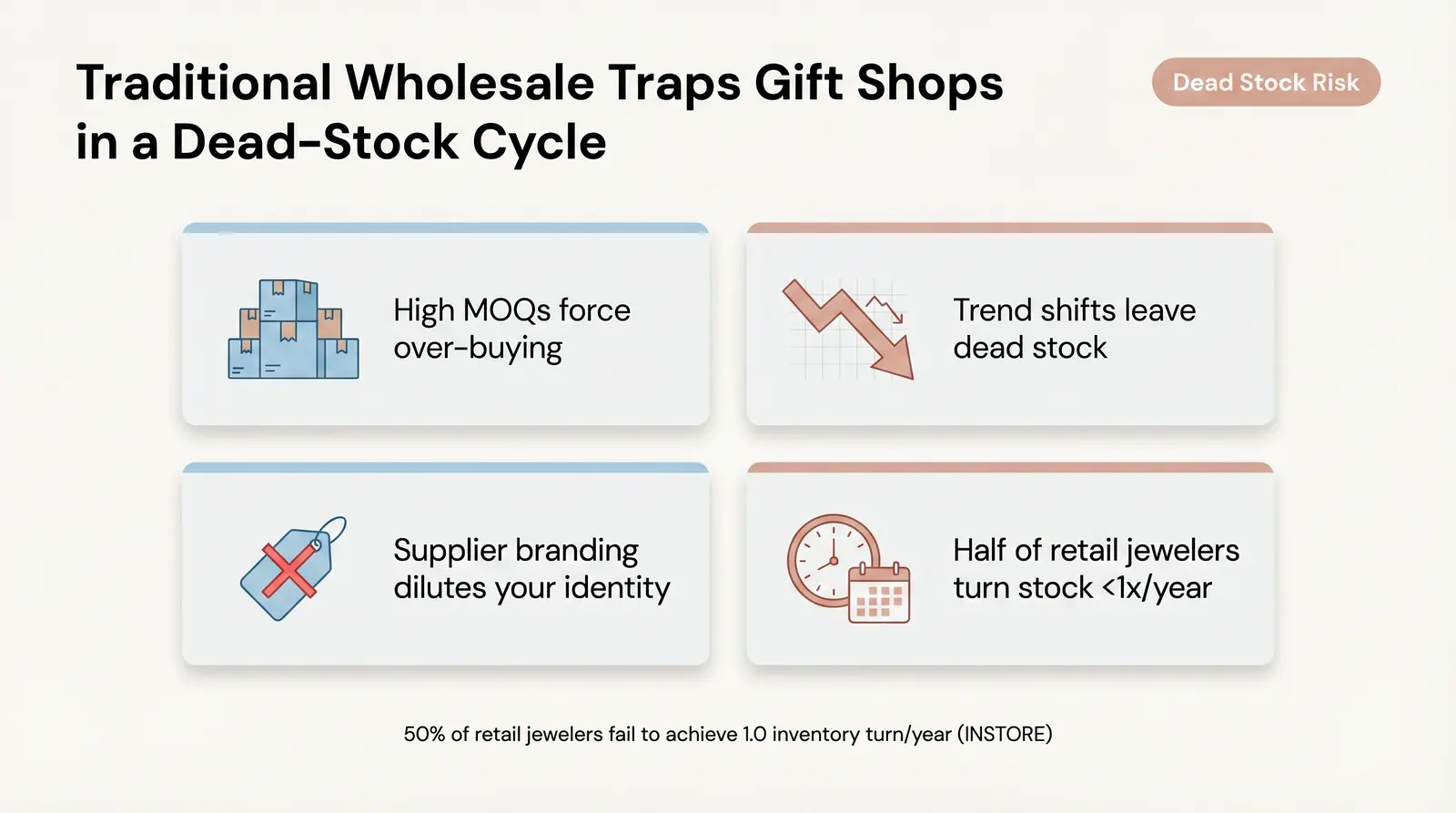
Traditional wholesale requires upfront capital and enforces Minimum Order Quantities (MOQs). A supplier might require a $300 minimum order, forcing you to buy deeper into a specific style than your local market can support. If that style misses the mark, you are left with dead stock. According to the National Retail Federation, manufacturing in bulk and storing goods while hoping demand aligns with supply is ill-suited to today's market, where trends shift rapidly [4].
Furthermore, traditional wholesale jewelry often comes with packaging limitations. You are either forced to sell the item in the supplier's branded packaging, which dilutes your own store's brand identity, or you must spend additional time and money repackaging every piece yourself. Vetting suppliers for quality control, managing return policies for defective items, and dealing with inconsistent fulfillment times add layers of operational friction.
We often see gift shop owners who've tried the wholesale route tell us they're sitting on $2,000 to $4,000 of jewelry that never sold. That is capital trapped in a display case, dragging down your overall store profitability. In fact, data from INSTORE Magazine reveals that half of surveyed retail jewelers fail to achieve even a 1.0 inventory turn per year, meaning their stock sits for more than 12 months on average [5].
The solution to the wholesale inventory trap is a fulfillment-first platform acting as a "digital inventory extension" for your physical store. Instead of buying 50 necklaces to sit in your back room, you use a platform like Branvas to display physical samples in-store while fulfilling actual customer orders on demand.
The model is straightforward. You set up a curated physical sample display in your store. A customer browses the display, selects a piece they love, and pays you at the register. You then log into your Branvas account, place the order at your wholesale cost, and Branvas blind ships the item directly to the customer's home (or to your store for pickup).
Blind shipping is a fulfillment method where the end customer does not see the original supplier's identity [6]. The shipping label and packing slip feature your store's name and branding, not Branvas. This protects your brand identity and ensures the customer attributes the premium experience entirely to your gift shop.
Consider how this works in practice. Maria runs a coastal gift shop in Charleston. She sets up a 12-piece jewelry sample display using pieces from Branvas's catalog. A customer loves a $48 retail necklace. Maria collects payment, logs into Branvas, places the order at her wholesale price of $18, and Branvas ships it directly to the customer in Maria's branded packaging. Maria keeps $30. No inventory purchased, no storage, no risk.
Curious how the display model works in practice? Explore Branvas's How It Works page before reading on.

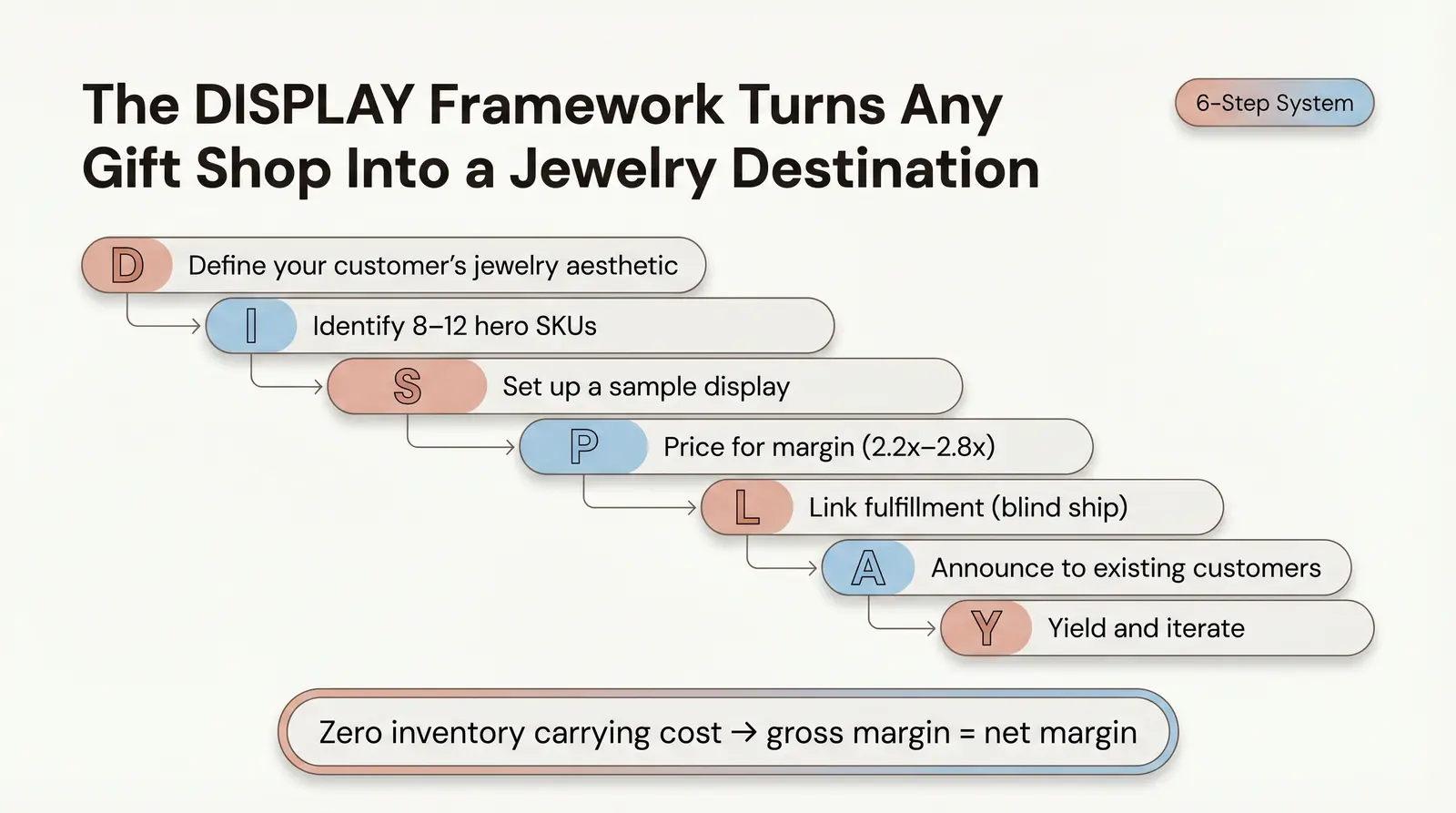
To help gift shop owners successfully implement a zero-risk jewelry program, we developed the DISPLAY Framework. This step-by-step system ensures you launch with the right products, the right pricing, and the right operational flow.
D: Define your customer's jewelry aesthetic
Before looking at catalogs, define the specific style that resonates with your existing foot traffic. Are your customers looking for coastal and nautical themes, bohemian layered pieces, or minimalist everyday wear? Your jewelry should feel like a natural extension of your store's current vibe, not a random assortment of shiny objects.
I: Identify 8 to 12 hero SKUs
Resist the urge to offer everything. Select a tight, cohesive collection of 8 to 12 hero items from the catalog. A smaller, highly curated selection prevents decision fatigue for your customers and makes your display look intentional and premium.
S: Set up a Sample Display
Create a dedicated, well-lit physical touchpoint in your store. Use professional signage to clearly explain the fulfillment process (e.g., "Custom ordered for you, shipped directly to your door"). Ensure the samples are accessible so customers can touch and feel the quality, which is a primary driver of impulse purchases.
P: Price for margin
Establish a retail markup that supports your business goals. We suggest pricing jewelry at 2.2x to 2.8x your base cost. Because you have zero inventory carrying costs and zero markdown risk, your gross margin effectively becomes your net margin on these items.
L: Link your fulfillment
Set up your Branvas account and configure your blind shipping details. Upload your store's logo and customize your packaging options so that every order reinforces your brand identity when it arrives at the customer's home.
A: Announce to your existing customers
Treat your new jewelry line as a major store event. Send an email newsletter to your customer base, post styling videos on your social media channels, and place prominent signage near your checkout counter to draw attention to the new display.
Y: Yield and iterate
Track what sells and what does not. Because you are not holding bulk inventory, you can easily rotate slow-moving samples out of your display and replace them with new styles. Expand on the winners by adding complementary pieces to your hero SKUs.
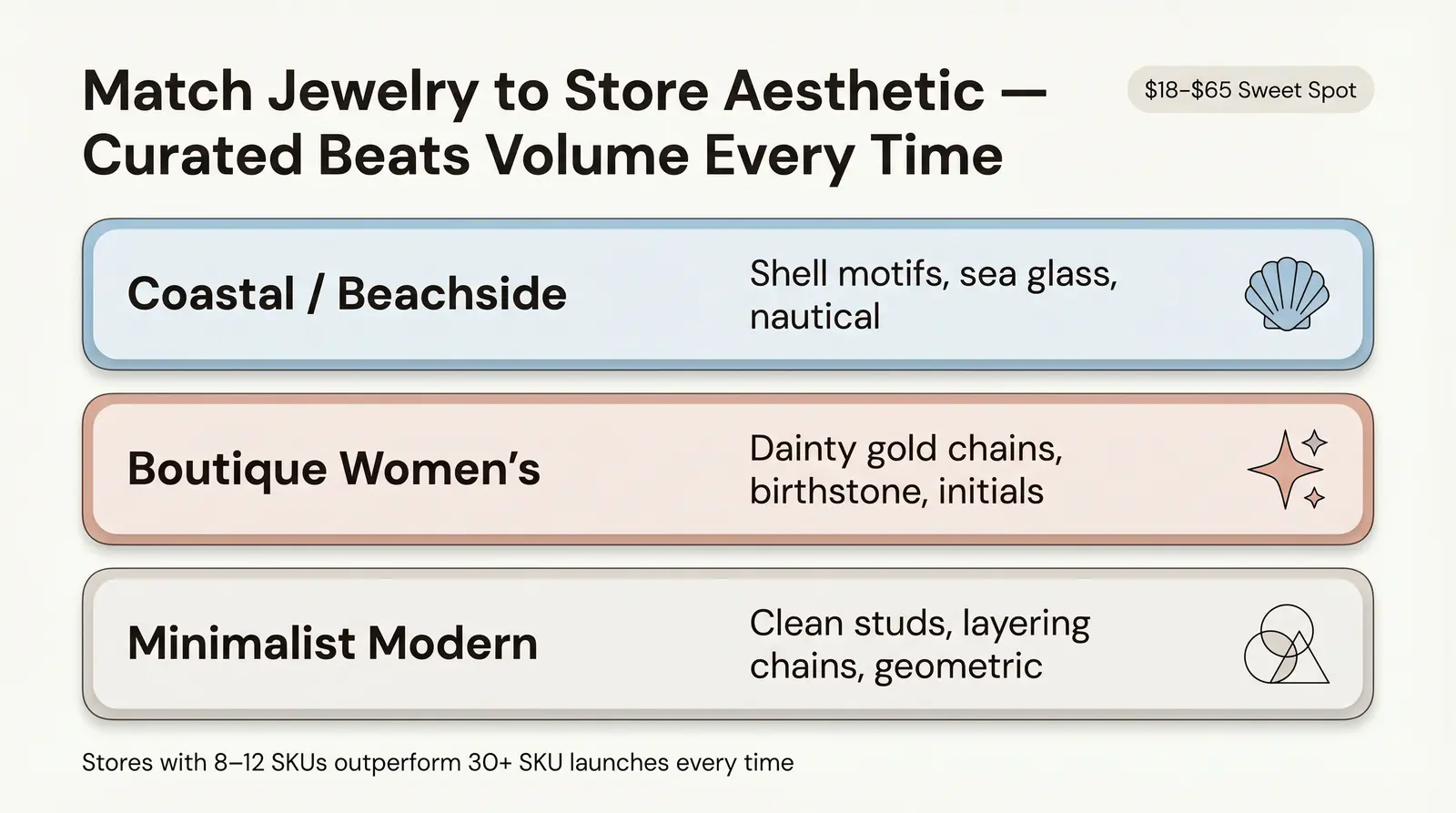
Matching your jewelry selection to your existing store identity is critical for conversion. If you run a beachside coastal shop, your customers will gravitate toward shell motifs, sea glass colors, and nautical styles. If you operate a boutique women's gift shop, dainty gold layering chains, birthstone pieces, and personalized initial necklaces will perform best.
Price point selection is equally important in a gift shop context. The sweet spot for gift shop jewelry is typically between $18 and $65 retail. At this price, the jewelry remains an accessible impulse buy or an easy add-on gift, rather than a considered luxury purchase that requires a lengthy sales consultation.
Branvas's product catalog (branvas.com/catalog) includes a curated range of styles suited to different store aesthetics, from minimalist fine-look pieces to bold statement jewelry. Browse by aesthetic to find the exact pieces that align with your brand.
In our experience at Branvas, stores that start with 8 to 12 tightly curated SKUs consistently outperform stores that launch with 30 or more pieces. Focus beats volume every time. A cluttered display overwhelms the buyer, while a curated selection elevates the perceived value of every piece.
The digital inventory model fundamentally changes the math of retail jewelry. In a traditional model, your gross margin is constantly eroded by the cost of holding inventory, the inevitable markdowns on dead stock, and the capital tied up in minimum order quantities. With Branvas, your margin is protected because you only pay for what you have already sold.
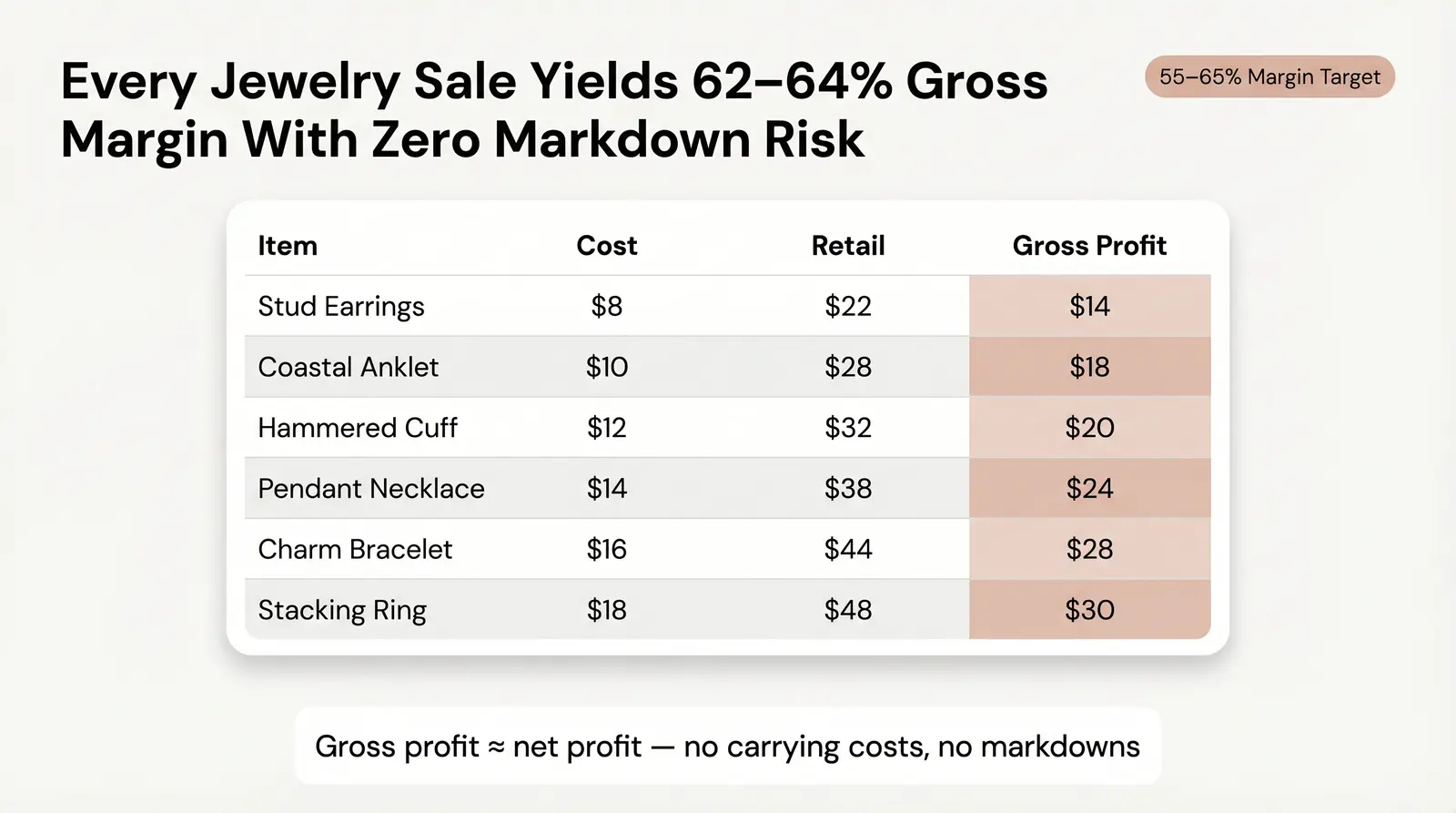
When pricing your jewelry, aim for a gross margin of 55 to 65 percent. This allows you to offer a premium product while maintaining excellent profitability.
| Item | Branvas Cost | Suggested Retail | Gross Profit | Gross Margin % |
|---|---|---|---|---|
| Minimalist Stud Earrings | $8.00 | $22.00 | $14.00 | 63.6% |
| Coastal Anklet | $10.00 | $28.00 | $18.00 | 64.2% |
| Hammered Cuff Bracelet | $12.00 | $32.00 | $20.00 | 62.5% |
| Layered Pendant Necklace | $14.00 | $38.00 | $24.00 | 63.1% |
| Personalized Charm Bracelet | $16.00 | $44.00 | $28.00 | 63.6% |
| Birthstone Stacking Ring | $18.00 | $48.00 | $30.00 | 62.5% |
Use the Branvas Profit Calculator to model your own numbers before you commit to any SKUs. By eliminating inventory carrying costs and markdown risk, the gross profit you see on paper is much closer to the actual cash you put in the bank.
Adding a high-margin jewelry display to your store is a straightforward process when you eliminate the friction of traditional wholesale.
First, sign up for an account and select the solution tailored for physical retailers at branvas.com/solutions/ecommerce-and-boutique-store-owners. Next, browse the catalog to identify the 8 to 12 hero pieces that perfectly match your store's aesthetic.
Order a single sample of each piece to build your physical in-store display. While you wait for the samples to arrive, set up your fulfillment preferences, upload your logo, and configure your blind shipping and custom packaging options. Once your display is set up, you are ready to take orders and let Branvas handle the rest.
Ready to add a jewelry display to your gift shop without the wholesale risk? Get started with Branvas today. No MOQ, no bulk orders, no inventory headaches.

Can I add jewelry to my gift shop without buying wholesale inventory?
Yes, you can use a digital inventory extension model to sell jewelry without buying bulk wholesale. By setting up a physical sample display in your store, customers can view and purchase items in person. You then route the order through a fulfillment platform like Branvas, which ships the jewelry directly to the customer, eliminating your need to hold inventory.
What is the best jewelry supplier for small gift shops?
The best supplier for a small gift shop is one that offers low or zero minimum order quantities (MOQs) and handles fulfillment on demand. Platforms like Branvas are ideal because they provide private-label branding, blind shipping, and a curated catalog, allowing you to sell high-margin jewelry without the financial risk of traditional wholesalers.
How much do gift shops typically mark up jewelry?
Gift shops typically mark up fashion and demi-fine jewelry by 2.2x to 3x the wholesale cost. This translates to a gross profit margin of roughly 55% to 65%. Because jewelry takes up very little physical space, this high markup makes it one of the most profitable categories per square foot in a retail store.
What types of jewelry sell best in gift shops?
The best-selling jewelry in gift shops usually falls into the $18 to $65 retail price range, making it an accessible impulse buy. Popular styles include minimalist everyday pieces like stud earrings and layering necklaces, as well as personalized items like initial pendants and birthstone rings that carry emotional gifting value.
How does blind shipping work for retail store owners?
Blind shipping is a fulfillment method where the supplier ships an order directly to your customer, but the supplier's identity is completely hidden. The shipping label, packing slip, and packaging feature your gift shop's name and logo. This protects your brand identity and ensures the customer associates the premium experience entirely with your store.