


This category-by-category study reveals profit-maximizing free shipping thresholds, showing the standard 20-30% above AOV rule fails for most ecommerce categories.
Published:
October 6, 2026
Author:
Yi Cui
The "20-30% above AOV" rule of thumb is wrong for 6 of 11 ecommerce categories. Here's the AOV-lift curve, with thresholds.
For years, ecommerce operators have relied on a simple heuristic to set their free shipping threshold: take your Average Order Value (AOV), add 20 to 30%, and call it a day. It is a clean, easy-to-remember rule that makes intuitive sense. When you look closely at the unit economics across different product types, however, this generalized advice falls apart. It fails to account for the massive variance in gross margins, shipping weights, and consumer price sensitivity that exist between selling a $50 face cream and a $50 dumbbell.
This article delivers a category-by-category analysis of the profit-maximizing free shipping threshold, not just the revenue-maximizing one. At Branvas, we work with jewelry and accessories brands at every AOV level, and we have watched founders leave significant margin on the table by copying a threshold that was built for apparel or electronics, not fine jewelry. By synthesizing data from industry benchmarks, consumer psychology studies, and margin structures, this framework helps you find the exact threshold that maximizes profit for your specific category.
The "20-30% above AOV" heuristic originated from broad platform averages and generalized studies aiming to provide a one-size-fits-all solution for merchants. [1] It assumes that a moderate stretch goal will incentivize customers to add an extra item to their cart, thereby increasing the overall order value enough to absorb the cost of shipping.
The problem is that this rule conflates revenue lift with profit lift. At high enough thresholds, you do increase AOV. But the incremental units added to hit that threshold often carry lower margins, and you have now conditioned customers to expect free shipping permanently. Behavioral economics shows that consumers view shipping fees as a penalty and value "free" disproportionately high due to loss aversion. [2] When they add items just to reach a threshold, those items are often low-margin accessories or clearance goods. If the gross margin on the incremental spend does not exceed the cost of the shipping subsidy, the higher AOV actually reduces your net profit per order. [3]
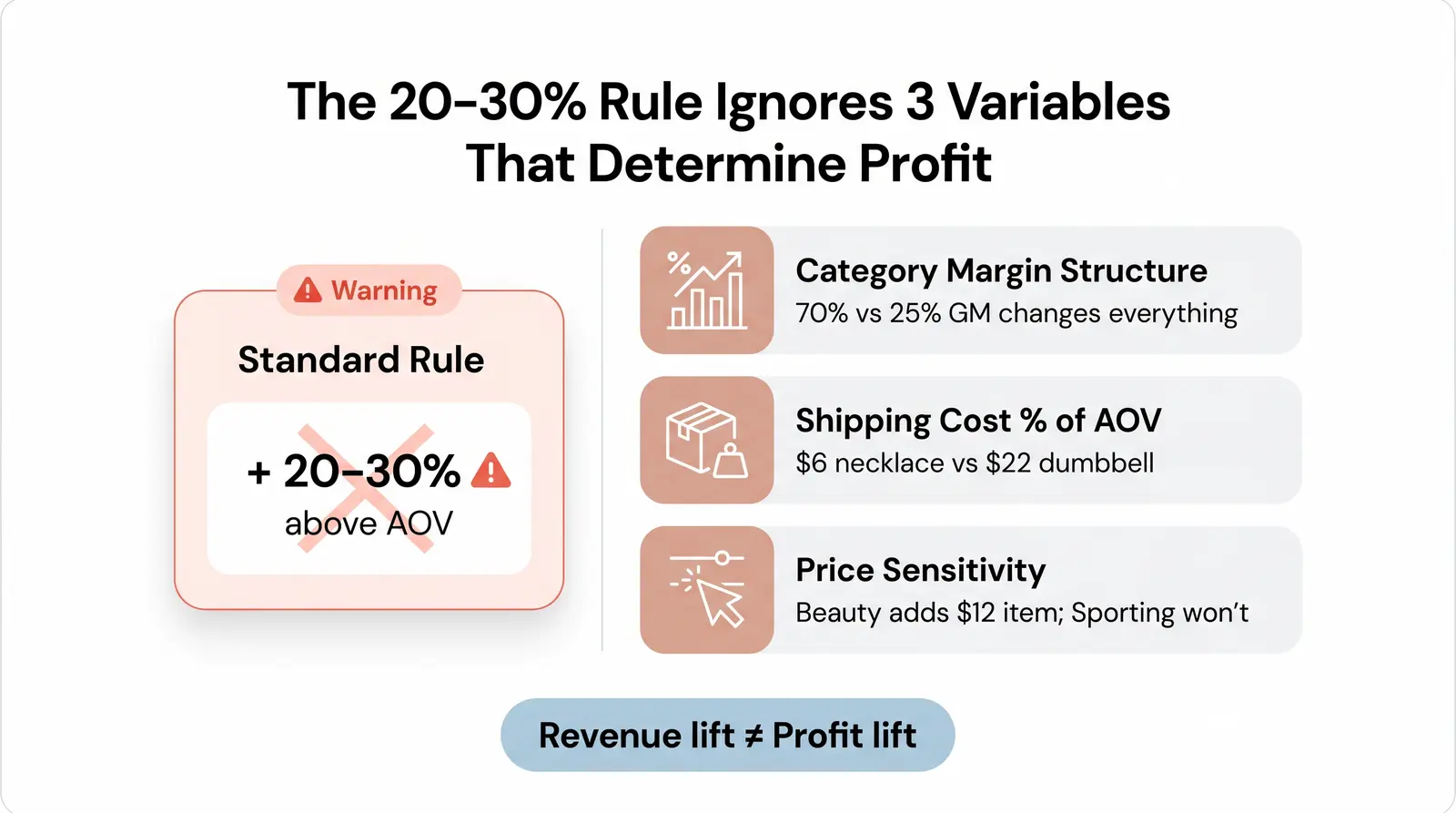
The standard heuristic ignores three critical variables.
Category margin structure: A 70% gross margin business can afford a much lower threshold than a 25% gross margin business. The shipping subsidy is covered by a fraction of the incremental sale in a high-margin category. In a low-margin category, the math rarely works.
Average shipping cost as a percentage of AOV: Shipping a $100 necklace costs roughly $6. Shipping a $100 set of dumbbells costs $22. The threshold math is entirely different, and conflating these two categories under the same rule is a guaranteed margin leak.
Category-specific price sensitivity curves: How willing are customers in your specific niche to pay for shipping if they do not meet the threshold? A beauty shopper will add a $12 travel-size product to qualify. A sporting goods shopper will not add a $45 resistance band they did not plan to buy.
We often see founders in the jewelry space set a $50 free shipping threshold because "that's what everyone does," without realizing their AOV is $38 and their shipping cost is $6.50. They end up subsidizing shipping on almost every order without getting the intended basket size increase.
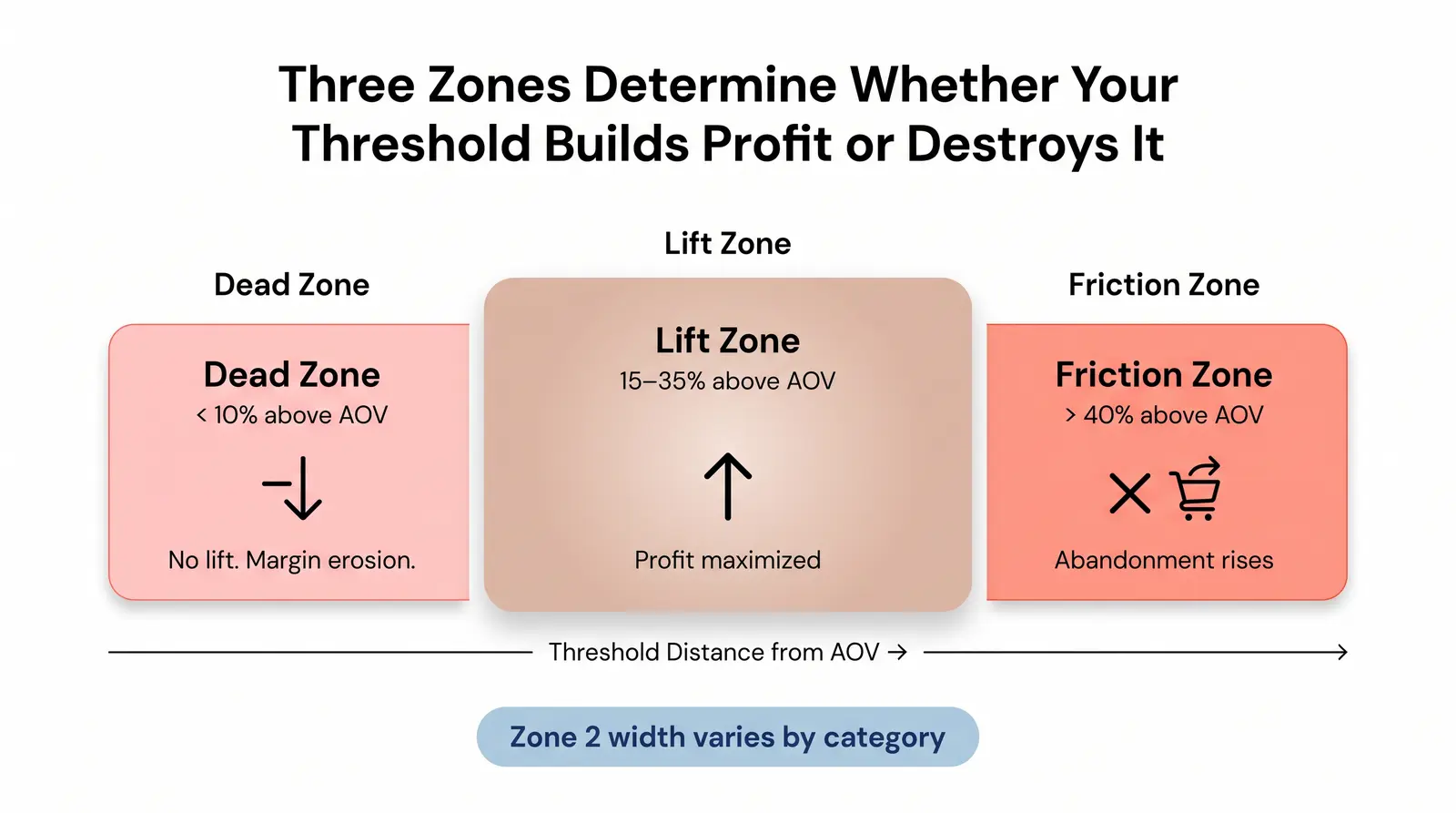
To solve this, we developed the Branvas AOV-Lift Curve Framework. It is a 3-zone model used when advising brand partners on threshold-setting, mapping how consumer behavior shifts as the threshold moves further away from their natural basket size.
Zone 1: The Dead Zone (threshold set less than 10% above AOV). The threshold is too easy to hit. Customers naturally qualify for free shipping without needing to add extra items to their cart. You give away shipping with zero AOV lift. This is pure margin erosion with no behavioral benefit.
Zone 2: The Lift Zone (threshold set 15-35% above AOV, category-dependent). This is the sweet spot where customers are incentivized to add one more item to qualify. The perceived pain of paying for shipping outweighs the cost of the incremental item. AOV lifts, conversion holds steady or improves, and the incremental margin covers the shipping cost.
Zone 3: The Friction Zone (threshold set more than 40% above AOV). The threshold feels punitive and out of reach. Customers abandon their carts rather than add items they did not want just to get free shipping. Conversion drops, and you have created a negative brand signal.
The width of Zone 2, the actual range that produces profitable lift, varies dramatically by category. That is what this study quantifies.
| Zone Name | Threshold vs. AOV | Expected AOV Lift | Conversion Impact | Margin Outcome |
|---|---|---|---|---|
| The Dead Zone | Less than 10% above | None | Neutral | Negative: margin erosion |
| The Lift Zone | 15-35% above | Moderate to High | Positive | Positive: profit maximized |
| The Friction Zone | More than 40% above | None | Negative: high abandonment | Negative: lost sales |
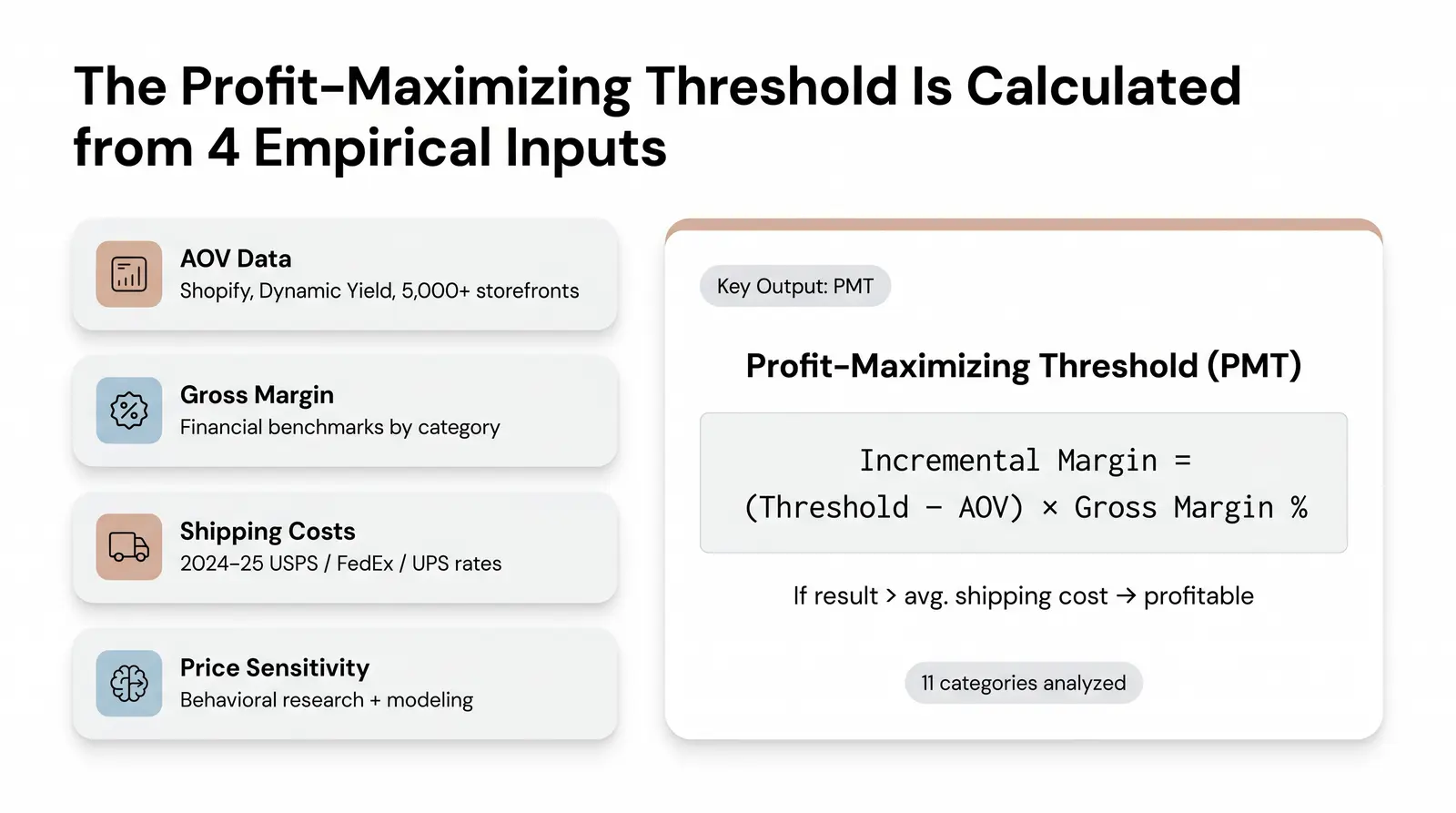
This model synthesizes published third-party research, publicly reported platform benchmarks, and logical modeling based on category margin structures and published shipping cost data. We are transparent about which data points are empirically sourced and which are modeled.
AOV data was aggregated from Shopify, Dynamic Yield, and industry benchmark reports covering 5,000-plus Shopify storefronts. [4] Gross margin benchmarks were sourced from financial data and ecommerce operator reports across categories. [5] Shipping costs were modeled using 2024-2025 USPS Ground Advantage and FedEx/UPS rate averages based on typical category package weights. [6] Where primary category-level data was unavailable, we modeled thresholds using the contribution-margin formula: Incremental Margin = (Proposed Threshold minus AOV) multiplied by Gross Margin Percentage.
The 11 categories analyzed are: Jewelry and Accessories, Apparel and Clothing, Beauty and Skincare, Home Goods and Decor, Electronics Accessories, Pet Supplies, Health and Supplements, Footwear, Books and Media, Food and Beverage, and Sporting Goods.
The key output metric is the Profit-Maximizing Threshold (PMT): the threshold that maximizes (AOV x conversion rate x gross margin) minus shipping cost subsidy. In plain language, it is the exact dollar amount that encourages enough customers to buy an extra item, where the profit from that extra item exceeds the cost of shipping the package for free.
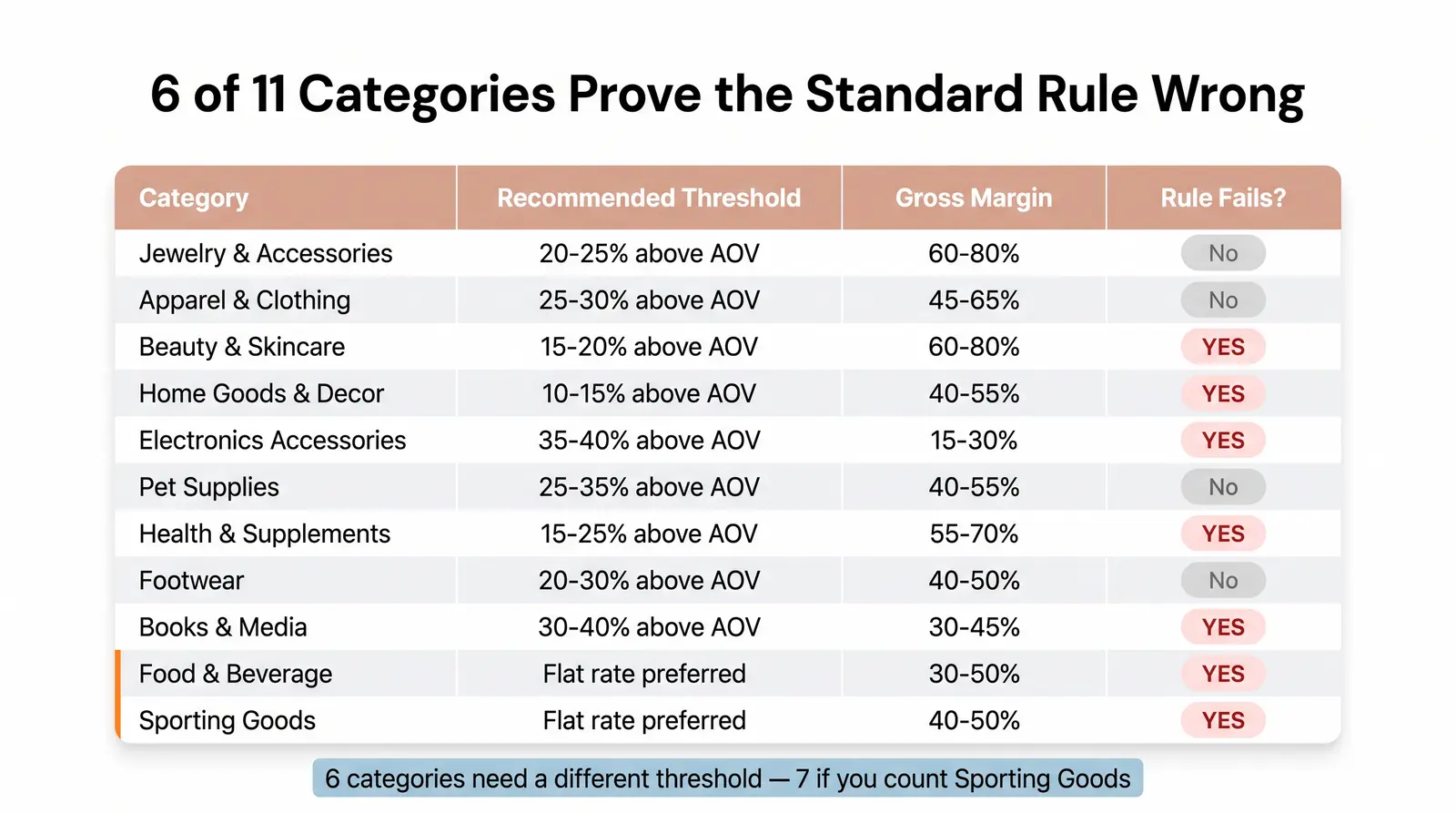
The table below is the core deliverable of this study. For each category, the threshold recommendation is grounded in the margin structure, typical shipping costs, and price sensitivity data from research. Categories where the standard "20-30% above AOV" rule fails are flagged with a warning symbol.
| Category | Typical AOV Range | Avg. Shipping Cost | Recommended Free Ship Threshold | Expected AOV Lift | Gross Margin | Notes |
|---|---|---|---|---|---|---|
| Jewelry and Accessories | $110-$200 | $5-$8 | 20-25% above AOV | High | 60-80% | Standard rule works but high margins allow lower thresholds to drive volume. |
| Apparel and Clothing | $70-$95 | $7-$10 | 25-30% above AOV | High | 45-65% | Standard rule was built for this category. Outfit building drives the lift. |
| Beauty and Skincare | $55-$75 | $6-$8 | 15-20% above AOV | Moderate | 60-80% | Customers will not double their spend for free shipping. Keep the threshold tight. |
| Home Goods and Decor | $180-$350 | $15-$30 | 10-15% above AOV | Low | 40-55% | High shipping costs destroy margins. Thresholds must be low or abandoned entirely. |
| Electronics Accessories | $55-$100 | $6-$9 | 35-40% above AOV | Moderate | 15-30% | Razor-thin margins require a high threshold to ensure the basket is profitable. |
| Pet Supplies | $45-$65 | $8-$15 | 25-35% above AOV | High | 40-55% | Heavy items increase shipping costs. Bundle treats and toys to reach threshold. |
| Health and Supplements | $55-$80 | $6-$8 | 15-25% above AOV | High | 55-70% | High margins allow lower thresholds. Subscriptions often negate the need entirely. |
| Footwear | $100-$150 | $9-$14 | 20-30% above AOV | Low | 40-50% | Hard to upsell a second pair of shoes. Thresholds often just subsidize single-item orders. |
| Books and Media | $25-$45 | $4-$6 | 30-40% above AOV | High | 30-45% | Low AOV requires a high percentage stretch to make the shipping math work. |
| Food and Beverage | $40-$55 | $10-$20 | Flat rate preferred | Low | 30-50% | Heavy, perishable items make free shipping a margin killer. Use flat rates instead. |
| Sporting Goods | $85-$130 | $12-$25 | Flat rate preferred | Low | 40-50% | Bulky items ruin the math. The 20-30% rule fails completely here. |
The 6 categories where the standard rule fails are: Beauty and Skincare (threshold too high), Home Goods and Decor (threshold too high), Electronics Accessories (threshold too low for the margin structure), Health and Supplements (threshold too high), Books and Media (threshold too low), and Food and Beverage (threshold model wrong entirely). Sporting Goods is a seventh failure case where the entire threshold model breaks down.
Here is a realistic scenario for a direct-to-consumer jewelry brand.
Brand economics: AOV of $52, COGS of $14 (gross margin of 73%), average shipping cost of $7.25, and a baseline conversion rate of 3.1%.
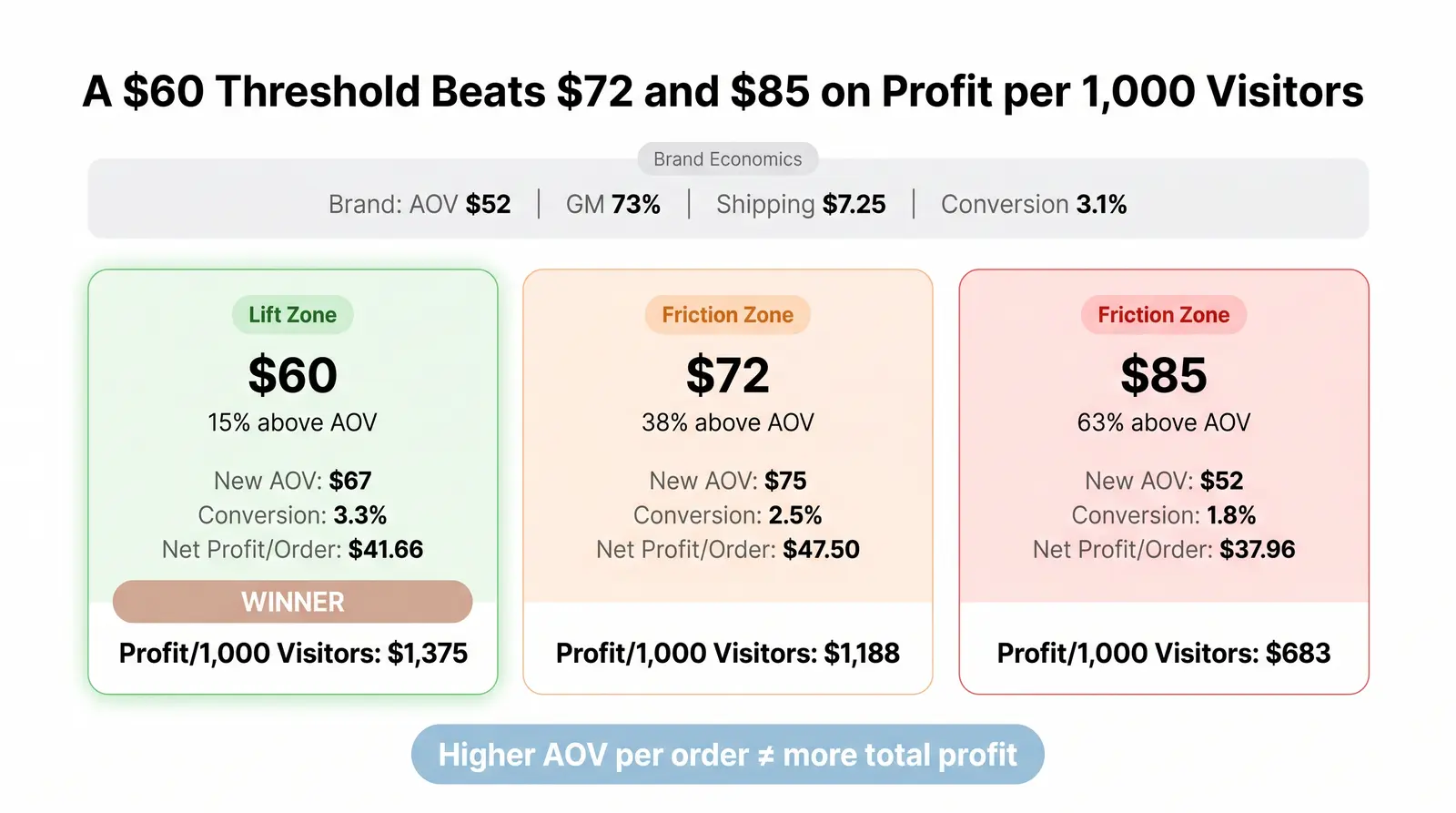
We model three threshold options: $60 (15% above AOV), $72 (38% above AOV), and $85 (63% above AOV).
| Threshold | % Above AOV | Zone | New AOV (Est.) | Conversion Rate | Margin per Order | Shipping Cost | Net Profit per Order | Profit per 1,000 Visitors |
|---|---|---|---|---|---|---|---|---|
| $60 | 15% | Lift Zone | $67 | 3.3% | $48.91 | $7.25 | $41.66 | $1,375 |
| $72 | 38% | Friction Zone | $75 | 2.5% | $54.75 | $7.25 | $47.50 | $1,188 |
| $85 | 63% | Friction Zone | $52 | 1.8% | $37.96 | $0 (paid by customer) | $37.96 | $683 |
The $60 threshold wins on profit per visitor, not just revenue per order. The $72 threshold produces a higher margin per individual order, but the conversion drop means fewer total orders, so total profit across 1,000 visitors is lower. The $85 threshold is a disaster: most customers either pay shipping or leave, and the ones who stay are buying at the baseline AOV with no lift.
If you're launching a jewelry brand and want to stress-test your pricing and fulfillment economics before you go live, Branvas's profit calculator is a useful starting point.
The contrarian case is worth making directly: for some categories and margin structures, a well-communicated flat-rate shipping fee converts better than a free shipping threshold. When a threshold is too high, it creates friction. A transparent, reasonable flat fee feels fair and predictable to the consumer. [7]
Research shows that while 72% of shoppers say free delivery would improve their experience, they are also highly sensitive to unexpected costs at checkout. [8] If they cannot reach the free shipping threshold, and the calculated shipping rate is high or unpredictable, they abandon the cart. A flat rate removes the surprise. The customer knows what they are paying from the moment they start browsing, and they can make a rational decision to proceed.
The four shipping strategies and when to use each one:
| Strategy | Best For | AOV Range | Margin Structure | Customer Type |
|---|---|---|---|---|
| Free Shipping Threshold | Encouraging cross-sells and bundles | Low to Mid | High | Impulse and discovery shoppers |
| Flat-Rate Shipping | Heavy or bulky items, predictable costs | Mid to High | Low to Mid | Intent-driven shoppers |
| Free Shipping Sitewide | High-ticket items where shipping is less than 5% of price | High | High | Luxury and premium buyers |
| Member-Only Free Shipping | Driving recurring revenue and LTV | Any | Any | Loyal and repeat customers |

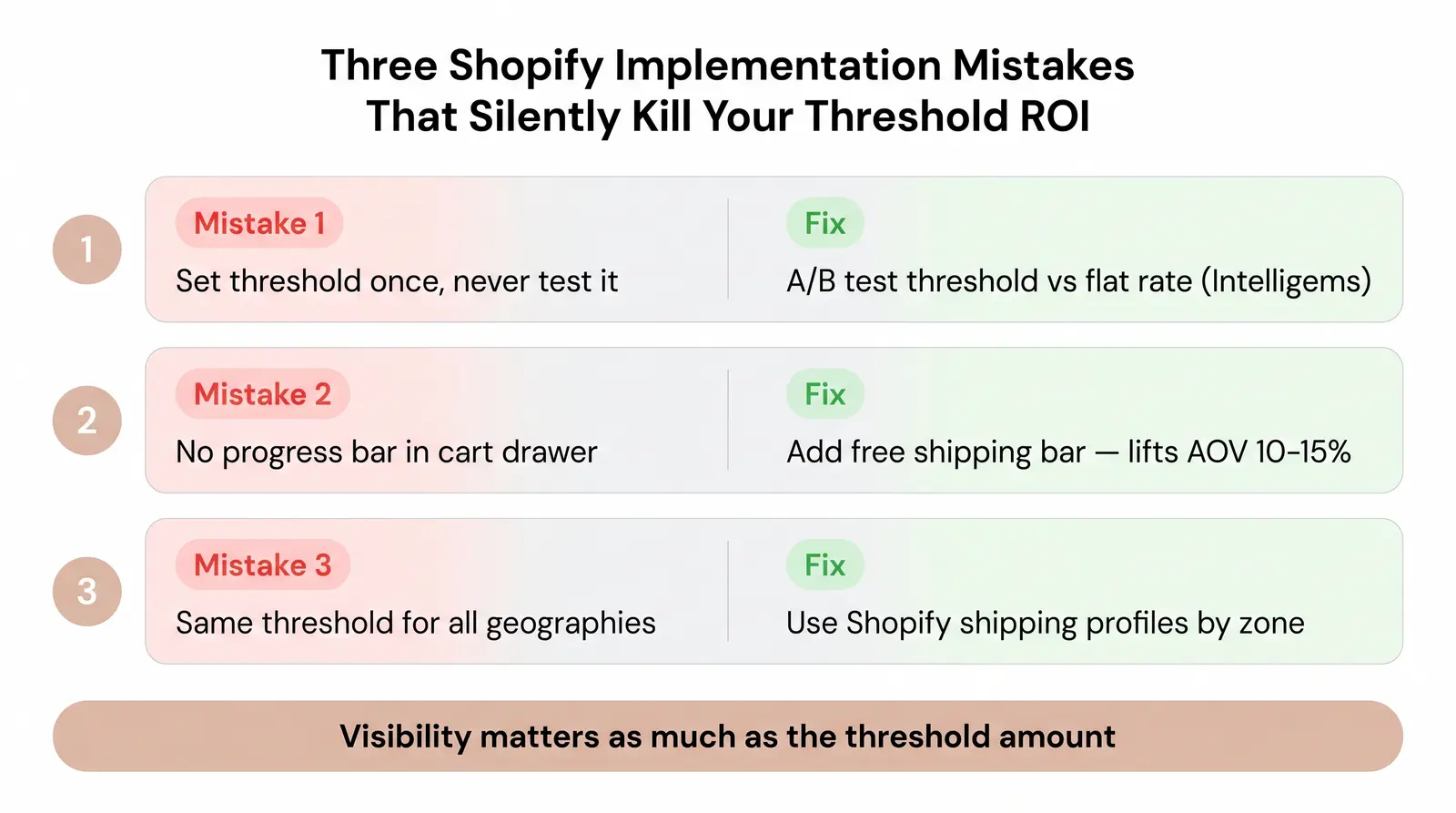
Setting a free shipping threshold in Shopify is technically simple. Navigate to Settings, then Shipping and delivery, select your shipping profile, and add a price-based condition. However, the strategic implementation is where most brands fail.
The most common mistake is setting the threshold once and never testing it. A/B testing your threshold against a flat rate, or against a different threshold amount, is the only way to know what actually maximizes profit for your specific store and customer base. Tools like Intelligems allow you to split-test shipping thresholds directly in Shopify without custom code.
The second mistake is poor visibility. If the customer does not see the "You are $X away from free shipping" message prominently in the cart drawer, the threshold cannot influence their basket size. Most Shopify themes support a free shipping progress bar natively or through apps. If yours does not, add one. This single change can lift AOV by 10-15% on its own.
The third mistake is ignoring geography. A $75 threshold might be profitable on domestic orders but will destroy your margins on international shipments where carrier rates are 2 to 3 times higher. Shopify shipping profiles allow you to set different rates by zone, and you should use them.
For brands using third-party fulfillment, the threshold calculation must account for actual fulfillment cost, not just carrier rates. The pick, pack, and packaging materials add to the total landed cost. Branvas handles fulfillment end-to-end for private-label jewelry brands, ensuring these costs are transparent before you set a threshold. See how it works.
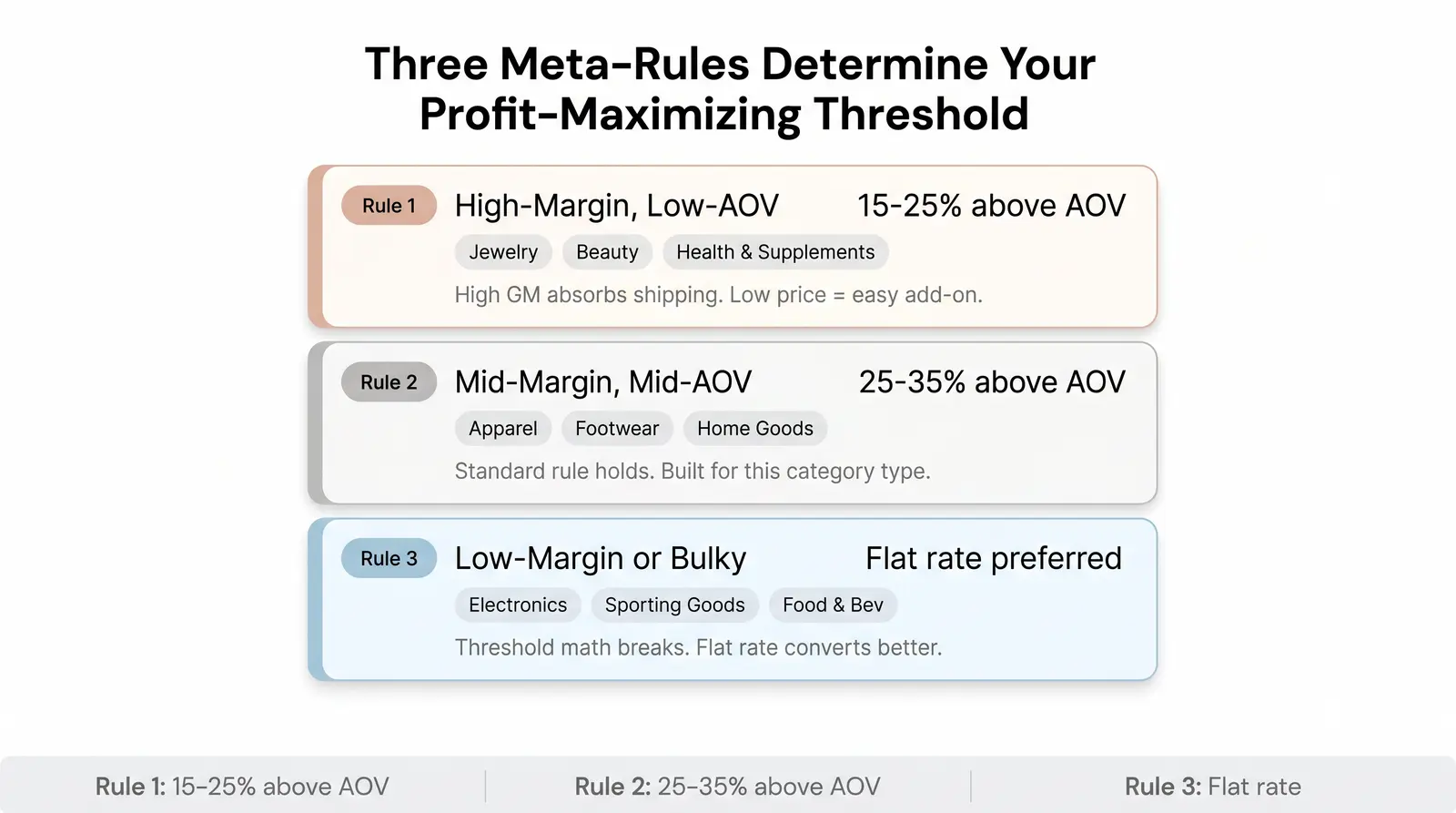
Three meta-category rules synthesize the findings above.
Rule 1: High-margin, low-AOV categories (jewelry, beauty, health and supplements). Set the threshold 15-25% above AOV. Shipping cost is relatively high compared to item value, so the threshold needs to incentivize bundling without triggering friction. The high gross margin easily absorbs the shipping cost on the incremental item, and the low price point means customers are willing to add a small item to qualify.
Rule 2: Mid-margin, mid-AOV categories (apparel, footwear, home goods). The standard 25-35% rule applies most reliably here. This is the traditional ecommerce sweet spot where the heuristic was originally built, and it holds up because the margin structure and shipping costs are close to the averages that generated the rule.
Rule 3: Low-margin, high-AOV or bulky categories (electronics accessories, sporting goods, food and beverage). A free shipping threshold may not be profitable at all. The incremental margin is too thin to cover the shipping subsidy, or the shipping costs are too high and volatile. Flat-rate or member-only free shipping often performs better in these categories.
Ready to launch a jewelry or accessories brand with fulfillment economics you can actually model?
Branvas is a Brand-as-a-Service platform built for ecommerce sellers and influencers: private-label products, custom packaging, and blind shipping, all handled. Explore Branvas
There is no single best threshold. The optimal number depends on your category's gross margin and average shipping costs. For high-margin categories like jewelry and beauty, 15-25% above AOV works best. For lower-margin or bulky categories like sporting goods and food, a flat rate is often more profitable than a threshold. The calculation that matters is whether the gross margin on the incremental spend exceeds the per-order shipping cost you are absorbing.
A free shipping minimum leverages consumer loss aversion. Shoppers dislike paying for shipping so strongly that they will add an extra item to their cart to reach the threshold, preferring to spend money on a tangible product rather than a perceived penalty fee. Research shows approximately 58% of shoppers actually follow through and add items to qualify, which is the behavioral figure operators should model against when projecting AOV lift.
Calculate your Profit-Maximizing Threshold by finding the point where the gross margin on the incremental spend equals or exceeds your average per-order shipping cost. The formula is: Incremental Margin = (Proposed Threshold minus AOV) multiplied by your Gross Margin Percentage. If the result is greater than your average shipping cost, the threshold is profitable. Start with your actual COGS and carrier rates, not industry averages.
No. If a free shipping threshold is set more than 40% above natural AOV, it creates friction. Customers who cannot reach the threshold may abandon their carts rather than pay shipping. In these cases, a transparent flat-rate shipping fee often converts better because it removes the uncertainty. The Baymard Institute has consistently found that unexpected extra costs, including shipping fees revealed late in checkout, are the leading cause of cart abandonment.
Jewelry and accessories brands typically have high gross margins (60-80%) and low shipping weights, with most packages under 1 pound. Set your threshold 20-25% above your AOV. This is close enough to encourage adding a low-cost accessory without causing cart abandonment, and the high margin easily covers the shipping subsidy on qualifying orders. If your AOV is below $50, consider whether a flat rate of $4-5 might perform better than a threshold that most customers cannot reach.
[1] Free Shipping Threshold Strategy 2026: The AOV Playbook, Digital Applied, 2026
[2] The Psychology of Free Shipping: Should You Offer It?, Speed Commerce, 2025
[4] AOV Benchmarks by Industry 2026: What's a Good Average Order Value?, Cartylabs, 2026
[5] Ecommerce Gross Margin by Category 2026, Hycos AI / Agentis, 2026
[6] 25 Shipping Cost Statistics for eCommerce Stores, Opensend, 2025
[7] Free, Flat, or Live Rate? A High-Level Look at How to Price E-commerce Shipping, Shippo, 2022
[8] Free Shipping: 8 Strategies to Boost Sales in 2026, Shopify, 2025