


Amazon dropshipping costs more than most sellers realize in 2026. This breakdown reveals the true fee stack, saturation trends, and why owned-store private-label models build lasting brand equity.
Published:
April 25, 2026
Author:
Yi Cui
Amazon dropshipping is where most beginners start and where most brands die. You rent attention, you don't own a customer, and you compete on a price axis that kills margin. The allure of zero inventory and instant access to millions of buyers is strong, but the reality of operating a dropshipping business on the world's largest marketplace has fundamentally shifted.
At Branvas, we talk to dozens of new sellers every month. The pattern is remarkably consistent: the ones who started on Amazon learned a hard lesson before finding a model that compounded. They spent months optimizing listings and fighting for the Buy Box, only to realize they were building Amazon's business instead of their own. This article provides an honest, unfiltered breakdown of how Amazon dropshipping actually works in 2026, what it costs visibly and invisibly, and which model is actually building lasting ecommerce businesses right now.
Amazon's official policy allows dropshipping, but the rules are strict and unforgiving. To remain compliant, you must be the seller of record. This means your business name must appear on all packing slips, invoices, and external packaging. Before an order ships, your supplier must remove any materials that identify them as a third-party entity [1]. Furthermore, you are entirely responsible for accepting and processing customer returns, handling customer service inquiries, and ensuring the product meets Amazon's quality standards.
There are two common models sellers attempt to use. The first is retail or wholesale arbitrage-style dropshipping, where sellers list products from other retailers like Walmart or Target and ship them directly to Amazon customers. This practice is explicitly prohibited and is a fast track to account suspension. The second model involves third-party supplier dropshipping, similar to the AliExpress model, where a dedicated supplier fulfills orders on your behalf. While this is technically allowed if you adhere to the seller of record requirements, it remains fraught with operational challenges.
Amazon's stringent rules make true "set-and-forget" dropshipping incredibly risky. Account suspensions are common for sellers who fail to control their supply chain. A-to-Z Guarantee claims, late shipment rates, and poor seller performance metrics can quickly lead to a permanent ban. Amazon dropshipping isn't illegal or impossible, but it has structural constraints most beginners don't read before starting. You are held to the same fulfillment standards as Amazon Prime, but without the infrastructure to guarantee it.

The visible costs of selling on Amazon are steep, but the hidden costs are what truly erode profitability. The fee structure begins with referral fees, which are calculated on the total sale price, including shipping and gift wrap. While most categories sit at a 15% referral fee, jewelry carries a hefty 20% fee for the portion of the price up to $250, dropping to 5% thereafter [2]. If you use Fulfillment by Amazon (FBA), you face additional fulfillment fees that range from $3.22 for small standard items to over $10 for larger products, with recent increases hitting standard-size products in 2026.
Beyond basic fees, advertising has transitioned from optional to unavoidable. The average cost-per-click (CPC) on Amazon reached $1.18 in early 2026, up from $0.97 in 2024 and just $0.71 before 2020 [3]. Most sellers now spend 10% to 15% of their total revenue on pay-per-click (PPC) advertising just to maintain visibility. When you factor in return processing costs (Amazon return rates hover between 5% and 15%), the margins become razor-thin [4].
The True Margin Stack
| Metric | Amazon Dropshipping (Marketplace) | Owned Shopify Store (Branded DTC) |
|---|---|---|
| Retail Price | $35.00 | $35.00 |
| Cost of Goods Sold (COGS) | $10.00 | $10.00 |
| Platform / Referral Fee | $7.00 (20% Jewelry Fee) | $1.17 (Payment Processing) |
| Fulfillment / Shipping | $5.50 (FBA or Supplier Shipping) | $5.00 (3PL or Supplier Shipping) |
| Advertising Spend (Estimated) | $5.25 (15% TACoS) | $5.25 (15% Blended CAC) |
| Net Profit Per Unit | $7.25 (20.7% Margin) | $13.58 (38.8% Margin) |
Most sellers calculate dropshipping margins wrong. They subtract COGS and fees but ignore the hidden cost of zero customer equity. Every Amazon sale builds Amazon's brand, not yours. The customer relationship, the email address, the repeat purchase behavior. Amazon owns all of it. A 20% net margin on Amazon is not equivalent to a 20% net margin on your own store. The latter compounds through repeat purchases and direct marketing. The former resets to zero with every transaction.

The Amazon marketplace has reached a critical inflection point. In 2025, Amazon registered just 165,000 new sellers, a decade low and a 44% drop from the previous year [5]. This decline signals a shift from an accessible entry point for beginners to a highly competitive arena dominated by sophisticated, well-capitalized operators. The active seller base has contracted, yet the revenue is concentrating among survivors who can navigate the complex environment.
Advertising costs reflect this saturation. With CPCs rising steadily, the "race to the bottom" dynamic on price is more punishing than ever. When hundreds of sellers list the exact same dropshipped product from the same overseas suppliers, differentiation is nearly impossible without a distinct brand identity. You are forced to compete solely on price and ad spend, squeezing margins until the business model breaks.
We often see founders who spent 6 to 12 months grinding on Amazon suddenly realize they've optimized a business they don't own. They have generated significant revenue but have no brand equity, no customer list, and no defensible moat against the next seller willing to accept a lower margin.

Not all products are created equal when it comes to channel strategy. Some items thrive in the search-driven, commoditized environment of Amazon, while others require the storytelling and visual appeal of an owned storefront.
Channel Fit Decision Matrix
| Niche | Marketplace (Amazon) Fit | Owned Store Fit | Key Reason |
|---|---|---|---|
| Consumer Electronics | Strong | Weak | High search volume, utility-driven, low brand loyalty. |
| Private-Label Supplements | Moderate | Moderate | High competition on Amazon, but strong repeat purchase potential on DTC. |
| Fashion Jewelry & Accessories | Weak | Strong | Visually driven, emotional purchase, requires brand storytelling and trust. |
| Home Décor | Moderate | Strong | Aesthetic-driven, benefits from lifestyle imagery and curated collections. |
| Books & Media | Strong | Weak | Standardized products, price and convenience are the primary drivers. |
| Branded Apparel | Weak | Strong | Fit, style, and brand identity are crucial; hard to differentiate on Amazon. |
Commoditized products with no brand story and high search volume can work on Amazon. If a customer simply needs a functional item quickly, they search Amazon and buy the highest-rated, lowest-priced option. However, products where visual identity, emotional resonance, gifting behavior, and repeat purchase loyalty matter belong on an owned store. This is where you can control the narrative and build a connection that transcends a single transaction.

Jewelry represents the perfect storm for the owned-store model. It boasts strong gross margin potential, often exceeding 50% to 70% at retail for private-label pieces [6]. The global online jewelry market is projected to reach $85.7 billion in 2026, driven heavily by social commerce and visual discovery [7]. Platforms like Instagram, TikTok, and Pinterest are natural discovery surfaces for jewelry, where aesthetics and styling drive engagement and conversion.
On Amazon, jewelry performs poorly as a pure dropshipping play. It is visually commoditized, trust is hard to establish without a compelling brand story, and price competition at the lower end is brutal. A generic necklace listed among thousands of similar items relies entirely on paid search to be seen.
Contrast this with an owned store featuring a branded presence. Here, jewelry becomes a story. The founder's aesthetic, the brand's values, and the unboxing experience create emotional resonance. These are elements Amazon structurally cannot offer a dropshipper. Social media engagement influences over 50% of jewelry purchase decisions, and capturing that audience requires a destination you control [7].
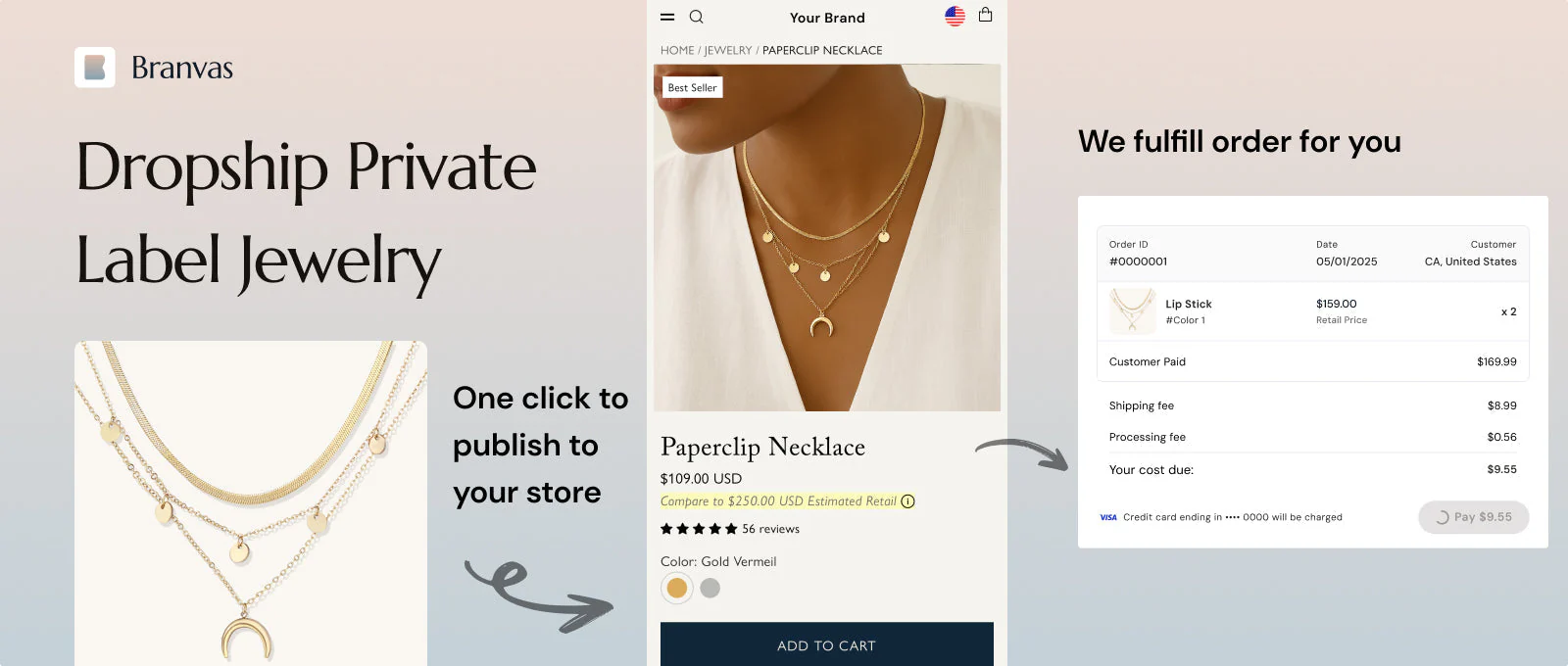
This is exactly the model Branvas is built for. Rather than sending unbranded product from a supplier, Branvas equips founders (whether they're influencers, boutique owners, or first-time entrepreneurs) with private-label jewelry, custom packaging, and blind-shipped fulfillment, so the brand experience is entirely theirs. You can learn more about how this works for influencers and creators or explore the general process.

The concrete alternative to Amazon dropshipping is an owned-store, private-label model where you control the customer relationship, the brand identity, and the margin structure. This approach shifts the focus from renting attention to building equity.
The Brand Equity Flywheel is our internal model for how early-stage brand founders compound value over time. It consists of several key components:
In this model, each sale builds a customer relationship. That relationship leads to repeat purchases, which generates word-of-mouth referrals and organic discovery, ultimately lowering your customer acquisition cost (CAC) over time. Contrast this with the Amazon model, where each sale resets to zero customer equity.
If you're evaluating which model fits your situation, the Branvas Academy has free resources on launching a private-label brand. No upsell required.
Ready to see what launching your own jewelry brand actually looks like, with no inventory risk? Explore Branvas's catalog and pricing to get a real sense of the economics.

Is Amazon dropshipping still profitable in 2026?
It can be, but the margins are significantly tighter than in previous years. Rising advertising costs, strict fulfillment requirements, and high referral fees mean that net profit margins often hover around 10% to 15%. Without owning the customer data, it is difficult to build a sustainable, compounding business solely through Amazon dropshipping.
What are Amazon's rules for dropshipping, and can you get banned?
Yes, violating Amazon's dropshipping policy is a common reason for account suspension. You must be the official seller of record, meaning your business name must be on all invoices and packaging. Purchasing items from another retailer and shipping them directly to the customer (retail arbitrage) is strictly prohibited.
How much does it cost to start dropshipping on Amazon?
While you don't need to purchase inventory upfront, there are unavoidable costs. A Professional Seller account costs $39.99 per month. You must also account for referral fees (typically 15%, but 20% for jewelry under $250), potential FBA fees, and the increasingly necessary advertising budget to gain visibility in a saturated market.
What's the difference between dropshipping on Amazon and running your own store?
The primary difference is ownership and control. On Amazon, you rent access to their massive customer base but sacrifice margins, brand identity, and customer data. Running your own store (like Shopify) requires you to drive your own traffic, but you keep higher margins, own the customer relationship, and build long-term brand equity.
Is jewelry a good niche for dropshipping or private-label?
Jewelry is an excellent niche for private-label on an owned store due to its high gross margins (often 50-70%+) and strong visual appeal on social media. However, it is a difficult niche for pure Amazon dropshipping because it is highly commoditized on the marketplace, making it hard to compete without a distinct brand story and aesthetic.