


Amazon is renting; Shopify is owning. Discover why relying on Amazon’s traffic creates fragility, while building on Shopify creates compounding business equity—and how to start without inventory risk.
Published:
January 29, 2026
Author:
Yi Cui
Every aspiring entrepreneur has felt the pull of Amazon. The platform promises instant access to millions of shoppers, built-in trust, and the allure of quick sales without the heavy lifting of marketing. For founders exploring dropshipping, Amazon seems like the obvious starting point. The question "can you do dropshipping on Amazon" generates thousands of searches monthly, reflecting a widespread belief that Amazon's traffic is the shortcut to ecommerce success.
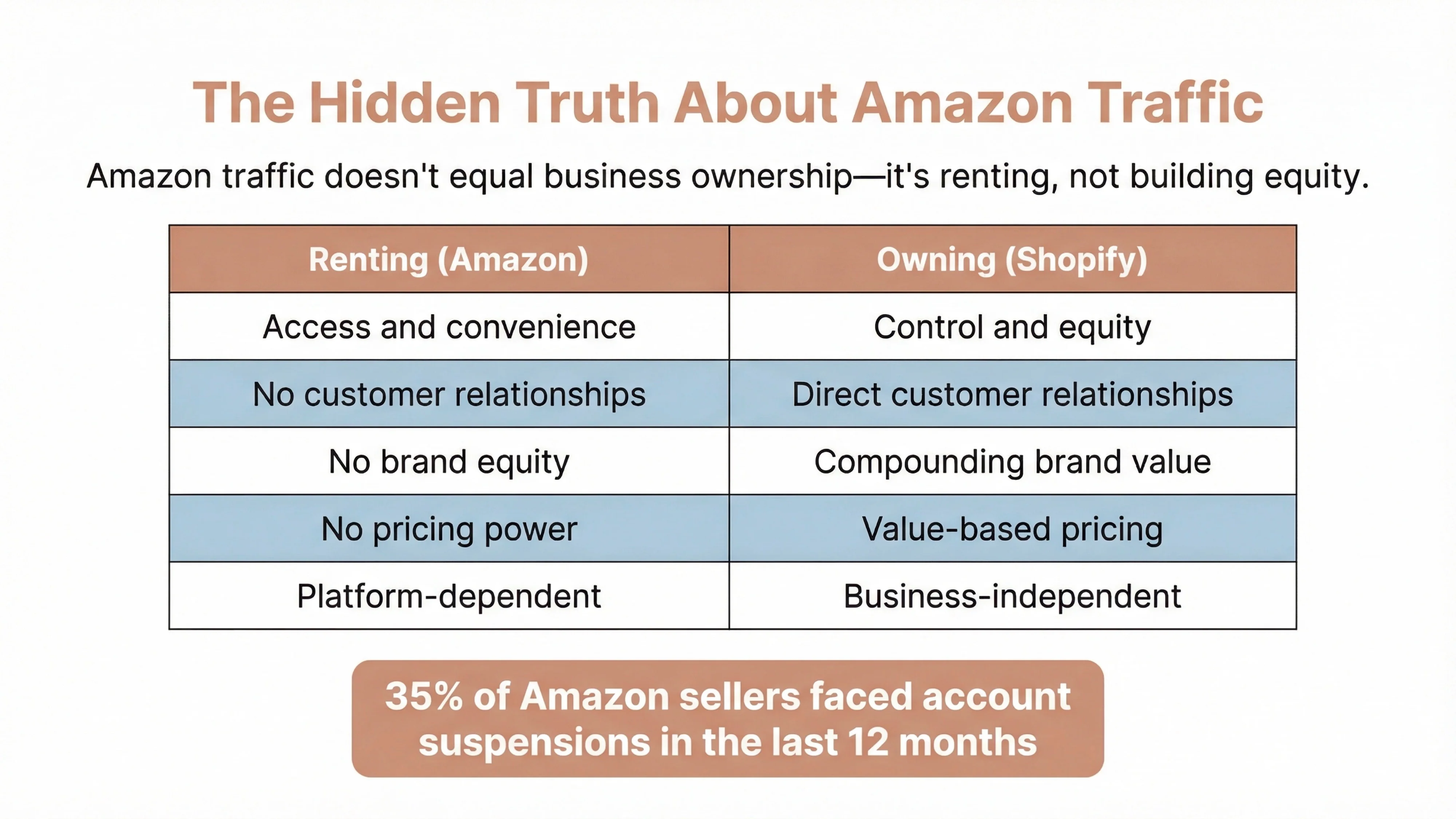
But here's the uncomfortable truth that most comparison articles won't tell you: Amazon traffic isn't the same as owning a business. Selling on Amazon is fundamentally different from building a brand. It's the difference between renting land and owning real estate. When you rent, you have access and convenience, but you build no equity. When you own, you control the asset, accumulate value, and create something that compounds over time.
In our experience at Branvas, we've watched countless founders start on Amazon, attracted by the promise of easy sales, only to realize months or years later that they don't actually own anything of value. They have sales, yes, but no customer relationships, no brand equity, no pricing power, and no defensible business asset. Meanwhile, founders who choose Shopify from the start—or transition quickly—build businesses that grow in value with every customer interaction.
This article will answer the critical questions: Can you actually do dropshipping on Amazon? How does it compare to Amazon FBA? And most importantly, why does the platform you choose determine whether you're building a business or just generating transactions? We'll introduce a proprietary framework for understanding the "renting vs. owning" dynamic, examine the economics and risks of each approach, and provide a clear decision checklist to help you choose the path that aligns with your long-term goals.
The short answer is yes -- you can do dropshipping on Amazon, but only if you follow Amazon's strict policies to the letter. The longer answer is that most beginners misunderstand what Amazon allows, which leads to account suspensions, lost revenue, and wasted effort.
According to Amazon's official Drop Shipping Policy, dropshipping is permitted under specific conditions [1]. You must be the seller of record for all products you list. This means your business name—and only your business name—must appear on all packing slips, invoices, and external packaging. You cannot ship products with another retailer's branding, logos, or invoices. If a customer receives a package from a third-party supplier with that supplier's name on it, Amazon considers this a violation and may suspend your account [2].
Here's where the confusion begins. Many new sellers assume they can simply list products from AliExpress, Walmart, or other retailers on Amazon and have those suppliers ship directly to customers. This model—often called "retail arbitrage dropshipping"—violates Amazon's policy because the seller is not controlling the fulfillment experience. Amazon requires that you have a formal agreement with your supplier, ensuring that you are the only entity identified as the seller [3].
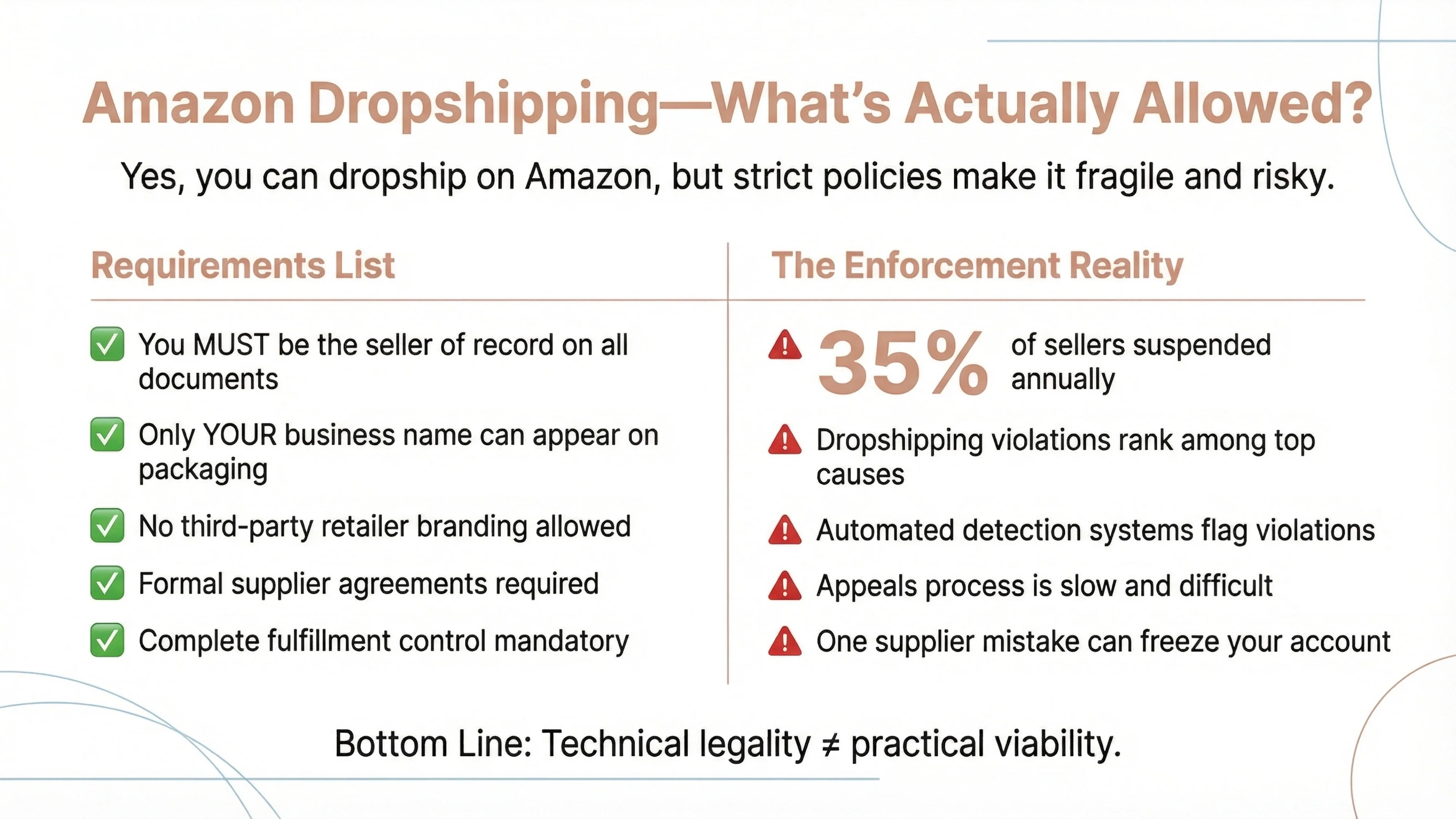
Amazon's enforcement of these rules has intensified significantly. Recent data shows that 35% of Amazon sellers faced account suspensions in the last 12 months, with dropshipping policy violations ranking among the top causes [4]. Amazon's algorithms are increasingly sophisticated at detecting third-party branding, inconsistent seller information, and patterns that suggest policy violations. Accounts can be suspended with little warning, and the appeals process is notoriously difficult.
So while dropshipping on Amazon is technically legal and allowed, it requires a level of supplier coordination, branding control, and operational discipline that most beginners underestimate. The platform's rules are designed to protect the customer experience, but they also create fragility for sellers who don't have direct control over fulfillment. This is the first hint that Amazon's model prioritizes the platform's interests over the seller's ability to build an independent, defensible business.
Understanding how to start dropshipping on Amazon requires more than just setting up a seller account and listing products. The operational reality is more complex—and more fragile—than most tutorials suggest.
The basic setup flow looks straightforward. You create an Amazon Seller Central account (either Individual at $0.99 per sale or Professional at $39.99 per month), find products from suppliers willing to ship under your brand name, list those products on Amazon, and fulfill orders as they come in. When a customer buys, you forward the order to your supplier, who ships the product directly to the customer with your branding [5].
But this is where theory meets reality. First, you need suppliers who will agree to white-label or private-label your products, removing all their own branding and using only yours. This eliminates most retail arbitrage opportunities and requires you to work with wholesalers, manufacturers, or specialized dropshipping suppliers who offer this service. Many suppliers charge extra for custom packaging and branding, cutting into your already thin margins.
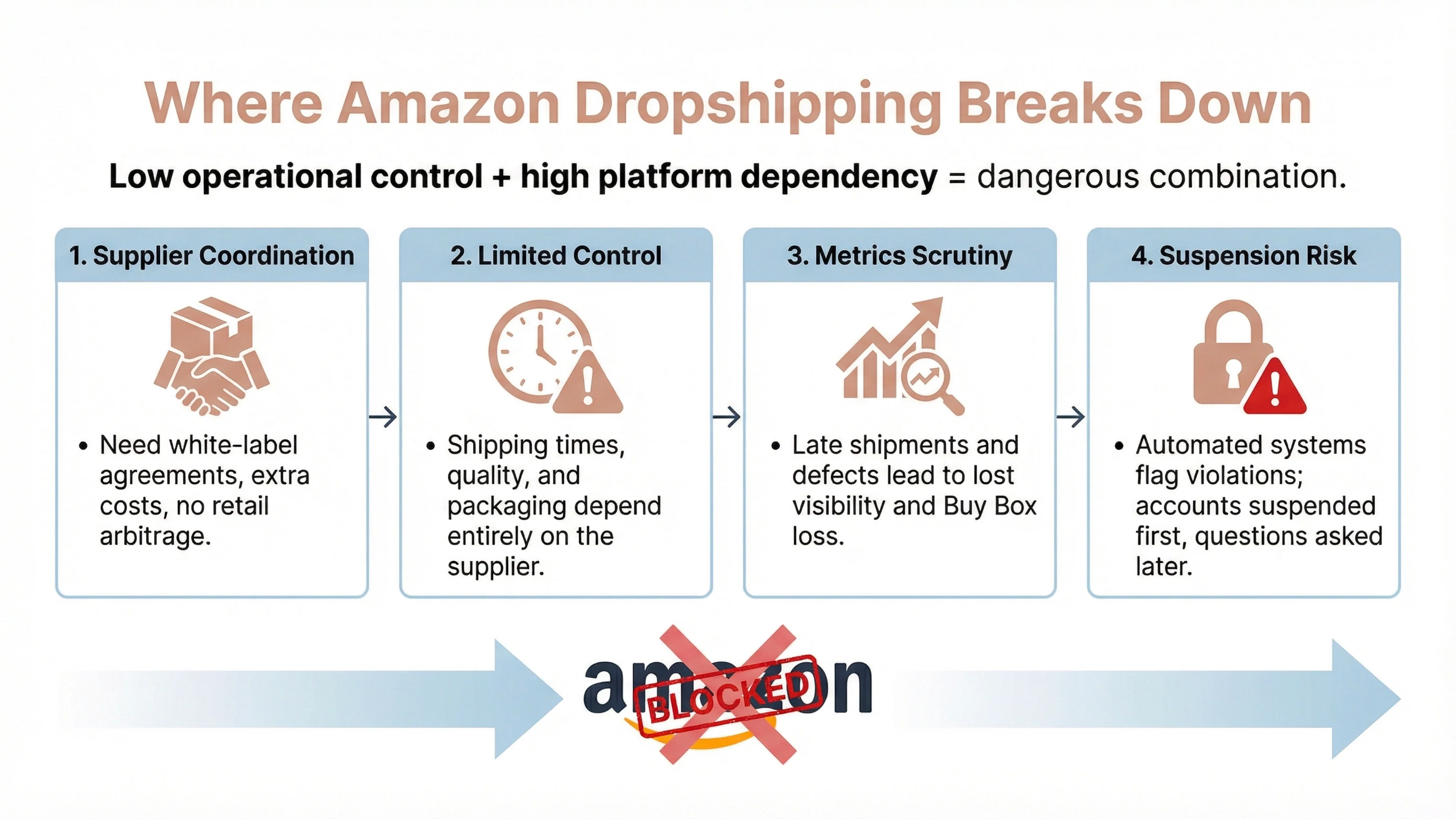
Second, you have limited control over the customer experience. Shipping times, product quality, packaging consistency, and communication all depend on your supplier's performance. If your supplier ships late, includes the wrong item, or uses substandard packaging, your Amazon account metrics suffer. Amazon tracks seller performance ruthlessly: late shipment rate, order defect rate, and customer service response time all affect your account health. Poor metrics lead to suppressed visibility, lost Buy Box eligibility, or outright suspension [6].
Third, Amazon's policies create constant enforcement risk. If even one package arrives with third-party branding—whether due to supplier error or miscommunication—Amazon may flag your account. Sellers report that Amazon's enforcement is inconsistent and often automated, meaning you can be suspended first and asked questions later [7]. The appeals process requires detailed Plans of Action (POAs), supplier invoices, and proof of compliance, which can take weeks to resolve while your sales are frozen.
Most beginners underestimate this fragility. They assume that because Amazon provides traffic, the business model is low-risk. In reality, Amazon dropshipping combines high platform dependency with low operational control—a dangerous combination. You're building on rented land, and the landlord can change the rules, raise the rent, or evict you at any time.
One of the most common sources of confusion is the difference between dropshipping vs Amazon FBA. While both models involve selling on Amazon, they operate under fundamentally different economics and risk profiles.
Amazon FBA (Fulfillment by Amazon) means you purchase inventory upfront, ship it in bulk to Amazon's warehouses, and Amazon handles storage, packing, shipping, and customer service. You own the inventory, and Amazon acts as your logistics partner. FBA products are eligible for Amazon Prime, which significantly increases conversion rates and Buy Box win rates [8].
Amazon dropshipping means you never touch the inventory. Your supplier ships directly to the customer when an order is placed. You don't pay for products until they sell, which reduces upfront capital requirements. However, you typically cannot offer Prime shipping (unless you qualify for Seller Fulfilled Prime, which has strict performance requirements), and you have less control over fulfillment speed and quality [9].
Here's a detailed comparison:
|
Dimension |
Amazon Dropshipping |
Amazon FBA |
|---|---|---|
|
Inventory Ownership |
No inventory; supplier ships on demand |
You purchase and own inventory upfront |
|
Cash Flow |
Low upfront cost; pay suppliers after sales |
High upfront cost; capital tied up in inventory |
|
Fees |
Amazon referral fees (8-15%) + per-item fees |
Referral fees + FBA fulfillment fees + storage fees |
|
Prime Eligibility |
Generally not eligible (unless SFP) |
Automatic Prime eligibility |
|
Control Over Branding |
Limited; depends on supplier cooperation |
Full control over packaging and inserts |
|
Customer Data |
None; Amazon owns the relationship |
None; Amazon owns the relationship |
|
Shipping Speed |
Slower; typically 5-10 days |
Fast; 1-2 days with Prime |
|
Account Risk |
High; policy violations common |
Moderate; inventory and performance risks |
|
Long-Term Defensibility |
Very low; no unique assets |
Low; competing on Amazon's terms |
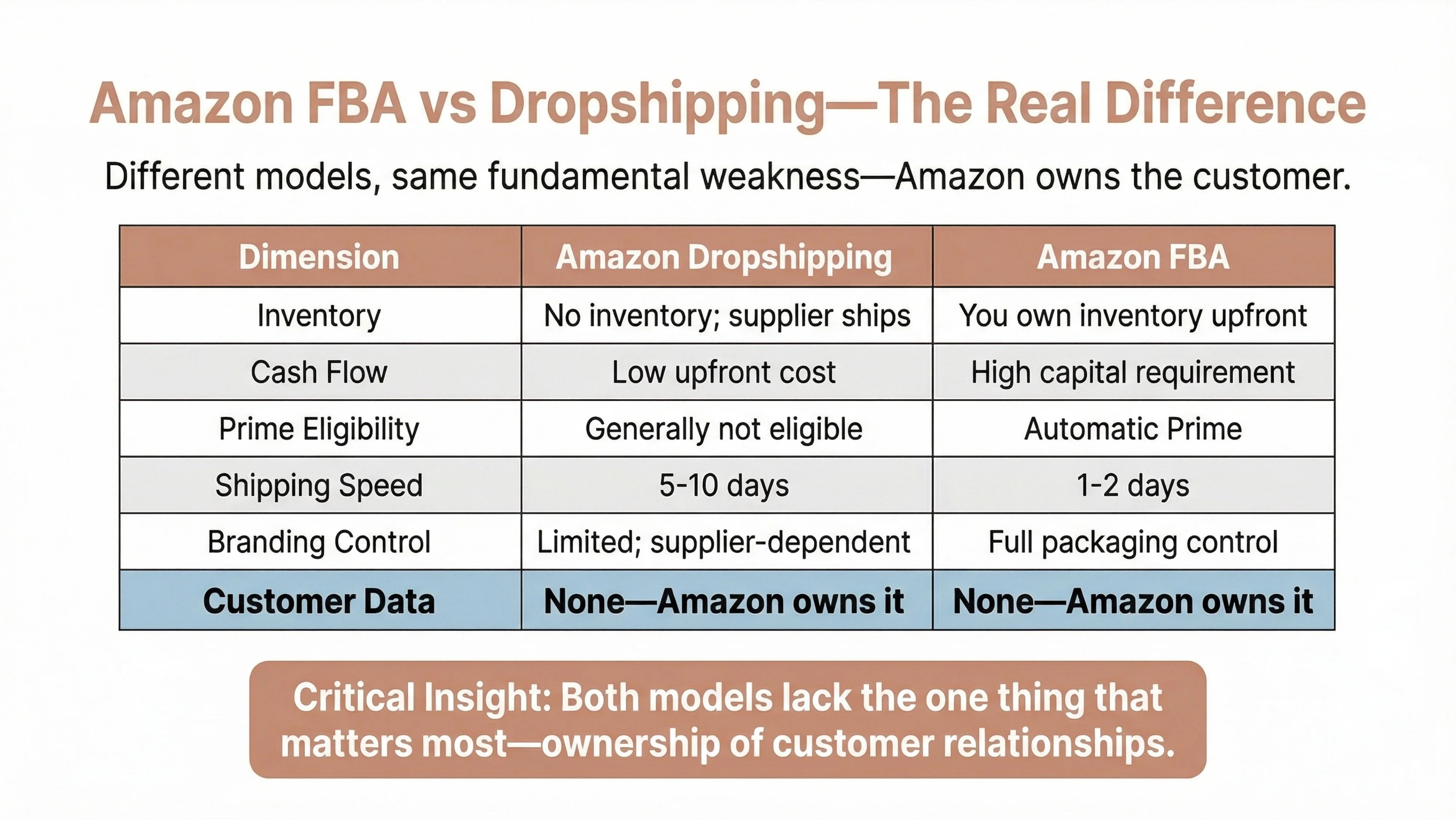
The key insight is that both models share the same fundamental weakness: Amazon owns the customer relationship, controls the traffic, and dictates the rules. Whether you're dropshipping or using FBA, you're building a business that depends entirely on Amazon's platform. You have no customer data, no ability to communicate directly with buyers, and no pricing power beyond what Amazon's algorithms allow.
FBA offers better unit economics and conversion rates, but it requires more capital and operational complexity. Dropshipping offers lower barriers to entry, but it's more fragile and harder to scale profitably. Neither model gives you the one thing that matters most for long-term value: ownership.
To understand the strategic difference between Amazon and Shopify, we've developed a framework we call the Platform Equity Matrix. This framework evaluates ecommerce platforms across six critical dimensions that determine whether you're building equity or just generating transactions.
|
Dimension |
Amazon (Renting Land) |
Shopify (Owning Real Estate) |
|---|---|---|
|
Traffic Control |
Controlled by Amazon; algorithm-dependent |
Owned and diversified; SEO, email, social, paid |
|
Brand Identity |
Amazon-first; your brand is secondary |
Founder-first; full creative control |
|
Customer Data |
Limited; no email, no purchase history |
Fully owned; email, SMS, purchase behavior |
|
Pricing Power |
Race to bottom; Buy Box competition |
Value-based; storytelling and positioning |
|
Platform Risk |
High; policy changes, suspensions, fees |
Low; business-dependent, not platform-dependent |
|
Exit Value |
3-4x EBITDA (marketplace-dependent) |
4-6x+ EBITDA (brand equity premium) [10] |
This framework reveals a fundamental economic truth: Amazon optimizes for transactions, Shopify optimizes for relationships. On Amazon, you're competing in a commodity marketplace where the platform extracts the majority of the value. On Shopify, you're building a brand asset that compounds over time.
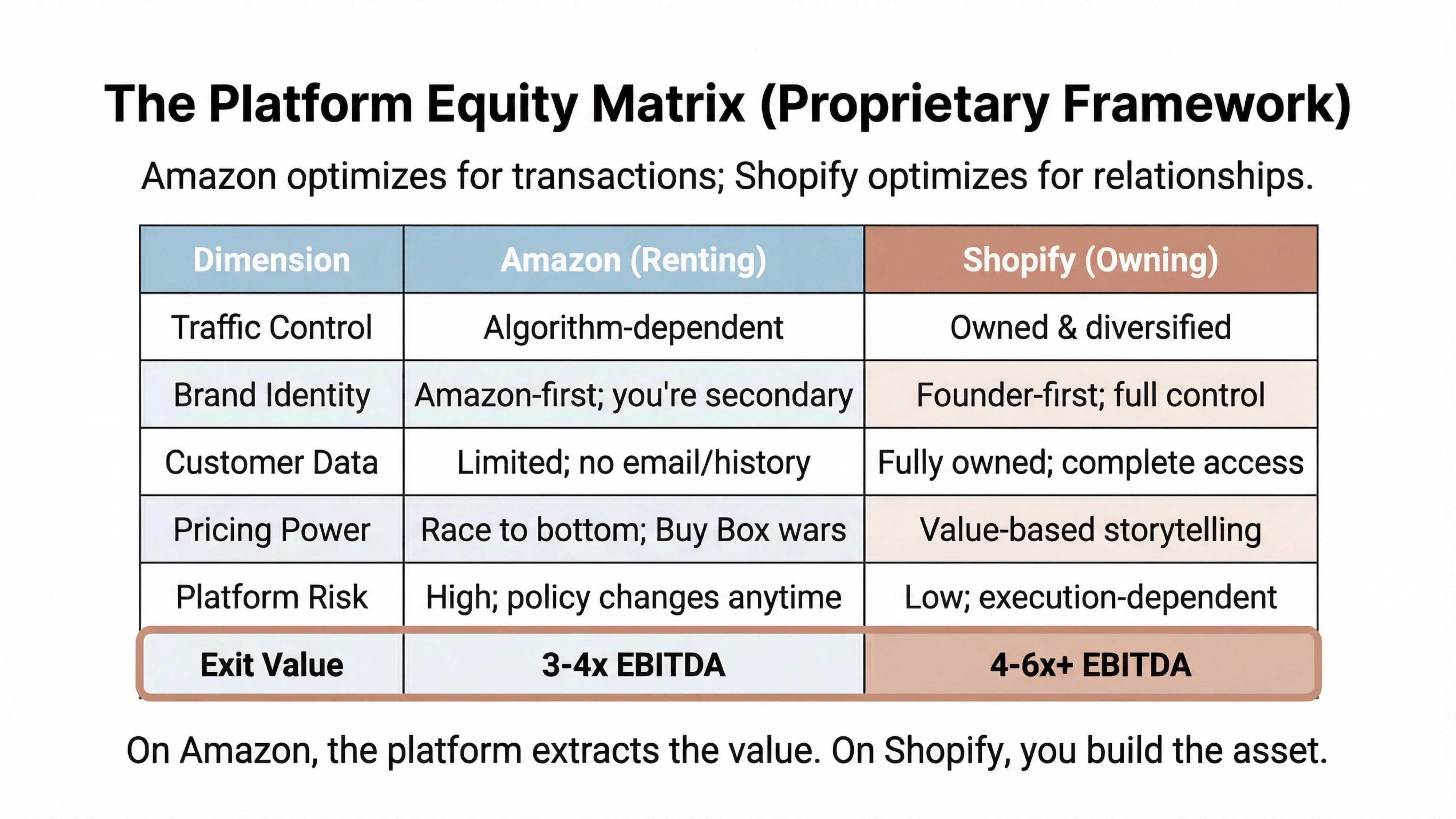
Let's break down each dimension:
Traffic Control: On Amazon, your visibility depends entirely on Amazon's A9 algorithm, which prioritizes price, conversion rate, and fulfillment speed. You have no control over who sees your products or when. On Shopify, you build your own traffic sources—organic search, email lists, social media communities, influencer partnerships—creating a diversified, defensible moat.
Brand Identity: Amazon's interface is designed to make all products look similar, reducing brand differentiation to bullet points and images. Customers often don't remember which seller they bought from; they remember buying "from Amazon." On Shopify, every element of the customer experience—from homepage design to checkout flow to post-purchase emails—reinforces your brand identity.
Customer Data: This is the most critical difference. Amazon does not share customer email addresses, purchase history, or contact information with sellers. You cannot build an email list, run retargeting campaigns, or create customer segments based on behavior. On Shopify, you own all customer data, enabling sophisticated lifecycle marketing, loyalty programs, and repeat purchase optimization [11].
Pricing Power: Amazon's Buy Box algorithm rewards the lowest price, creating a race to the bottom. Sellers who try to maintain premium pricing lose visibility and sales. On Shopify, you can charge based on brand value, storytelling, and customer perception, not just price comparison.
Platform Risk: Amazon can change fees, policies, or algorithms at any time, and sellers have no recourse. Account suspensions can happen with minimal warning, freezing revenue overnight. On Shopify, your business risk is tied to your own execution, not a third party's decisions.
Exit Value: When it comes time to sell your business, marketplace-dependent businesses are valued at 3-4x EBITDA, reflecting the high risk of platform dependency. DTC brands with owned customer relationships and diversified traffic sources command 4-6x+ EBITDA or higher, reflecting the premium buyers place on defensible assets [10].
This framework makes it clear: founders who want to build assets should prioritize ownership over convenience. Amazon may offer faster initial sales, but Shopify offers compounding long-term value.
The structural limitations of Amazon's platform make it nearly impossible to build a true brand. While it's possible to generate revenue—even significant revenue—on Amazon, the economics and constraints of the platform work against brand building at every turn.
Commoditization is baked into the system. Amazon's search and discovery algorithms prioritize price, reviews, and fulfillment speed, not brand story or differentiation. Customers search for products ("wireless earbuds," "yoga mat," "protein powder"), not brands. Even if you invest in branding, packaging, and storytelling, the Amazon interface strips most of that away, reducing your product to a title, bullet points, and images that look nearly identical to every competitor [12].
Review dependency creates fragility. On Amazon, reviews are the primary signal of trust and quality. A product with 500 reviews at 4.5 stars will almost always outsell a product with 50 reviews at 4.8 stars, regardless of actual quality. This creates a "review moat" that's difficult to overcome for new entrants, but it also means your success is tied to an asset you don't fully control. Negative reviews, review manipulation accusations, or changes in Amazon's review policies can devastate your rankings overnight [13].
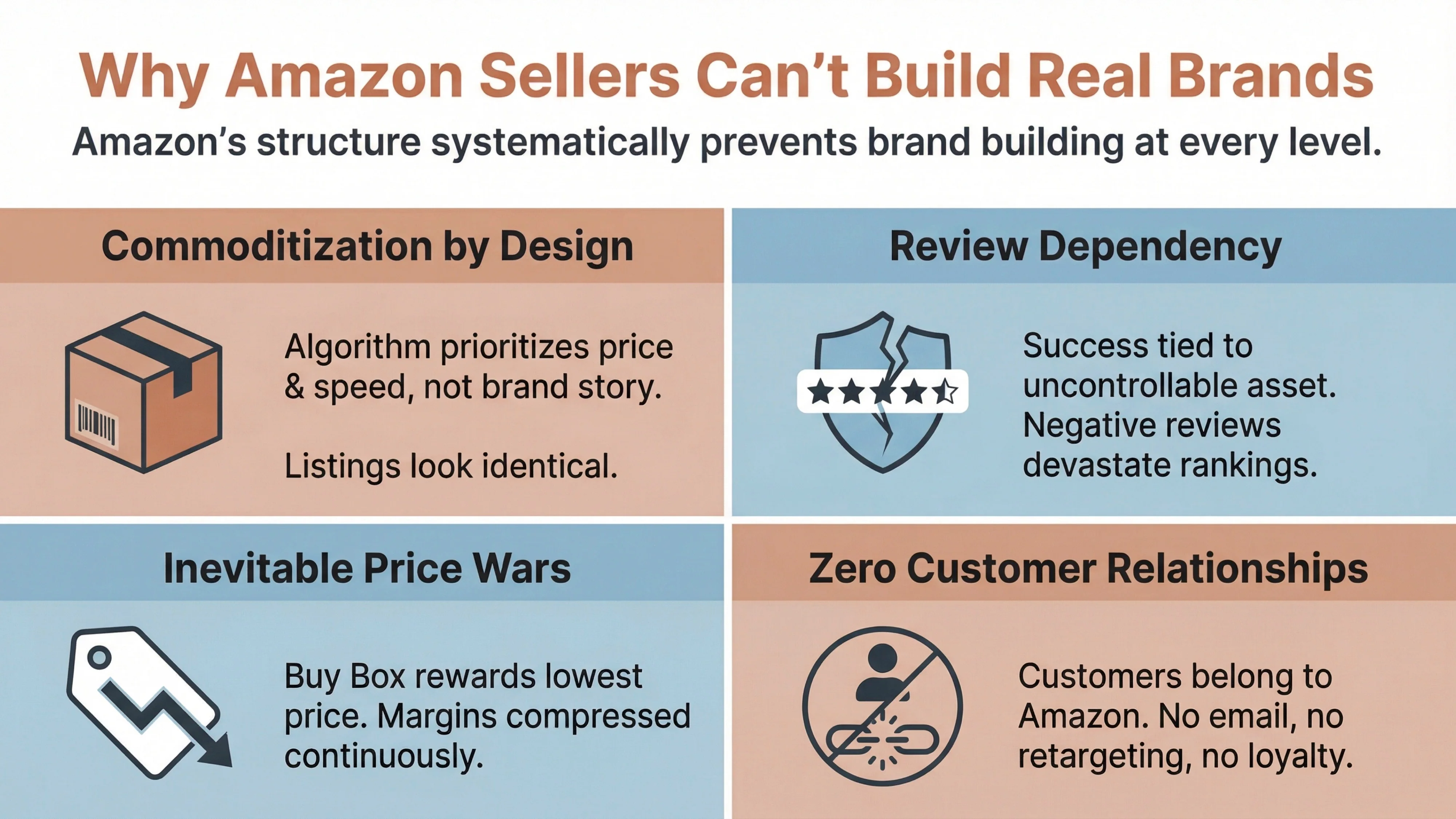
Price wars are inevitable. Because Amazon's Buy Box algorithm rewards the lowest price, competitors can undercut you at any time. If you're dropshipping or reselling, you have no cost advantage, so you're forced to compress margins to stay competitive. Even private label sellers face constant pressure from cheaper alternatives and Amazon's own private label brands, which have access to seller data and can undercut successful products [14].
Account risk is constant. Amazon's enforcement of policies is aggressive and often automated. Sellers report that minor infractions—or even false accusations from competitors—can lead to account suspensions that freeze revenue for weeks or months. The appeals process is opaque and slow, and many sellers never fully recover [15].
No meaningful customer relationship. This is the most damaging limitation. When a customer buys your product on Amazon, they don't become your customer—they become Amazon's customer. You cannot email them, retarget them, or invite them to join a community. You cannot offer them exclusive products, early access, or loyalty rewards. Every transaction is a one-time event, not the beginning of a relationship.
In our experience at Branvas, sellers who start on Amazon often come to us only after realizing they don't actually own anything. They have sales, but no email list. They have revenue, but no brand equity. They have transactions, but no customer loyalty. They've been optimizing for the wrong metric—sales volume instead of business value.
Shopify represents the opposite approach: full ownership, full control, and full responsibility. While this requires more effort upfront, it creates compounding advantages that Amazon can never offer.
Complete brand control is the foundation. On Shopify, you design every element of the customer experience. Your homepage, product pages, checkout flow, email sequences, and packaging all reinforce your brand identity. You're not competing in a commodity marketplace; you're creating a destination that customers choose because of who you are, not just what you sell [16].
Customer data ownership unlocks lifecycle marketing. Every customer who purchases from your Shopify store becomes part of your owned audience. You can segment customers based on purchase behavior, send personalized email and SMS campaigns, run retargeting ads, and build loyalty programs that increase repeat purchase rates. Studies show that DTC brands with strong email marketing see 30% or higher repeat purchase rates, compared to single-digit repeat rates on Amazon [17].
Pricing power through storytelling allows you to charge based on value, not just cost. When customers understand your brand story, mission, and differentiation, they're willing to pay a premium. Shopify stores can use content marketing, influencer partnerships, and community building to create perceived value that justifies higher prices.

Diversified traffic sources reduce platform risk. Instead of depending on Amazon's algorithm, Shopify brands build traffic from SEO, social media, email marketing, paid ads, partnerships, and word-of-mouth. This diversification creates resilience; if one channel underperforms, others can compensate.
Repeat purchase and lifetime value optimization become possible. With owned customer data, you can calculate customer acquisition cost (CAC) and lifetime value (LTV) accurately, then optimize your marketing spend accordingly. Brands that focus on LTV can afford higher CAC because they know customers will return multiple times, creating profitable unit economics over time [18].
Exit value premium reflects the market's recognition of brand equity. When you sell a Shopify-based DTC brand, buyers pay for the customer list, brand reputation, traffic sources, and growth potential—not just trailing revenue. This is why DTC brands command higher valuation multiples than marketplace-dependent businesses [10].
Shopify isn't easier than Amazon in the short term. It requires you to generate your own traffic, handle your own customer service, and build your own systems. But this effort compounds. Every email subscriber, every repeat customer, every piece of content, and every brand touchpoint increases the value of your business. You're not renting; you're building equity.
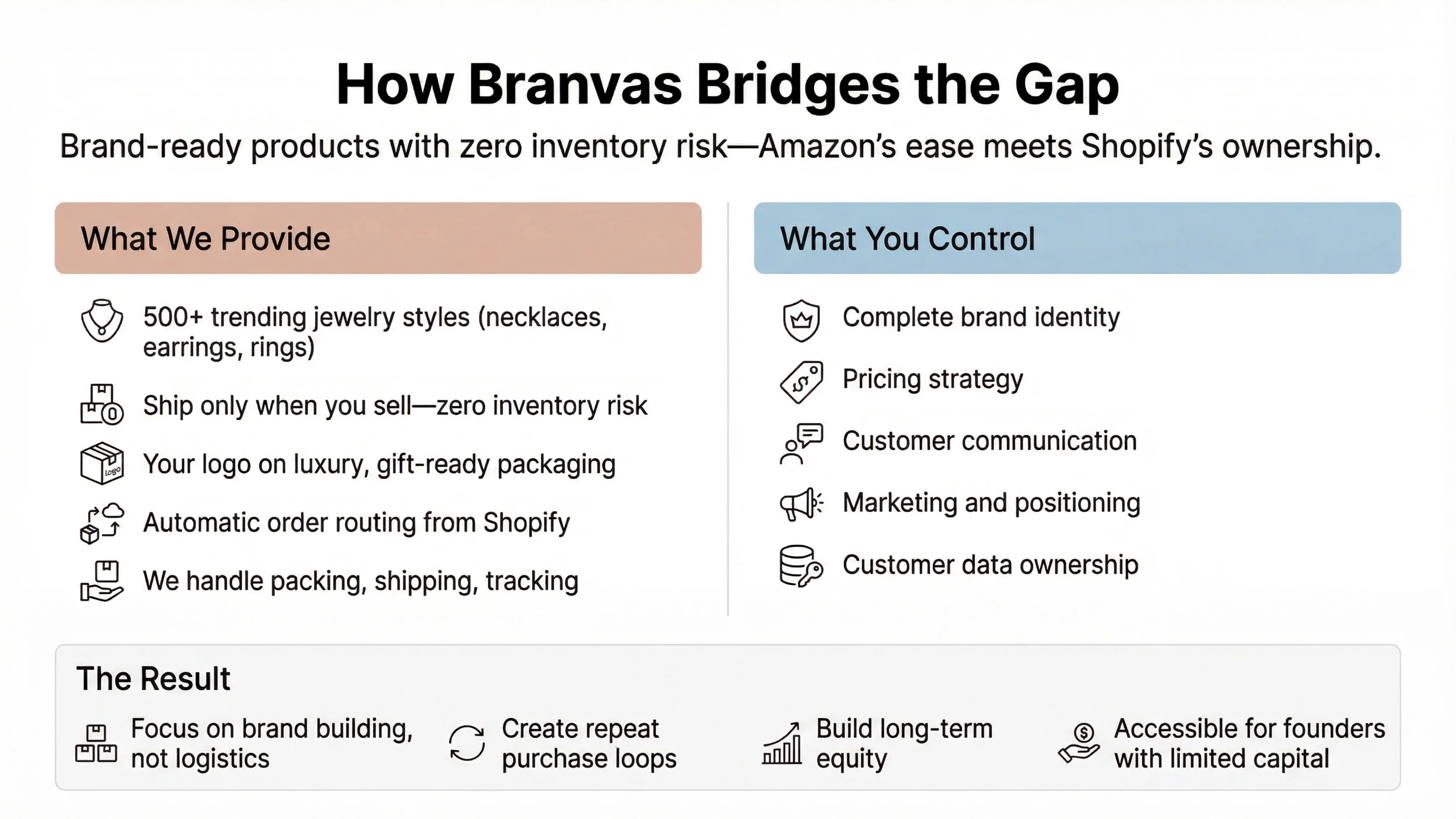
At Branvas, we've built a solution that bridges the gap between Amazon's ease and Shopify's ownership. We understand that many founders want to build a brand but feel overwhelmed by the operational complexity of inventory, fulfillment, and product sourcing.
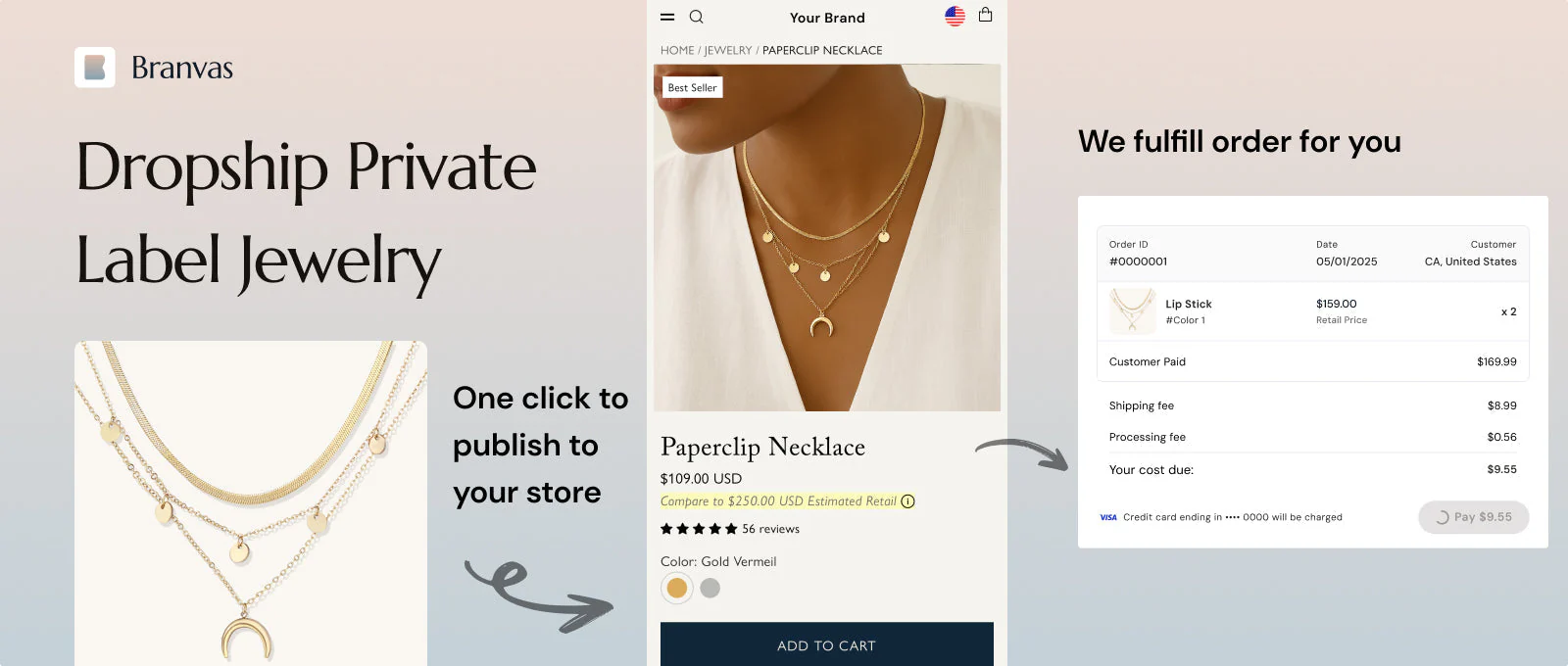
Branvas provides brand-ready products with zero inventory risk. We offer a curated catalog of over 500 trending jewelry styles—necklaces, earrings, rings, and more—that ship only when you sell. Every order is fulfilled with your logo on luxury, gift-ready packaging, creating a consistent brand experience without requiring you to manage inventory or logistics [19].
Our model is designed specifically for Shopify brand builders. When a customer orders from your store, the order automatically routes to Branvas for fulfillment. We handle packing, shipping, and tracking, while you maintain full control over branding, pricing, and customer communication. This allows you to focus on what matters most: building your brand, growing your audience, and creating customer relationships.
In our experience, founders who use Branvas to launch on Shopify build businesses with significantly higher long-term value than those who start on Amazon. They own their customer data, control their brand narrative, and create repeat purchase loops that compound over time. They're not optimizing for quick sales; they're optimizing for equity.
We're not anti-Amazon. We recognize that Amazon can be a useful channel for product exposure and incremental revenue. But we believe that founders who want to build real businesses—businesses with defensible moats, customer loyalty, and exit value—should start with ownership, not convenience. Branvas makes that path accessible, even for founders with limited capital and no experience in fulfillment operations.
The conventional wisdom in ecommerce is to "start where the traffic is." This advice leads most beginners to Amazon, where they assume the platform's built-in audience will compensate for their lack of marketing skills. But this is a trap.
Ease does not equal leverage. Amazon is easy to start because it requires no brand building, no traffic generation, and no customer relationship management. But this ease comes at a cost: you're building on someone else's platform, playing by someone else's rules, and competing in a race to the bottom. The skills you develop on Amazon—optimizing listings, managing PPC, navigating policy enforcement—are non-transferable. They don't help you build a brand, grow an audience, or create a defensible business.
Shopify is harder to start because it requires you to learn marketing, branding, and customer acquisition. But these are the skills that create long-term value. Every dollar you spend on Facebook ads, every blog post you write, every email sequence you build, and every customer you convert teaches you how to grow a business. These skills compound. They transfer to new products, new markets, and new ventures.
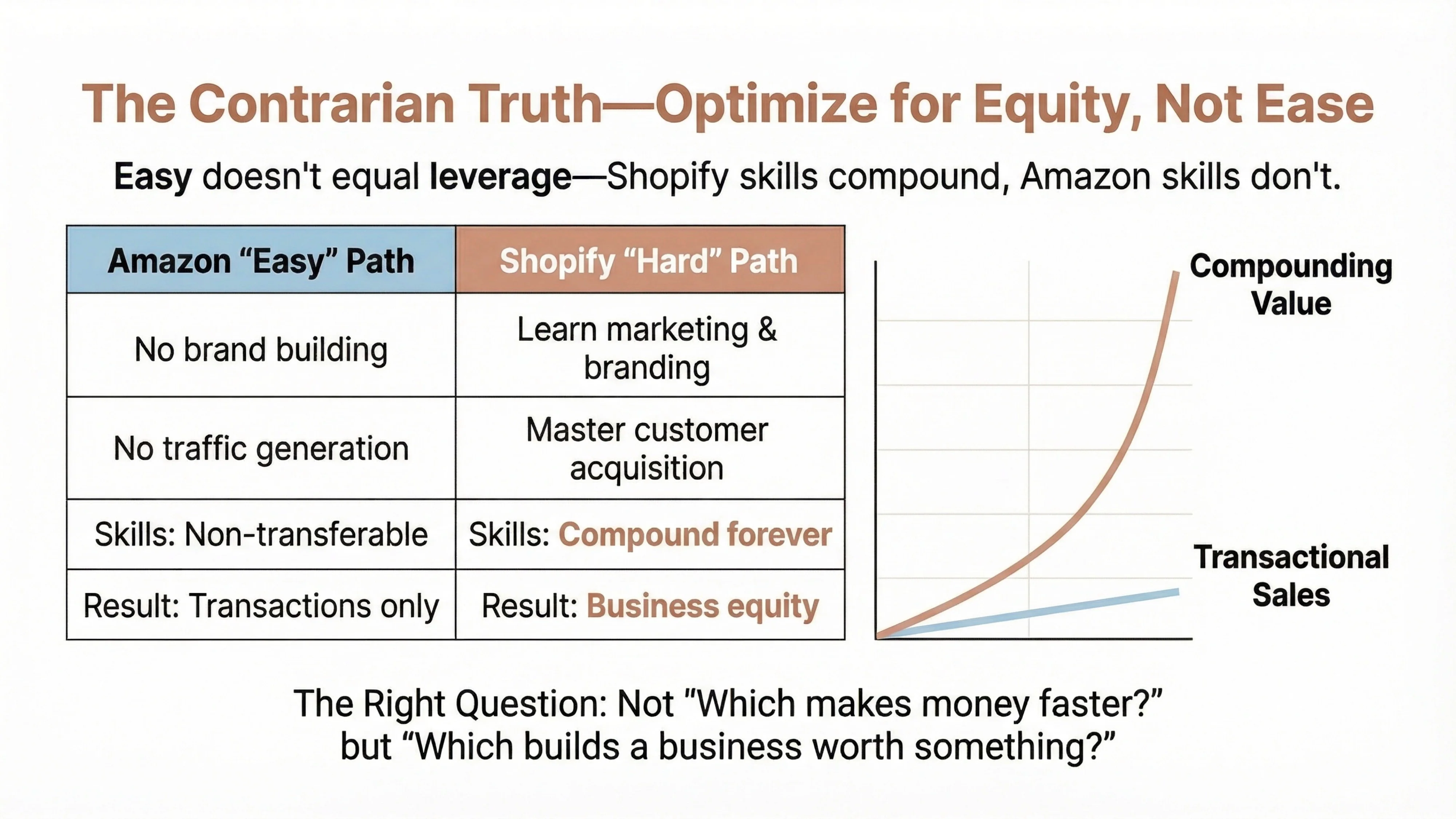
Founders should optimize for learning and ownership, not short-term sales. The goal of your first ecommerce business should not be to generate revenue as quickly as possible; it should be to build a foundation for long-term success. This means choosing the platform that forces you to develop the skills that matter: brand positioning, content creation, audience building, and customer retention.
Shopify brands compound; Amazon listings don't. On Shopify, every customer interaction increases the value of your business. Your email list grows, your brand recognition expands, your SEO authority improves, and your customer lifetime value increases. On Amazon, every sale is an isolated transaction. There's no compounding effect, no accumulation of brand equity, and no increase in defensibility.
This is the insight that most comparison articles miss. The question isn't "Which platform will make me money faster?" The question is "Which platform will help me build a business that's worth something?" The answer is clear: start where you can build equity, not where it's easy.
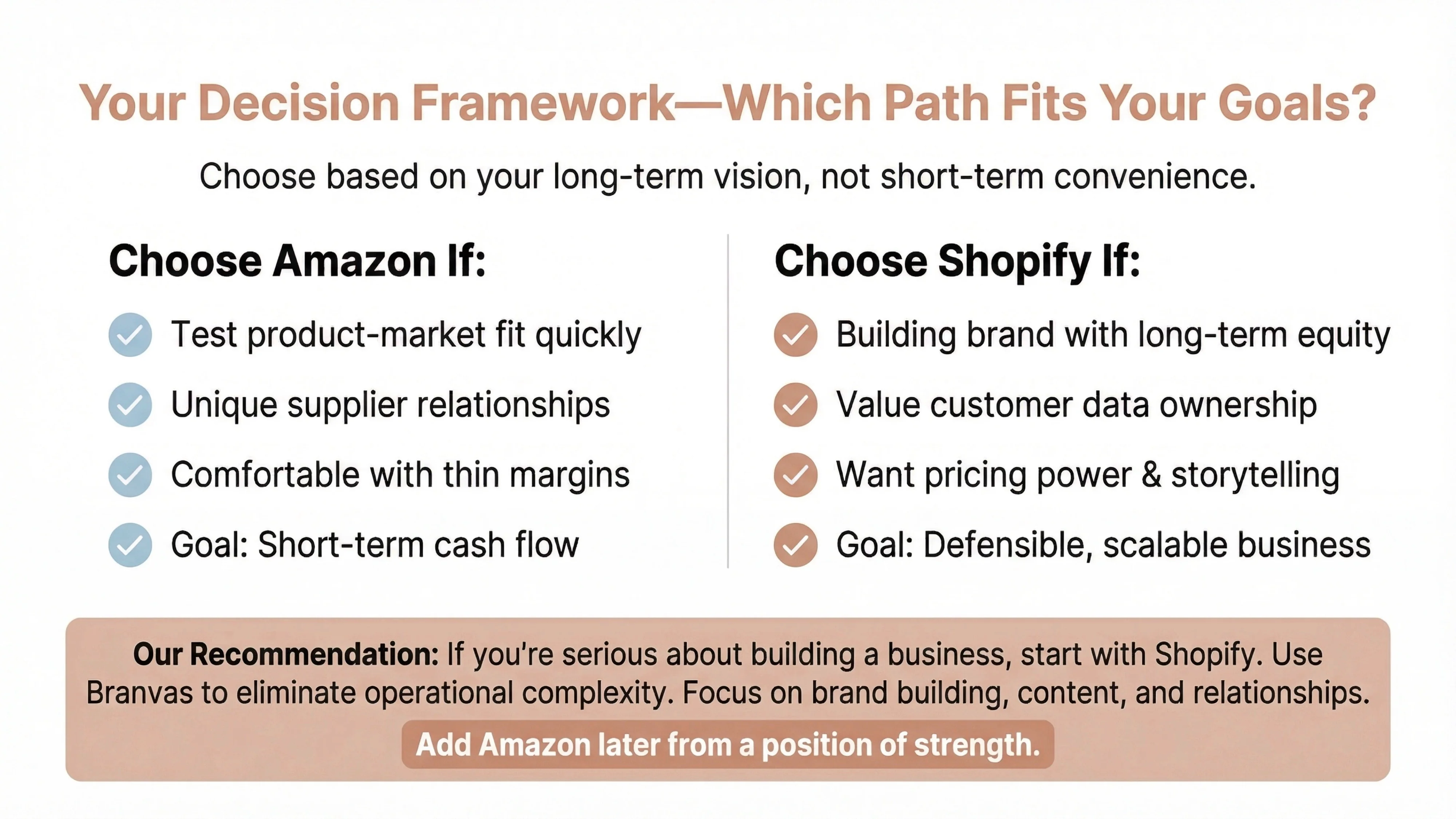
Choosing between Amazon and Shopify depends on your goals, resources, and risk tolerance. Here's a practical framework to guide your decision:
Choose Amazon if:
Choose Shopify if:
When to transition (and why most do):
Many successful ecommerce founders start on Amazon to validate demand, then transition to Shopify once they've proven product-market fit. This hybrid approach allows you to use Amazon's traffic for initial sales while building your owned channel in parallel. However, the longer you wait to transition, the harder it becomes. Founders who spend years optimizing for Amazon's algorithm often struggle to develop the brand-building skills required for Shopify success.
Our recommendation: if you're serious about building a business, start with Shopify. Use tools like Branvas to eliminate the operational complexity of inventory and fulfillment, and focus your energy on the activities that create long-term value: brand building, content creation, and customer relationships. If you later decide to add Amazon as a secondary channel, you can do so from a position of strength, with an established brand and owned audience.
Can you do dropshipping on Amazon legally?
Yes, dropshipping on Amazon is legal and allowed under Amazon's Drop Shipping Policy, but only if you comply with strict requirements. You must be the seller of record, meaning your business name—and only your name—appears on all packing slips, invoices, and packaging. You cannot ship products with third-party branding or retailer names. Violating these rules can result in account suspension, which affects approximately 35% of Amazon sellers annually [4].
Is Amazon dropshipping better than Shopify?
Amazon dropshipping offers faster access to traffic and lower upfront costs, but it comes with significant limitations: no customer data, no brand control, thin margins, and high platform risk. Shopify requires more effort to generate traffic but provides full brand ownership, customer data, pricing power, and higher business valuation multiples. For founders focused on long-term equity and exit value, Shopify is the better choice.
What's the difference between Amazon FBA and dropshipping?
Amazon FBA requires you to purchase inventory upfront and ship it to Amazon's warehouses, where Amazon handles fulfillment. Dropshipping means your supplier ships directly to customers without you holding inventory. FBA offers Prime eligibility and faster shipping but requires more capital. Dropshipping has lower upfront costs but less control over fulfillment quality. Both models share the same weakness: Amazon owns the customer relationship, limiting your ability to build brand equity.
Why do Amazon dropshipping accounts get suspended?
The most common reasons for suspension include violating Amazon's dropshipping policy (shipping with third-party branding), poor performance metrics (late shipments, high defect rates), intellectual property complaints, and suspected policy violations flagged by Amazon's automated systems. Recent data shows that 35% of Amazon sellers faced suspensions in the past year, with dropshipping violations ranking among the top causes [4].
Is it better to build a Shopify store instead of selling on Amazon?
If your goal is to build a defensible brand with long-term value, Shopify is the better choice. Shopify gives you full control over branding, customer data, pricing, and marketing, allowing you to create a business with higher exit value (4-6x+ EBITDA vs. 3-4x for Amazon-only businesses) [10]. Amazon is useful for quick sales and product validation but limits your ability to build customer relationships and brand equity. Many successful founders use both, but they prioritize Shopify as their primary channel.
[1] Amazon Seller Central. (2024). Drop Shipping Policy. Retrieved from https://sellercentral.amazon.com/help/hub/reference/external/G201808410
[2] AutoDS. (2025, November). Amazon Dropshipping Policy And Sellers Requirements For 2026. Retrieved from https://www.autods.com/blog/suppliers-marketplaces/amazon-dropshipping-policy/
[3] Seller Assistant. (2025, May). New Dropshipping Strategy That Complies With Amazon's Policy. Retrieved from https://www.sellerassistant.app/blog/new-dropshipping-strategy-that-complies-with-amazon-s-policy
[4] Donelan, P. (2025, August). 35% of Amazon sellers faced account suspensions in last 12 months. LinkedIn. Retrieved from https://www.linkedin.com/posts/patrick-donelan-b576851_35-of-amazon-sellers-faced-account-suspensions-activity-7364265026641096705-lq97
[5] Amazon Seller Central. (2025, August). How to dropship on Amazon in 2025. Retrieved from https://sell.amazon.com/blog/dropshipping-on-amazon
[6] Canopy Management. (2025). Amazon Account Suspension Guide 2025: Prevention, Appeals. Retrieved from https://canopymanagement.com/how-to-prevent-amazon-suspension/
[7] MyAmazonGuy. (2025, July). Amazon Account Suspended? What Sellers Need to Know in 2025. Retrieved from https://myamazonguy.com/suspensions/amazon-suspension-what-amazon-sellers-need-to-know-for-2024/
[8] Three Colts. (2025, September). Amazon FBA vs. dropshipping: What's the best move for you? Retrieved from https://www.threecolts.com/blog/amazon-fba-vs-dropshipping/
[9] Hostinger. (2025, September). Amazon FBA vs Dropshipping: Which One to Choose in 2026. Retrieved from https://www.hostinger.com/tutorials/amazon-fba-vs-dropshipping
[10] Exit.io. (2025, September). Amazon brand vs. reseller businesses: Which is more valuable? Retrieved from https://blog.exit.io/2025/09/07/amazon-brand-vs-reseller-businesses-which-is-more-valuable/
[11] Omnisend. (2025, November). Shopify vs. Amazon for sellers: Pros, cons, and best use cases. Retrieved from https://www.omnisend.com/blog/shopify-vs-amazon/
[12] Charle Agency. (2025, May). Shopify vs Amazon: Which is Better for Your Online Business. Retrieved from https://www.charleagency.com/articles/shopify-vs-amazon/
[13] SmartScout. (2025, April). The Top Challenges Facing Amazon Third-Party Sellers in 2025. Retrieved from https://www.smartscout.com/blog/amazon-third-party-sellers-problems
[14] Forbes. (2021, June). The Risks Keep Growing For Amazon Third-Party Sellers. Retrieved from https://www.forbes.com/sites/richardkestenbaum/2021/06/14/the-risks-keep-growing-for-amazon-third-party-sellers/
[15] eCommerceChris. (2025, April). Why Amazon is Suspending Resellers in 2025. Retrieved from https://www.ecommercechris.com/amazon-reseller-suspensions-2025-supply-chain-requirements/
[16] Cometly. (2026, January). Amazon vs Shopify The Ultimate Guide for Ecommerce Brands. Retrieved from https://www.cometly.com/post/amazon-vs-shopify
[17] eDesk. (2025, November). Driving Repeat Purchases to Your Owned Store via Support. Retrieved from https://www.edesk.com/blog/amazon-shopify-customer-ownership-support/
[18] Three Colts. (2025, February). Direct-to-Consumer (DTC) vs Amazon FBM for Ecommerce Profits. Retrieved from https://www.threecolts.com/blog/dtc-vs-amazon-fbm/
[19] Branvas. (2026). Private Label Jewelry Dropshipping for Shopify Brands. Retrieved from https://branvas.com/
[20] Uptek. (2025, July). Shopify Revenue & Merchant Stats 2025: Growth Data & Trends. Retrieved from https://uptek.com/shopify-statistics/merchant-revenue/
[21] Chargebacks911. (2025, December). Key Shopify Statistics & Indicators for 2026. Retrieved from https://chargebacks911.com/shopify-statistics/
[22] Aurelius Equity Advisors. (2025, January). Supplier Dependence – Silent Killer of Business Valuation. Retrieved from https://aureliusequityadvisors.com/blog/f/supplier-dependence-%E2%80%93-silent-killer-of-business-valuation
[23] Shopify. (2025). What is Global Ecommerce? Trends and How to Expand. Retrieved from https://www.shopify.com/enterprise/blog/global-ecommerce-statistics
[24] Flexport. (2021, August). The Relationship Between LTV and CAC on Marketplaces vs DTC Websites. Retrieved from https://www.flexport.com/blog/the-relationship-between-ltv-and-cac-on-marketplaces-vs-dtc-websites/
[25] Jungle Scout. (2024). Amazon FBA vs. Dropshipping in 2024 – Which Is Better? Retrieved from https://www.junglescout.com/resources/articles/amazon-fba-vs-dropshipping/