


This Trendsi review evaluates its strengths and weaknesses, then recommends the best dropshipping supplier for each fashion niche using a scored Niche-Fit Matrix.
Published:
May 15, 2026
Author:
Yi Cui
Trendsi is a solid fashion-first platform, but "fashion" is too broad a category to win in 2026. You need to pick a tighter niche, and that changes which supplier actually fits. Here is the honest breakdown.
Trendsi is a B2B fast-fashion dropshipping application designed primarily for US-based entrepreneurs building online clothing boutiques. It integrates directly with Shopify, allowing sellers to import products, sync inventory, and automate order fulfillment without purchasing upfront stock [1]. The platform is built for creators, influencers, and boutique owners who want to sell trendy women's apparel without the traditional risks of wholesale buying.
When a customer places an order on a Shopify store, Trendsi handles the picking, packing, and shipping directly to the end consumer. The platform uses blind shipping, meaning packages arrive without Trendsi branding, so your store appears to be the origin. Trendsi also offers a premium "Luxe" tier with curated collections and faster 2 to 7 day US shipping. Despite these strengths, Trendsi remains fundamentally a generalist fashion supplier competing in an increasingly crowded market [1].

Trendsi excels at catalog breadth and trend responsiveness. The platform constantly updates its inventory with new styles, particularly through its Trendsi Luxe collection, which launches curated pieces every business day [1]. This allows store owners to test new trends instantly without financial risk. The Shopify integration is clean and well-documented, making onboarding and product importing straightforward even for beginners.
Because there are no minimum order quantities (MOQs) and no monthly subscription fees for the basic tier, the barrier to entry is virtually zero. Trendsi also provides free, high-quality studio photography and video assets for all products, which saves significant time and cost for new sellers. Furthermore, Trendsi offers a branded invoicing feature, allowing sellers to print their logo and a personalized message on the packing slip, which adds a professional touch to the customer experience [1].
The platform's biggest weakness is the generic product experience. While you can add a logo to the invoice, Trendsi does not offer custom branded packaging such as boxes, pouches, or branded mailers [1]. This is a fundamental limitation for anyone serious about building a recognizable brand. Shipping times are also a significant pain point. While US-based inventory ships in 2 to 5 days, overseas shipments can face extended delays of several weeks, which frustrates customers and damages store reputation [2].
Catalog overlap is perhaps the most structural problem. Because Trendsi is free and accessible to anyone, you are often selling the exact same trending pieces as thousands of other dropshippers. When the same product is being advertised simultaneously by multiple sellers to the same audience, ad costs rise and conversion rates fall [3]. Finally, the platform completely lacks a men's fashion category, limiting its utility for broader apparel brands [1].
Trendsi is best suited for social media influencers or content creators who already have an engaged, fashion-focused audience and need a quick way to monetize their following without managing inventory. It is also a viable testing ground for absolute beginners learning the mechanics of Shopify dropshipping and paid social advertising.
If your goal is to build a long-term, defensible brand with high profit margins and strong customer loyalty, Trendsi's lack of true private-label capabilities and its saturated product pool make it a stepping stone rather than a final destination. It is a great place to start. It is not a great place to stay.

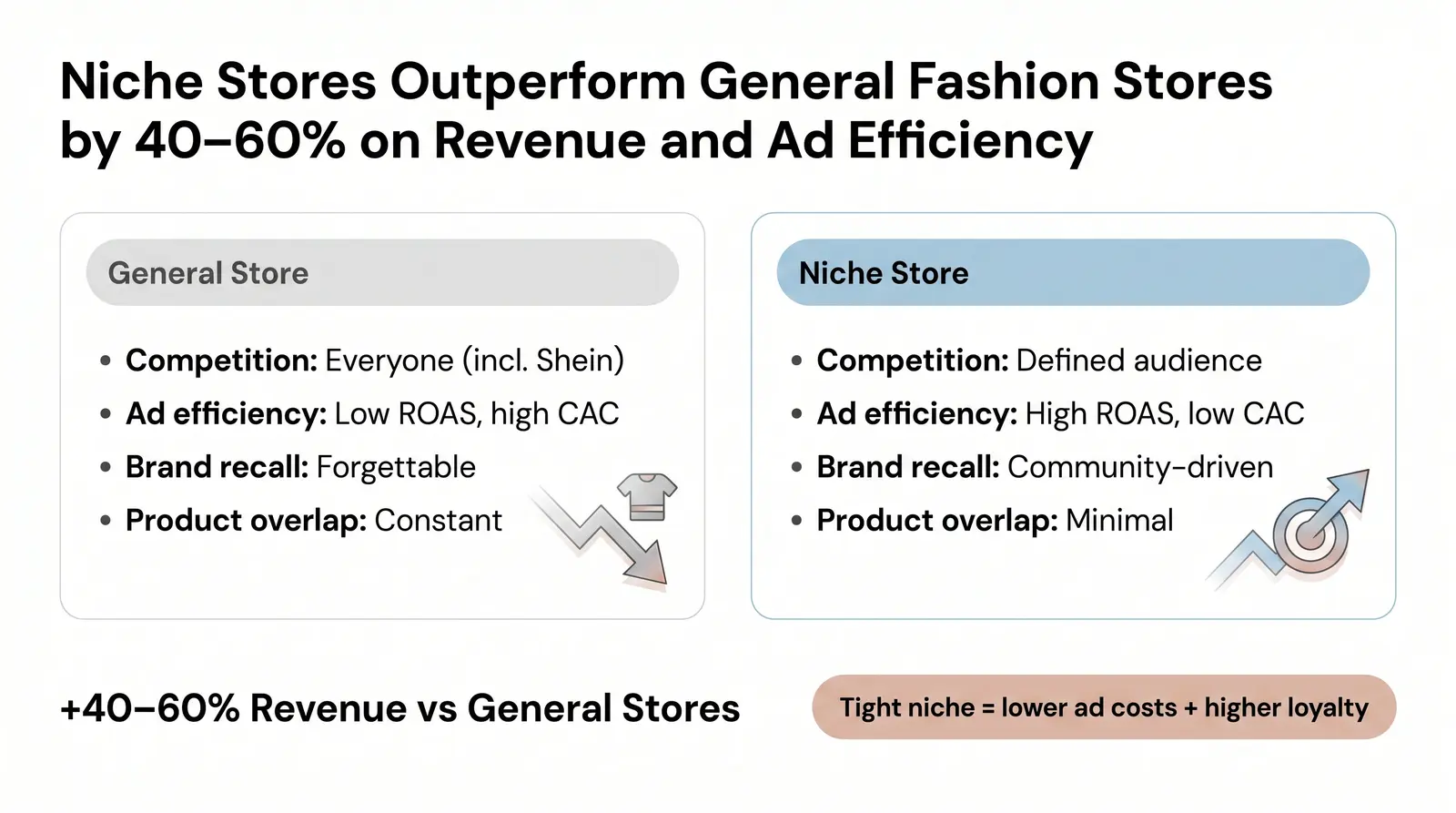
The saturation argument against general fashion stores is mathematically undeniable. When your store is simply categorized as "fashion," you are competing with everyone from fast-fashion giants like Shein to every other dropshipper using the same supplier apps. Recent ecommerce data shows that niche-specific stores consistently outperform general stores by 40% to 60% because they build customer loyalty and command higher prices [4].
Broad categories make it nearly impossible to build recognition, repeat purchase rates, or word-of-mouth referrals. If a customer buys a generic floral dress from your store, they are unlikely to remember your brand name a month later. There is no story, no community, and no reason to come back. Niche stores, by contrast, attract customers who identify with the brand's specific aesthetic or values, which drives repeat purchases and organic referrals.
The algorithm and ad efficiency argument also heavily favors narrow niches. Tighter audiences lead to lower Customer Acquisition Costs (CAC) and higher Return on Ad Spend (ROAS) because ad platforms can optimize delivery more effectively to a defined persona [5]. A store selling "minimalist gold jewelry for women who travel" will consistently outperform a store selling "women's fashion" on ad efficiency, simply because the audience signal is cleaner.
Here is the non-obvious insight that most beginner guides skip entirely. The biggest risk in fashion dropshipping is not competition in the abstract. It is that your supplier's trending pieces are the same ones your competitor is running ads on at the same time. When multiple sellers bid on the same audience for the exact same product, ad costs skyrocket while conversion rates collapse. Your "winning product" becomes a money pit the moment it goes viral on TikTok and every other Trendsi seller starts promoting it [3].
In our experience working with brand-builders across categories, the stores that struggle most aren't the ones with bad products. They're the ones with no answer to 'what kind of store is this, exactly?'
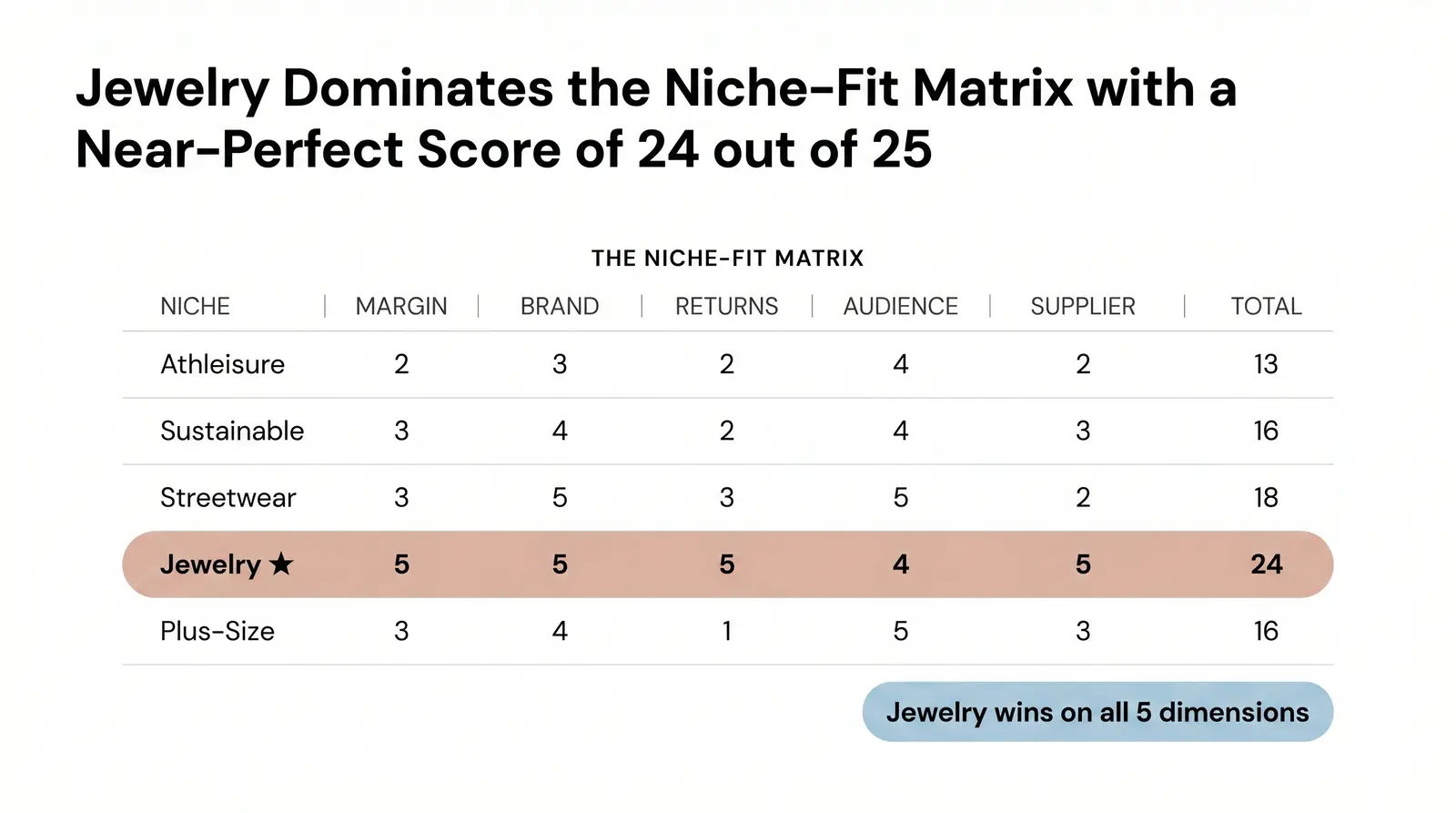
To help founders navigate this landscape, we developed the Niche-Fit Matrix™, a decision tool for fashion and accessories dropshippers to evaluate which niche they should enter and which supplier type fits best.
The matrix evaluates niches across five dimensions, each scored from 1 to 5:
| Niche | Margin Defensibility | Brandability | Return Rate Risk | Audience Clarity | Supplier Differentiation | Total /25 |
|---|---|---|---|---|---|---|
| Athleisure | 2 | 3 | 2 | 4 | 2 | 13 |
| Sustainable Apparel | 3 | 4 | 2 | 4 | 3 | 16 |
| Streetwear | 3 | 5 | 3 | 5 | 2 | 18 |
| Jewelry & Accessories | 5 | 5 | 5 | 4 | 5 | 24 |
| Plus-Size Fashion | 3 | 4 | 1 | 5 | 3 | 16 |
Athleisure is dominated by massive brands, making margins hard to defend at the dropshipping level. Sustainable apparel offers great branding potential but faces the same high return rates as general clothing. Streetwear has incredible audience clarity but relies heavily on original designs and cultural credibility rather than dropshipped blanks. Plus-size fashion serves a highly engaged, underserved market, but fit issues keep return risk elevated. Jewelry and accessories dominate the matrix due to structural advantages in margins, return rates, and private-label accessibility.
The global activewear market reached $439 billion in 2024 [6]. However, it is also fiercely competitive. Success in athleisure requires high-performance fabrics, reliable sizing, and a brand community that goes beyond the product itself. Competing against Lululemon, Gymshark, and Alo Yoga on product alone is not a viable strategy.
For athleisure, Printful is a strong option if you want to apply custom designs to high-quality activewear blanks such as sports bras and leggings, using print-on-demand to differentiate. If you prefer pre-designed boutique activewear, Spocket connects you with US and EU-based suppliers for faster shipping times, though margins will be tighter than in other categories.
Eco-conscious consumers are willing to pay a premium, but they demand transparency and authenticity. You cannot succeed in this niche with cheap, mass-produced garments shipped in plastic polymailers. You need suppliers that provide organic cotton, recycled materials, and verifiable ethical manufacturing practices. Greenwashing is a real reputational risk here.
GreenDropship is a solid choice for natural and organic products, though their apparel selection is limited. For a more robust clothing catalog, Faire allows you to source wholesale from independent, sustainable brands. While Faire is technically a wholesale marketplace rather than a pure dropshipper, many brands on the platform offer low minimums suitable for testing and early-stage brand building.
Streetwear is entirely driven by culture, exclusivity, and graphic identity. The global streetwear market is projected to reach $511 billion by 2030 [7]. Dropshipping generic streetwear is a losing battle. You must inject your own brand DNA into the products through original graphics, premium construction, and cultural credibility.
Apliiq is widely considered the best supplier for streetwear brands. They specialize in premium apparel finishing, offering custom woven labels, embroidery, and high-quality heavyweight blanks that streetwear consumers expect. BrandsGateway is an alternative if you want to dropship authentic luxury streetwear brands, though the capital requirements are higher and the margins are thinner.
Jewelry structurally outperforms apparel on almost every critical ecommerce metric, and the data makes the case clearly. While online apparel return rates average 24% to 28% due to fit and sizing issues, jewelry returns typically fall in the 4% to 8% range [8]. That is not a small difference. It is the difference between a business that constantly bleeds cash on reverse logistics and one that keeps nearly every dollar it earns.
Why jewelry beats apparel on key metrics. Jewelry commands significantly higher gross margins, often 50% to 80%, compared to the 30% to 40% typical of clothing dropshipping [9]. It is easier to photograph because the product does not require a human model to convey fit. It is cheaper to ship because even premium pieces are lightweight. It benefits from strong gift-purchase behavior, which drives both repeat sales and new customer acquisition through gifting occasions. And critically, fit is not a primary concern, which is the single biggest driver of apparel returns, cited in over 50% of clothing return cases [8].
The private-label advantage in jewelry. Unlike apparel, where custom sizing, patterns, and fabrics require significant upfront investment and complex supplier relationships, jewelry is one of the easiest product categories to private-label at scale. Custom packaging, logo stamping, and premium unboxing experiences can be achieved even at low order volumes. Some manufacturers offer private-label programs starting at 50 to 100 pieces. The result is that a jewelry brand can feel genuinely premium and exclusive from its very first order, without the capital requirements of a traditional wholesale clothing brand.
A worked example: the demi-fine minimalist brand. Consider a creator launching a minimalist demi-fine jewelry brand targeting women aged 25 to 40 who value understated, everyday elegance. A gold-plated sterling silver ring might cost $12 to source and $4 to ship. If sold generically through a standard dropshipping app with no branding, the realistic price ceiling is around $28 to $32. At that price, after ad costs of approximately $10 per conversion, the net margin is roughly 10% to 15%, which is fragile and difficult to scale.
Now apply private-label packaging: a custom-branded kraft box, a velvet pouch, and a handwritten-style care card with the brand's story. The perceived value of the exact same ring increases substantially. That piece can now comfortably retail for $48 to $65. At $55 with the same $10 ad cost, the net margin climbs to approximately 35%. The product has not changed. The brand infrastructure has. These figures are illustrative, but they reflect the real economics that brand-builders in this category consistently report [9].
We often see founders gravitate toward clothing because it feels obvious. But the ones who pivot to jewelry almost always tell us the same thing: 'I wish I'd started here.'
If you are serious about building a jewelry brand rather than just dropshipping jewelry, the supplier infrastructure looks completely different. Branvas is a purpose-built platform for jewelry brand-builders, not a generalist app that happens to carry some jewelry. It handles true private-label sourcing, custom branded packaging, and blind fulfillment. You hold no inventory, but your customers receive a premium unboxing experience with your logo on the box, pouch, and cards. To evaluate the margin difference before committing, the profit calculator is a good place to start.
The plus-size market is one of the most underserved segments in fashion. Approximately 67% of American women wear a size 14 or above, yet the market has historically been treated as an afterthought by mainstream fashion brands [10]. The global plus-size clothing market was valued at $119.4 billion in 2024 and is projected to grow at a 5.5% CAGR through 2032, driven by increasing demand for inclusive sizing and body-positive fashion [10].
This niche requires suppliers who understand inclusive grading, not just scaling up standard patterns. Fit is even more critical here than in general fashion, which means return rates can be high if sizing is inconsistent. Trendsi actually performs reasonably well in this category, as they offer a dedicated plus-size filter and a solid selection of inclusive sizing [1]. AutoDS is another strong alternative, providing access to a wide network of suppliers with specific plus-size catalogs, allowing you to build a highly targeted, size-inclusive boutique.

Choosing the right niche and supplier is the single most important decision you will make before launching an ecommerce store. The Niche-Fit Matrix™ makes clear that not all product categories are created equal, and that the category you choose determines your ceiling on margins, brand equity, and long-term defensibility.
To apply this framework to your own launch, follow a three-step action plan. First, score your proposed niche honestly using the five matrix dimensions. Do not inflate your scores based on enthusiasm. Be particularly rigorous about Return Rate Risk and Margin Defensibility, because these are the two dimensions that most often destroy otherwise promising stores. Second, validate demand using tools like Google Trends or by auditing successful Shopify stores in that specific lane. Look for stores that have been running for more than 12 months with consistent ad activity, which is a strong signal of sustainable profitability. Third, vet your supplier against the five matrix dimensions before committing your time and ad budget. Ask specifically about private-label capabilities, packaging options, and shipping reliability to your target market.
If jewelry or accessories is where your matrix points, Branvas makes it straightforward to launch a private-label brand without the complexity of traditional wholesale. See how it works

Is Trendsi good for dropshipping beginners?
Yes, Trendsi is a strong starting point for beginners. It is free to install, integrates cleanly with Shopify, and requires no upfront inventory commitment. The platform allows new sellers to learn the mechanics of ecommerce, product selection, and paid social advertising without significant financial risk. The main limitation is that building a truly differentiated brand on Trendsi is difficult, so beginners who want to scale beyond a basic boutique will eventually need to consider more specialized platforms.
How much can you make dropshipping fashion with Trendsi?
Profit margins in fashion dropshipping are notoriously compressed. While gross margins might appear to be 30% to 40% on paper, after factoring in advertising costs, Shopify fees, and the high return rates inherent to apparel (often 20% to 30%), net operational margins frequently shrink to 10% to 15% [9]. Generating meaningful income requires significant volume, which in turn requires consistent ad spend. It is possible, but the math is tighter than most YouTube tutorials suggest.
What are the best alternatives to Trendsi for jewelry?
For jewelry specifically, generalist fashion apps like Trendsi fall short because they do not offer the private-label infrastructure that makes jewelry a high-margin, brand-buildable category. The top alternative for brand-builders is a platform that offers true private-label packaging and blind shipping. Other alternatives include Spocket for boutique-quality pieces with US and EU suppliers, and ShineOn for print-on-demand message card jewelry, which is a different model suited to personalized gifting.
Is jewelry or clothing more profitable to dropship?
Jewelry is structurally more profitable for most operators. It offers higher gross margins (typically 50% to 80%), significantly lower shipping costs due to its compact size, and drastically lower return rates (4% to 8% for jewelry versus 24% to 28% for apparel) [8]. The combination of these factors means that a jewelry store's net profit per order is often two to three times higher than a comparable apparel store, even at lower price points.
Can you build a real brand with a dropshipping supplier?
Yes, but only if the supplier offers genuine private-label capabilities. Generic dropshipping, where products arrive in blank polymailers with no brand identity, builds a storefront, not a brand. To build a real brand, you need a supplier that provides custom packaging, branded inserts, consistent product quality, and blind shipping. The packaging is not cosmetic. It is the primary mechanism through which a customer forms a brand impression, and it directly influences repeat purchase rates and word-of-mouth referrals.