


Temu dropshipping fails due to slow shipping, unbranded packaging, return liability, and brand erosion—explore private-label and niche-specific alternatives that build sustainable businesses instead.
Published:
June 20, 2026
Author:
Yi Cui
Temu prices look irresistible. Until you factor in 15-30 day shipping, zero branded packaging, and the customer service chaos when returns happen.
If you have been keeping a pulse on the global ecommerce landscape, you know that Temu is impossible to ignore. From dominating app store charts to reshaping consumer expectations, this marketplace has redefined what "affordable" means. For dropshippers, those rock-bottom prices look like the ultimate arbitrage opportunity. The math seems simple: buy a necklace for $4, sell it for $19.99 on your branded store, and pocket the difference. It sounds like the perfect low-risk business model.
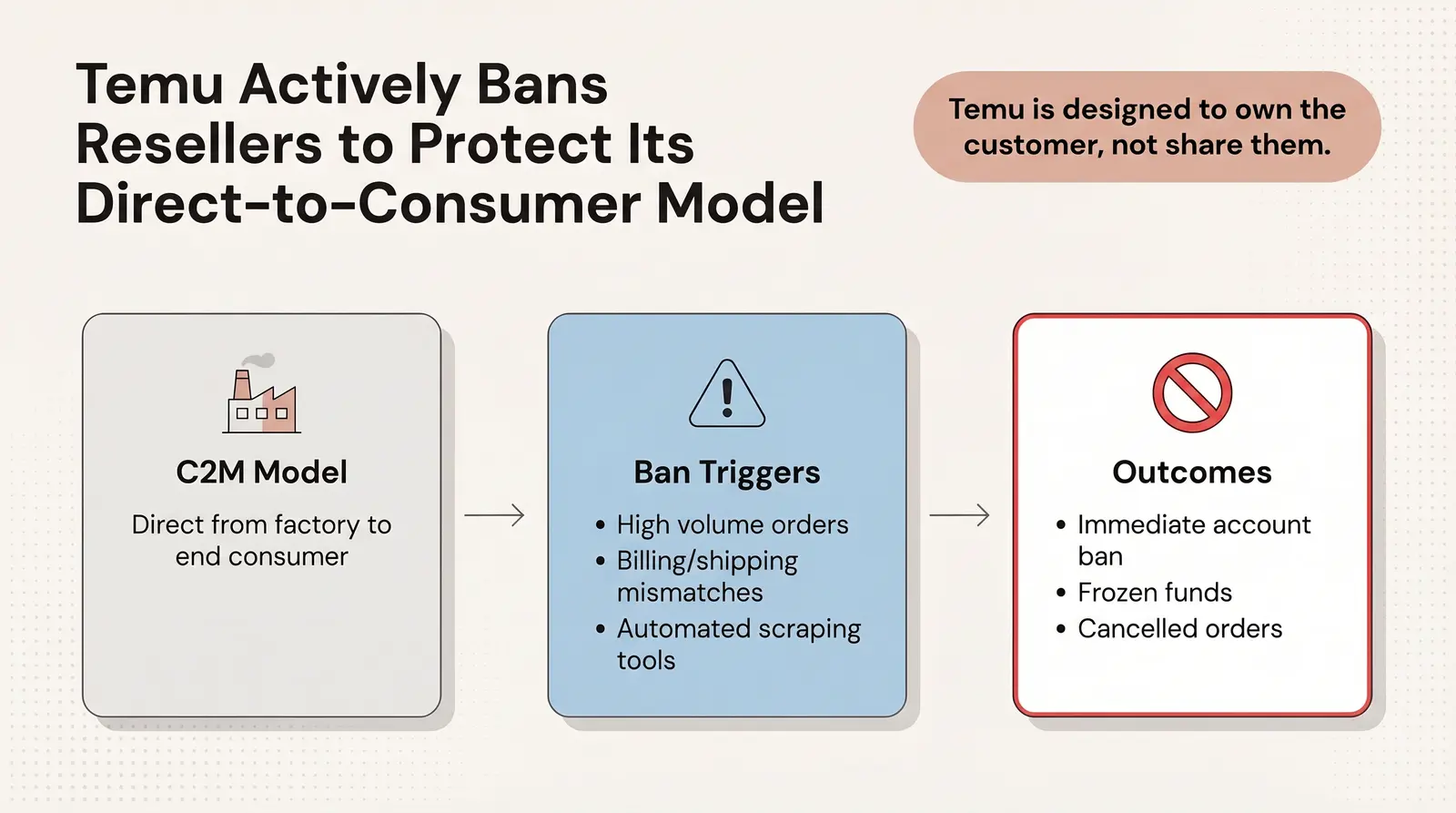
But here is the reality check that most YouTube gurus will not tell you: Temu is not built for dropshippers. Unlike traditional B2B platforms, Temu is a direct-to-consumer marketplace aggressively focused on user experience and brand dominance. Their entire model is designed to own the customer relationship, not to share it with a reseller.
By the end of this article, you will know exactly what Temu dropshipping actually involves, where it breaks down by niche, and what to do instead to build a sustainable, branded business. We will cover the official mechanics, the shipping reality, the return nightmare, the brand damage you cannot see on a spreadsheet, and the alternatives that actually work.
Temu is owned by PDD Holdings, the Chinese ecommerce conglomerate that also operates Pinduoduo, one of the largest platforms in China. Temu operates a consumer-to-manufacturer (C2M) model that connects buyers directly with Chinese factories, removing layers of traditional supply chain markup. This structure allows for prices that seem almost impossibly low. However, this model is designed for end consumers, not resellers.
Officially, Temu does not support dropshipping. Their Terms of Use prohibit commercial resale in a way that disrupts their platform or confuses consumers [1]. They want end buyers, not middlemen. Their support documentation explicitly states that the marketplace does not promote or integrate dropshipping as a business model [5]. While buying a product and reselling it is generally legally permissible under the First Sale Doctrine in many jurisdictions, Temu reserves the right to refuse service to anyone, and they actively exercise that right [2].
Despite this, a "grey zone" exists. Many sellers attempt to dropship from Temu unofficially by manually placing orders and entering their customers' shipping addresses. This approach carries significant risks. Temu's algorithms actively look for patterns indicating reseller activity, including high order volumes from a single account to multiple different addresses, frequent mismatches between billing and shipping details, and the use of automated tools to scrape prices or place orders. Flagged accounts face immediate bans, frozen funds, and cancelled orders mid-fulfillment [2]. Beyond the account risk, when a customer receives a package covered in Temu branding, the illusion of your independent store shatters instantly.
It is also important to distinguish dropshipping from the Temu affiliate program. The affiliate program allows creators to earn commissions ranging from 5% to 20% by referring new users who download the app and make purchases [3]. This is a legitimate, officially supported marketing partnership. Dropshipping from Temu, by contrast, involves unauthorized reselling that violates their core business model and ToS.
We talk to a lot of early-stage sellers at Branvas, and Temu comes up constantly as a "first idea." Here's why we always slow them down.
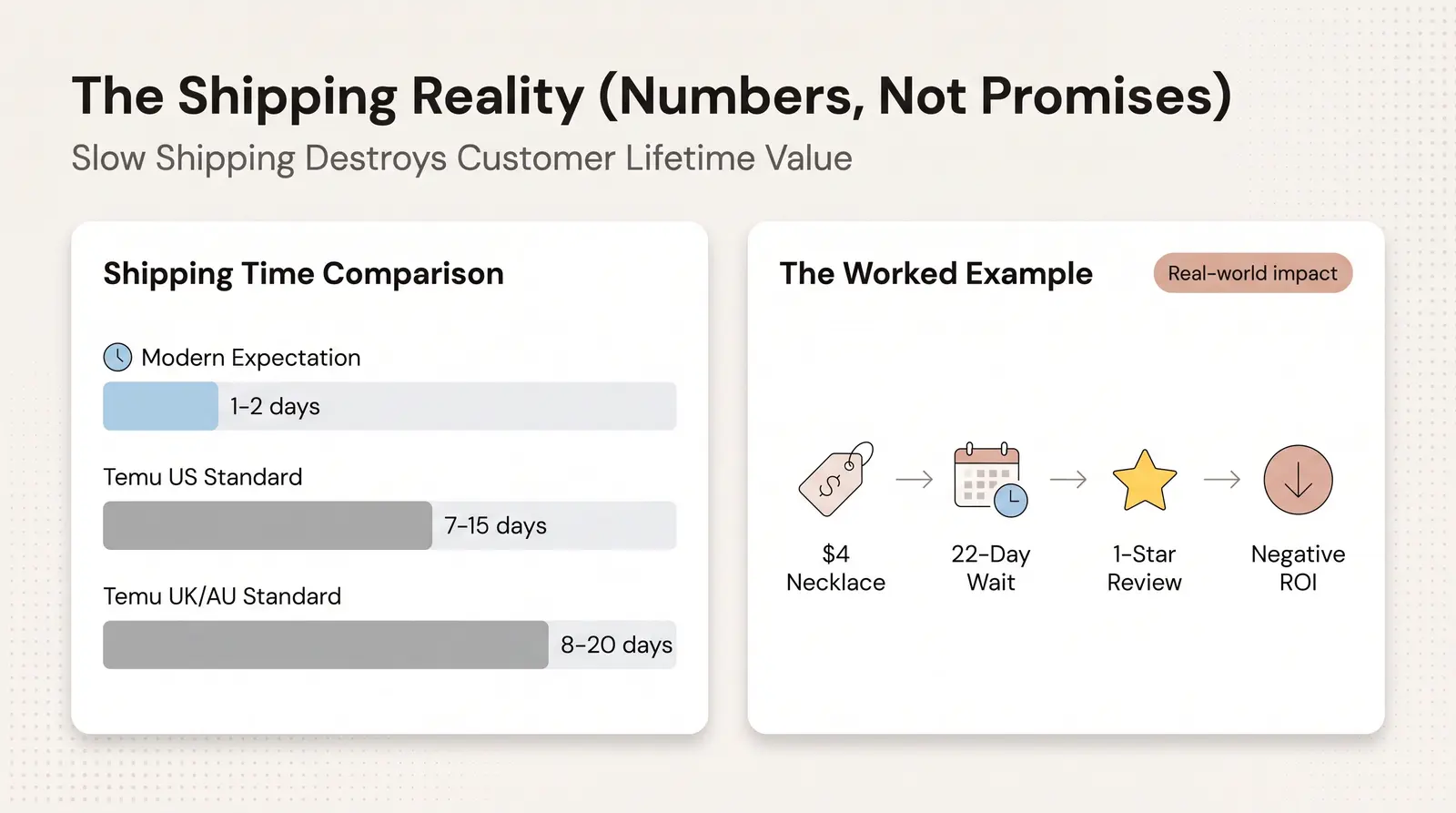
In an era where Amazon Prime has normalized one-to-two-day delivery, shipping speed is not just a nice-to-have. It is a baseline customer expectation. Temu's shipping times simply do not align with what modern ecommerce customers consider acceptable.
For buyers in the US, standard shipping typically takes 7 to 15 business days, while express shipping takes 5 to 10 business days [4]. For UK and Australian customers, standard shipping runs 8 to 20 days, with express options at 5 to 10 days [4] [5]. These are the optimistic estimates. Depending on the supplier, customs processing, and seasonal demand, standard shipping can stretch up to 25 or even 30 days [5]. Sellers who have attempted Temu dropshipping consistently report that real-world delivery times exceed the published estimates.
Long shipping times destroy customer lifetime value and review scores. When a customer waits three weeks for an order, their excitement fades into frustration. They have likely already forgotten why they bought the item. This delay leads to negative reviews, chargebacks, and a refusal to purchase from your store again. In 2026, a 1-star review citing "slow shipping" is not just one unhappy customer. It is a public signal to every future visitor that your store cannot deliver.
The economics of cross-border shipping have also fundamentally changed. In May 2025, the US government eliminated the Section 321 de minimis exemption for Chinese imports, which previously allowed packages under $800 to enter duty-free [6]. By August 2025, the exemption was removed globally, meaning all imports now face tariffs regardless of value. This policy change forced Temu to announce price increases starting April 25, 2025, eroding the massive cost advantage that had fueled their early growth [7]. Temu's US daily active users dropped approximately 48% between March and May 2025 as a direct result [7].
Worked Example: A seller lists a $4 Temu necklace for $19.99. The customer places an order, expecting standard ecommerce delivery. After a 22-day wait, the package finally arrives in a bright orange Temu poly mailer. The customer, who has the Temu app installed, opens it and sees the same necklace listed for $4.99. They leave a 1-star review ("took forever, cheap packaging, found it on Temu for $5") and request a return. The seller now faces a return shipping cost, a refund out of pocket, a damaged store rating, and a customer who has been directly onboarded to Temu. The gross margin on that single order was $15.99. After the return, the platform fee, and the reputational cost, the seller is in the red.
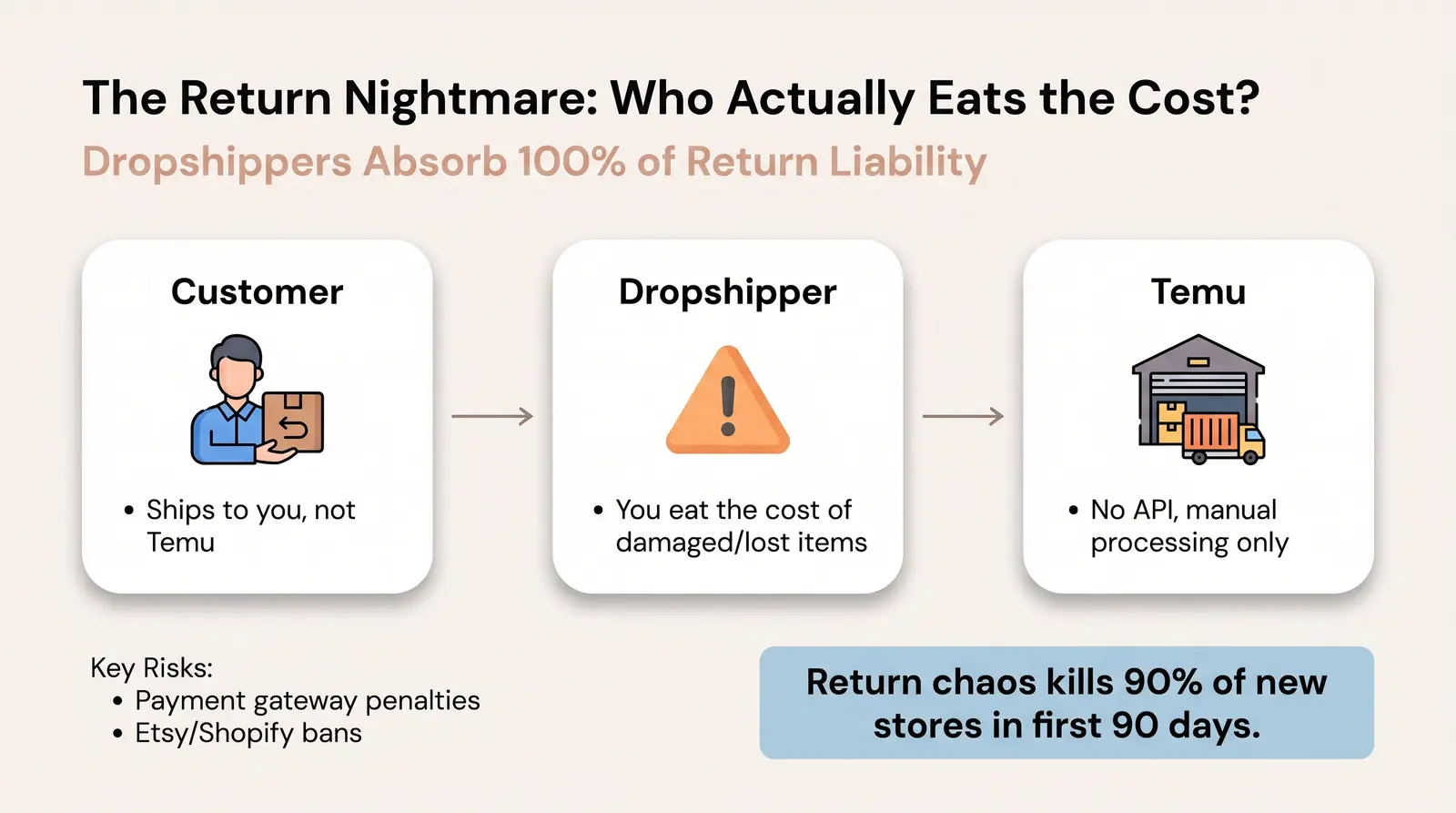
Returns are an inevitable part of ecommerce, but dropshipping from Temu turns this standard procedure into a logistical nightmare. The structural problem is that dropshippers take on full return liability for products they do not control, cannot inspect before shipping, and cannot repackage.
Temu offers a 90-day return policy, but this policy applies to the account holder who made the purchase. That's you, the dropshipper. You cannot ask your customer to log into your Temu account to print a return label, as this would immediately expose your sourcing strategy and pricing [2]. The customer would see exactly where the product came from and how much you paid for it.
Instead, you must act as the middleman. The customer ships the item back to your business address. Once you receive it, you must process the return with Temu separately. If the item is damaged or lost in transit, or if Temu rejects the return for any reason, you absorb the cost entirely. There is no automated system, no API, and no dropshipping-specific support from Temu's customer service team.
This friction creates a cascade of financial risks. High dispute rates via payment gateways like PayPal or Stripe can result in severe penalties, including frozen funds, elevated reserve requirements, or permanent account termination. Platform penalties on Shopify, Etsy, and Amazon are equally serious. Etsy, for example, explicitly prohibits dropshipping from Temu in its seller policies, and accounts found doing so face permanent suspension.
In our experience, return chaos is the #1 thing that kills new dropshipping stores in their first 90 days.
The issue is compounded by product quality inconsistency. Temu sources from thousands of different manufacturers, and quality varies wildly between listings and even between orders of the same listing. A product that looked acceptable in the sample order may arrive in a completely different quality on the tenth order. You have no control over this, and your customer holds you responsible.
Brand equity bleed is the gradual erosion of customer trust and brand value caused by repeated negative brand interactions. When you dropship from Temu, every delivery that arrives in an unbranded or Temu-branded poly mailer is a brand moment you have permanently lost.
The psychology of unboxing is well-documented. Customers associate packaging quality with product quality and seller trustworthiness. A well-designed unboxing experience boosts loyalty, encourages social sharing, and drives repeat purchases [8]. Research on consumer behavior consistently shows that the physical presentation of a product shapes the customer's perception of its value before they even touch the item itself. Conversely, receiving a product in cheap, recognizable marketplace packaging signals that the seller adds no value to the transaction and has no genuine brand identity.
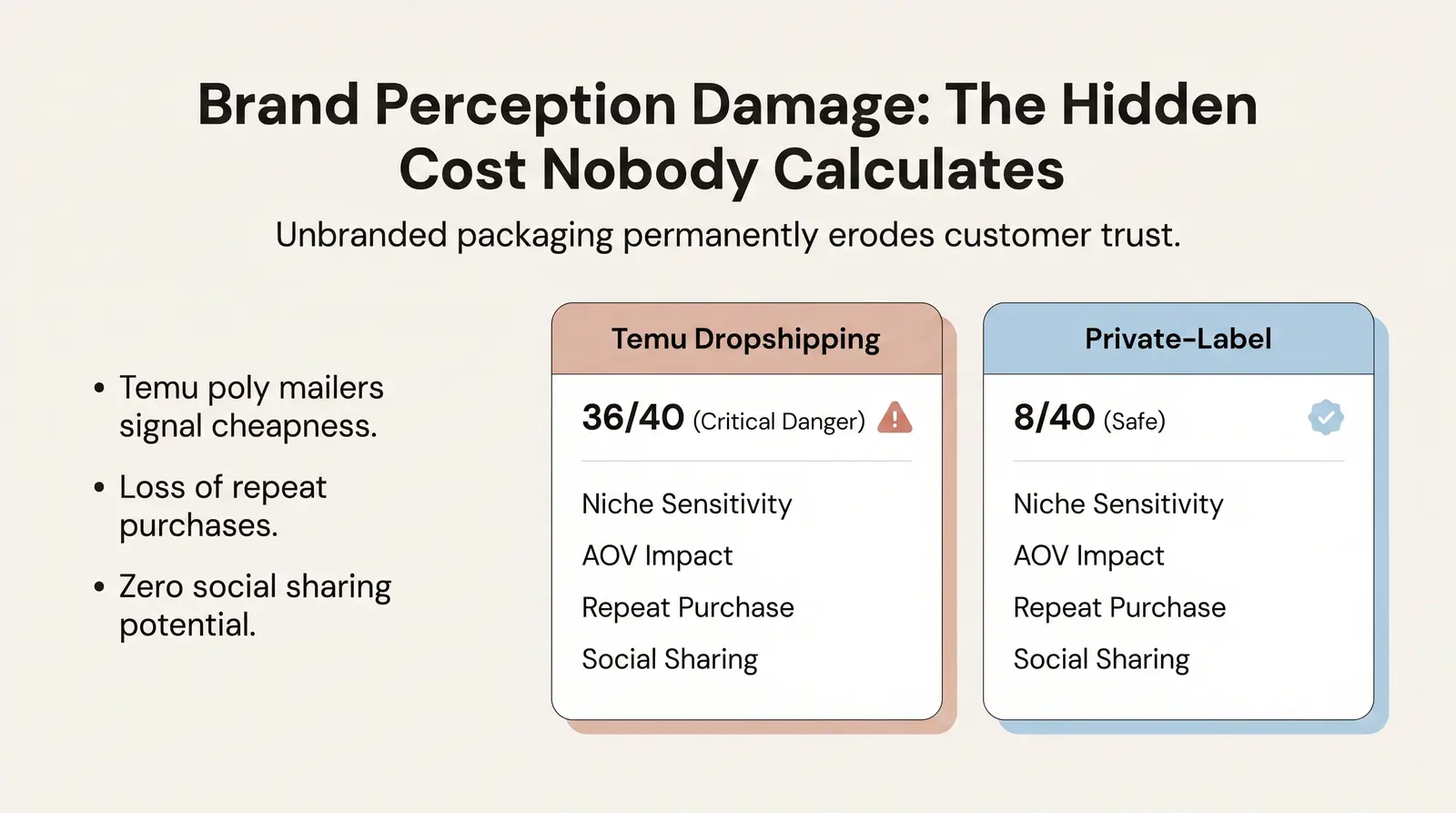
This brand damage is particularly severe in niches where presentation is integral to the product experience. To quantify this risk, we use the Branvas Brand Erosion Index, a proprietary 4-factor scoring model that evaluates the danger of using unbranded fulfillment for a given business.
The four factors are:
Each factor is scored from 1 (low risk) to 10 (critical risk). The table below scores Temu dropshipping against a private-label alternative across all four factors.
| Factor | Temu Dropshipping (1-10) | Private-Label Alternative (1-10) |
|---|---|---|
| Niche Sensitivity to Packaging | 9 (High Risk) | 2 (Low Risk) |
| Average Order Value Impact | 8 (High Risk) | 3 (Low Risk) |
| Repeat-Purchase Likelihood | 9 (High Risk) | 2 (Low Risk) |
| Social Sharing / Gift-Giving Rate | 10 (Critical Risk) | 1 (Very Low Risk) |
| Total Brand Erosion Score | 36 / 40 (Critical Danger) | 8 / 40 (Safe) |
A score above 30 indicates that unbranded fulfillment will actively and measurably harm your business. Temu dropshipping scores at the critical danger threshold. A private-label alternative, by contrast, scores in the safe zone, meaning every touchpoint reinforces rather than erodes your brand.
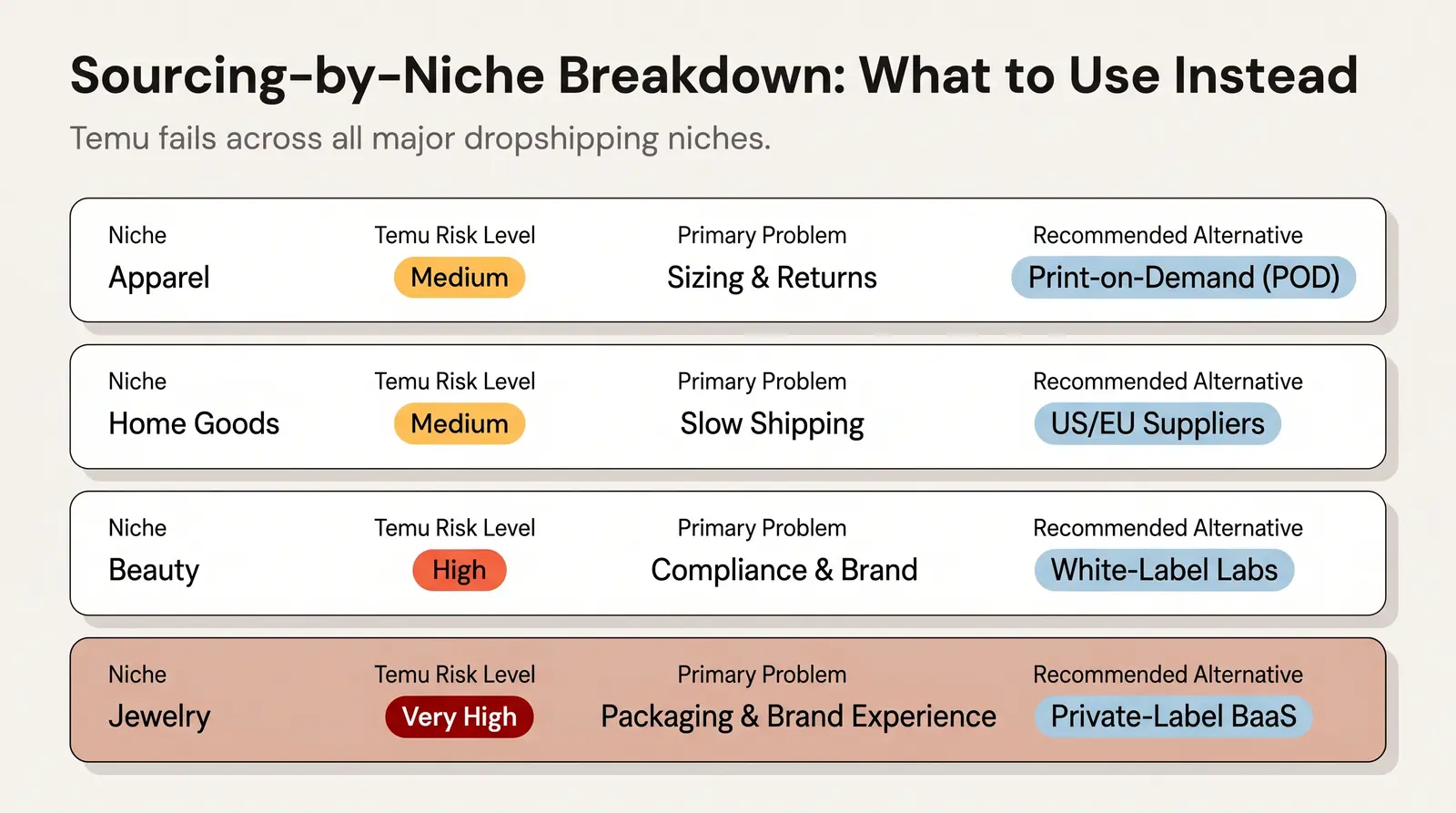
Different niches face unique challenges when sourcing from Temu. Here is a structured breakdown of four major categories, the specific problems Temu creates in each, and the credible alternatives you should use instead.
The core problems with dropshipping apparel from Temu are sizing inconsistencies, high return rates, and the complete inability to add private labels or custom tags. Clothing requires precise fits, and generic marketplace items sourced from dozens of different factories often arrive in wildly inconsistent sizes. A customer who orders a medium and receives something that fits like a small will not only return the item but will leave a review that poisons future conversions.
Alternatives: Print-on-demand services like Printful and Printify allow you to sell custom-designed apparel with your branding, fulfilled from US and EU facilities. For boutique fashion, Faire connects you with independent brands that offer wholesale terms. For higher volume, sourcing directly from vetted factories via Alibaba or 1688 with a freight agent gives you quality control and custom labeling options.
Home decor and accessories are frequently purchased as gifts for specific occasions: housewarmings, weddings, birthdays. Temu's long and unpredictable shipping times kill these gifting opportunities. A customer who needs a gift for a weekend event will not wait three weeks, and they will not forgive you for making them show up empty-handed.
Alternatives: Spocket and CJdropshipping both offer access to US and EU-based suppliers with significantly faster delivery times, typically 3 to 7 business days domestically. Syncee is another strong option for curated home goods from vetted suppliers. For established stores, direct wholesale purchasing from US-based distributors eliminates shipping uncertainty entirely.
Dropshipping cosmetics and skincare from Temu carries severe regulatory risks that go beyond brand damage. Products may lack FDA approval for the US market or CE compliance for the EU. Ingredient transparency is often nonexistent, and a customer with a skin reaction will hold you legally and reputationally responsible. Furthermore, beauty products rely entirely on brand story and trust. A skincare brand with no verifiable origin story, no ingredient transparency, and no branded packaging has no business competing in this category.
Alternatives: Partner with private-label beauty suppliers or white-label cosmetic labs. Platforms like Jubilee (available via Spocket) specialize in private-label beauty with no minimum order quantities and full compliance documentation. These manufacturers ensure regulatory compliance, provide full ingredient lists, and allow you to build a trustworthy brand identity from day one.
Jewelry is the single category where Temu fails most catastrophically for a dropshipper trying to build a brand. The failure is not just operational. It is structural.
In the jewelry niche, branded packaging is not optional. It is the product experience. A ring arriving in a crushed Temu poly mailer versus a ring presented in a custom-branded box with a care card and a brand insert are fundamentally different products in the customer's mind. The perceived value of the ring drops to near zero the moment the customer sees the orange bag. This is not an exaggeration. Perceived value in jewelry is almost entirely constructed by context, and the context Temu provides is "cheap marketplace item."
Jewelry return rates spike when the physical product does not match the highly edited marketplace photography. Temu product images are often professionally lit and digitally enhanced. The reality of a $4 necklace in person rarely matches those images, and in jewelry, the gap between expectation and reality is the primary driver of returns and negative reviews.
Gift-giving is the dominant use case for jewelry. Birthdays, anniversaries, Valentine's Day, Mother's Day: the majority of jewelry purchases are made as gifts. This means the unboxing moment is the gifting moment. The recipient's first impression of the gift is formed by the packaging, not the product. If the packaging says "I bought this from a Chinese marketplace for $4," the gift has failed before the box is open. There is no recovering from that moment.
The social sharing dimension compounds this further. Jewelry is one of the most photographed and shared product categories on Instagram, TikTok, and Pinterest. Every unboxing video, every flat lay, every "look what I got" post is a brand impression. When that impression is a Temu poly mailer, it is not just one lost customer. It is a public record of your brand's cheapness.
This is exactly the gap Branvas was built to fill. Branvas provides a private-label jewelry brand-as-a-service model: product sourcing, custom branding and packaging, and blind fulfillment, so sellers ship premium, branded jewelry directly to their customers without holding a single piece of inventory. The customer receives a branded box, a care card, and a product that matches the photography. That is the experience that builds repeat customers and generates organic social sharing.
If you're building a jewelry brand and you're tired of the Temu trap, explore how Branvas works →.
| Niche | Temu Risk Level | Primary Problem | Recommended Alternative Type |
|---|---|---|---|
| Apparel | Medium | Sizing/returns/no label | POD or direct factory |
| Home Goods | Medium | Shipping speed | US/EU dropship suppliers |
| Beauty | High | Compliance + brand | White-label lab |
| Jewelry | Very High | Packaging + brand experience | Private-label BaaS (e.g., Branvas) |
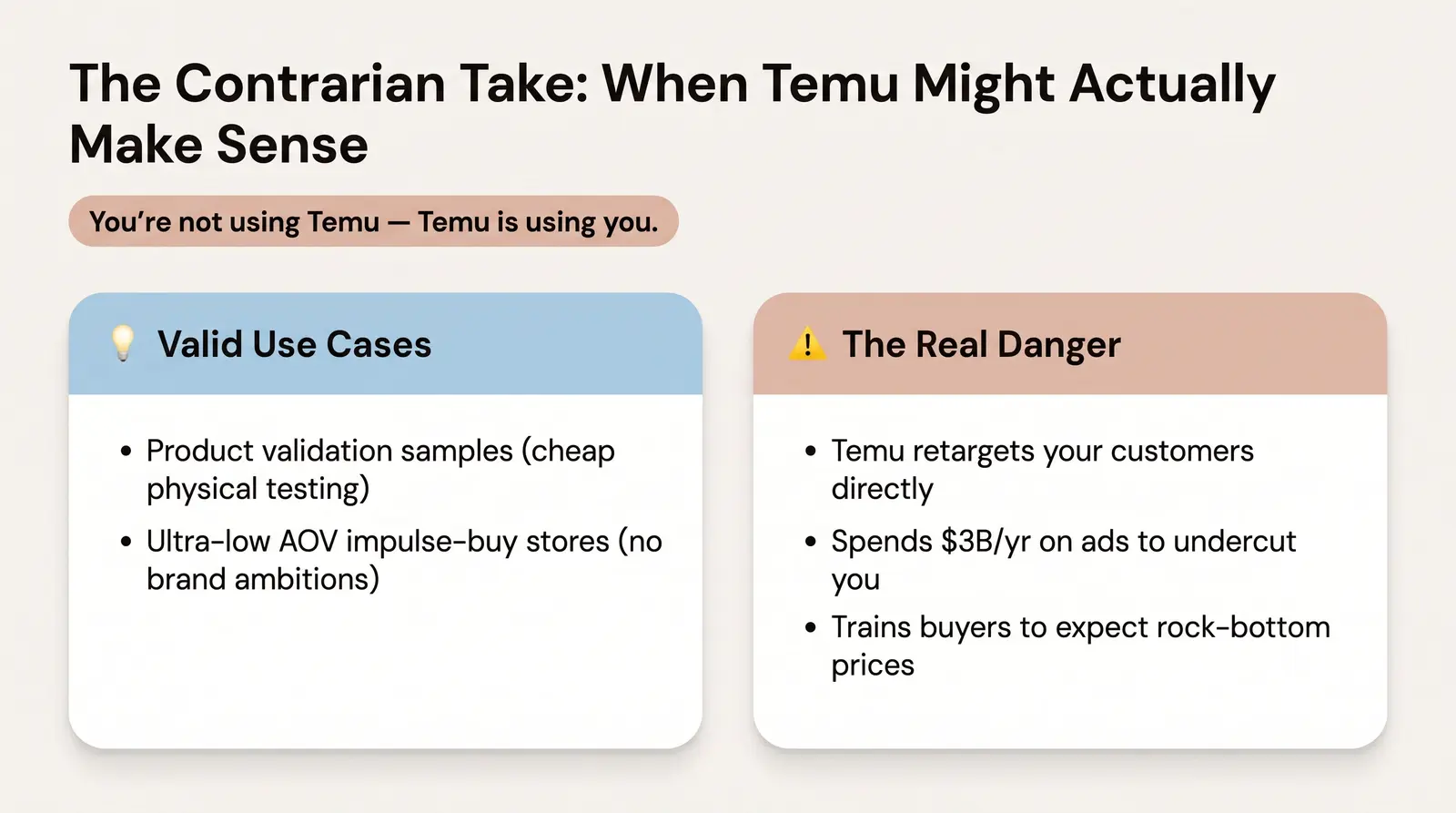
To be intellectually honest, there are a few narrow scenarios where sourcing from Temu is defensible, and a credible analysis has to acknowledge them.
If you are in the early stages of product validation and need cheap physical samples before committing to a real manufacturer, Temu is a cost-effective way to test product concepts. Ordering a $3 item to assess quality, dimensions, and photography potential costs almost nothing. This is a legitimate use case.
It can also work for ultra-low AOV impulse-buy stores that do not rely on repeat purchases, have no brand ambitions, and fully disclose their 15 to 30 day shipping times upfront. Some sellers run this model successfully on platforms that attract bargain hunters who prioritize price over experience. It is a race to the bottom, but it is a race some sellers choose to run.
These are the exceptions, not the rule.
The real problem with Temu dropshipping is not the shipping time. It is that Temu is optimising against you. Their app retargets your customers directly, undercuts your price, and trains buyers to associate your niche with rock-bottom price expectations. Temu spent an estimated $3 billion on advertising in 2023 alone, bidding on the same keywords as nearly every other online retailer and appearing in 90% of Google Shopping auction insights reports [7]. When you send a customer a Temu package, you are essentially paying to acquire a user for Temu. Their gamified app, their referral mechanics, their push notifications. All of it is designed to bring that customer back to Temu directly, at a price you cannot match.
You're not using Temu. Temu is using you.
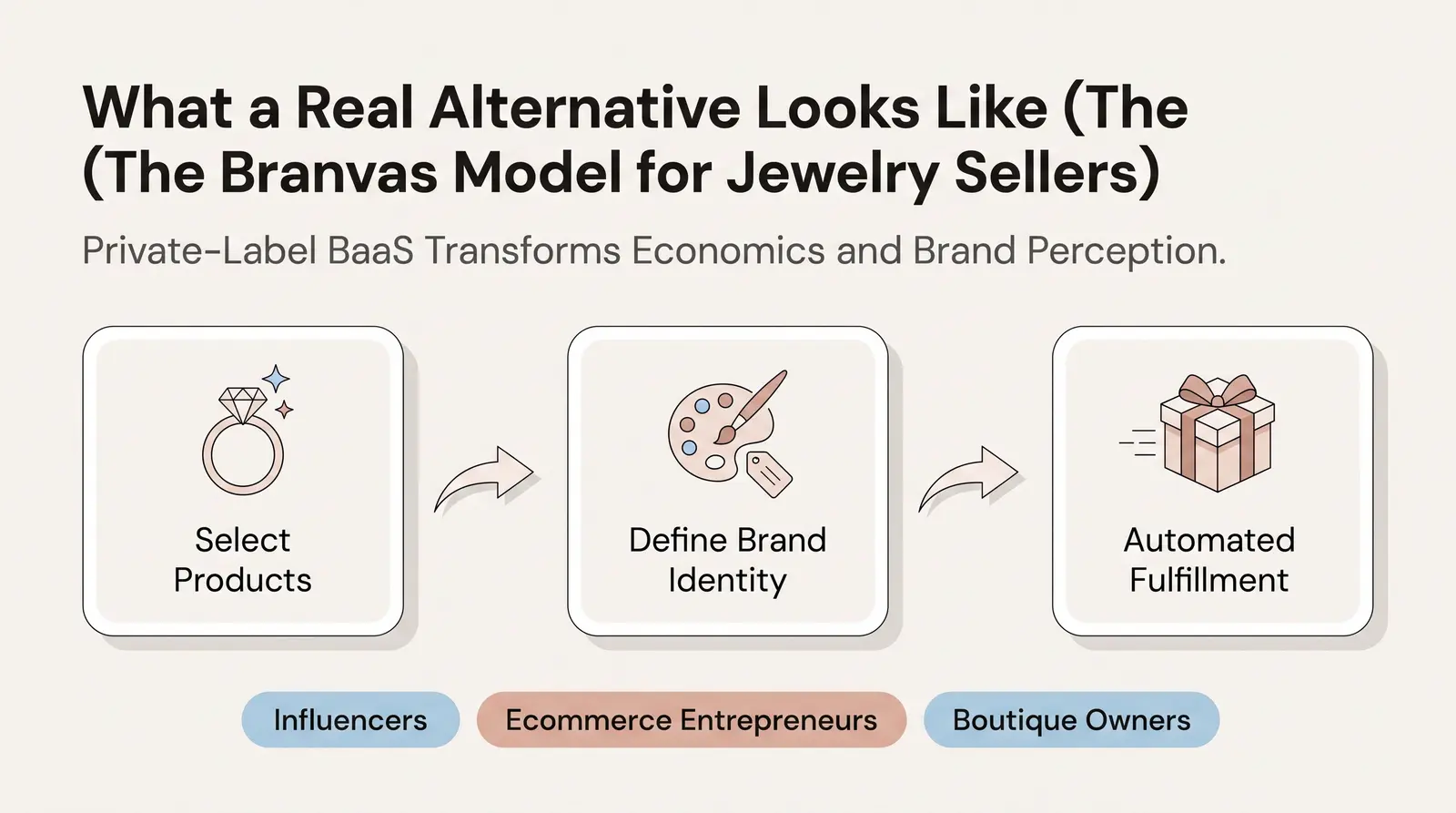
A private-label Brand-as-a-Service model fundamentally changes both the economics and the customer perception of a jewelry business. Instead of acting as a transparent middleman for cheap marketplace goods, you become a brand owner with a defensible identity, a loyal customer base, and a product experience that customers want to share.
The Branvas process is designed to be simple for the seller while delivering a premium experience for the customer:
This model is built for influencers launching a product line, ecommerce entrepreneurs who want to scale without inventory risk, and boutique store owners who want to expand their digital presence without compromising on the customer experience they have built in-store.
Ready to stop dropshipping and start building? Launch your jewelry brand with Branvas →
Officially, no. Temu's Terms of Use prohibit commercial resale that disrupts their platform, and they explicitly do not offer a dropshipping program or API integration [1]. While some sellers attempt it manually, they risk immediate account bans, frozen funds, and order cancellations if Temu's algorithms detect reseller activity. Platforms like Etsy also explicitly prohibit dropshipping from Temu in their own seller policies.
Temu standard shipping typically takes 7 to 15 business days for US customers, and 8 to 20 days for UK and Australian buyers. Express shipping runs 5 to 10 business days [4]. However, real-world delivery times frequently exceed these estimates, stretching to 25 or 30 days depending on customs and supplier location. In 2026, this is a significant competitive disadvantage against platforms offering 2 to 5 day domestic fulfillment.
While initial gross margins look attractive, the hidden costs typically destroy long-term profitability. High return rates driven by quality inconsistency, chargeback fees from frustrated customers, platform penalties for policy violations, and the manual labor required to process every order without automation make it an unsustainable model for most sellers. The elimination of the de minimis exemption in 2025 has also eroded the price advantage that made Temu sourcing appealing in the first place [6].
The best alternative is a private-label Brand-as-a-Service provider like Branvas. Unlike Temu, Branvas offers high-quality jewelry, custom branded packaging, and blind fulfillment under your brand name. This allows you to build a premium, recognizable brand experience without holding inventory. For a category where packaging is the product experience, this distinction is not marginal. It is the entire business model.
No. Temu does not offer white-label or private-label services of any kind. Every order is shipped in their highly recognizable orange packaging with Temu branding prominently displayed. There is no option for neutral packaging, custom inserts, or brand-specific presentation. This makes it structurally impossible to build a cohesive, independent brand identity when sourcing from Temu.