
Compare Spocket and Zendrop on pricing, shipping speed, branding, and automation to choose the best dropshipping platform for your ecommerce store.
Published:
June 17, 2026
Author:
Yi Cui

When choosing a dropshipping supplier app, the decision often comes down to where your suppliers are located versus how much of the fulfillment process you want automated.
| Feature | Spocket | Zendrop | Branvas |
|---|---|---|---|
| Model | Regional supplier marketplace | Automated dropshipping platform | Private-label jewelry dropshipping |
| Best for | Beginners & fast US/EU shipping | Automation, branding, & scaling | Sellers who want to own a high-margin brand |
| Quality | Vetted US/EU suppliers, higher costs | Standard global sourcing, US warehouse option | Premium jewelry, branded packaging |
| Typical margin | 15–30% | 15–30% | 50–60% |
| Branding | Basic branded invoicing | Private labeling & custom packaging (Plus plan) | Branded packaging & blind shipping standard |
| Monthly cost | $39.99 – $299.99 | $0 – $79+ (Usage-based options) | $0 – $149 |
| Returns risk | Moderate (depends on supplier) | Moderate (chargeback management on higher tiers) | Low (jewelry has light shipping & low returns) |
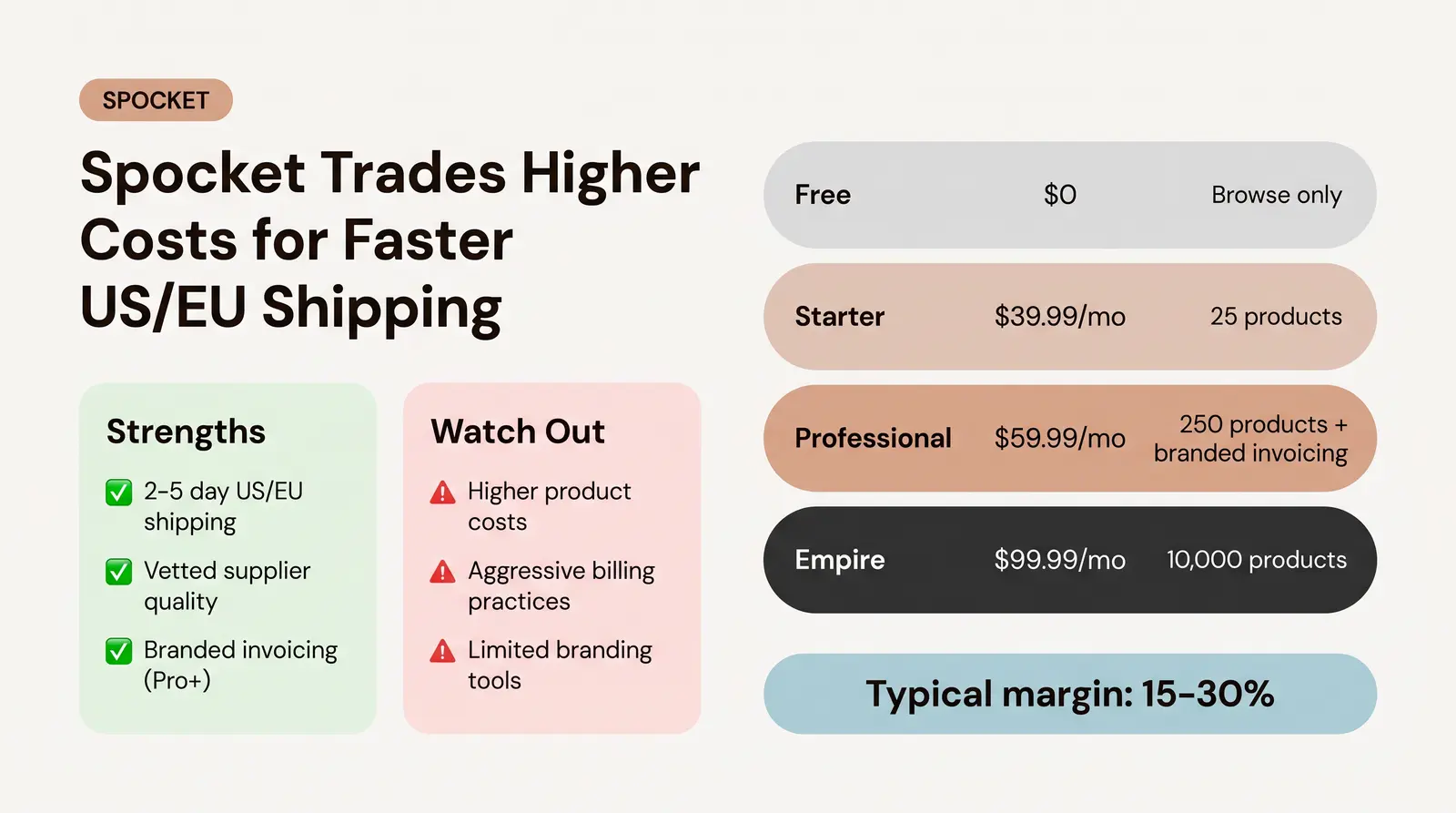
Spocket is a dropshipping marketplace that distinguishes itself by focusing heavily on suppliers based in the United States and the European Union. Rather than relying entirely on overseas manufacturers, Spocket aims to provide ecommerce store owners with faster shipping times and higher-quality products [1]. This regional focus makes it a popular choice for beginners who want to avoid the long wait times traditionally associated with dropshipping from China.
Spocket’s pricing is tiered based on the number of products you want to import and the features you need [2].
| Plan | Price (Monthly) | Key Features |
|---|---|---|
| Free | $0 | Browse catalog only |
| Starter | $39.99 | 25 unique products, AliExpress dropshipping |
| Professional | $59.99 | 250 unique products, 25 premium products, branded invoicing |
| Empire | $99.99 | 10,000 unique products, 10,000 premium products |
| Unicorn | $299.99 | 25,000 unique products, bulk checkout, priority support |

Zendrop positions itself as a comprehensive dropshipping fulfillment platform built to solve the pain points of scaling an ecommerce business. Founded by experienced dropshippers, it focuses heavily on automation, faster processing times, and providing a pathway from basic dropshipping to private labeling and custom branding [4]. While it sources globally (including China), it offers US warehousing for faster delivery of high-volume items.
Zendrop recently introduced a usage-based billing model alongside its standard plans, making costs dependent on how many products you link to your store [5].
| Plan | Price (Monthly) | Key Features |
|---|---|---|
| Free | $0 | Access catalog, 0 linked products (browse only) |
| Beginner | $29 | 1–20 linked products, basic fulfillment |
| Pro | $49 | 21–100 linked products, automated fulfillment, custom branding |
| Plus | $79 | 101+ linked products, private labeling, bundles, coaching |
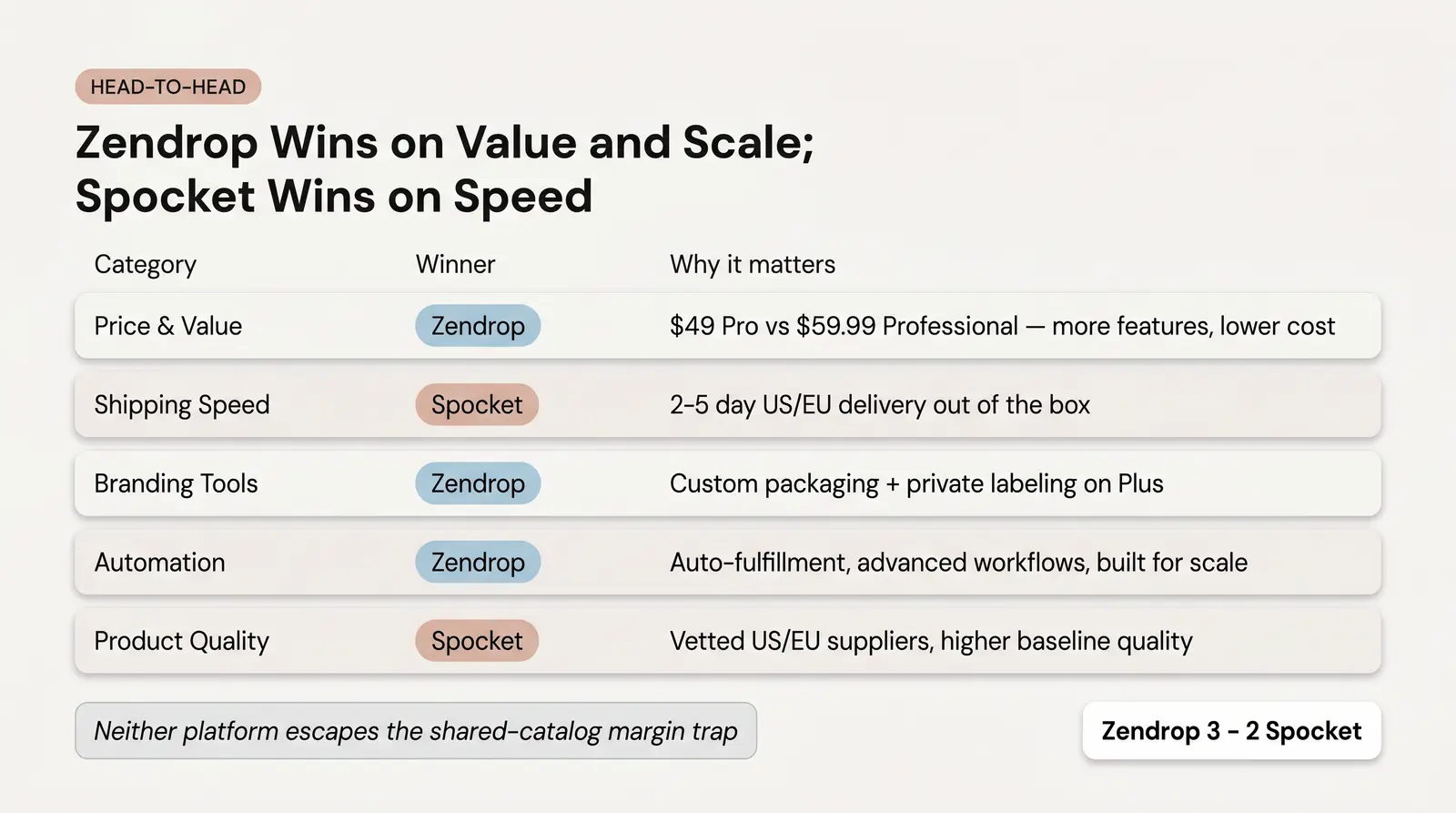
When comparing Spocket and Zendrop directly, the "winner" depends entirely on your business priorities.

To get a sense of how these platforms perform in the real world, we analyzed several discussions across dropshipping subreddits (r/dropship, r/dropshipping). The consensus highlights clear strengths and significant frustrations for both tools.

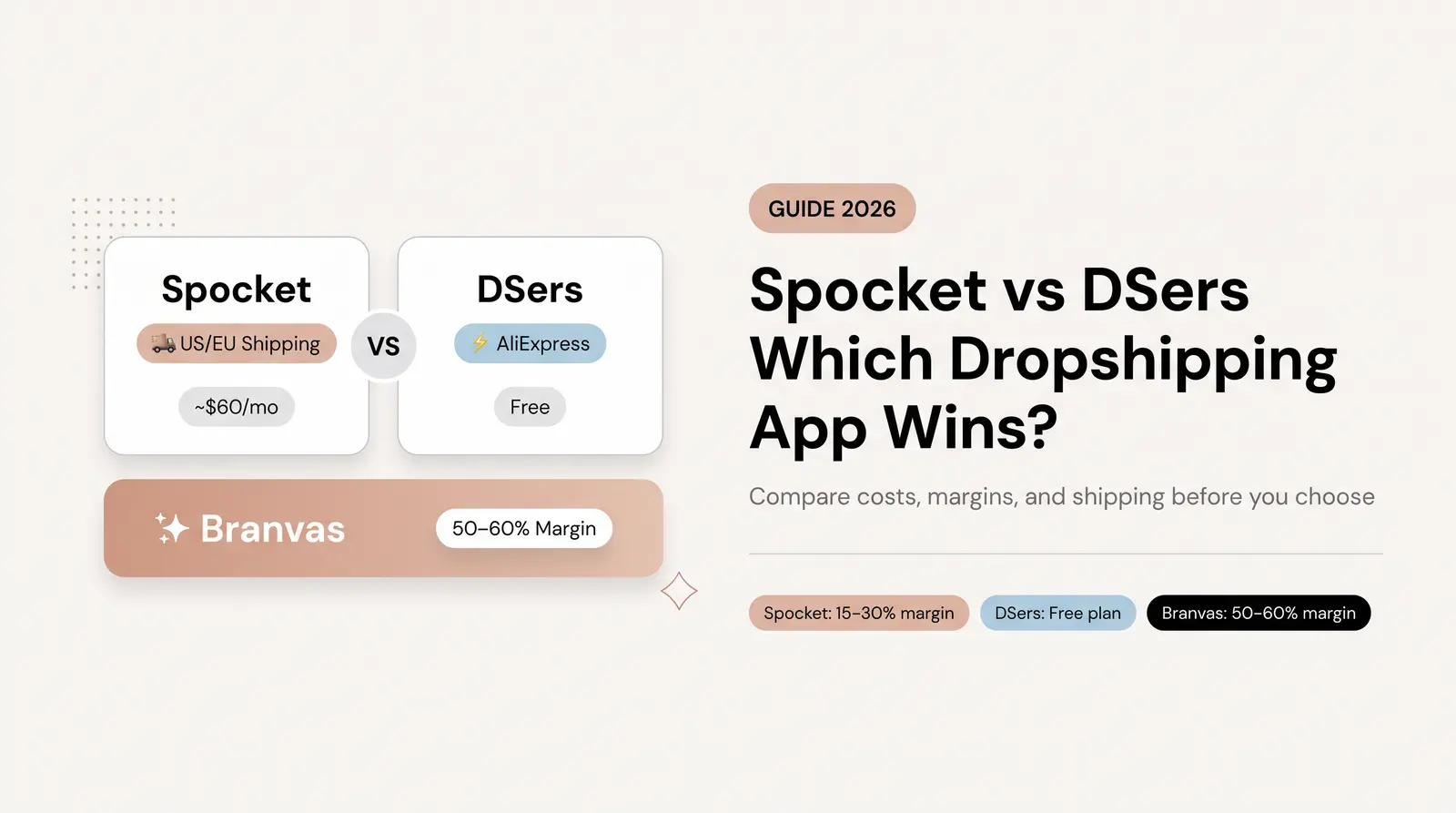
Spocket sells faster US/EU shipping, Zendrop sells automation, but both leave you reselling shared catalogs. Branvas as the niche pick: high-margin private-label jewelry (light shipping, low returns) for sellers who would rather own a brand than arbitrage a catalog.
While Spocket and Zendrop fight over who can deliver a generic phone case or dog toy slightly faster or with better automation, they both suffer from the same fundamental dropshipping flaw: you are competing on price with thousands of other sellers offering the exact same products. This race to the bottom often results in razor-thin margins of 15–30%, which are quickly eaten up by ad spend and unexpected shipping fees.
If your goal is to build a sustainable, profitable ecommerce business, the alternative is to step away from the generalist catalogs and focus on a high-value niche. This is where Branvas comes in.
Branvas is a B2B private-label jewelry dropshipping platform designed specifically for Shopify. Instead of offering millions of random items, Branvas provides a curated catalog of over 600 premium jewelry SKUs. The key difference? You are building your own brand, not just moving inventory.
With Branvas, branded packaging and blind shipping come standard. There are no print files to manage or design steps required; the jewelry ships as a beautiful, finished product bearing your brand's identity. Because jewelry is inherently lightweight and inexpensive to ship, Branvas offers a flat $8.99 DDP (Delivered Duty Paid) shipping rate worldwide, eliminating the surprise tariffs and exorbitant shipping costs that plague Zendrop users.
More importantly, the economics of private-label jewelry are vastly superior. Branvas members typically see 50–60% margins, a massive upgrade over traditional dropshipping. You can even run the numbers yourself using their profit calculator.
Crucially, members pay for products only after their customer pays — meaning zero inventory risk. Whether you choose the Free $0 plan to start, or scale up through the Growth ($29/mo), Scale ($79/mo), or VIP ($149/mo) pricing tiers, Branvas offers a clear path for sellers who want to escape the shared-catalog grind and own a high-margin brand.

Choosing the right platform depends entirely on your current stage and long-term business goals.
Is Spocket or Zendrop better for beginners?
Both are beginner-friendly, but they serve different needs. Spocket is easier if your main concern is finding US/EU suppliers for fast shipping. Zendrop is better if you want a guided, highly automated platform that handles fulfillment seamlessly from day one.
Do I have to pay for products upfront with these platforms?
No. With dropshipping, you only pay the supplier (through Spocket or Zendrop) after your customer has placed an order and paid you on your storefront.
Why are people complaining about Spocket's billing?
Many users on Reddit and review sites report that Spocket requires a credit card for its 14-day free trial and automatically charges for an annual subscription if not canceled perfectly on time. Users frequently note that the cancellation process is difficult and customer support is unresponsive to refund requests [3] [7].
Does Zendrop really ship faster than AliExpress?
It depends. Zendrop's standard shipping from China (10-15 days) is comparable to premium AliExpress shipping. However, Zendrop's advantage lies in its US warehouse options and automated processing, which can cut down the total delivery time significantly compared to unvetted AliExpress sellers.
Can I use Spocket/Zendrop and sell jewelry too?
Absolutely. You don't have to choose just one platform. Many successful Shopify stores use a hybrid approach. You can use Zendrop or Spocket to fulfill your general trending products or accessories, while simultaneously using Branvas to power a high-margin, private-label jewelry collection on the same storefront.
What's the most profitable product to add to a store like this?
The most profitable products are those with high perceived value, low shipping weight, and low return rates. This is why private-label jewelry is incredibly effective. Items like necklaces and personalized pieces cost very little to ship globally, rarely break in transit, and allow for 50–60% profit margins when presented in branded packaging.
[1] Spocket vs Zendrop: Which Is the Better Dropshipping Supplier?
[2] Spocket Pricing
[3] Reddit: Beware of Spocket. These guys are absolute scammers preying on free-trial expiration!!!
[4] Zendrop vs Spocket: Which Dropshipping Platform Is Better in 2026
[5] Zendrop Plans and Pricing: Standard and Usage-Based
[6] Reddit: Zendrop Shipping
[7] Reddit: Should you use Spocket?
[8] Reddit: Zendrop sucks. I need to switch. What should I do?
[9] Reddit: Zendrop worth it?