



The 2026 Jewelry Dropshipping Report reveals key benchmarks including 62% average gross margins, top-performing SKU categories, seasonal demand patterns, and the growing dominance of social commerce for jewelry brands.
Published:
April 26, 2026
Author:
Yi Cui
According to Branvas's 2026 Jewelry Dropshipping Report, the intersection of social commerce and private-label branding has fundamentally altered the trajectory of the jewelry ecommerce sector. As the global jewelry market expands toward a projected $578.45 billion by 2033, the dropshipping model is maturing from a low-barrier entry point into a sophisticated vehicle for creator-led brands and agile ecommerce operators. This report synthesizes proprietary platform signals from over 600 SKUs and member stores with macro-industry data to establish the definitive benchmarks for jewelry dropshipping in 2026.
Key findings from this year's analysis include:

The global jewelry market is experiencing a profound digital transformation. For decades, the industry was defined by legacy brick-and-mortar retailers, high inventory holding costs, and opaque supply chains. Today, the landscape is being rewritten by agile ecommerce operators and creator-led brands leveraging the dropshipping model to launch and scale with unprecedented speed. The online jewelry sector, valued at $93.3 billion in 2025, is growing at a 13.8% CAGR, significantly outpacing the broader jewelry market's 5.5% growth rate [1] [2].
This acceleration is not merely a byproduct of general ecommerce adoption; it is driven by the specific mechanics of jewelry dropshipping in 2026. The model has evolved past the era of generic, white-labeled products shipped slowly from overseas. Modern jewelry dropshipping is characterized by high-quality materials (such as vermeil and sterling silver), rapid fulfillment, and sophisticated private-label branding. Furthermore, the rise of social commerce, particularly on platforms like TikTok Shop and Instagram, has created a direct revenue channel where visual, emotionally resonant products like jewelry thrive.
A common assumption in the ecommerce space is that jewelry is too commoditized to build a sustainable brand around, leading to a race to the bottom on price. The data suggests the exact opposite. Jewelry offers one of the highest perceived value ratios in dropshipping. Consumers do not evaluate the raw material cost of a minimalist necklace; they purchase the aesthetic, the story, and the identity the brand conveys. In our experience at Branvas, the founders who struggle most in their first 90 days aren't struggling because of product. They're struggling because of positioning.
The year 2026 represents an inflection point. As customer acquisition costs on traditional paid social channels fluctuate, the brands that succeed are those pivoting from pure transactional dropshipping to community-driven, creator-led models. Influencers and micro-creators are no longer just marketing channels; they are the founders, utilizing platforms like Branvas to handle sourcing and fulfillment while they focus entirely on audience monetization and brand building. For creators building a jewelry brand from scratch, see how Branvas supports influencer-led brands.

The insights presented in this report are derived from a triangulated methodology designed to provide the most accurate and actionable benchmarks available for the jewelry dropshipping industry.
First, we analyzed proprietary platform data from Branvas, encompassing performance signals across more than 600 active SKUs and our network of member stores throughout 2025 and early 2026. This internal dataset provides granular visibility into average order values, gross margins, time-to-first-sale metrics, and SKU-level demand trends. All proprietary data points have been aggregated and anonymized to protect member privacy while extracting statistically significant patterns.
Second, we integrated publicly available industry data and market research from leading intelligence firms, including Grand View Research, Mordor Intelligence, the National Retail Federation (NRF), and specialized ecommerce analytics platforms. This macro-level data contextualizes our platform signals within the broader global jewelry and dropshipping markets.
Finally, we incorporated category-level trend signals from major ecommerce and social commerce platforms, including Shopify, TikTok Shop, and Instagram, to map the evolving channel mix and consumer purchase behaviors shaping the industry in 2026.

The macroeconomic environment for jewelry ecommerce is exceptionally robust. The global jewelry market size was estimated at $381.54 billion in 2025 and is projected to reach $578.45 billion by 2033, expanding at a steady CAGR of 5.5% [1]. Within this massive total addressable market, the online segment is capturing an increasingly larger share. Digital channels now account for approximately 25% of total global jewelry purchases, representing a $93.3 billion market that is projected to grow at a 13.8% CAGR through 2032 [2].
The dropshipping industry as a whole is experiencing explosive growth, valued at $414.93 billion in 2025 and projected to reach $1.35 trillion by 2031 at a CAGR of 21.67% [3]. The intersection of these two growth curves, jewelry and dropshipping, creates a highly lucrative sub-sector. The fashion and accessories segment, which includes jewelry, led the dropshipping market with a 32.08% revenue share in 2025 [3].
Category performance within the jewelry sector reveals distinct growth trajectories:

While macro-industry reports provide the landscape, operational success requires granular benchmarks. The following data points are derived from Branvas's platform signals, analyzing the performance of member stores and over 600 SKUs to establish realistic targets for jewelry dropshippers in 2026.

To assist founders in catalog planning, we have synthesized our platform signals and public market data into a comparative matrix. This table evaluates key jewelry categories across critical performance metrics.
Branvas SKU Performance Matrix: Jewelry Category Rankings, 2026
| Jewelry Category | Demand Trend (YoY) | Avg. Gross Margin | Avg. Order Value | Seasonal Peak | Difficulty to Brand |
|---|---|---|---|---|---|
| Layered Necklaces | +18% | 65% | $72 | Q4 (Holiday) | Low |
| Minimalist Studs | +12% | 70% | $45 | Q2 (Mother's Day) | Medium |
| Men's Chains | +24% | 58% | $85 | Q4 (Holiday) | Medium |
| Personalized/Initial | +21% | 75% | $60 | Q1 (Valentine's) | Low |
| Signet Rings | +15% | 62% | $55 | Q4 (Holiday) | High |
| Bridal Accessories | +8% | 55% | $110 | Q2 (Wedding Season) | High |
| Charm Bracelets | +19% | 68% | $95* | Q4 (Holiday) | Low |
*Note: Charm bracelet AOV is elevated due to the inherent multi-item nature of the purchase (base bracelet + multiple charms).
Data sourced from Branvas platform analysis and aggregated 2025-2026 public market data.

The jewelry market is inherently cyclical, driven by cultural gifting occasions and seasonal fashion shifts. Understanding this demand curve is the difference between holding dead stock and maximizing cash flow. Branvas platform data reveals distinct quarterly patterns that dictate which SKUs perform best throughout the year.
Q1: The Valentine's Day Surge
The first quarter is defined by romantic gifting. In 2026, the National Retail Federation reported a record $29.1 billion in total Valentine's Day spending, with jewelry remaining the top gift category at $7 billion [8]. During this period, personalized pieces (initial necklaces, engraved coordinates) and classic romantic motifs (heart pendants, delicate tennis bracelets) dominate sales. We often see Branvas members underestimate Q1 demand. Valentine's Day jewelry orders on our platform consistently outperform member forecasts.
Q2: Mother's Day and Wedding Season
As spring arrives, the focus shifts to maternal appreciation and bridal preparation. Mother's Day drives significant volume in birthstone jewelry, family tree pendants, and high-quality minimalist studs that appeal to a broader demographic. Simultaneously, the onset of wedding season spikes demand for bridal party gifts (matching bridesmaid sets) and elegant, understated pieces suitable for wedding guests.
Q3: Back-to-School and Late Summer
Historically the quietest quarter for fine jewelry, Q3 is a strong period for fashion and demi-fine dropshippers targeting younger demographics. Back-to-school shopping drives sales in trend-focused items like chunky gold hoops, layered chains, and charm bracelets. This is also a critical period for testing new product lines and building audience engagement ahead of the holiday rush.
Q4: The Holiday Peak
The fourth quarter is the undisputed revenue driver, often accounting for 40% or more of a jewelry brand's annual sales. High-ticket items, statement pieces, and men's jewelry (particularly chains and signet rings) see their highest conversion rates of the year. During Q4, the ability to offer premium, gift-ready packaging becomes a decisive competitive advantage, as consumers are purchasing for others rather than self-gifting.

The channels through which jewelry is discovered and purchased have fragmented significantly by 2026. While traditional Shopify DTC storefronts remain the foundation of a brand's owned audience, the point of transaction is increasingly moving to social platforms.
US social commerce is projected to reach $100.99 billion by 2026, and jewelry is uniquely positioned to capitalize on this trend [9]. TikTok Shop has emerged as a dominant force, generating $15.82 billion in US sales in 2025 [9]. The platform's algorithm favors highly visual, short-form video content, ideal for showcasing the sparkle, movement, and styling of jewelry. Instagram Shopping continues to perform strongly for established brands with high-quality aesthetic feeds, while platforms like Etsy and Amazon Handmade cater to consumers specifically seeking artisanal or personalized items.
Branvas platform data suggests that channel diversification is essential for long-term stability, but new brands should focus on mastering one social channel before expanding. For ecommerce store owners and boutique operators, Branvas's ecommerce solutions are designed to integrate directly with your existing storefront. The most significant trend we observe is the rise of creator-commerce. Influencer-led jewelry brands, where the founder already possesses an engaged audience, are vastly outperforming traditional dropshippers who rely solely on paid ads. These creators leverage their built-in trust to drive higher conversion rates and lower customer acquisition costs.

In a crowded market, competing on price is a race to the bottom. The most profitable jewelry dropshippers in 2026 are those who utilize private-labeling to build a distinct brand identity, allowing them to command premium pricing. To quantify this, we developed The Branvas Brand-Lift Model™, a 4-factor scoring framework used to assess a new jewelry brand's potential to transcend commoditization.
Worked Example: Take a hypothetical Branvas member, a lifestyle influencer with 85K Instagram followers launching a minimalist jewelry line. Here's how they'd score on the Brand-Lift Model:
With a total score of 36/40, this brand is positioned to achieve a faster time-to-first-sale and a significantly higher AOV than a generic competitor selling the exact same base products. If you're building a jewelry brand and want to understand where your Brand-Lift score stands, Branvas's How It Works page walks through exactly how we set up new member brands.
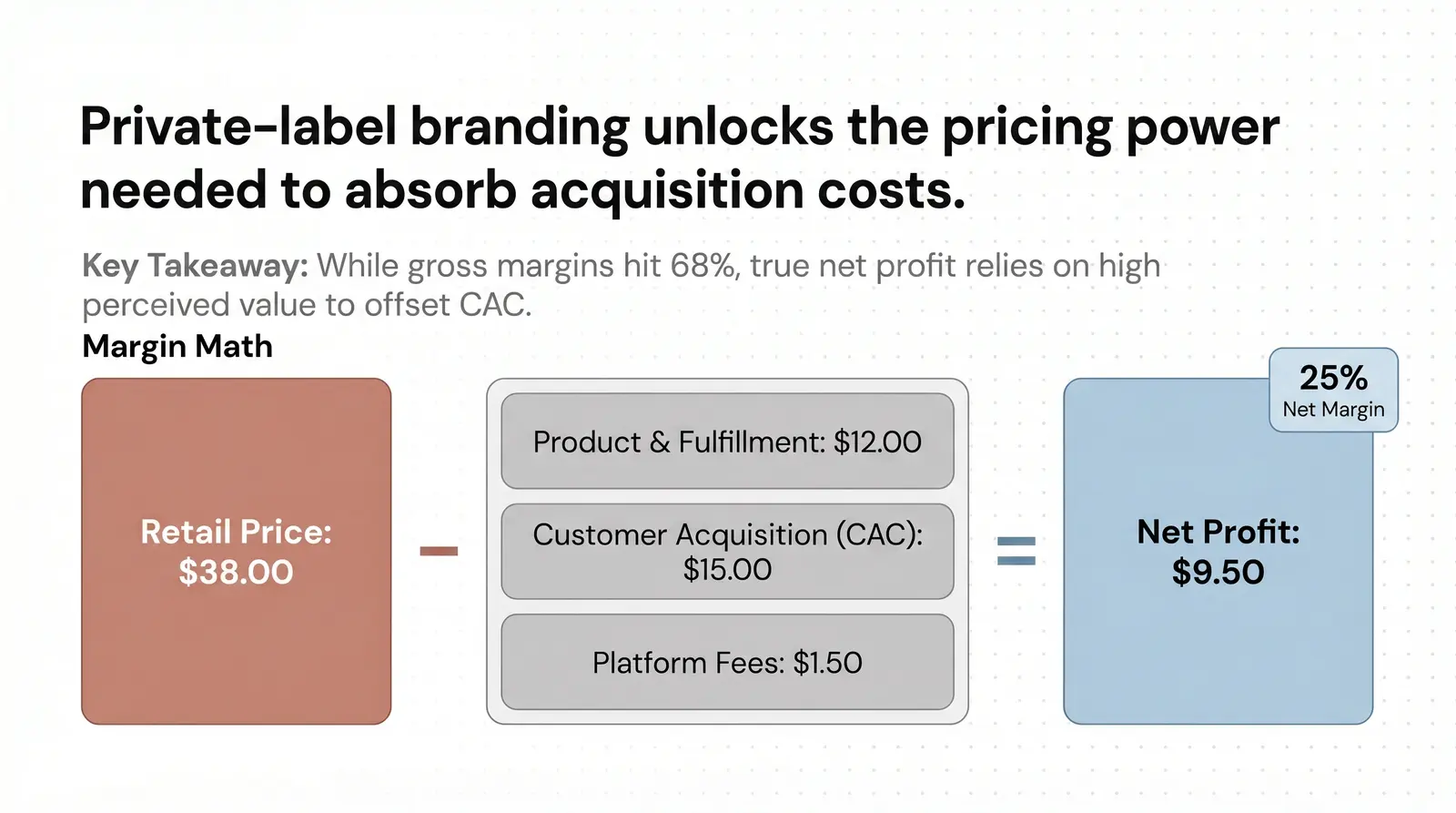
The allure of jewelry dropshipping often stems from the high gross margins, but understanding the full margin stack is crucial for profitability. Unlike general merchandise dropshipping (e.g., electronics or home goods), where margins might hover around 20-30%, jewelry allows for substantial markups due to its high perceived value.
Consider a worked example of a popular SKU: a layered gold-plated necklace.
| Cost Layer | Amount |
|---|---|
| Product Cost (Manufacturing) | $8.00 |
| Branvas Member Cost (sourcing, QA, blind fulfillment) | $12.00 |
| Retail Price (set by the brand) | $38.00 |
| Gross Margin | $26.00 (68%) |
However, this $26 is not pure profit. The net margin must account for customer acquisition costs (CAC), platform fees (Shopify, payment gateways), and potential returns. If the brand spends $15 to acquire a customer via Meta ads, and pays $1.50 in transaction fees, the net profit on that single sale is $9.50 (a 25% net margin).
The key to unlocking higher profitability lies in private-label branding and custom packaging, services provided by Branvas. A generic necklace might struggle to sell for $25, but that same necklace, presented with a strong brand identity and premium unboxing experience, can easily retail for $45 or more. This pricing power absorbs the CAC and significantly increases the net margin. Use the Branvas Profit Calculator to model your own margin stack before launching.

The data from 2026 paints a clear picture of a maturing, highly profitable industry for those who approach it strategically.
Outlook for 2027
Looking ahead, we anticipate the jewelry dropshipping market will be shaped by the maturation of AI-assisted product personalization, allowing brands to offer customized pieces at scale without holding inventory. Furthermore, consumer demand for sustainability and ethical sourcing will force dropshippers to be more transparent about their supply chains, favoring platforms that can guarantee quality and ethical manufacturing. Finally, cross-border ecommerce will continue to grow, enabling US-based brands to easily tap into emerging markets in Europe and Latin America.
Ready to launch your own jewelry brand in 2026? Branvas handles sourcing, branding, packaging, and blind fulfillment, so you can focus on selling. Start with Branvas today
Gross margins in jewelry dropshipping typically range from 45% to 80%, depending on the product and branding. However, after accounting for marketing, shipping, and platform fees, a realistic net profit margin for a well-run store is between 10% and 30%. Brands utilizing Branvas for private-labeling often achieve the higher end of this spectrum due to increased pricing power.
Based on Branvas platform data and industry trends, the top-performing categories include minimalist layered necklaces, waterproof/tarnish-free everyday hoops, personalized or initial pendants, and men's chains. Demi-fine jewelry (like gold vermeil) is also seeing rapid growth as consumers seek affordable luxury. You can explore these trending categories in the Branvas catalog.
The median time-to-first-sale for new Branvas member stores is 14 days. This timeline is heavily dependent on the brand's marketing strategy and existing audience. Creator-led brands or those with a highly targeted social commerce approach often see sales within the first few days, while stores relying on broad, unoptimized ads may take several weeks.
Yes, jewelry dropshipping remains highly profitable in 2026, but the model has evolved. Success is no longer found in selling generic, unbranded products. Profitability now relies on building a strong brand identity, utilizing high-quality imagery, and leveraging social commerce channels to create emotional connections with buyers, which justifies premium retail pricing.
Traditional dropshipping involves selling generic products supplied by a third party, often resulting in high competition and low margins. Private-label jewelry involves taking those same high-quality base products and applying your own branding, custom packaging, and unique aesthetic. Platforms like Branvas facilitate this transition, allowing founders to build distinct, high-margin brands without holding inventory.
[1] Jewelry Market Size, Share & Share | Industry Report, 2033 - Grand View Research, 2025
[2] Jewelry E-commerce Statistics and Market Size (2026) - Dojo Business, 2025
[3] Dropshipping Market Size, Share, Trends & Industry Report, 2031 - Mordor Intelligence, 2026
[4] Costume Jewelry Market Size, Share & 2031 Trends Report - Mordor Intelligence, 2026
[5] Global Demi-fine Jewelry Market Size, Share, Trends & Growth - Verified Market Research, 2026
[6] U.S. Men's Jewelry Market Size, Share & Growth Report - Polaris Market Research, 2025
[7] Bridal Jewelry Market Size, Share and Forecast - Stellar Market Research, 2025
[8] NRF Survey: Jewelry Tops Valentine's Day Spending for the 10th Straight Year - Mills Jewelers / NRF, 2026
[9] The Biggest Jewelry Marketing Trends and Insights - Brenton Way, 2026