


This guide explains ecommerce sales tax nexus types, 2026 economic nexus thresholds by state, marketplace facilitator laws, and dropshipping tax obligations to help online sellers stay compliant.
Published:
August 7, 2026
Author:
Yi Cui
A quiet liability most new sellers don't know they have.
Most new online sellers operate under a dangerous assumption: they believe they only owe sales tax in the state where they live or incorporated their business. For years, this was largely true. But in today's ecommerce landscape, this assumption is not just wrong—it is potentially one of the most costly mistakes a growing brand can make. The moment you launch your store, your products can reach customers in all 50 states, and with that reach comes a web of state-level tax obligations that can trigger silently as your sales grow.
This article breaks down exactly what you need to know about sales tax nexus in 2026. We will cover the different types of nexus, the current economic nexus thresholds for every state, how marketplace facilitator laws impact your liability, and the complex reality of dropshipping tax obligations. Whether you are running a private-label jewelry brand, a dropship store, or a multi-channel ecommerce empire, understanding where you actually owe tax is the first step to protecting your margins.
This article is for general informational purposes only and does not constitute legal or tax advice. Consult a qualified tax professional for guidance specific to your business.
In plain English, sales tax nexus is a sufficient connection between a seller and a state that triggers a legal obligation for the seller to collect and remit sales tax to that state [1]. If you have nexus in a state, you must register for a sales tax permit and charge sales tax to buyers located there. If you do not have nexus, you generally do not have to collect sales tax, and the burden falls on the buyer to pay use tax.
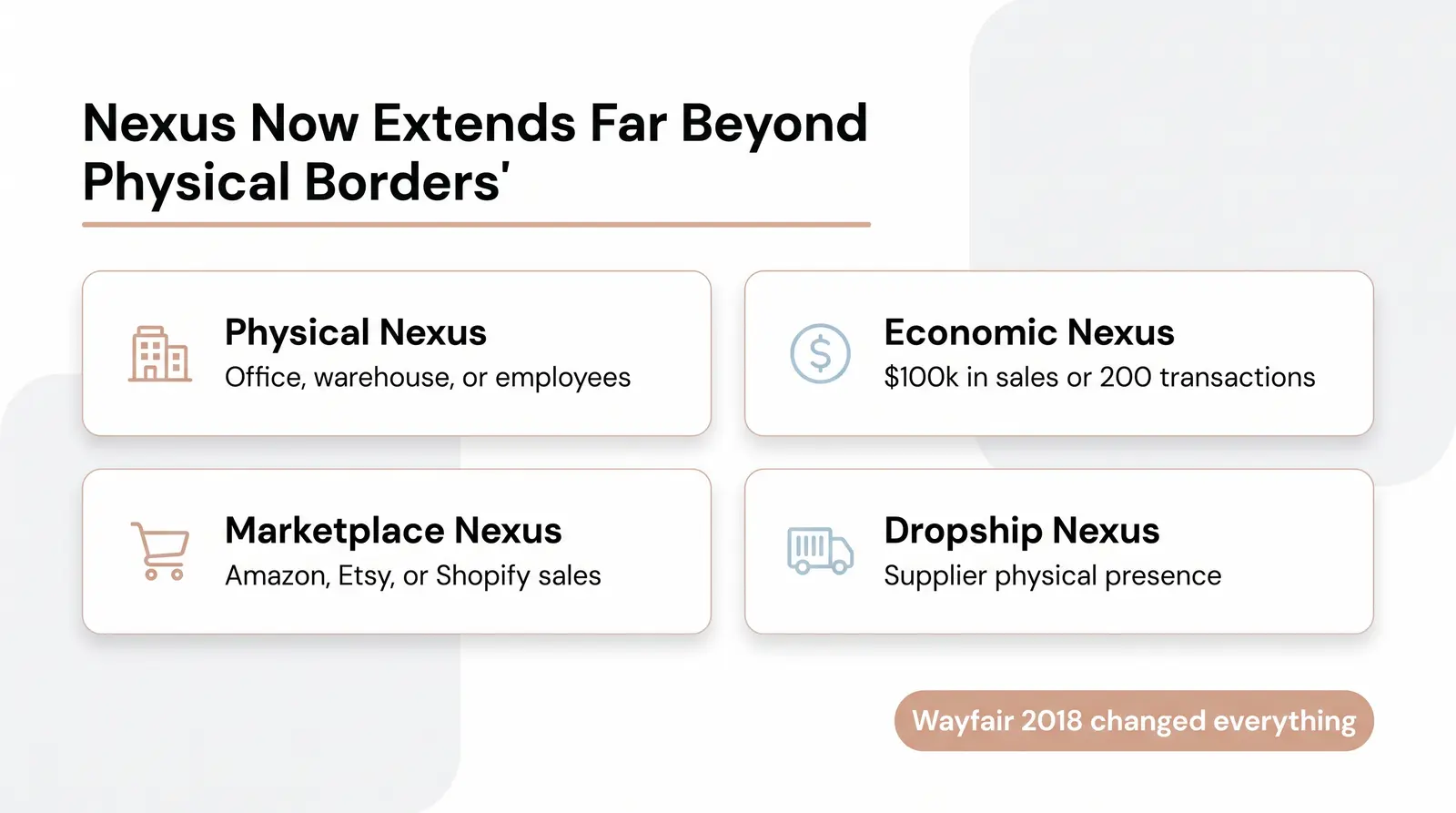
Historically, nexus was defined by physical presence. In the 1992 Supreme Court case Quill Corp. v. North Dakota, the Court ruled that a business had to have a physical presence—such as an office, warehouse, or employees—in a state to be required to collect sales tax [2]. This meant early ecommerce companies could sell nationwide without collecting tax in most states, giving them a significant price advantage over local brick-and-mortar retailers.
That all changed in 2018. In the landmark decision South Dakota v. Wayfair, Inc., the Supreme Court overturned the Quill physical presence rule [3]. The Court ruled that an "economic and virtual" presence is sufficient to create nexus, allowing states to require remote sellers to collect and remit sales tax based solely on their sales volume or transaction count into the state.
Today, there are several main types of nexus that can trigger tax obligations:
As of 2026, every U.S. state with a general sales tax has enacted economic nexus laws [4]. Only five states—Oregon, Montana, New Hampshire, Delaware, and Alaska (at the state level)—do not have a statewide sales tax, though Alaska allows local municipalities to enforce economic nexus through the Remote Seller Sales Tax Code [5].
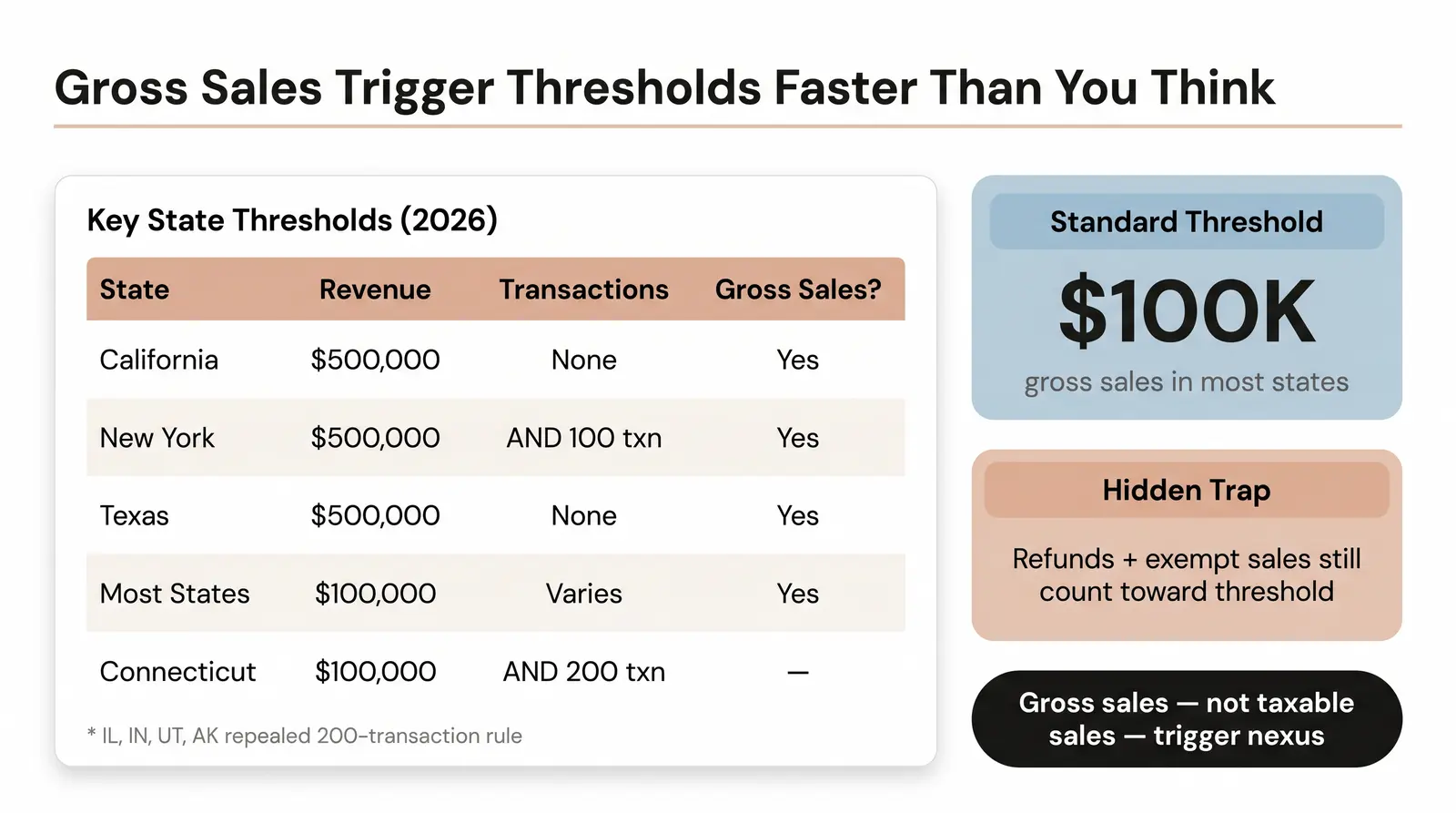
Most states use a standard threshold of $100,000 in sales or 200 transactions. However, a major trend in 2025 and 2026 has been the elimination of the transaction threshold. States like Alaska, Utah, Illinois, and Indiana have recently repealed their 200-transaction rules to prevent low-dollar, high-volume sellers from triggering nexus based on transaction count alone [6].
A crucial, non-obvious insight that catches many sellers off guard: Many states base their economic nexus calculations on gross sales, not taxable or net sales [7]. This means that every transaction into the state counts toward your threshold—including sales that were refunded, sales made through a marketplace that already collected the tax, and wholesale sales that are exempt from tax. You can easily cross a $100,000 gross sales threshold even if your actual taxable retail sales are much lower.
| State | Revenue Threshold | Transaction Threshold | Effective Date of Law | Notes |
|---|---|---|---|---|
| Alabama | $250,000 | None | Oct 1, 2018 | Marketplace sales excluded |
| Alaska | $100,000 | None (Repealed 2025) | Varies locally | Local jurisdictions only; gross sales |
| Arizona | $100,000 | None | Oct 1, 2019 | Marketplace sales excluded; gross sales |
| Arkansas | $100,000 | Or 200 transactions | Jul 1, 2019 | Marketplace sales excluded |
| California | $500,000 | None | Apr 1, 2019 | Marketplace sales included; gross sales |
| Colorado | $100,000 | None (Repealed 2019) | Dec 1, 2018 | Marketplace sales excluded |
| Connecticut | $100,000 | AND 200 transactions | Dec 1, 2018 | Must meet both; marketplace sales included |
| Delaware | No sales tax | N/A | N/A | No state sales tax |
| District of Columbia | $100,000 | Or 200 transactions | Jan 1, 2019 | Marketplace sales included |
| Florida | $100,000 | None | Jul 1, 2021 | Marketplace sales excluded |
| Georgia | $100,000 | Or 200 transactions | Jan 1, 2019 | Marketplace sales excluded |
| Hawaii | $100,000 | Or 200 transactions | Jul 1, 2018 | Marketplace sales included; gross sales |
| Idaho | $100,000 | None | Jun 1, 2019 | Marketplace sales included; gross sales |
| Illinois | $100,000 | None (Repealed 2026) | Oct 1, 2018 | Marketplace sales excluded |
| Indiana | $100,000 | None (Repealed 2024) | Oct 1, 2018 | Marketplace sales excluded; gross sales |
| Iowa | $100,000 | None (Repealed 2019) | Jan 1, 2019 | Marketplace sales included; gross sales |
| Kansas | $100,000 | None | Jul 1, 2021 | Marketplace sales included; gross sales |
| Kentucky | $100,000 | Or 200 transactions | Oct 1, 2018 | 200 txn rule repeals Aug 2026; gross sales |
| Louisiana | $100,000 | None (Repealed 2023) | Jan 1, 2019 | Marketplace sales excluded |
| Maine | $100,000 | None (Repealed 2022) | Jul 1, 2018 | Marketplace sales excluded; gross sales |
| Maryland | $100,000 | Or 200 transactions | Oct 1, 2018 | Marketplace sales included; gross sales |
| Massachusetts | $100,000 | None | Oct 1, 2019 | Marketplace sales excluded; gross sales |
| Michigan | $100,000 | Or 200 transactions | Oct 1, 2018 | Marketplace sales included; gross sales |
| Minnesota | $100,000 | Or 200 transactions | Oct 1, 2018 | Marketplace sales included |
| Mississippi | $250,000 | None | Sep 1, 2017 | Marketplace sales excluded; gross sales |
| Missouri | $100,000 | None | Jan 1, 2023 | Marketplace sales excluded; gross sales |
| Montana | No sales tax | N/A | N/A | No state sales tax |
| Nebraska | $100,000 | Or 200 transactions | Jan 1, 2019 | Marketplace sales included |
| Nevada | $100,000 | Or 200 transactions | Oct 1, 2018 | Marketplace sales included |
| New Hampshire | No sales tax | N/A | N/A | No state sales tax |
| New Jersey | $100,000 | Or 200 transactions | Nov 1, 2018 | Marketplace sales included; gross sales |
| New Mexico | $100,000 | None | Jul 1, 2019 | Marketplace sales excluded |
| New York | $500,000 | AND 100 transactions | Jun 21, 2018 | Must meet both; marketplace sales included |
| North Carolina | $100,000 | None (Repealed 2024) | Nov 1, 2018 | Marketplace sales included; gross sales |
| North Dakota | $100,000 | None | Oct 1, 2018 | Marketplace sales excluded |
| Ohio | $100,000 | Or 200 transactions | Aug 1, 2019 | Marketplace sales included |
| Oklahoma | $100,000 | None | Nov 1, 2019 | Marketplace sales excluded |
| Oregon | No sales tax | N/A | N/A | No state sales tax |
| Pennsylvania | $100,000 | None | Jul 1, 2019 | Marketplace sales excluded; gross sales |
| Rhode Island | $100,000 | Or 200 transactions | Jul 1, 2019 | Marketplace sales included; gross sales |
| South Carolina | $100,000 | None | Nov 1, 2018 | Marketplace sales included; gross sales |
| South Dakota | $100,000 | None | Nov 1, 2018 | Marketplace sales included; gross revenue |
| Tennessee | $100,000 | None | Oct 1, 2020 | Marketplace sales excluded |
| Texas | $500,000 | None | Oct 1, 2019 | Marketplace sales included; gross revenue |
| Utah | $100,000 | None (Repealed 2025) | Jan 1, 2019 | Marketplace sales excluded; gross sales |
| Vermont | $100,000 | Or 200 transactions | Jul 1, 2018 | Marketplace sales included; gross sales |
| Virginia | $100,000 | Or 200 transactions | Jul 1, 2019 | Marketplace sales excluded |
| Washington | $100,000 | None (Repealed 2019) | Oct 1, 2018 | Marketplace sales included; gross sales |
| West Virginia | $100,000 | Or 200 transactions | Jan 1, 2019 | Marketplace sales included; gross sales |
| Wisconsin | $100,000 | None (Repealed 2021) | Oct 1, 2018 | Marketplace sales included; gross sales |
| Wyoming | $100,000 | None (Repealed 2024) | Feb 1, 2019 | Marketplace sales excluded; gross sales |
(Data compiled from state revenue departments and Avalara [8].)
If you sell on platforms like Amazon, Etsy, eBay, or Walmart Marketplace, you are operating under marketplace facilitator laws. In all 45 states with a sales tax, these platforms are legally required to collect and remit sales tax on behalf of their third-party sellers [9].
Practically, this means that if you sell only through a qualifying marketplace, the platform handles the tax collection for those sales. However, there is a massive catch that traps many multi-channel sellers: your sales on that marketplace may still count toward your economic nexus threshold for your independent store.
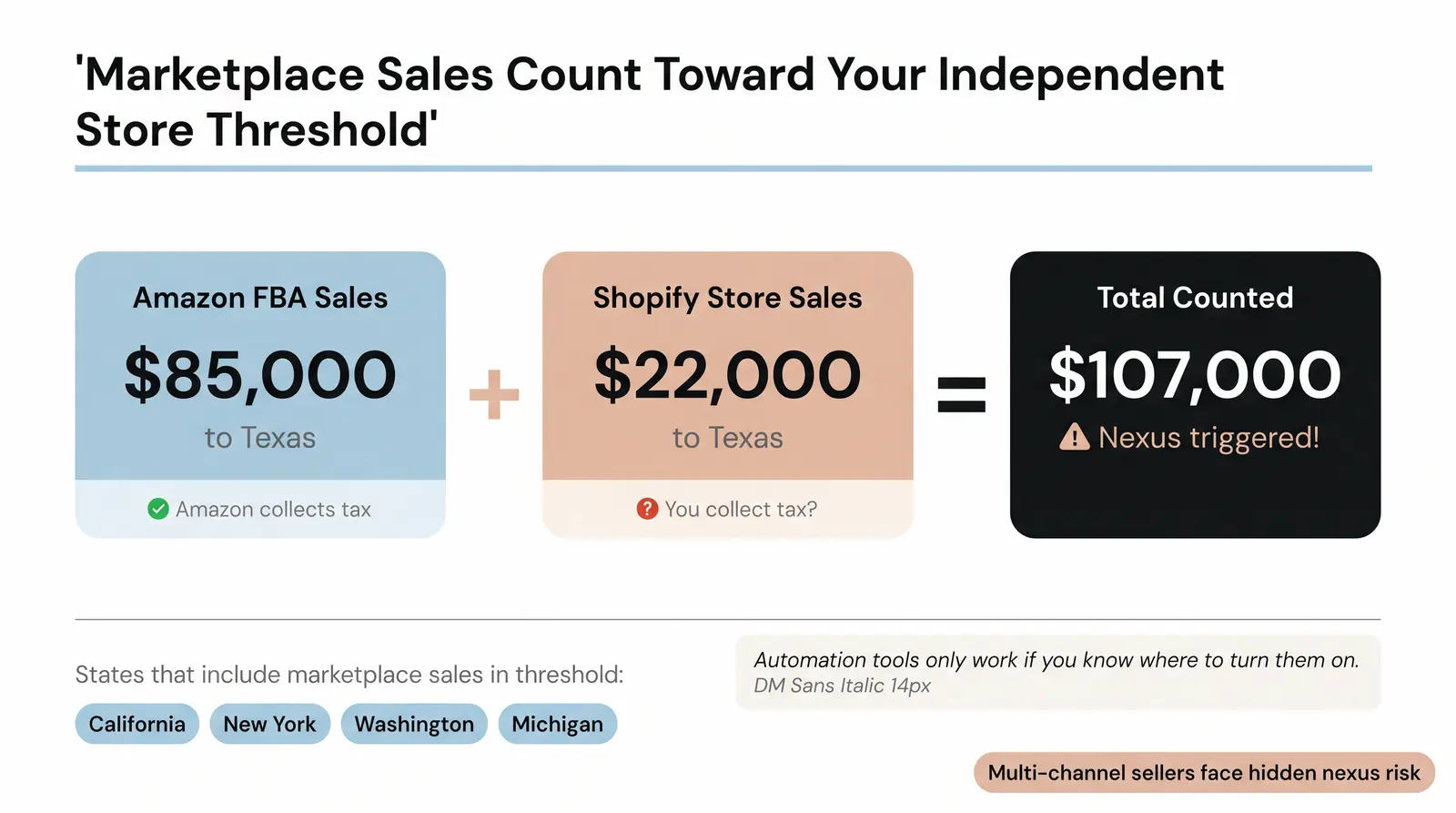
States like California, New York, Washington, and Michigan include marketplace sales when calculating your economic nexus threshold [10]. If you cross the threshold due to Amazon sales, you must register and collect sales tax on any sales made through your own website to customers in that state.
Worked Example: Maya sells handmade-style jewelry through Amazon FBA and her own Shopify storefront. In 2025, she generates $85,000 in Amazon sales to Texas customers and $22,000 from her own site to Texas customers. Amazon collects sales tax on its portion. But Texas counts all $107,000 toward Maya's economic nexus threshold—she has crossed the $100,000 mark and now owes collection obligations on her Shopify sales to Texas customers, even though Amazon handled its own portion.
Tools like Shopify Tax help automate collection at checkout, but they only work if you know where to turn them on. Automation software does not eliminate the need to understand your nexus footprint.
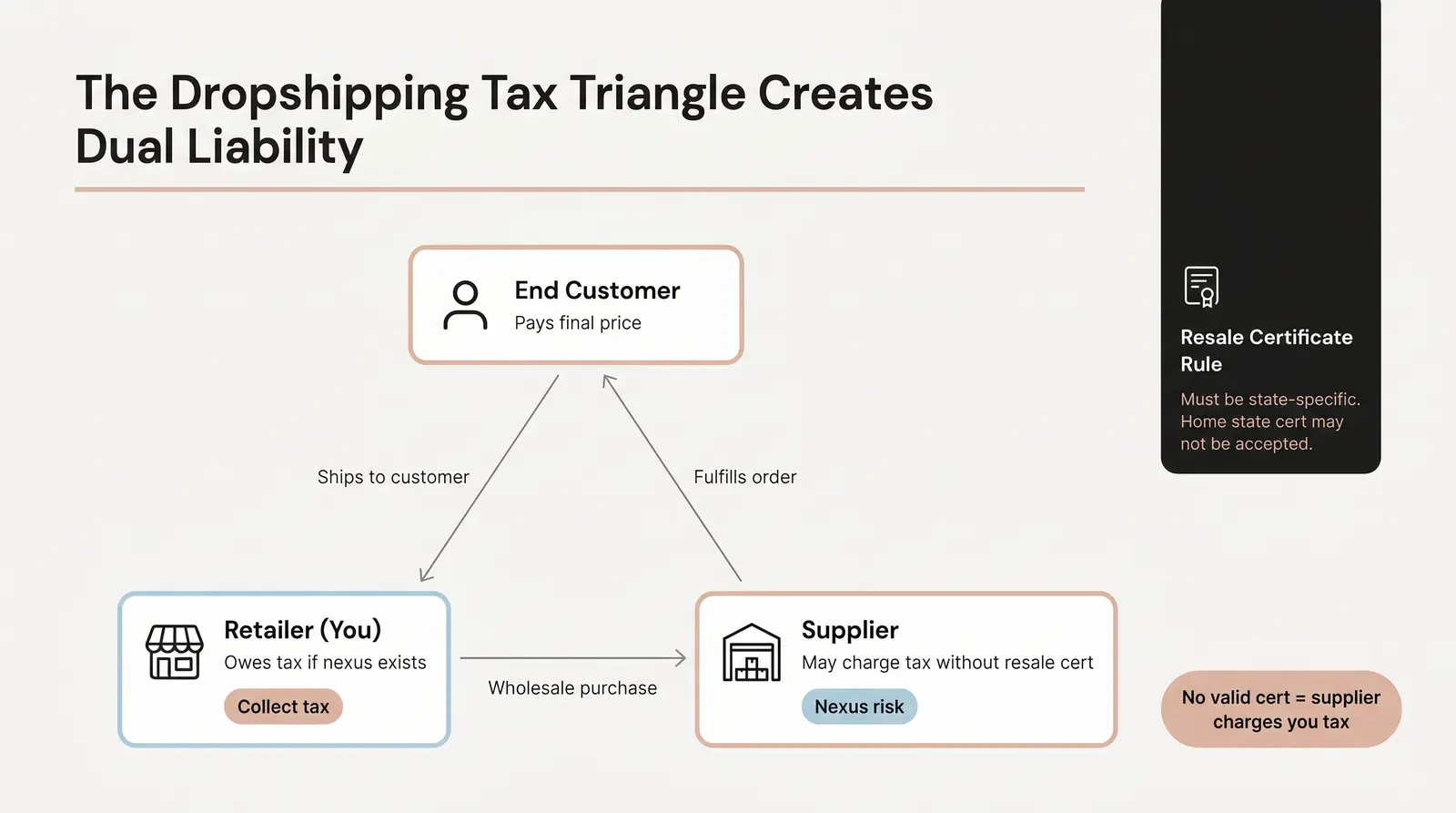
Dropshipping creates a unique tax scenario known as the dropshipping tax triangle. Three parties are involved: the end customer, the retailer (your brand), and the supplier (the dropshipper) [11]. Tax obligations can theoretically fall on both the retailer and the supplier, depending on who has nexus where.
The general rule is that the retailer (brand) is responsible for collecting sales tax from the end customer if the retailer has nexus in the customer's state.
However, the supplier also has exposure. If the supplier ships a product to a state where the supplier has nexus, the state expects sales tax to be paid. If the retailer does not provide a valid resale certificate, the supplier may be legally required to charge the retailer sales tax on the wholesale transaction [12].
Resale certificates are state-specific documents that prove you are buying goods for resale and should not pay tax on the wholesale purchase. A resale certificate from your home state may not be accepted by your supplier if they are shipping to a different state where they have nexus, particularly in strict states like California [13].
To navigate this, we use the Branvas Nexus Clarity Checklist™, a practical decision tool we use to help new sellers audit their exposure before launch:
The Branvas Nexus Clarity Checklist™
Use this before you make your first sale in any new state:
- Do you store inventory in this state? (Physical nexus — likely yes)
- Do you have employees, contractors, or a registered agent in this state? (Physical nexus)
- Have you crossed $100,000 in sales or 200 transactions in this state in the past 12 months? (Economic nexus — check state-specific threshold)
- Does your dropship supplier have nexus in this state? (Supplier tax exposure — request their nexus disclosure)
- Do you have a valid, state-specific resale certificate on file with your supplier for this state?
- Are you selling through a marketplace that qualifies as a marketplace facilitator in this state?
- Have you registered with the state's department of revenue (required before collecting tax)?
- Are you using automated tax software (TaxJar, Avalara, Vertex, or Shopify Tax) to calculate rates at checkout?
In our experience at Branvas, the most common gap we see in new private-label seller setups isn't the big states like California or New York—it's the surprise obligations in mid-size states like Pennsylvania, Michigan, or Colorado, where sellers crossed thresholds without realizing it.
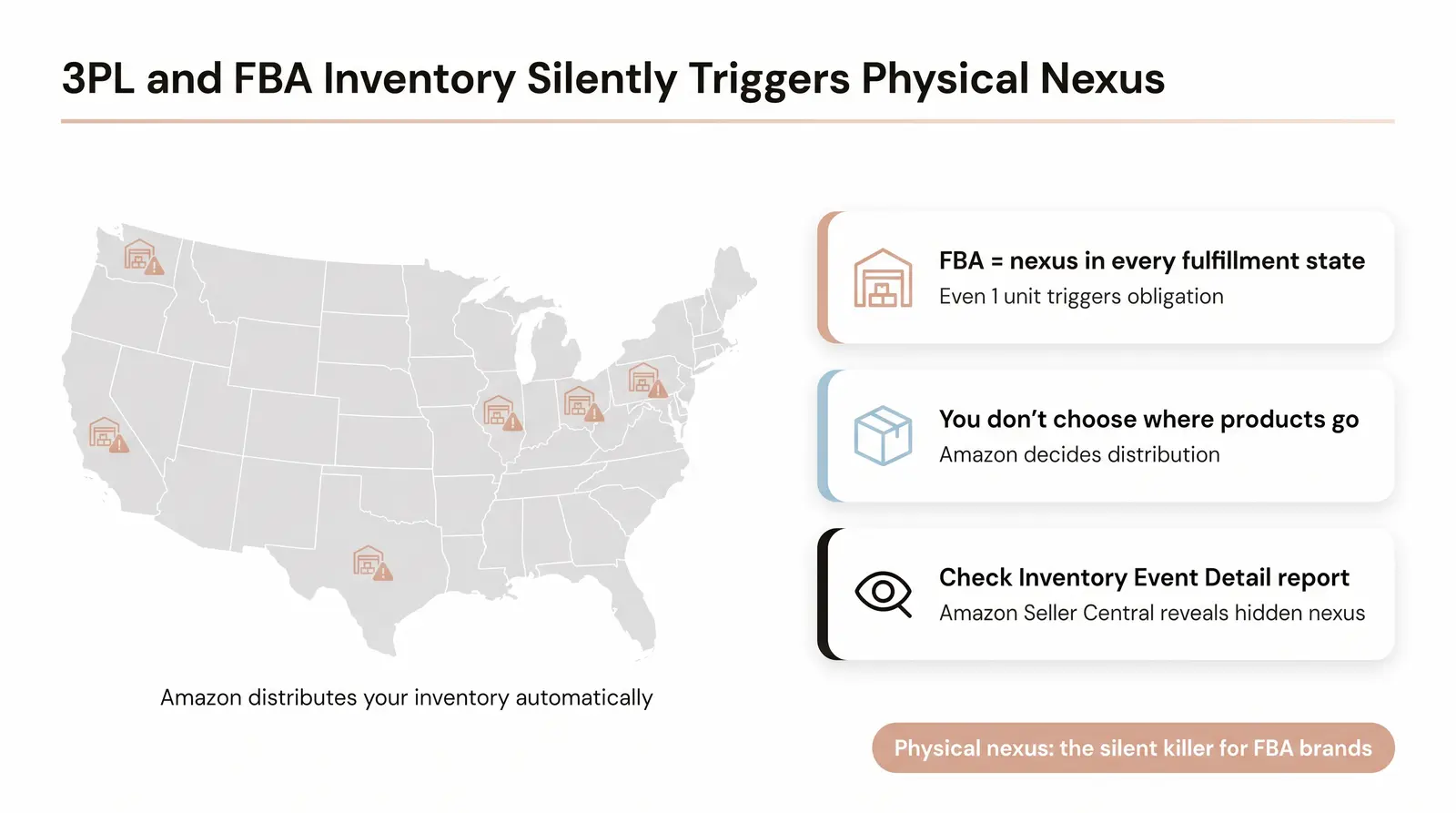
Economic nexus gets all the headlines, but physical nexus is the silent killer for ecommerce brands. Using 3PL (third-party logistics) warehouses or Fulfillment by Amazon (FBA) creates physical nexus in every state where your inventory is stored—even if it is just one unit [14].
Amazon automatically distributes your inventory across its nationwide network of fulfillment centers to ensure fast delivery. You do not choose where your products go, but you inherit the tax liability of wherever they land. Sellers can, and should, pull an Inventory Event Detail report in Amazon Seller Central to see exactly which states currently house their products.
A non-obvious insight for growing brands: sellers using private-label fulfillment partners who handle blind shipping may not always know which warehouse a package ships from. If your fulfillment partner routes your orders through a new facility in a new state, physical nexus may be created on day one. This is a critical operational consideration for sellers working with fulfillment-as-a-service providers.
If you're launching a private-label brand and want to understand how your fulfillment setup might affect tax exposure, Branvas's how-it-works page explains our fulfillment model so you can have an informed conversation with your tax advisor.
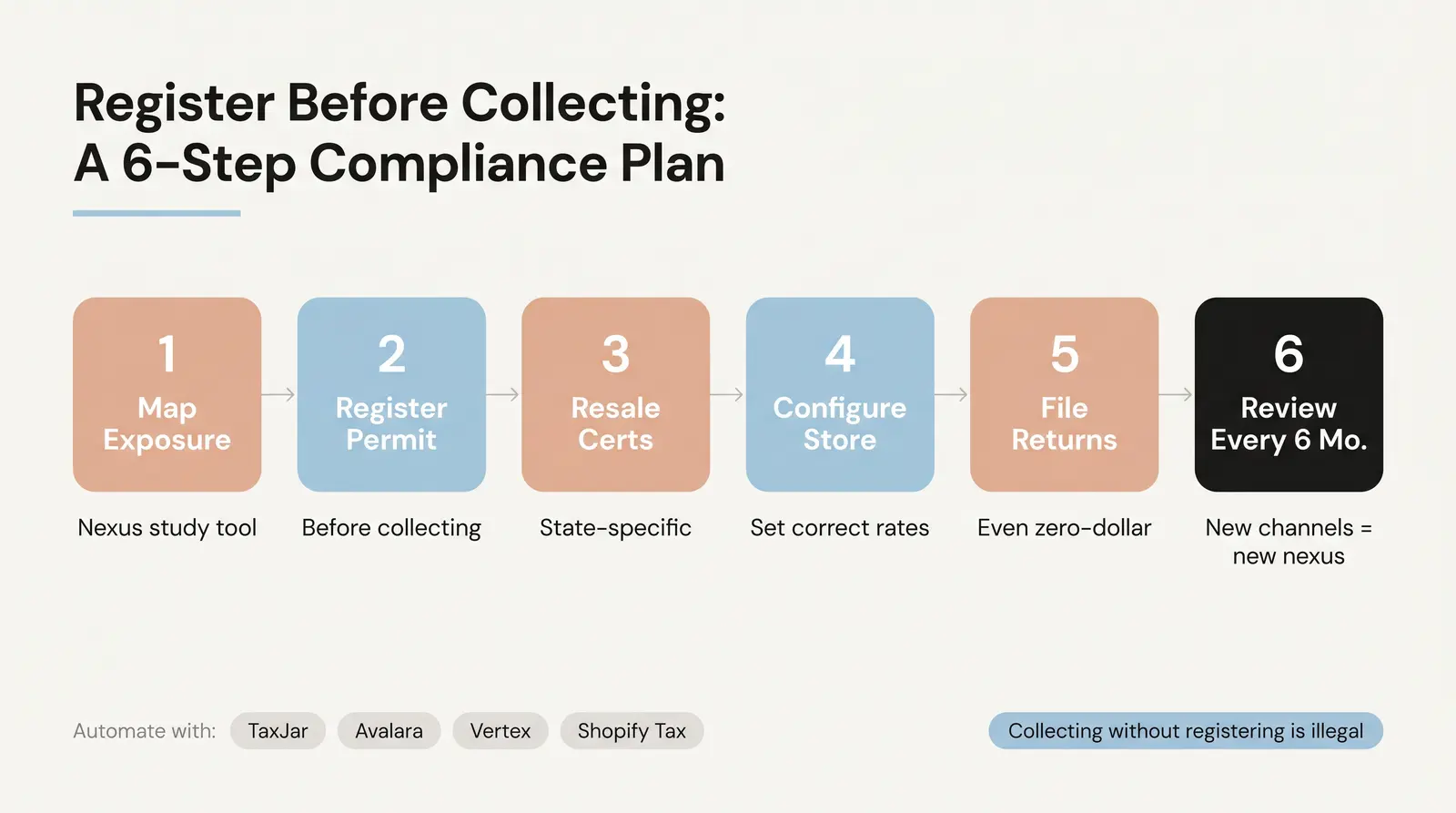
If you determine that you have nexus in a new state, do not panic, but do act deliberately. Follow this step-by-step plan:
Tools like TaxJar, Avalara, Vertex O Series, and Shopify Tax are widely used to automate the calculation and filing process, taking the manual burden off your plate.
Branvas sellers who are building or scaling a private-label jewelry brand can explore our fulfillment and brand setup process at branvas.com/how-it-works — and when you're ready to see what's possible, check our catalog or run your numbers with our profit calculator.
Yes, if you have nexus in the state where your customer is located. The fact that you never physically handle the inventory does not exempt you from economic nexus thresholds. If you cross a state's sales threshold, you must register and collect tax from buyers in that state.
You are liable for the uncollected tax out of your own pocket, plus potential penalties and interest. If your exposure is significant, you should speak with a tax professional about a Voluntary Disclosure Agreement (VDA), which allows you to come forward anonymously, pay back taxes, and often get penalties waived [15].
No. While marketplace facilitators collect tax on the sales made through their platforms, those sales often count toward your economic nexus thresholds. If you cross the threshold, you will be required to collect sales tax on any independent sales (like through your own Shopify store) made into that state.
Indirectly, yes. If your supplier has nexus in a state they are shipping to on your behalf, they are required to collect tax on the transaction. If you do not provide them with a valid resale certificate for that state, they will charge you sales tax on the wholesale price, eating into your profit margins.
You generally obtain a resale certificate by registering for a sales tax permit with a state's department of revenue. While some states accept out-of-state certificates or the multi-state uniform certificate, strict states (like California) often require you to register and use their specific state certificate to avoid paying tax to your supplier.