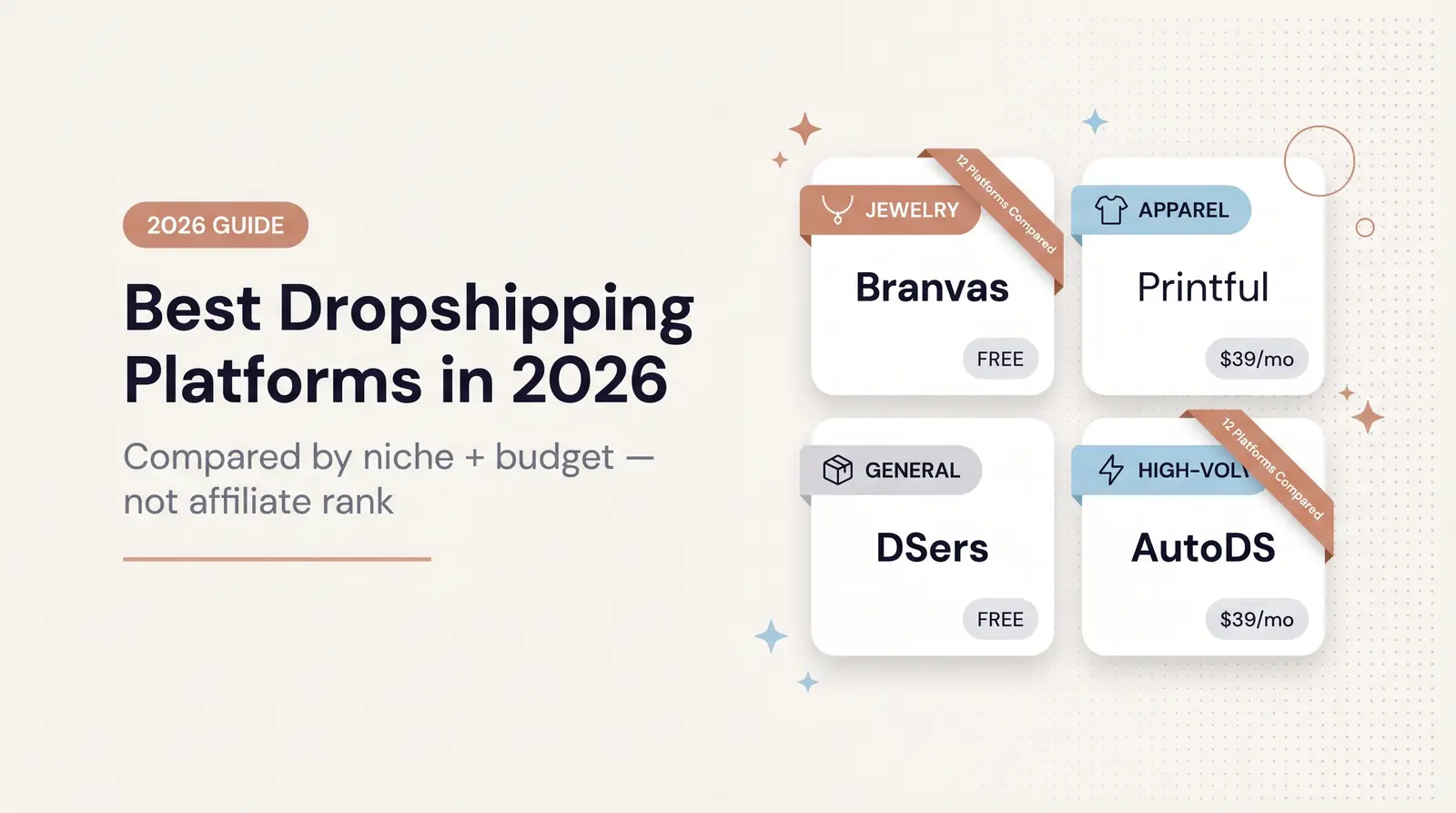



This honest guide walks through how to dropship on Shopify in 2026, covering store setup, niche selection, supplier vetting, pricing strategy, and common mistakes to avoid.
Published:
April 28, 2026
Author:
Yi Cui
Most Shopify dropshipping guides read like they were written by people who've never actually run a store. Here's the version with the unglamorous truth: what breaks, what works, and what niche actually gives you a chance in 2026.
Most dropshipping content is recycled theory from people who have never debugged a broken DSers sync at midnight or eaten a $400 ad loss on a product that "looked great on paper." The reality of dropshipping on Shopify today is far removed from the passive income fantasies of 2018. This guide is an honest, operational playbook for building a store that can realistically make money right now, starting today. In our experience at Branvas, the founders who succeed in dropshipping in 2026 are the ones who treat it like a brand business from day one, not a product arbitrage game.
Dropshipping is an ecommerce fulfillment model where you sell products without holding inventory. When a customer places an order on your Shopify store, you purchase the item from a third-party supplier who ships it directly to the buyer. You keep the difference between the retail price and the supplier cost.
The core mechanics remain the same, but the landscape has shifted dramatically in 2025 and 2026. The global dropshipping market is projected to reach $476 billion by 2026 [1], yet consumer expectations have evolved well beyond what the old playbook assumed. Post-COVID, buyers demand faster shipping times, transparent tracking, and premium unboxing experiences. The days of waiting four weeks for a generic ePacket delivery from AliExpress are over. Customer acquisition costs on platforms like Meta and Google have also risen sharply, squeezing margins for sellers who compete solely on price.
Here is the contrarian insight that most guides miss: the commoditization of "winning products" via TikTok viral cycles has made generic dropshipping harder, but it has simultaneously created a vacuum for branded, niche-specific stores that own an aesthetic. This is actually good news for new entrants who are willing to build a brand rather than chase SKUs. When a product goes viral, dozens of stores spin up overnight to sell the exact same item, driving ad costs up and margins down. A store with a distinct brand identity, curated catalog, and premium packaging can command higher prices and build customer loyalty that outlasts any single trend cycle.
To be clear, Shopify dropshipping is not a get-rich-quick scheme, nor is it passive income by default. It is a logistics and marketing business that requires active management. It is not dead. It has simply matured into a model that rewards brand builders over arbitrageurs.

Before diving into the setup, it is worth understanding the realities of the business model. The barrier to entry remains low, but the barrier to profitability has risen considerably.
| Factor | Generic Dropshipping | Branded/Niche Dropshipping |
|---|---|---|
| Startup cost | Low | Low to Medium |
| Margin potential | Low (5 to 15%) | Medium to High (30 to 60%+) |
| Brand differentiation | Minimal | Strong |
| Customer LTV | Low | Higher |
| Supplier dependency risk | High | Medium (with right partner) |
| Competitive moat | None | Building over time |
| Packaging/unboxing experience | Generic | Customizable |
The table above illustrates the stark contrast between the old way of dropshipping and the modern, brand-focused approach. Generic dropshipping offers the lowest possible startup costs, but it traps sellers in a race to the bottom on price, resulting in razor-thin margins. Branded dropshipping requires slightly more upfront effort to establish an identity and source quality suppliers, but it unlocks significantly higher margins and the potential for repeat customers who actually remember your store.

Building a successful store requires a methodical approach. Here is the operational walkthrough for setting up a Shopify dropshipping business in 2026.
1. Choose your niche. Select a specific category with strong margins and brand potential, rather than a random assortment of trending items. A full breakdown of niche selection follows in the next section.
2. Create your Shopify store. Start a Shopify trial and select the Basic plan at $29 per month (billed annually), which is sufficient for new stores. Choose a clean, professional theme. The free Dawn theme is excellent for jewelry, accessories, and general product stores. Create essential pages immediately: About Us, Shipping Policy, Refund Policy, and a Contact page. Transparency on these pages builds the trust that converts first-time visitors into buyers.
3. Choose and vet your supplier. Look beyond wholesale prices. Evaluate suppliers based on their shipping times to your target markets, return policies, and ability to provide blind or branded shipping. We often see founders skip the "sample your supplier" step to save $30, and then spend $300 managing angry customers over quality issues. Always order samples to verify product quality and shipping speed firsthand [2].
4. Install and configure your dropshipping app. Connect your store to a supplier network. DSers is the standard for AliExpress sourcing. Spocket and Zendrop offer faster US and EU shipping options. AutoDS provides robust multi-platform automation. For specific categories like jewelry, private-label solutions offer superior quality control and branding capabilities compared to general marketplaces.
5. Import and optimize your product listings. Never use the default supplier descriptions or titles. Write original, benefit-driven copy that speaks to your target audience. Optimize product titles for search intent, and use high-quality lifestyle imagery alongside standard product photos to help customers visualize owning the item.
6. Set your pricing. Do not guess your prices. Use this formula: Supplier Cost divided by (1 minus Target Margin %) equals Retail Price. For example, if a necklace costs $12 from your supplier and you want a 60% gross margin: $12 divided by 0.40 equals $30 retail price. Ensure this price leaves enough room to cover your marketing costs and Shopify fees.
7. Configure order routing and fulfillment. Set up your dropshipping app to automate order processing where possible. Understand how orders flow from Shopify to your supplier. Place a test order yourself before driving live traffic to ensure the fulfillment sync works correctly and tracking information updates as expected.
8. Set up payments and checkout. Enable Shopify Payments to accept major credit cards, Apple Pay, and Google Pay. Add PayPal as a secondary option, as many buyers prefer its buyer protection. Ensure your checkout process is seamless and mobile-optimized, since the majority of social traffic arrives on phones.
9. Install essential apps. Keep your app stack lean to maintain site speed. Essential additions include an email marketing tool such as Klaviyo or Shopify Email for capturing leads and abandoned cart recovery, a reviews app such as Loox or Judge.me for social proof, and a post-purchase upsell app to increase average order value.
10. Drive your first traffic. Begin with a focused strategy. For visual niches, organic TikTok and Instagram Reels offer high upside with low financial risk. If using paid social, start with small daily budgets of $10 to $20 to test creatives and audiences before scaling. Implement basic SEO on your product pages to build long-term organic traffic alongside paid efforts.

Selecting the right niche is the most consequential decision you will make. To evaluate opportunities objectively, we use the Branvas Niche Opportunity Scoring Matrix. This framework assesses categories across six critical dimensions to identify where new sellers have the highest probability of building a sustainable business. Each dimension is scored from 1 (weakest) to 5 (strongest), with Competition Level scored inversely, meaning a lower competition score is better.
| Niche | Market Size | Margin Potential | Social Shareability | Repeat Purchase | Brand Buildability | Competition Level (lower = better) | Total Score |
|---|---|---|---|---|---|---|---|
| General electronics accessories | 5 | 1 | 2 | 2 | 2 | 1 | 13 |
| Pet products | 4 | 3 | 4 | 4 | 3 | 2 | 20 |
| Fitness supplements | 4 | 3 | 3 | 5 | 4 | 1 | 20 |
| Print-on-demand apparel | 3 | 2 | 3 | 3 | 4 | 1 | 16 |
| Home decor | 5 | 3 | 4 | 2 | 4 | 2 | 20 |
| Jewelry and accessories | 5 | 5 | 5 | 4 | 5 | 3 | 27 |
Jewelry and accessories score highest overall, and the data supports this. The global jewelry market is projected to reach $408.64 billion in 2026, growing at a CAGR of 5.5% toward $578.45 billion by 2033 [3]. Online penetration reached approximately 25% of total global jewelry sales in 2025, and the global online jewelry market alone is projected at $85.7 billion in 2026, growing at a 13% CAGR [3]. This is not a niche in decline. It is a category in structural growth.
The margin structure is highly favorable. Jewelry offers low cost of goods sold combined with high perceived value, granting sellers strong pricing power. Markups of 50% to 75% are common across fashion and semi-fine jewelry segments, providing the necessary buffer to absorb rising customer acquisition costs [4]. This is a category where a $12 product can legitimately retail for $38 to $45 without the buyer feeling overcharged, because the perceived value is tied to aesthetics and emotion, not utility.
Jewelry is also inherently visual and highly shareable on social media. A well-shot unboxing video or a styling reel on TikTok can generate thousands of organic views at zero cost. The unboxing experience itself becomes content. Premium branded packaging does not just protect the product; it generates user-generated content and drives repeat purchases. Customers share it, and that sharing becomes free advertising.
The category also benefits from evergreen demand punctuated by strong gifting seasonality. Valentine's Day, Mother's Day, Christmas, and birthdays create predictable revenue spikes that a well-prepared store can plan around. And unlike fitness supplements or electronics, jewelry faces no FDA compliance requirements, no complex safety certifications, and no import restrictions that would complicate a new seller's operations.
This combination of high margins, social virality, brand buildability, and low regulatory friction is exactly why Branvas was built: to solve the hardest parts of jewelry dropshipping, specifically sourcing, branding, and blind fulfillment, in one centralized platform. For founders who want to explore what this looks like in practice, the ecommerce seller solutions page is a good starting point.
On the other side, exercise caution with niches that are heavily saturated or structurally fragile in 2026. General electronic gadgets suffer from low margins, high return rates due to quality inconsistency, and intense price competition from established players. Building a store entirely around a single viral TikTok trend is equally risky. When the trend fades, the business collapses with it. Heavily regulated categories like supplements and CBD add compliance complexity that is unnecessary for a new seller to take on.

The failure rate in dropshipping is notoriously high. Studies suggest only 10 to 20% of dropshipping stores ever achieve consistent profitability [5]. Most failures trace back to the same predictable errors.
Launching without a niche identity. At Branvas, we see this constantly: new sellers launch with 50 products and no clear customer in mind, then wonder why their conversion rate is 0.4%. A general store selling dog toys, phone cases, and cheap watches confuses buyers and makes targeted marketing impossible. Focus on a specific aesthetic or customer avatar and curate a cohesive catalog around that person.
Not sampling products before selling. Relying solely on supplier photos is a significant risk. If the product feels cheap or breaks easily, your refund rate will spike and your ad accounts may be flagged due to poor customer feedback. Always order samples to verify quality, packaging, and actual shipping times before spending money on ads.
Ignoring shipping time transparency. Trying to obscure 3-week shipping times will destroy your business through chargebacks and customer service volume. Be upfront about delivery estimates on your product pages and in your shipping policy. If your shipping takes longer than a week, compensate with exceptional product quality, proactive communication, and a strong brand experience.
Competing on price instead of brand. If your only competitive advantage is being the cheapest option, a larger competitor will eventually undercut you. Price wars erode margins and attract low-loyalty customers who will leave the moment they find a cheaper alternative. Compete on brand presentation, curated selection, premium packaging, and superior customer service instead.
Underestimating customer service load. Many dropshippers assume the business is entirely automated. In reality, handling inquiries about tracking updates, returns, and product details requires significant time, especially in the early months. Failing to respond promptly leads to negative reviews and lost trust. Implement a helpdesk tool early and create a comprehensive FAQ page to deflect common questions before they reach your inbox.
Ignoring post-purchase retention. Acquiring a new customer costs significantly more than retaining an existing one. Many dropshippers focus entirely on acquisition and neglect email flows, loyalty incentives, and re-engagement campaigns. A single post-purchase email sequence asking for a review and offering a discount on the next order can meaningfully improve your customer lifetime value.
Choosing a supplier based on price alone. The cheapest supplier is rarely the best supplier. Evaluate reliability, communication responsiveness, return handling, and packaging quality alongside unit costs. A supplier who goes silent when there is a fulfillment issue will cost you far more than the margin you saved.

Your supplier is your operational backbone. Choosing the right partner dictates your shipping speed, product quality, and customer satisfaction.
| Supplier/Platform | Best For | Shipping Times | Branded/Private Label? | Shopify Integration | Pricing Model |
|---|---|---|---|---|---|
| DSers (AliExpress) | Broad sourcing, beginners | 2 to 4 weeks (standard) | No | Yes (native) | Free tier available |
| Spocket | US/EU suppliers, fast shipping | 3 to 7 days (US/EU) | Limited (invoice branding only) | Yes | From $24/month |
| Zendrop | US-based products, auto-fulfillment | 5 to 8 days (US) | Yes (custom packaging add-on) | Yes | Free tier; Pro from $49/month |
| AutoDS | Multi-platform automation, product research | Varies by warehouse | Limited | Yes (and eBay, WooCommerce) | From $26.90/month |
| CJdropshipping | Wide product range, global warehouses | 7 to 15 days | Yes (custom packaging available) | Yes | Free (pay per order) |
| Branvas | Jewelry and accessories brands | Fast (US/global) | Yes: full private label | Yes (native Shopify app) | View pricing plans |
For general merchandise, platforms like Spocket and Zendrop offer meaningful upgrades over standard AliExpress sourcing by providing faster shipping and better quality control. AutoDS stands out for sellers who need multi-platform automation and robust product research tools. CJdropshipping is a solid choice for broad product variety with global warehouse access.
For jewelry specifically, generic supplier platforms often have quality consistency issues and limited branding capabilities. The packaging that arrives in a standard AliExpress shipment does not build a brand. Private-label solutions built explicitly for the category, like Branvas, solve this at the infrastructure level by providing premium branded packaging, hand-inspected products, and reliable fulfillment without requiring minimum order quantities.
If jewelry is the niche you're leaning toward, it's worth understanding what a purpose-built fulfillment partner looks like versus a general marketplace. Branvas's how it works page walks through exactly how private-label jewelry dropshipping works end to end, without the sourcing headaches.

To illustrate how these concepts apply in practice, here is a realistic launch scenario for a fictional founder named Maya.
Maya decides to launch a minimalist, gold-plated jewelry brand targeting millennial professionals aged 28 to 40. She chooses this niche because it aligns with her own aesthetic, offers strong margins, and has a clearly defined customer she can speak to directly. Rather than sourcing from AliExpress, she partners with Branvas to ensure every order arrives in premium branded packaging, elevating the perceived value of her store from day one.
She sets up her Shopify store using the free Dawn theme, keeping the design clean and editorial. Her first product is a simple layered pendant necklace. The supplier cost through Branvas is $14. Applying the pricing formula with a 65% target margin: $14 divided by 0.35 equals $40 retail price. She lists it as "Layered Gold Pendant Necklace, Tarnish-Resistant, Minimalist Everyday Jewelry" and writes a product description focused on its versatility for office wear and its durability.
For her initial traffic strategy, Maya avoids expensive Facebook ads. She orders two samples, films aesthetic unboxing videos and styling clips on her iPhone, and posts consistently to TikTok and Instagram Reels over four weeks.
Her first 30-day results are honest: four sales totaling $160 in revenue, with a net profit of approximately $56 after supplier costs. It is not a windfall. But it validates the concept and gives her real data. Her key lesson is that videos showing the jewelry being worn on camera perform significantly better than static product shots. Moving forward, she plans to double down on UGC-style content, introduce an abandoned cart email flow, and add two more products before the holiday gifting season.

1. How much does it cost to start dropshipping on Shopify?
Starting a lean Shopify dropshipping business in 2026 typically requires $200 to $600 for the first month. This covers the Basic Shopify plan ($39/month or $29/month billed annually), a custom domain ($16/year), product samples ($50 to $100), and a small initial budget for marketing or essential apps [2]. While the software costs are low, having a realistic budget for testing and sampling is critical. Founders who launch with zero testing budget tend to discover quality or shipping issues at the worst possible time: after a customer complains.
2. Do I need an LLC or business entity to dropship on Shopify?
You can start dropshipping as a sole proprietor without an LLC, which is how many beginners test their initial concepts. However, as your store begins generating consistent revenue, forming an LLC or equivalent business entity is highly recommended to protect your personal assets and simplify tax reporting. Business registration fees in the US typically range from $50 to $500 depending on your state, with varying annual fees. Always consult a local tax or legal professional regarding requirements in your jurisdiction.
3. How long does Shopify dropshipping shipping take, and will customers complain?
Shipping times depend entirely on your chosen supplier and their warehouse locations. Standard AliExpress shipping can take 2 to 4 weeks, which frequently leads to customer complaints and chargebacks in 2026, when buyers expect Amazon-like delivery windows. Partnering with suppliers who use US or EU warehouses, or specialized fulfillment services, can reduce shipping times to 3 to 8 days. Whatever your shipping timeline, communicate it clearly on your product pages and shipping policy page. Surprises are what cause complaints, not timelines.
4. Is dropshipping jewelry profitable in 2026?
Yes, jewelry remains one of the most profitable dropshipping niches due to its high gross margins, often 50% to 75%, and low shipping costs given the small size and weight of most pieces. Net profitability depends on your ability to build a trustworthy brand and manage customer acquisition costs. Stores that rely on generic presentation and AliExpress-quality packaging struggle to justify premium pricing. Stores that invest in branded packaging, aesthetic marketing, and a cohesive brand identity see significantly stronger returns and repeat purchase rates.
5. What's the difference between dropshipping and private-label dropshipping?
Standard dropshipping involves selling generic products shipped in unbranded supplier packaging directly to your customer. The customer has no idea they are buying from a brand; they are simply receiving a product in a plain box. Private-label dropshipping allows you to sell products under your own brand name, with custom packaging, branded inserts, and in some cases custom product designs. Private labeling creates a far stronger brand experience, justifies higher retail prices, and drives organic word-of-mouth through the unboxing moment. It typically requires partnering with a specialized fulfillment service rather than a general marketplace.
Shopify dropshipping in 2026 is not dead, but the generic, product-chasing version is on life support. The era of throwing up a basic store, importing random trending items, and relying on cheap social media traffic is over. The version of dropshipping that works today is niche-specific, brand-forward, and operationally tight. It requires treating the fulfillment model as a backend logistics solution while building a real brand on the front end.
Jewelry and accessories remain one of the most accessible, high-margin, and brand-buildable categories available to new entrants. The market is large and growing. The margins are strong. The social shareability is unmatched. And the barrier to entry for private-label jewelry has never been lower. By focusing on a specific aesthetic, prioritizing the unboxing experience, and partnering with reliable suppliers, founders can build sustainable businesses that outlast fleeting viral trends. Success in dropshipping on Shopify in 2026 requires patience, a focus on customer experience, and a willingness to do the unglamorous operational work that most guides skip over.
Ready to launch your jewelry brand without sourcing, packaging, or fulfillment headaches? Branvas is built for exactly this. See how it works or explore the product catalog to see what you can launch under your own brand today.