


A detailed 2026 cost breakdown reveals starting an online store realistically requires $2,000 to $10,000, covering platform fees, apps, branding, inventory, and marketing.
Published:
July 15, 2026
Author:
Yi Cui
The real startup cost isn't the platform fee — it's everything no one warns you about.
Ecommerce platforms have done an exceptional job marketing the dream of the low-cost startup. The narrative is always the same: pay a basic subscription fee of $29 to $39 a month, pick a free theme, and you are in business. This framing is technically true, but practically misleading. The platform fee is the least of a founder's financial concerns when launching a real, competitive brand in 2026.
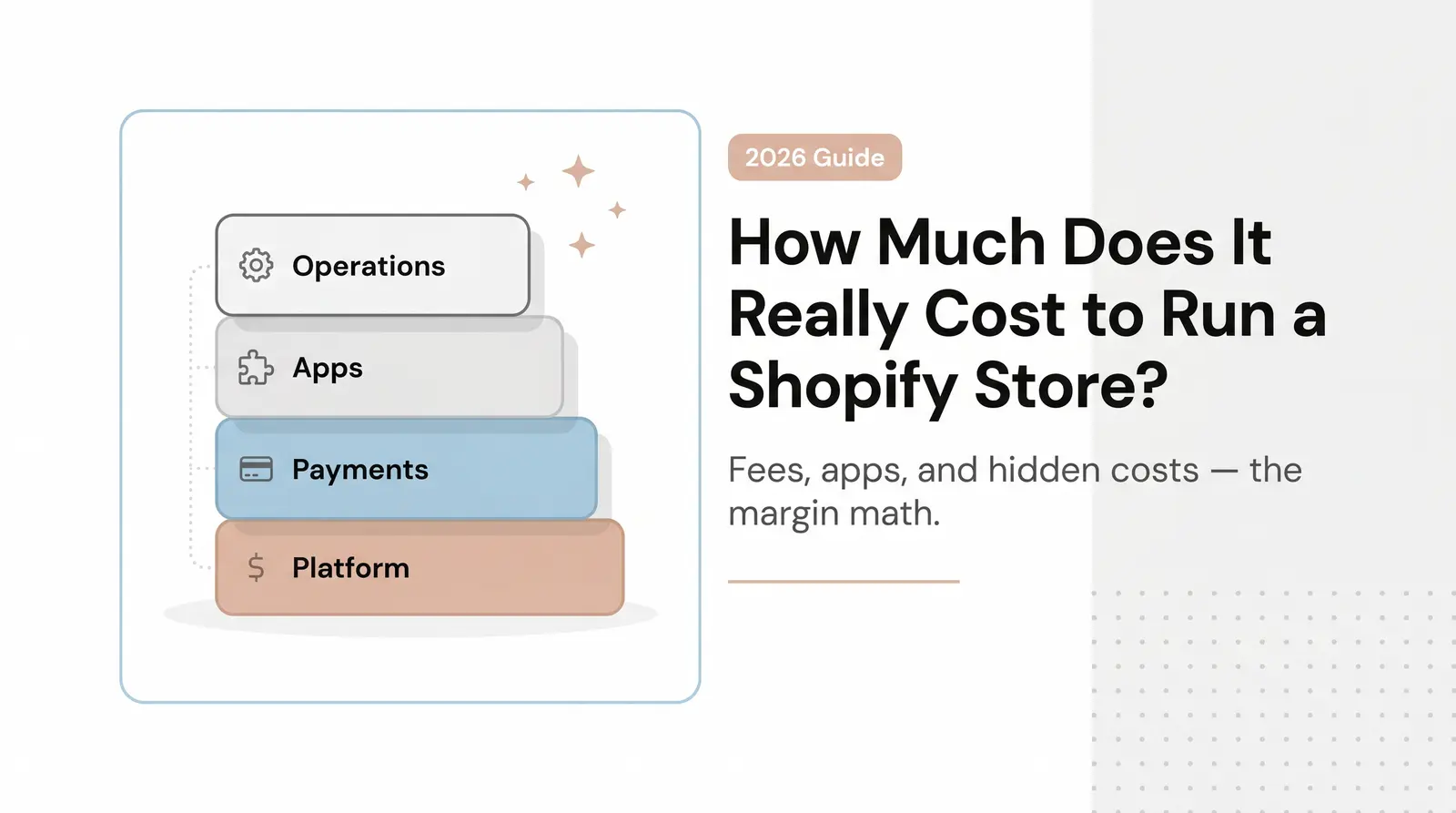
When you pay that base subscription, you are essentially renting four empty walls. You still need to buy the shelves, stock the products, install the cash register, and pay for the billboard outside. To actually run a store that converts traffic into sales, you need email marketing, review widgets, advanced analytics, and abandoned cart recovery. Suddenly, that $39 monthly fee balloons as you add six or seven essential apps, each charging their own monthly subscription.
More importantly, the platform fee ignores the cost of acquiring customers. In an era where customer acquisition costs (CAC) for ecommerce brands average around $70, the idea that you can launch a profitable store with just pocket change is a dangerous misconception. Founders who budget strictly for the software quickly find themselves with a functional website but zero traffic, zero sales, and no capital left to fix the problem.

To understand what it takes to launch, you have to look past the software subscriptions and map out the entire capital requirement for year one. The following matrix breaks down the realistic costs of launching a standard inventory-based or private-label ecommerce brand in 2026.
The Branvas Ecommerce Startup Cost Matrix (2026 Edition)
| Cost Category | Item | Low-End Estimate | Realistic Mid-Range | Notes |
|---|---|---|---|---|
| Platform & Tech | Ecommerce platform (e.g., Shopify Basic) | $39/mo | $105/mo | Transaction fees apply unless using native payments |
| Platform & Tech | Domain name | $15/yr | $20/yr | |
| Platform & Tech | Paid apps/plugins | $150/mo | $300/mo | Average Shopify merchant uses 6+ apps |
| Branding | Logo + brand identity | $100 | $500 | DIY vs. freelancer range |
| Branding | Product photography | $250 | $1,500 | Often skipped; hurts conversion |
| Inventory/Product | Initial inventory (if holding stock) | $500 | $3,000 | The biggest variable based on model |
| Inventory/Product | Samples/prototypes | $100 | $300 | |
| Packaging | Custom packaging (MOQ-based) | $300 | $1,000 | High MOQs often required |
| Marketing | Paid ads (first 90 days) | $1,500 | $3,000 | Google, Meta, TikTok ($50/day min to learn) |
| Marketing | Influencer/UGC content | $200 | $800 | |
| Marketing | Email platform | $20/mo | $50/mo | Scales with list size |
| Operations | Payment processing fees | 2.9% + 30¢ | 2.9% + 30¢ | Stripe, PayPal, Shop Pay |
| Operations | Returns + refunds buffer | $200 | $500 | Often ignored in planning |
| Legal | LLC formation | $50 | $300 | Varies by state |
| Legal | Trademark (optional early) | $0 | $350 | |
| TOTAL FIRST-YEAR ESTIMATE | $5,653 | $12,460 |
The most surprising line item for new founders is almost always the marketing budget. Paid ads cost more than all platform fees combined. To train the algorithms on Meta or TikTok in 2026, you generally need a minimum daily budget of $50 just to exit the learning phase. That means spending $1,500 a month before you even know if your ads are profitable.
Another massive blind spot is product photography. It has an outsized ROI impact, yet founders consistently skip it to save $300, relying instead on generic supplier photos or poor smartphone shots. In doing so, they lose thousands in potential conversion. A store with premium branding and professional photography can charge a higher margin and convert colder traffic, making that initial $500 to $1,500 investment one of the highest leverage spends on the matrix.

1. Over-investing in inventory before validating demand.
The fastest way to kill an ecommerce business is tying up all your liquid capital in boxes of product that sit in a garage. Founders often buy large quantities to secure a lower cost-per-unit, only to realize they picked the wrong color, size, or product entirely. In our experience at Branvas, the founders who burn through their budget fastest are usually the ones who buy inventory before they've made a single sale.
2. Over-spending on custom web design too early.
It is tempting to hire an agency for $5,000 to build a custom storefront, but a premium pre-built theme for $250 will convert just as well for a new brand. Until you have consistent traffic and a proven product-market fit, custom development is an ego metric, not a business requirement.
3. Paying for apps they don't need in month one.
Founders often install loyalty programs, advanced analytics, and complex upsell funnels before they have any customers to analyze or reward. Stick to the absolute basics—email capture and reviews—until your transaction volume justifies the monthly cost of additional software.
4. Underpricing and running out of margin.
Many new sellers try to compete on price, ignoring the fact that they have to pay for shipping, packaging, transaction fees, and customer acquisition. If your gross margin isn't at least 50% to 60%, you will likely lose money on every sale once marketing costs are factored in.

Your choice of business model is the single biggest lever you have for controlling startup costs. It dictates whether your capital goes toward physical goods, marketing, or software.
Ecommerce Model Startup Cost Comparison (2026)
| Model | Upfront Capital Needed | Inventory Risk | Brand Control | Margin Potential | Best For |
|---|---|---|---|---|---|
| Dropshipping | $ (Very Low) | None | Low | Low–Medium | Testing, beginners |
| Print-on-Demand | $ (Very Low) | None | Medium | Low | Creators, designers |
| Inventory-Based (Wholesale) | $$$ (High) | High | High | High | Experienced operators |
| Private-Label + Fulfillment-as-a-Service (e.g., Branvas) | $$ (Low–Medium) | Very Low | High | Medium–High | Influencers, brand builders |
Dropshipping and print-on-demand are excellent for testing concepts with minimal risk, but they severely limit your ability to build a recognizable brand or control the unboxing experience. Traditional inventory models give you total control and the best unit economics, but require thousands of dollars upfront and carry the existential risk of unsold stock.
Private-label fulfillment services occupy a compelling middle ground. Founders get real brand identity and quality product control without holding inventory or managing logistics. You can launch a cohesive, premium brand while keeping your capital liquid to deploy into marketing. If you're launching a jewelry or accessories brand, it's worth exploring how Branvas works before committing capital to inventory.

To help founders allocate their limited resources effectively, we use a proprietary decision model called the Branvas Capital Stack™. It treats startup capital as a sequence of layers, ensuring you fund the essentials before spending on variables.
The Branvas Capital Stack™ — A Founder's Framework for Ecommerce Budget Allocation
Stage 1 — The Non-Negotiables (Platform, Domain, Payment Processing)
What you must spend before you can sell anything. Aim to minimize this layer. Stick to basic platform tiers, standard domains, and native payment processors.
Stage 2 — The Brand Foundation (Logo, Photography, Packaging)
What separates a real brand from a generic store. Where to invest early, and what to DIY. Spend on professional product photography; DIY your initial logo using tools like Canva.
Stage 3 — The Demand Engine (First 90-Day Marketing Budget)
The stage most founders underfund. This is where budget allocation matters most. You need enough runway to test creatives and find a profitable acquisition channel without panicking after the first week.
Stage 4 — The Inventory/Product Layer
The variable that changes everything. Choosing a fulfillment-as-a-service model compresses this layer dramatically, allowing you to shift funds back into Stage 3.
A Worked Example: Maya's Launch
Consider Maya, a 28-year-old lifestyle creator launching a jewelry brand with a $3,000 starting budget. Using the Branvas Capital Stack, she avoids the trap of buying $2,000 worth of wholesale inventory.
Instead, she allocates her budget strategically:
By compressing her inventory costs to zero, Maya ensures she has the marketing runway required to actually generate sales.

The absolute minimum viable budget to launch a real online store in 2026 is between $500 and $1,000.
While you will see YouTube videos promising "$0 store launches," those rarely result in sustainable businesses. A "real" store means something with a functioning checkout, a custom domain, a branded presence, and a product someone would actually buy.
If you bootstrap entirely, you will spend roughly $50 on a domain and initial platform fees, $100 on LLC formation, $150 on product samples to photograph yourself, and you must reserve at least $200 to $500 for initial marketing experiments or micro-influencer seeding. Below this $500 floor, you are forced to use generic domains and unbranded products, which destroys consumer trust and plummets your conversion rate, making it nearly impossible to compete against established brands.

Models like Branvas's Brand-as-a-Service compress startup costs by eliminating the traditional barriers to entry: inventory purchase, warehousing, and fulfillment setup.
When you use a fulfillment-as-a-service model, the economics work differently. You don't pay for the product until a customer places an order. There are no high minimum order quantities (MOQs) to hit, meaning your cash isn't trapped in a warehouse. Furthermore, Branvas handles blind shipping under your brand name, and branding and packaging are handled centrally.
This shifts your business from a capital-intensive inventory model to a lean, marketing-focused operation. You can offer a premium, private-label catalog of jewelry and accessories without the traditional financial risk.
Ready to see what launching a jewelry brand actually costs with Branvas? Explore the Profit Calculator → or view the full catalog.

Q1: How much does it cost to start an online store in 2026?
The realistic total startup cost ranges from $2,000 to $10,000. This covers platform fees, essential apps, legal setup, professional photography, and the crucial first 90 days of marketing spend.
Q2: What is the minimum budget needed to start an ecommerce business?
For lean, bootstrapped founders using a dropshipping or fulfillment-as-a-service model, you need an absolute minimum of $500 to $1,000 to cover your domain, basic platform fees, samples, and initial marketing tests.
Q3: Is dropshipping actually cheap to start?
Yes, dropshipping has lower upfront costs because you don't buy inventory. However, you still need a substantial marketing budget to acquire customers, and the thin profit margins make it difficult to scale profitably without high volume.
Q4: What are the hidden costs of running an online store most people miss?
The most common hidden costs are third-party app subscriptions (which can add hundreds per month), payment processing fees (typically 2.9% + 30¢ per transaction), return buffers, and the high cost of paid customer acquisition.
Q5: How does a private-label fulfillment model reduce startup costs?
It eliminates the need to purchase inventory upfront or meet high minimum order quantities. With platforms like Branvas, the product is only paid for when a customer buys it, and fulfillment is handled for you, keeping your startup capital liquid.