


A 15-point checklist to evaluate brand-ready jewelry suppliers for EU fulfillment, covering packaging, blind shipping, compliance, and returns.
Published:
March 8, 2026
Author:
Yi Cui
Stop gambling on random suppliers. Use this checklist to find brand-ready jewelry fulfillment that protects your brand in the European Union.
This article is for jewelry entrepreneurs, influencers, and Shopify sellers who want to ship branded jewelry to EU customers. You will learn what "brand-ready" means in the EU context, the most common supplier pitfalls to avoid, a concrete 15-point evaluation checklist, what to know about EU shipping and returns, and a clear path to your first branded order.
"Brand-ready" is not a quality grade. It is a capability standard. A supplier can produce beautiful jewelry and still be completely unfit to represent your brand in the EU market. Your customers never interact with your supplier directly. They interact with your packaging, your shipping label, and the experience of opening a parcel. If any of those touchpoints expose the supplier behind the curtain, your brand takes the hit.
A brand-ready supplier meets a specific set of operational criteria: custom packaging that carries your logo and brand identity, white-label and blind shipping so every parcel shows your return address with no supplier identification, consistent SKU availability, scalable MOQs that work at 10 units and at 500, and brand-safe communication with no pricing sheets or promotional materials in any customer parcel.
Generic dropship suppliers fulfill orders. Brand-ready suppliers fulfill your brand. A generic supplier ships in a plain poly mailer with their warehouse return address. A brand-ready supplier ships in your custom jewelry box, with a branded insert card, from a return address that reads as your business. For EU customers, who have high expectations around unboxing, that gap is not cosmetic. It directly affects whether they trust you enough to buy again.
The EU jewelry market was valued at approximately USD 37 billion in 2024 and is projected to grow steadily through 2033 [1]. Cross-border e-commerce in Europe reached 275.6 billion euros in 2024, a 16% increase year-on-year [2]. Selling into this market is a real opportunity, but only if your fulfillment matches the brand experience your customers expect.

Most sellers who come to Branvas after a failed supplier relationship share a recognizable pattern: the supplier looked fine on paper, samples were acceptable, and the first order shipped without major issues. Then something broke. In our experience at Branvas, the failure almost always traces back to one of these pitfalls.
High or rigid MOQs. A supplier who requires 200 units per SKU before adding your logo to packaging is not designed for the way modern jewelry brands launch. You need to test products, validate demand, and iterate. Locking up capital in large minimum orders before you know what sells kills cash flow and limits your ability to pivot. The brand consequence: dead stock while your audience moves on.
Product inconsistency across batches. A necklace that looks one way in your first sample and slightly different in your third reorder is a customer service problem waiting to happen. Inconsistent plating thickness, varying chain lengths, or different clasp quality across batches generate returns, negative reviews, and eroded trust. Batch inconsistency is a brand-reputation risk, not just an operational inconvenience.
Unbranded or competitor-branded packaging. A customer opens a parcel and finds a generic brown box, a supplier's own branded tissue paper, or a packing slip with another company's wholesale pricing. That single moment can undo months of brand-building. In our experience at Branvas, this is the pitfall sellers underestimate most, because suppliers often promise branded packaging but default to generic fulfillment unless the process is explicitly enforced at every order.
Unreliable tracking and fulfillment SLAs. EU customers expect tracking updates. A supplier who ships via untracked economy mail creates a customer service burden that falls entirely on you. Delayed parcels with no tracking create support tickets, chargebacks, and one-star reviews.
Poor returns handling. A supplier who cannot process exchanges cleanly, or who sends replacement items in unbranded packaging, creates a second brand-damaging touchpoint at the exact moment a customer is already unhappy.

Use this framework before committing to any supplier relationship. A supplier who cannot clearly answer these questions in writing is not ready to represent your brand.
Scoring heuristic: If a supplier checks fewer than 8 of these 15 criteria, consider it a red flag before committing to a first order. A supplier who cannot meet the majority of these standards will cost you more in brand repair than they save on unit economics.

This section provides general operational context only and is not legal or tax advice. Always consult a qualified professional for compliance requirements specific to your business.
Shipping jewelry to EU customers involves more than choosing a carrier. Documentation, tax, and labeling considerations all affect whether your parcels clear customs smoothly and whether customers receive a compliant, professional package.
Customs documentation. Every international parcel entering the EU requires a commercial invoice that accurately describes the contents, their value, and their country of origin. Jewelry falls under HS codes 7113 (articles of jewelry of precious metal) and 7117 (imitation jewelry), depending on materials [4]. Misclassification can cause delays, additional duties, or seizure at customs. Your supplier should be able to confirm the correct HS code for each product they ship.
VAT and IOSS awareness. Since July 2021, the EU's Import One Stop Shop (IOSS) scheme allows sellers to collect and remit VAT on goods valued at 150 euros or less at the point of sale [5]. Without IOSS registration, your customers may face unexpected VAT charges at delivery, creating friction and increasing return rates. Verify your obligations with a qualified tax professional.
Labeling expectations. The GPSR requires that products include your business name and contact information on the product or its packaging [3]. If your jewelry contains small parts or materials that present safety concerns, appropriate warnings are required. Accurate material descriptions on listings and packaging are expected across the EU.
EU consumer return expectations. EU consumers have a statutory right of withdrawal for online purchases, giving them the ability to cancel and return most online orders within 14 days of delivery without providing a reason [6]. Your returns process needs to be clearly communicated and easy to initiate. A supplier who cannot process returns cleanly is a liability in this market.
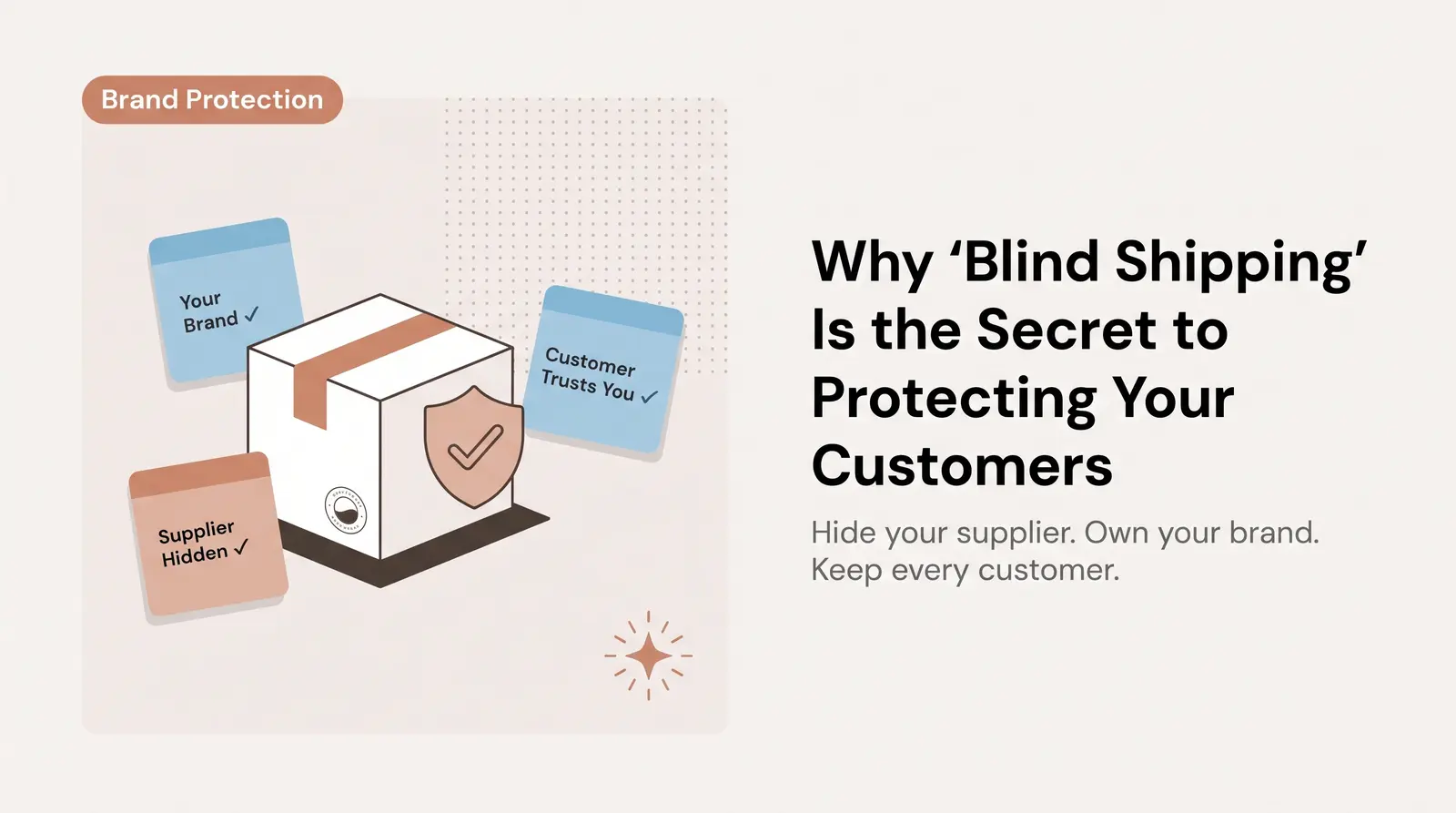
Blind shipping means the parcel your customer receives shows no trace of the supplier who fulfilled it. The shipping label displays your brand name and return address, with no supplier invoices, no third-party inserts, and no branded packaging from anyone other than you.
A package that reveals your supply chain is a brand credibility problem. It also creates a practical risk: a customer who can identify your supplier can bypass you entirely on future purchases. When evaluating a supplier's blind shipping capability, confirm that their return address configuration is fully under your control, verify that their packing process explicitly excludes any supplier documentation, and test it by placing a sample order to your own address before trusting the process with customers.

Getting from idea to first EU order does not have to be a six-month project. Here is a practical sequence for most early-stage jewelry brands.
Step 1: Define your brand identity and niche. Know who you are selling to and what your brand stands for before you evaluate a single supplier. Your niche determines your product range, your packaging aesthetic, and the supplier type you need.
Step 2: Identify your core SKU range. Start with 5 to 10 SKUs. A tight range is easier to source consistently and easier to market.
Step 3: Evaluate and shortlist suppliers using the checklist above. Any supplier who cannot answer the majority of those criteria clearly and in writing should be removed from your shortlist. Review Branvas's catalog and pricing as a benchmark for what brand-ready fulfillment looks like in practice.
Step 4: Request samples. Order samples shipped to your address as if you were a customer. Inspect the packaging, product quality, and unboxing. If anything feels off at the sample stage, it will be worse at scale.
Step 5: Configure your packaging and unboxing experience. Finalize your branded packaging: box or pouch, insert card, and tissue paper. Confirm the blind shipping setup is correct before any customer-facing orders.
Step 6: Set up your Shopify store and fulfillment workflow. Test the order flow end-to-end. Confirm your VAT and IOSS setup with your accountant.
Step 7: Place a pilot order. Run a small pilot before opening to full traffic. Fix any issues before scaling.
If you would rather skip the supplier vetting entirely, Branvas's Brand-as-a-Service model handles sourcing, branding, and blind fulfillment for you. Explore how it works at branvas.com/how-it-works.
For influencers and creators building a product line, see Branvas's influencer solutions. For ecommerce store owners, the ecommerce and boutique solution is a better starting point. Use the profit calculator to model your margins before committing to a product range.
Ready to launch your jewelry brand in the EU without the sourcing headaches? Start with Branvas at branvas.com/how-it-works.

A: Blind shipping is a fulfillment method where every parcel shows only your brand name and return address, with no trace of the supplier who packed and shipped it. For jewelry brands, this protects customer relationships, prevents supplier poaching, and ensures a consistent branded experience. It requires explicit configuration with your supplier and should be tested with a sample order before going live.
A: MOQ requirements vary significantly by supplier. Some require hundreds of units per SKU before offering custom branding; others work with as few as 10 to 20 units. Always ask specifically about the MOQ for branded packaging, not just for the product itself. Platforms like Branvas are designed for low-MOQ branded fulfillment, which makes them a practical fit for sellers still validating their product range.
A: EU customers expect a professional unboxing experience that reflects the brand they purchased from. Your packaging should carry your brand name and contact information, which is required under the EU's General Product Safety Regulation (GPSR). Beyond compliance, invest in packaging that matches your brand positioning: a premium jewelry brand needs a premium box, not a generic poly mailer. Test it by ordering samples to your own address first.
A: EU consumers have a statutory right of withdrawal for online purchases, allowing them to return most items within 14 days of delivery. Your supplier needs to accept returns, process exchanges, and dispatch replacements within a timeframe that lets you meet your customer obligations. Confirm whether they cover return shipping for defective items, and whether replacements ship with the same blind and branded configuration as original orders.
A: Yes. A brand-ready supplier with blind fulfillment capability handles storage, packing, and shipping on your behalf. You list products in your Shopify store, take orders, and the supplier fulfills directly to your EU customers under your brand name. The 15-point checklist above is designed to help you verify whether a supplier can do this reliably. Branvas operates on this model, handling sourcing, branding, and blind fulfillment so sellers can focus on marketing and growth.