


Blind shipping prevents suppliers from stealing your jewelry customers by hiding their identity during fulfillment, protecting your brand, margins, and customer relationships.
Published:
February 11, 2026
Author:
Yi Cui
If your supplier's identity leaks, your business is rented—not owned. This statement is the hard truth for thousands of e-commerce entrepreneurs, especially in the high-stakes world of jewelry. You've spent months, maybe years, building a brand, curating a collection, and earning customer trust. But a single misstep in the fulfillment process—a stray invoice, a branded box from a supplier—can unravel it all, exposing your sources and inviting customers to bypass you entirely. This is where blind shipping becomes one of the most critical, yet often misunderstood, processes in your operational toolkit.
This guide provides a comprehensive walkthrough of how to implement blind shipping for your jewelry business. We will cover not just the blind shipping meaning, but also the specific failure modes that can cost you customers and margin. By the end of this article, you will understand blind shipping, know exactly how to implement it for jewelry dropshipping or wholesale, identify risks before they happen, and have a ready-to-send supplier audit email template to secure your supply chain.
Blind shipping is a fulfillment method where products are shipped directly from a third-party supplier to the end customer, but all identifying information about the supplier is removed. The shipping label, return address, and internal documentation are all configured to make it appear as though the package originated directly from the retailer. For the customer, the experience is seamless; they receive a package from the brand they purchased from, with no indication of the complex supply chain operating behind the scenes [1].
In the context of jewelry, this process is paramount. Jewelry is an industry built on brand trust, perceived value, and emotional connection. When a customer buys a necklace, they are buying into your brand's story and promise of quality. If they receive a package from an unknown entity named "Global Gems & Findings," that illusion is shattered. The perceived value of their purchase plummets, and worse, they now have the name of your wholesale supplier, whom they can easily find online. Blind shipping is the operational shield that protects your brand's perceived value and secures your customer list.

The primary motivation for using blind shipping is defensive: to prevent customer poaching by suppliers. However, its benefits extend to brand consistency and margin protection, which are especially crucial in the competitive jewelry market.
In our work with jewelry brands at Branvas, we've seen firsthand how a single packing slip with wholesale pricing can destroy a customer relationship forever. The jewelry market is already navigating significant pressures, from a 60% spike in gold prices over the past year to a "K-shaped" economic recovery where value is scrutinized more than ever [2]. In this environment, protecting your brand and margins is not optional.
Blind shipping directly addresses several key risks:

Implementing blind shipping requires careful coordination between you, your supplier, and your e-commerce platform. It's a sequence of events that must be executed flawlessly for every order. The process generally follows these steps:
| Step | Action | Key Consideration |
|---|---|---|
| 1 | Order Placed | A customer purchases a piece of jewelry from your online store. |
| 2 | Order Transmitted | The order is automatically or manually sent to your supplier. |
| 3 | Blind Ship Request | The order includes a clear, unmissable instruction: "BLIND SHIPMENT." |
| 4 | Supplier Fulfillment | The supplier picks and packs the order. |
| 5 | Documentation Swap | The supplier removes their own commercial invoice and any promotional materials. |
| 6 | Neutral Packaging | The item is placed in unbranded packaging. |
| 7 | Label Generation | A shipping label is generated with your business name and a neutral return address. |
| 8 | Shipment | The package is sent directly to the customer. |
Unbranded packaging is the cornerstone of blind shipping. It must be completely neutral, with no logos, names, or branding from the original supplier. This includes:
According to a 2025 report on e-commerce packaging, nearly half of customers are more likely to reorder from a brand that uses unique, thoughtful packaging [5]. While fully branded packaging is the goal for many (a service known as white-labeling), neutral packaging is the essential first step in the blind shipping process.
This is one of the most common failure points. Even if the packaging is perfect, a neutral return address is non-negotiable. If a customer needs to return an item and the label sends them to your supplier's warehouse, the secret is out. The return address on the shipping label must be an address you control, whether it's your office, a P.O. box, or a designated third-party logistics (3PL) partner. This is typically configured in your Shopify or e-commerce platform's shipping settings, but it must be confirmed with your supplier.
The accidental inclusion of a supplier sending invoices is a catastrophic and surprisingly common error. The commercial invoice contains the supplier's name, address, and—most damagingly—the wholesale price of the goods. Your agreement with your supplier must explicitly forbid the inclusion of any such documents. Instead, if a packing slip is needed, it should be a branded one that you provide or one that is generated with only your store's name and the customer's order details.

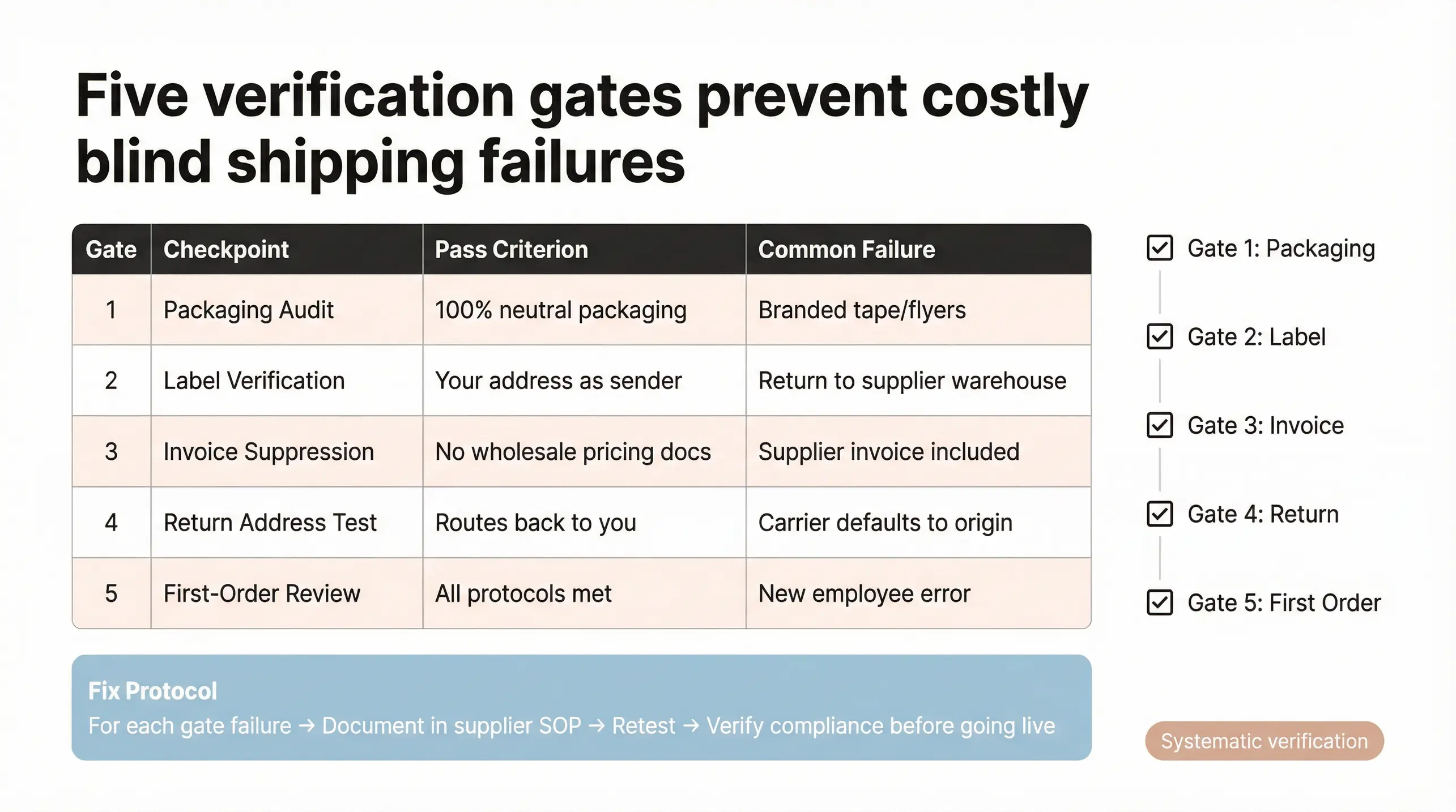
Assuming a supplier will handle blind shipping correctly is a recipe for disaster. To truly secure your business, you need a verification system. At Branvas, we use a proprietary model called The 5-Gate Blind Ship Audit to ensure every step of the process is validated. This framework turns ambiguity into a clear, actionable checklist.
| Gate | Checkpoint | Pass Criterion | Common Failure | Fix |
|---|---|---|---|---|
| 1 | Packaging Audit | All packaging is 100% neutral. No supplier logos, names, or marketing materials on the box, tape, or internal dunnage. | Supplier uses branded packing tape or includes a promotional flyer. | Specify "plain, unbranded packaging only" in your supplier SOP. Provide your own branded materials if desired. |
| 2 | Label Verification | Shipping label shows your business name/address as the sender and a neutral return address (your business or a designated 3PL). | Return address defaults to the supplier's warehouse. | Configure shipping settings in your e-commerce platform or supplier portal. Provide pre-paid labels if necessary. |
| 3 | Invoice Suppression | No documents inside the package reveal the wholesale cost or the original supplier's identity. The only document should be a branded packing slip (if used). | Supplier includes their commercial invoice or a packing slip with their name. | Explicitly state "NO INVOICES" in order notes and your supplier agreement. Confirm they have a process to suppress these documents. |
| 4 | Return Address Test | A test return initiated by you is correctly routed back to your specified address, not the supplier. | The carrier's system defaults to the physical origin address for returns, overriding the label. | Conduct a live test by refusing a trial order shipment or using the carrier's return service to verify the end-to-end return path. |
| 5 | First-Order Review | A real customer's first order is successfully delivered with all blind shipping protocols met. Consider using a friend or family member for this initial test. | A new warehouse employee misses the "blind ship" note and follows standard procedure. | After the first few successful orders, implement a quarterly spot-check process to ensure ongoing compliance. |
Here are three realistic scenarios where blind shipping can fail, and how to prevent them.
The Accidental Invoice: A busy warehouse worker forgets to remove the supplier's commercial invoice. The customer receives their $300 necklace along with a piece of paper showing you paid $30 for it.
The Default Return Label: A customer wants to return a ring. The shipping label on the box has your store name as the sender, but the return address embedded in the carrier's QR code system defaults to the origin scan location—the supplier's warehouse in another state.
The Google-able Packing Slip: Your supplier agrees to use a neutral packing slip but includes an internal SKU or lot number that is unique to their company. The customer, curious about the product, Googles the SKU and finds your supplier's B2B portal.

Use this checklist to set up blind shipping with a new supplier:

Several tools can help manage the complexities of blind shipping:


1. What does blind shipping mean in dropshipping?
In dropshipping, blind shipping means your supplier ships directly to your customer, but the packaging and documents are modified to hide the supplier's identity. The goal is to make it appear as if the product came directly from your brand [1].
2. Can I blind ship high-value jewelry items safely?
Yes, but it requires a high degree of trust and verification. For high-value items, it is even more critical to conduct thorough trial orders and use a supplier with a proven track record of flawless blind shipping execution. Some brands opt to bring high-value fulfillment in-house or use a dedicated 3PL for this reason.
3. How do I stop my supplier from sending invoices to customers?
You must have an explicit, written agreement with your supplier that they will suppress all commercial invoices and other documents revealing wholesale pricing. This should be reinforced in the order notes for every single order. The Branvas 5-Gate Audit Framework recommends making this a non-negotiable part of your supplier SOP.
4. What should I look for in unbranded packaging for jewelry?
For jewelry, unbranded packaging should be both neutral and protective. Look for plain, sturdy corrugated boxes or padded mailers. The interior should have unbranded foam or cotton inserts to protect the item. Avoid any supplier logos on the tape, box, or internal materials [5].
5. Is blind shipping legal and compliant with consumer protection laws?
Yes, blind shipping is a legal and widely used commercial practice. However, it is for commercial concealment, not for evading legal or customs requirements. All customs declarations must remain truthful and list the actual country of origin and supplier details for regulatory purposes [6]. The FTC's Mail, Internet, or Telephone Order Merchandise Rule requires you to have a reasonable basis for stated shipping times, which is an important consideration when relying on a dropship supplier [7].
In the world of e-commerce, and especially in the jewelry industry, your customer list is your most valuable asset. Blind shipping is not just a logistics tactic; it is a fundamental strategy for protecting that asset, preserving your brand equity, and owning your business instead of renting it. By implementing a rigorous verification process like the 5-Gate Blind Ship Audit and maintaining clear communication with your suppliers, you can effectively eliminate the risk of supplier poaching and build a resilient, scalable brand.
If you're scaling a jewelry brand and want to automate blind shipping without constant supplier back-and-forth, explore how Branvas handles logistics orchestration for brands like yours.
Use this template to formally vet a new supplier's blind shipping capabilities. Sending this email sets clear expectations from the start and gives you a written record of their commitments. Simply copy and paste the text below into an email.
**Subject:** Inquiry: Blind Shipping Protocol for New Jewelry Partner

Hi [Supplier Contact Name],

My name is [Your Name] and I'm the owner of [Your Jewelry Brand], a [Shopify/e-commerce] store specializing in [your niche]. We are looking for a reliable, long-term fulfillment partner for our dropshipping operations and are impressed with your catalog.

To protect our brand integrity and customer relationships, we require strict adherence to a blind shipping protocol. Before proceeding, could you please confirm in writing if you can meet the following requirements for all of our orders?

1.  **100% Neutral Packaging:** Can you guarantee that all shipments will be sent in plain, unbranded boxes or mailers with no supplier logos or marketing materials on the exterior or interior?
2.  **Invoice Suppression:** What is your process for ensuring no commercial invoices, packing slips with wholesale pricing, or any documents revealing your company's name are included in the package?
3.  **Return Address Configuration:** Can you set the "Sender" and "Return Address" on all shipping labels to our business address? Our address is: [Your Business Address].
4.  **Branded Materials (Optional):** Would you be able to include our own branded packing slips or thank-you cards if we provide the design or physical assets?
5.  **Packing Slip Details:** If you generate a packing slip, can you confirm it will only list our brand name and the customer's order details, with no mention of your company?
6.  **No Promotional Inserts:** Can you confirm that no promotional flyers, coupons, or business cards from your company will be added to our packages?
7.  **Trial Order:** We would like to place a small trial order to verify these processes. Are you open to this?

Adherence to these points is critical for our partnership. We've found that suppliers who master this process become invaluable long-term partners.

Thank you for your time, and I look forward to your response.

Best regards,

[Your Name]
[Your Title]
[Your Jewelry Brand]
[Your Website]
[1] Blind Shipping: How to Hide Your Dropshipping Suppliers. Ship To The Moon. January 20, 2026. https://www.shiptothemoon.com/what-is-blind-shipping-dropshipping-guide/
[2] Looking Back on Jewelry Retail in 2025, and Ahead for 2026. JCK Online. December 3, 2025. https://www.jckonline.com/article-long/jewelry-retail-in-2025-and-2026/
[3] 2026 Ecommerce Trends: How Brands Are Planning Ahead. Shopify. January 9, 2026. https://www.shopify.com/blog/ecommerce-trends-predictions
[4] The State of E-commerce Fulfillment. Ryder. December 29, 2025. https://www.ryder.com/en-us/insights/blogs/e-comm/the-state-of-e-commerce-fulfillment
[5] The Future of E-commerce Packaging Trends & Innovations for 2025. PackageIt. March 7, 2025. https://www.packageit.com/the-future-of-e-commerce-packaging-trends
[6] What Is Blind Shipping? How It Works, When to Use It, and Why It Matters. IncoDocs. May 9, 2025. https://incodocs.com/blog/what-is-blind-shipping/
[7] Business Guide to the FTC's Mail, Internet, or Telephone Order Merchandise Rule. Federal Trade Commission. https://www.ftc.gov/business-guidance/resources/business-guide-ftcs-mail-internet-or-telephone-order-merchandise-rule