



Avoid stockouts in jewelry dropshipping by implementing sync cadence rules, safety buffers, auto-unpublish automation, substitution maps, and customer communication templates.
Published:
March 28, 2026
Author:
Yi Cui
Most "out of stock" problems are communication problems.
When a customer buys a necklace that you do not actually have, the failure rarely starts at the warehouse level. It starts in the data layer between your supplier's system and your storefront.
In the jewelry dropshipping space, this disconnect is a silent killer of brands.
Stockouts represent a massive financial drain on the ecommerce industry. The global retail sector loses $1.73 trillion annually due to inventory distortion, which includes both out-of-stocks and overstocks [1].
For dropshippers, the cost is not just a lost sale. It is the permanent loss of a customer.
Research shows that 69% of online shoppers will abandon their purchase and buy from a competitor when they encounter an out-of-stock item [2]. Even worse, 91% of customers refuse to wait for restocks. They simply move on.
Jewelry dropshipping is uniquely vulnerable to these inventory shocks. The combination of high SKU counts, trend-driven demand spikes, and reliance on third-party suppliers creates a perfect storm for overselling.
When you do not hold physical inventory, your only defense against stockouts is information.
If you want to avoid stockouts dropshipping jewelry, you must understand exactly why this business model faces such high risks. This article walks through the root causes of inventory accuracy gaps and introduces a concrete system to prevent them. You will walk away with a reliable, low-friction inventory management system you can implement without holding physical stock.
Jewelry is not like other ecommerce categories. It operates on micro-trends, seasonal shifts, and aesthetic virality.
This creates a high SKU turnover rate. What sells out today might be dead inventory next month.
Because jewelry items are small and relatively inexpensive to produce, suppliers often carry thousands of variants. Rings, necklaces, and bracelets come in multiple metals, lengths, and stone types. This SKU proliferation makes inventory tracking exponentially more difficult.
Dropshippers face a structural disadvantage here. You have no physical buffer. When a supplier runs out of a specific gold-plated chain, you have zero units in reserve to fulfill pending orders. You are entirely dependent on the supplier's restock schedule.
The compounding effect of multi-channel selling makes this worse. If you sell on Shopify, TikTok Shop, and Instagram simultaneously, your inventory data must sync perfectly across all platforms. A sudden spike on TikTok can drain your supplier's stock before your Shopify store even registers the change.
Many dropshippers try to solve this by adding more suppliers. The logic seems sound: if one supplier runs out, another will have it. But this is a dangerous trap.
Having more supplier options can actually increase your stockout risk. This is the contrarian reality of dropshipping. When you fragment your supply chain across multiple vendors, you multiply your data latency issues.
Each supplier has a different inventory feed format, a different sync frequency, and a different threshold for accuracy. Managing inventory across multiple dropshipping suppliers without overselling requires complex routing logic [3]. Without a unified system, your sales channels compete for the same fragmented inventory pool. You end up overselling because your systems cannot reconcile the conflicting data fast enough.

When it comes to inventory accuracy dropshipping businesses face a fundamental issue: the gap between supplier "available stock" and real-time sellable stock. These two numbers are rarely the same.
Suppliers process orders from hundreds of different merchants simultaneously. Their inventory levels fluctuate by the minute. If your store only pulls inventory data once a day, you are operating on stale information for 23 hours and 59 minutes.
Feed latency is the primary culprit. Many suppliers still rely on manual CSV updates or FTP file drops. Even those with API connections often batch their updates to save server resources. This creates a dangerous window where a product shows as "in stock" on your site but is actually depleted at the source.
In our experience at Branvas, the most common stockout is not caused by a product running out. It is caused by a 6 to 24 hour delay between supplier depletion and storefront update.
Dropshippers often ignore this gap because they trust the "in stock" flag too much. They assume that if the supplier feed says there are 10 units left, they can safely sell 10 units. They fail to account for the other 50 merchants looking at those exact same 10 units.
This false confidence leads to overselling. You accept the order, capture the payment, and send the fulfillment request to the supplier. Only then do you receive the dreaded cancellation notice.
You are then forced to refund the customer, apologize, and take a hit to your brand reputation. If this happens on a marketplace like TikTok Shop, your account health score drops. Too many cancellations, and you get suspended.
To survive, you must stop trusting raw supplier data. You need a system that assumes supplier data is delayed and builds a protective buffer around your storefront.

To solve the inventory accuracy gap, we developed a proprietary system for our private-label clients. The Branvas Stock-Certainty Framework™ is a step-by-step model designed to minimize stockout exposure for jewelry sellers who do not hold physical inventory.
This framework shifts your strategy from reactive apologies to proactive prevention. It consists of five distinct tiers, each targeting a specific failure point in the dropshipping inventory chain.
Your inventory sync frequency must match your product velocity. A daily CSV upload is insufficient for a fast-moving jewelry brand.
For fast-moving SKUs, you need real-time API connections that push updates at least every 15 to 30 minutes. If your supplier cannot support this, you must find a middleware tool that can poll their data more frequently.
For slow-moving evergreen items, an hourly sync might be acceptable. But you must categorize your catalog and apply strict sync cadence rules based on sales volume. Never treat a viral TikTok product the same way you treat a basic silver stud earring.
The minimum acceptable sync frequency for any live product is once per hour. For anything trending or actively promoted, drop that to 15 minutes or less.
Since you have no physical warehouse, you must create a virtual safety buffer. This means setting your Shopify inventory threshold to trigger an action before the supplier actually hits zero.
If a supplier feed shows 5 units remaining, your store should treat that as 0 units. Those last 5 units are likely already claimed by other merchants in the sync lag window.
Set specific threshold rules based on supplier reliability. For a highly reliable supplier with a fast API, unpublish the product when their quantity drops below 3 units. For a slower, less reliable supplier using CSV uploads, set the buffer at 10 units. This virtual buffer absorbs the shock of feed latency.
Manual monitoring is impossible at scale. You must automate the removal of low-stock items from your storefront.
In Shopify, you must ensure the "Continue selling when out of stock" toggle is strictly turned off for all dropshipped items. But you need to go further than that. You need rules that hide products when they hit your safety buffer threshold, not just when they hit zero.
You can use Shopify Flow to build an automation using the built-in "Publish and unpublish products based on inventory level" template [5]. Set the trigger to "Product variant inventory quantity changed," add a condition checking if the quantity is below your defined buffer, and set the action to "Unpublish product." Alternatively, use dedicated inventory apps like Stock Sync or Trunk to manage these rules dynamically across multiple channels. When the supplier restocks, the app should automatically republish the item.
When a stockout inevitably slips through, you need a backup plan ready to execute instantly. This requires a pre-built product substitution map.
Map every primary SKU to a backup SKU. The backup must meet strict criteria: it must be the same metal type, a similar price point within 10%, and a comparable style. If a customer orders a 14k gold-plated herringbone chain, your backup must be a nearly identical 14k gold-plated chain, not a silver alternative.
You can source this backup from the same supplier or an alternate vendor. Having this map pre-built means your customer service team does not have to scramble to find alternatives when an order fails. The decision is already made.
How you communicate a stockout determines whether you lose a sale or build trust. You need ready-to-use messaging templates for every scenario.
Pre-emptive low-stock notification (send when buffer threshold is hit):
"We wanted to give you a heads-up: [Product Name] is almost sold out. Only a few left. Grab yours before it is gone, or join the waitlist to be first when we restock."
Post-purchase stockout apology with substitution offer:
"We are so sorry. Due to an inventory update, [Product Name] is no longer available for your order. We have found a nearly identical piece, [Substitute Name], that we would love to send you at the same price. Reply to confirm, or we will issue a full refund within 24 hours. We appreciate your patience."
Restock waitlist confirmation:
"You are on the list. We will notify you the moment [Product Name] is back in stock. As a thank you for your patience, you will receive 10% off when it drops."
Keep the tone brand-friendly. Never blame the supplier. Take ownership of the issue and provide the customer with clear, frictionless options.

Not all jewelry pieces carry the same stockout risk. You must evaluate your catalog and apply the Branvas Stock-Certainty Framework™ dynamically based on each product's risk profile.
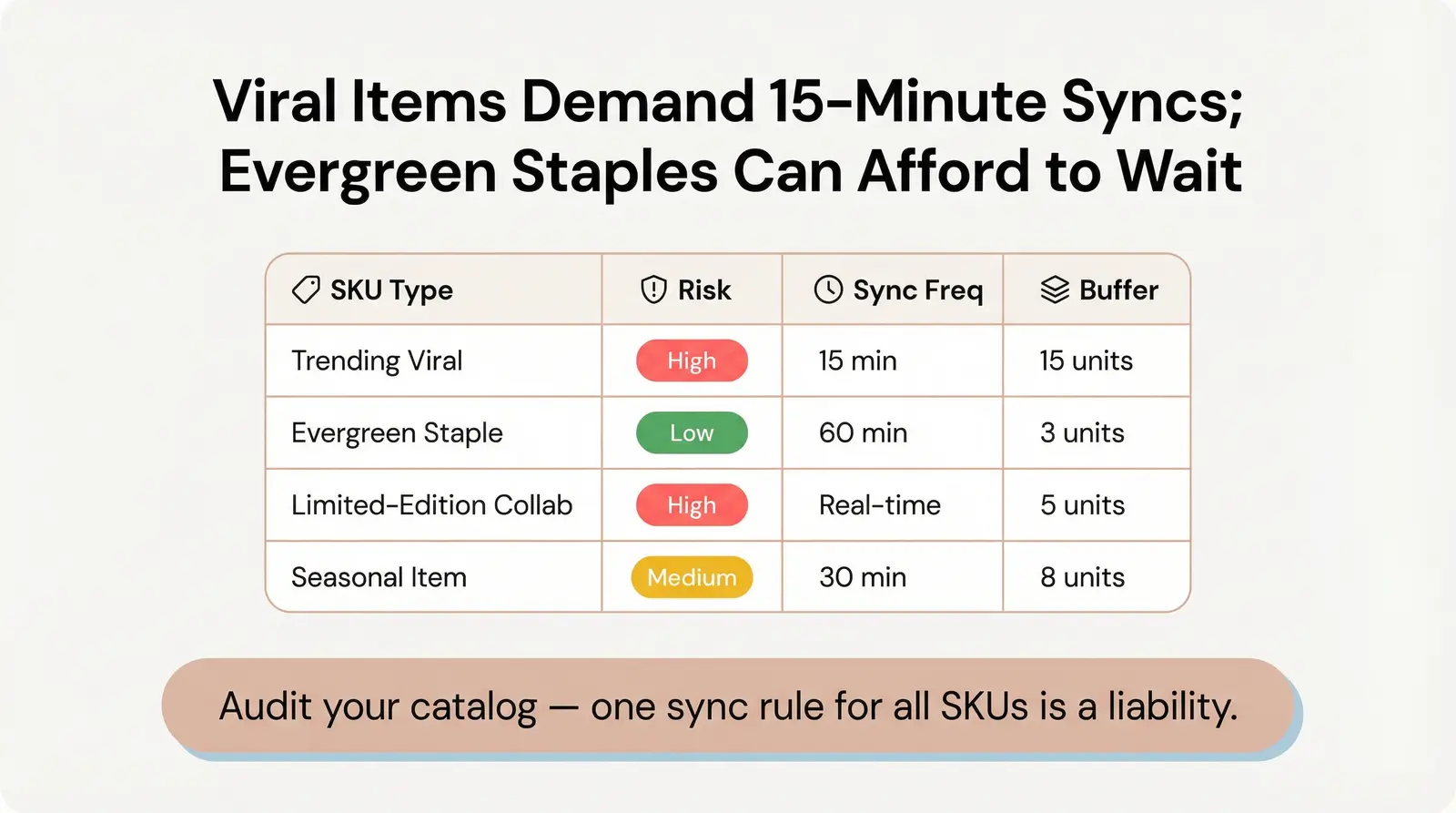
We use a specific matrix to score jewelry SKU types across four risk dimensions. This helps determine the appropriate safety buffer and sync cadence for each product category.
| SKU Category | Supplier Dependency | Restock Speed | Demand Predictability | Substitution Availability | Risk Score | Recommended Action |
|---|---|---|---|---|---|---|
| Trending Viral Item | High (Often single-source) | Slow (Factory backlogs) | Low (Spikes instantly) | Low (Unique designs) | High | 15-min sync, Buffer: 15 units, Strict auto-unpublish |
| Evergreen Staple | Low (Many suppliers) | Fast (Always in production) | High (Steady daily sales) | High (Generic designs) | Low | Hourly sync, Buffer: 3 units, Map 2 backup SKUs |
| Limited-Edition Collab | High (Exclusive source) | None (No restocks) | Medium (Marketing driven) | None (Cannot substitute) | High | Real-time API only, Buffer: 5 units, Waitlist only |
| Seasonal Item (e.g., Holiday) | Medium (Shared factories) | Medium (Batch production) | Medium (Calendar based) | Medium (Similar motifs) | Medium | 30-min sync, Buffer: 8 units, Aggressive unpublish post-holiday |
Use this matrix to audit your current catalog. If your entire store consists of High-Risk viral items, you need the most aggressive inventory protection tools available. If you are building a stable, evergreen jewelry brand, you have more flexibility, but you still need the framework in place.
Let us look at how this framework operates in the real world.
Imagine a small private-label jewelry brand running on Shopify. They sell a signature chunky gold hoop earring as their hero product. On a Tuesday night, a mid-tier influencer posts a TikTok video wearing the hoops. The video goes semi-viral overnight, generating 400,000 views by morning.
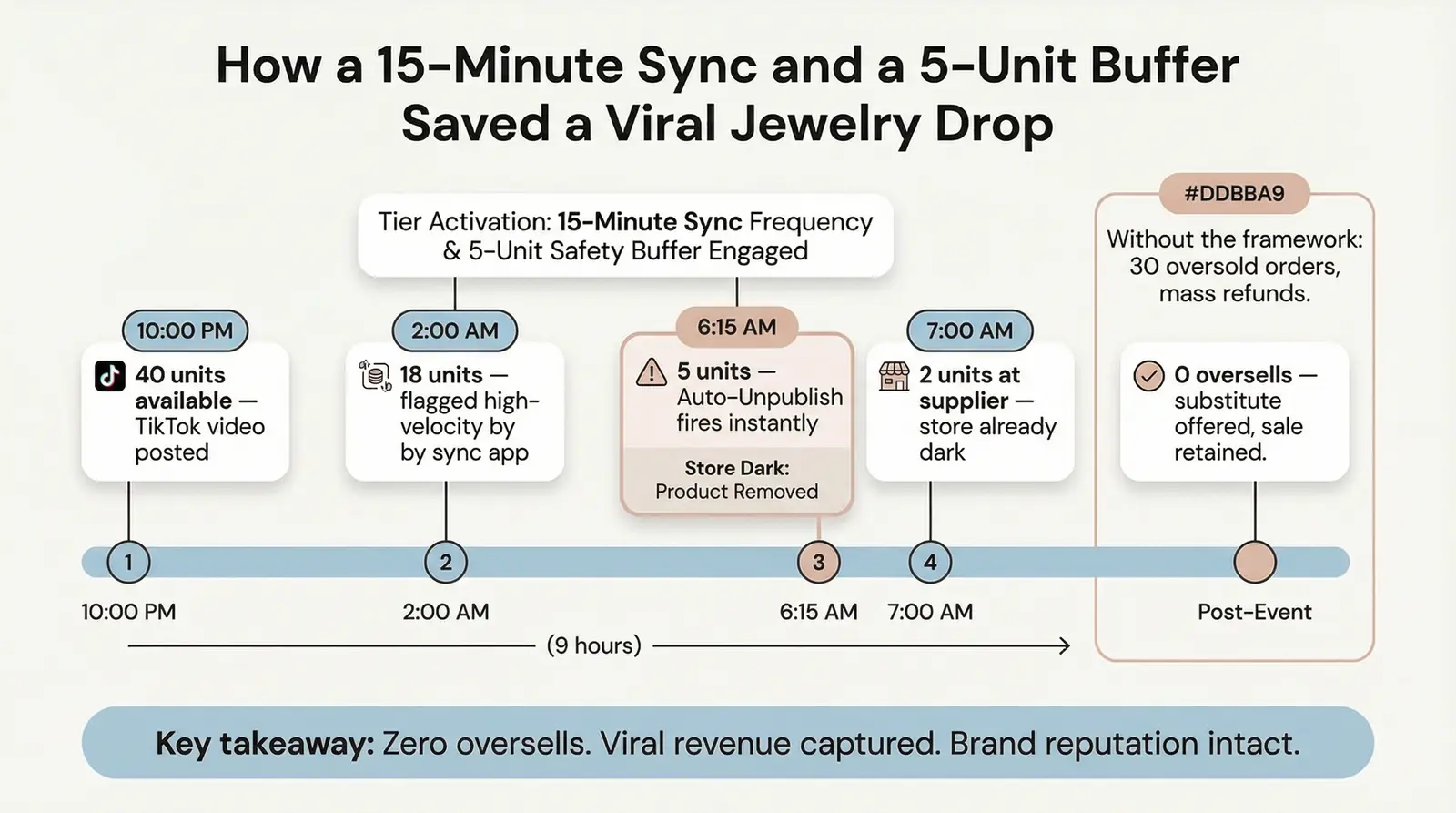
At 10:00 PM, the supplier feed shows 40 units available. By 7:00 AM the next morning, the supplier only has 2 units left. In a traditional dropshipping setup, the Shopify store would still show 40 units because the daily sync has not happened yet. The brand would wake up to 30 oversold orders, furious customers, and a massive refund headache.
Here is how the Branvas Stock-Certainty Framework™ prevents this disaster.
Tier 1 (Sync Cadence) activates: The brand uses an inventory app polling the supplier API every 15 minutes. As the TikTok traffic converts overnight, the app registers the rapid depletion in near-real-time. By 2:00 AM, the system already shows 18 units remaining and flags the product as high-velocity.
Tier 2 (Safety Buffer) and Tier 3 (Auto-Unpublish) activate: The brand set a safety buffer of 5 units for this specific SKU because it is classified as a Trending Viral Item in their risk matrix. At 6:15 AM, the supplier inventory drops to 5. The Shopify Flow automation instantly fires, unpublishing the product from the storefront. The last 5 units at the supplier are left to absorb any sync lag from other merchants. The brand oversells exactly zero units.
Tier 4 (Substitution Policy) activates: A few customers managed to place orders right at the cutoff, and one order fails at the supplier level due to a damaged unit. The brand's substitution map immediately surfaces the backup SKU: a slightly thicker gold hoop from a secondary supplier at the same price point. The customer service team is notified automatically.
Tier 5 (Customer Communication) activates: Within 2 hours, the affected customer receives the post-purchase stockout template. It apologizes for the inventory error, offers the backup hoop as an immediate replacement, and includes a 15% discount code for the trouble. The customer accepts the substitute. The brand retains the sale and the customer relationship.
The brand captured the viral revenue, protected their reputation, and avoided marketplace penalties. The system worked exactly as designed.
Implementing this framework requires the right technology stack. You cannot manage high-velocity jewelry dropshipping with spreadsheets.
You need robust inventory sync tools. Apps like Stock Sync, Trunk, and Skustack are industry standards for Shopify merchants. They allow you to connect multiple supplier feeds, set complex mapping rules, and automate your safety buffers.
Stock Sync is excellent for handling messy supplier data formats, like XML, FTP, or custom CSVs. It supports over 60 connection methods and lets you schedule sync frequency per feed. Trunk provides exceptional real-time syncing across multiple sales channels, ensuring your Shopify and Etsy stores do not compete for the same inventory pool.
But tools are only as good as the data they receive. You must demand better data access from your suppliers.
When negotiating with a dropship supplier, insist on real-time API access. If they only offer daily CSV drops, they are not a viable partner for scaling a brand. You must also demand feed frequency SLAs (Service Level Agreements). They need to contractually guarantee how often their data refreshes, and what happens when they miss that window.
Finally, ask for proactive low-stock alerts. A good supplier will notify you when a raw material shortage threatens a popular SKU, giving you days to adjust your marketing spend before the crisis hits.
We often see jewelry sellers exhaust themselves trying to force outdated suppliers into modern tech stacks. It is a constant battle against bad data.
Branvas clients benefit from direct inventory visibility because we handle sourcing and fulfillment in-house, eliminating the supplier communication gap entirely. You never have to guess if our data is accurate. Curious how Branvas handles inventory sync for private-label jewelry? See how it works at branvas.com/how-it-works.

Even with the best systems, anomalies happen. A supplier might have a warehouse fire, or a container ship might get delayed. You need to know the difference between stockout prevention and stockout recovery, and have a plan for both.
Prevention is the framework we just covered. Recovery is your emergency response playbook when a customer buys a product you cannot deliver.
Your first priority in recovery is customer trust repair. Do not wait for the customer to ask where their order is. The moment you identify an unfulfillable order, reach out. Silence breeds suspicion, and suspicion turns into chargebacks.
Use a strict refund-vs-substitute decision tree. If the item is a generic staple, offer the substitute immediately. If the item is a highly specific, emotional purchase like an engagement ring alternative, default to a full refund and a deep apology. Do not try to substitute highly personal items without explicit customer consent.
Next, update your product page immediately. Do not just leave it as "Sold Out." Change the button to "Join Waitlist" or "Notify Me When Available." This captures the lingering traffic from a viral spike and turns it into a future revenue opportunity.
A waitlist turns a stockout into a future sale signal. It tells you exactly how many units to order for the next batch. It transforms a negative customer experience into an exclusive, high-demand brand positioning tactic. Scarcity, when handled correctly, builds brand desirability.
If you want to learn more about building a resilient jewelry brand from the ground up, the Branvas Academy covers sourcing, branding, and operational strategy for private-label sellers.

Stockouts are a systems problem, not a luck problem.
When you oversell a piece of jewelry, it is because your data architecture failed to protect your storefront. Relying on raw supplier feeds and daily updates is a guaranteed path to customer churn and brand damage.
By implementing the Branvas Stock-Certainty Framework™, you take control of your inventory data. You build virtual buffers, automate your unpublish rules, and prepare your substitution maps. You stop reacting to supplier shortages and start managing your catalog like a professional retail operation.
Inventory without physical inventory requires flawless communication. Build the systems today, before your next product goes viral.
If you want to skip the supplier sync headaches entirely, Branvas manages sourcing, inventory, and fulfillment for your private-label jewelry brand so you can focus on selling. Start your brand at branvas.com.
To prevent overselling Shopify merchants must implement a virtual safety buffer using inventory sync apps like Trunk or Stock Sync. Set rules to automatically hide or unpublish products when supplier inventory drops below a specific threshold, such as 5 units. This absorbs data latency and prevents customers from buying items that are effectively already sold. Pair this with Shopify Flow automation and ensure the "Continue selling when out of stock" toggle is disabled for all dropshipped products.
You can use Shopify Flow to create an automated workflow using the built-in "Publish and unpublish products based on inventory level" template. Set the trigger to "Product variant inventory quantity changed," add a condition checking if the quantity falls below your safety buffer threshold, and set the action to "Unpublish product." For more advanced multi-channel needs, apps like Trunk or Stock Sync offer similar automation with additional supplier feed management features.
When defining safety stock rules dropshipping requires a data threshold rather than physical units. It involves treating a low supplier inventory number, such as 3 to 10 units depending on supplier reliability, as zero on your storefront. This buffer protects you from the time delay between the supplier selling their last unit and your store updating its data. The exact threshold should be calibrated based on how frequently your supplier updates their feed and how fast your products sell.
Sync frequency should match product demand velocity. For trending or viral jewelry pieces, you need real-time API syncs or updates every 15 to 30 minutes. For slower-moving evergreen items, hourly or bi-hourly syncs may suffice. Daily syncs are generally too slow for modern ecommerce, especially if you run paid advertising or influencer campaigns that can spike demand unpredictably.
Reach out immediately with a transparent, brand-friendly apology. Do not blame the supplier. Clearly state the item is unavailable, and immediately offer a comparable substitution or a full, expedited refund. Include a discount code for a future purchase to help repair the damaged trust. The key is speed and ownership: customers are far more forgiving when you reach out proactively rather than waiting for them to chase you down.