



Retail price is the final consumer price covering all costs and profit. Use the CAPA Pricing Stack to set competitive, margin-protective prices for your online store.
Published:
May 1, 2026
Author:
Yi Cui
Most 'retail price' explanations are one sentence long and useless. Real pricing decisions involve cost breakdown, margin targets, competitive anchoring, and psychology — and getting them right is the difference between a profitable store and a dying one.
Pricing is the most powerful lever in your business, yet it is the one founders guess at the most. Most sellers set prices by gut feel or by copying competitors, and it costs them everything. They look at what others are charging, apply a generic multiplier to their product cost, and hope there is enough money left over at the end of the month to pay themselves. This is not a strategy. It is a gamble.
In this guide, we are breaking down the exact mechanics of retail pricing. You will learn how to calculate your true costs, the dangerous difference between markup and margin, and the proprietary framework we use at Branvas to help brands set prices that are competitive, psychologically effective, and highly profitable.
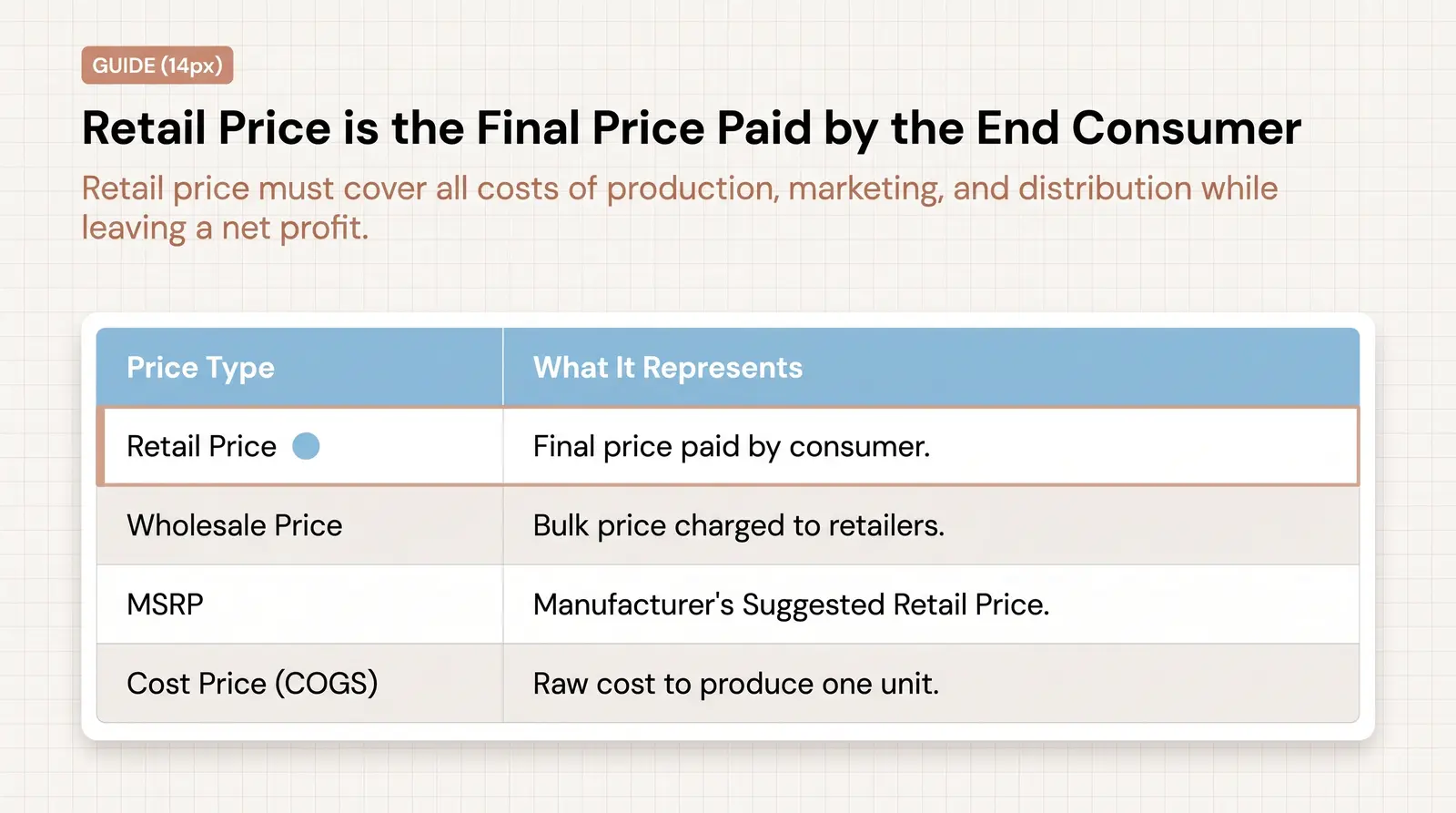
Retail price is the final price a consumer pays for a product when purchasing it from a retailer or direct-to-consumer (DTC) brand. It is the end of the pricing chain, designed to cover all costs of production, marketing, and distribution while leaving a net profit for the seller.
To understand retail price, you have to understand what it is not. Here is how it compares to other common pricing terms:
| Price Type | Who Sets It | What It Represents | Typical Use Case |
|---|---|---|---|
| Retail Price | Retailer / DTC Brand | The final price paid by the end consumer. | B2C sales on Shopify, Amazon, or in-store. |
| Wholesale Price | Manufacturer / Brand | The bulk price charged to retailers who will resell the item. | B2B sales to boutiques or distributors. |
| MSRP | Manufacturer | Manufacturer's Suggested Retail Price; a recommended selling price. | Used to standardize pricing across different retailers. |
| Cost Price (COGS) | Manufacturer / Supplier | The raw cost to produce or acquire one unit of the product. | Internal metric used to calculate baseline profitability. |
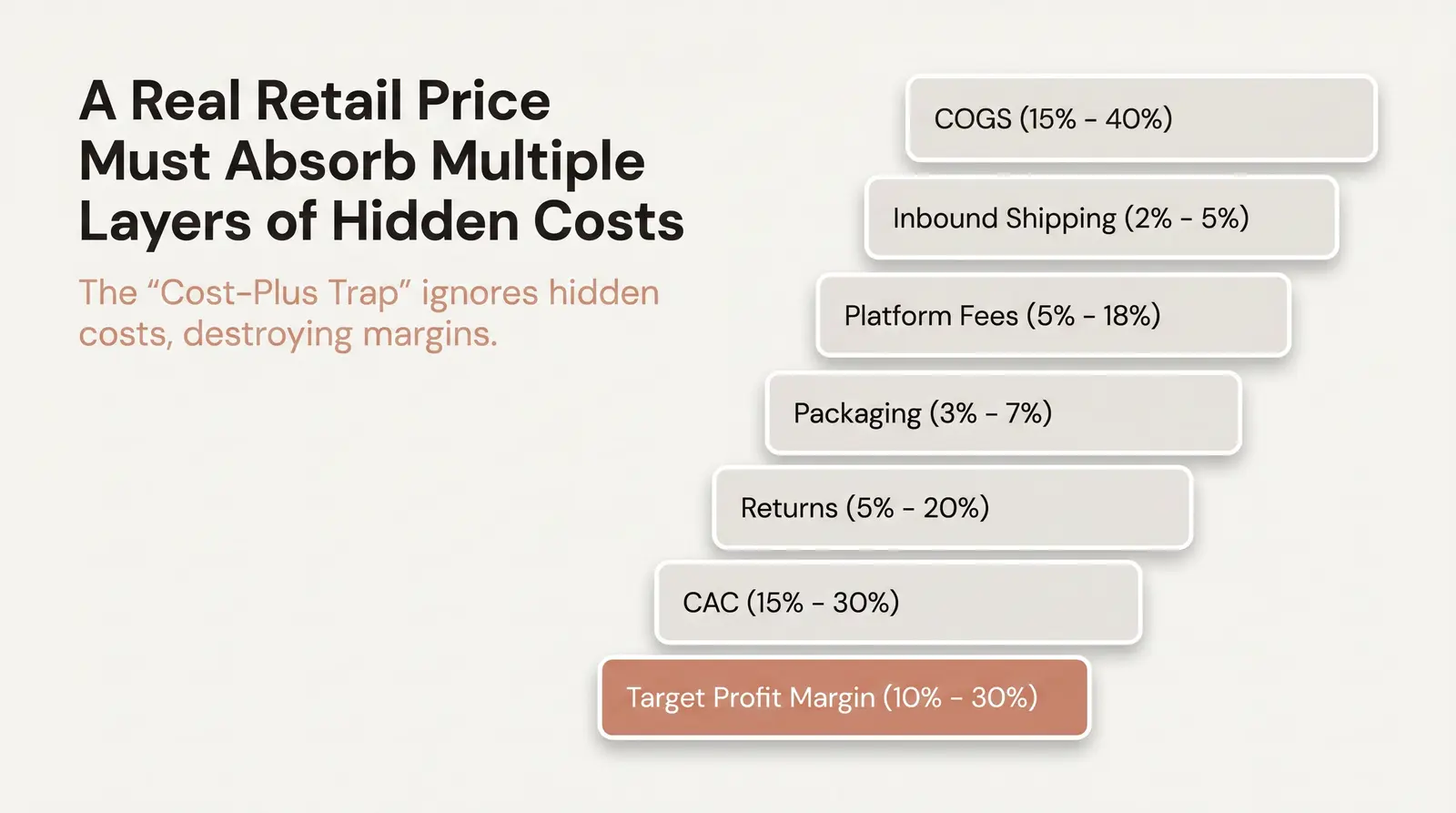
The biggest mistake new ecommerce sellers make is the "Cost-Plus Trap." They buy a product for $10, add $10 for profit, and sell it for $20. Then they wonder why they are losing money.
A real retail price must absorb multiple layers of hidden costs before you see a single dollar of profit. If you do not account for these in your pricing model, your margins will vanish.
| Cost Component | Description | Typical Range (%) | Notes |
|---|---|---|---|
| COGS | Product cost + raw materials + manufacturing labor. | 15% – 40% | Varies wildly by category (jewelry is low, electronics are high). |
| Inbound Shipping | Freight costs to get the product from the factory to your warehouse. | 2% – 5% | Often forgotten until the invoice arrives. |
| Platform Fees | The cut taken by Shopify, Amazon, or Etsy. | 2% – 15% | Shopify is ~2.9% + 30¢ [1]; Amazon averages 15% [2]; Etsy is 6.5% [3]. |
| Payment Processing | Fees charged by Stripe, PayPal, or Shop Pay. | 2.9% + 30¢ | Standard across most major gateways [4]. |
| Packaging & Fulfillment | Boxes, inserts, tape, and the labor to pack the order. | 3% – 7% | Custom branded packaging increases this cost. |
| Returns & Shrinkage | Allowance for refunded items, damaged goods, or lost packages. | 5% – 20% | The average ecommerce return rate is around 20% [5]. |
| CAC (Customer Acquisition) | Paid ads, influencer seeding, and marketing costs to get one sale. | 15% – 30% | Average ecommerce CAC is $68–$84 [6]. |
| Target Profit Margin | The actual money left over to reinvest or take home. | 10% – 30% | This is your reward for taking the risk. |
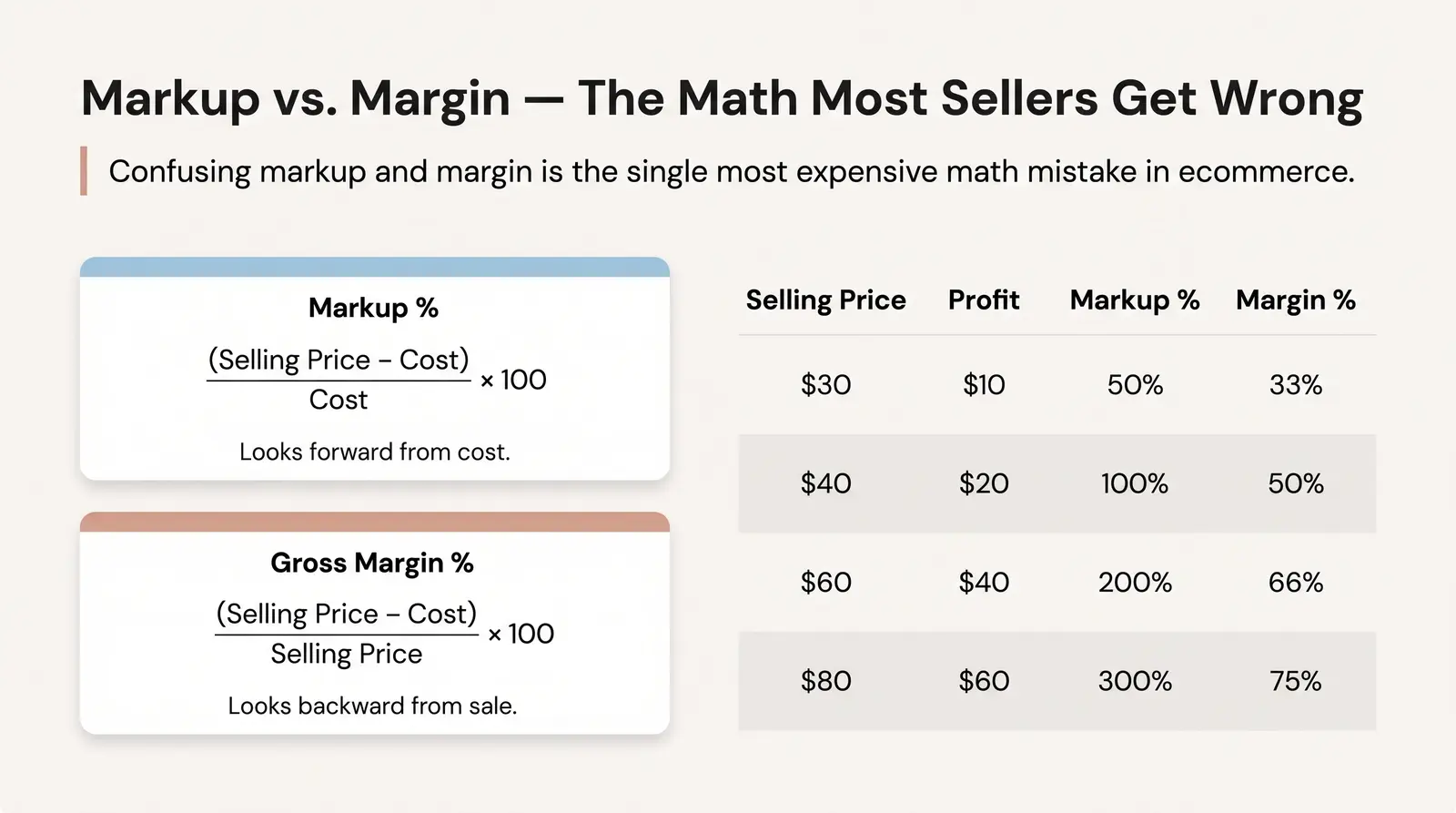
If there is one concept you take away from this article, let it be this: markup and margin are not the same thing. Confusing the two is the single most expensive math mistake in ecommerce.
Why does this matter? Because a 50% markup is only a 33% margin. If your product costs $50 and you mark it up 50%, your selling price is $75. Your profit is $25. But $25 divided by the $75 selling price is a 33% margin.
Here is the contrarian truth: most ecommerce "rules of thumb" (like "3x your cost") are actually markup formulas disguised as margin advice — and they systematically underprice high-cost items and overprice low-cost ones.
Let's look at how the math plays out side by side for a product that costs $20 to produce:
| Selling Price | Profit ($) | Markup % | Gross Margin % |
|---|---|---|---|
| $30 | $10 | 50% | 33% |
| $40 | $20 | 100% | 50% |
| $60 | $40 | 200% | 66% |
| $80 | $60 | 300% | 75% |
If you aim for a 50% margin but accidentally apply a 50% markup, you will price your product at $30 instead of $40. That $10 difference comes directly out of your net profit, leaving you with zero room to run ads or offer discounts.
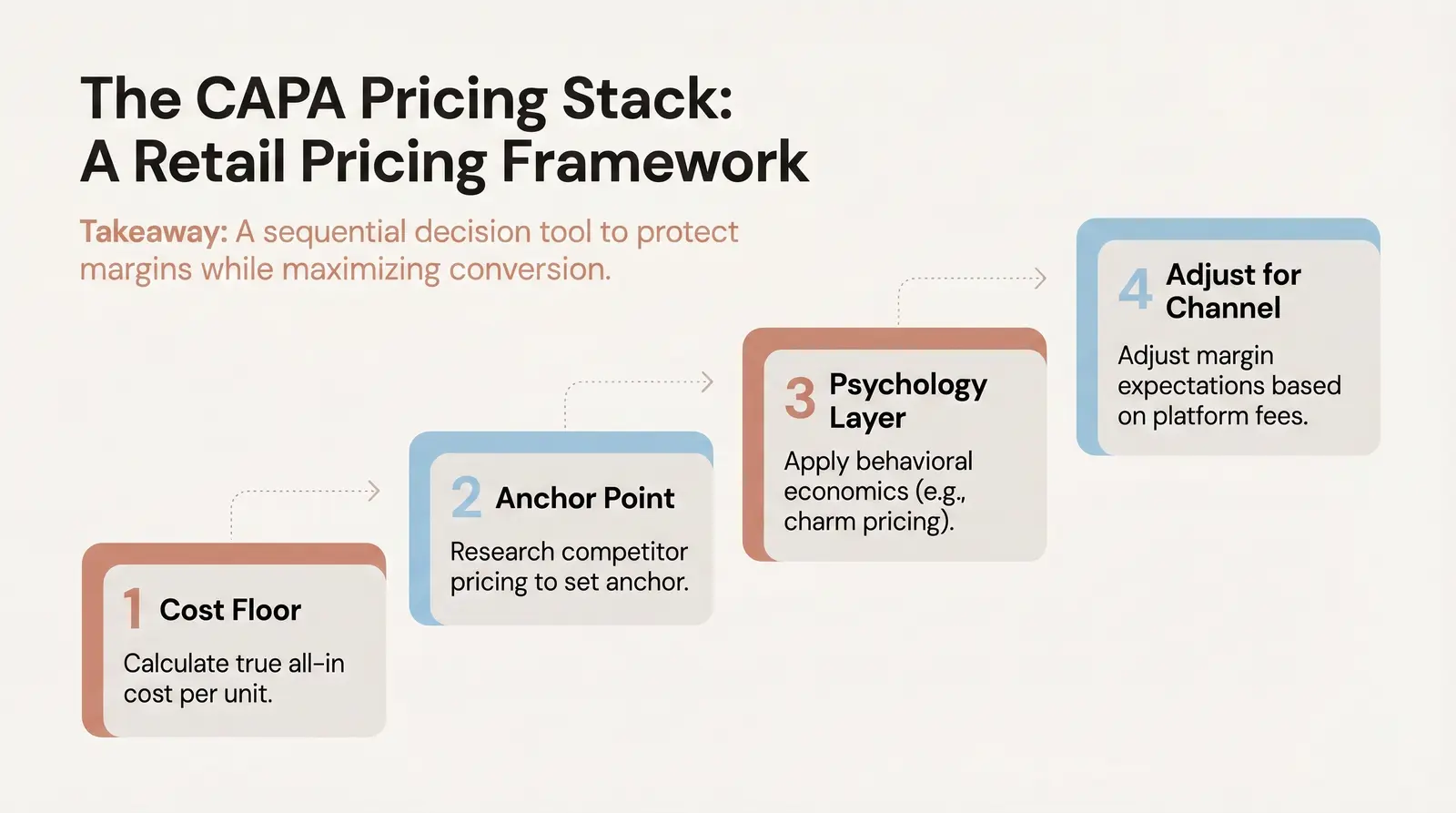
At Branvas, we don't guess at pricing. We use a proprietary framework called the CAPA Pricing Stack (Cost → Anchor → Psychology → Adjust). It is a sequential decision tool designed to protect margins while maximizing conversion rates.
In our experience working with early-stage brand founders at Branvas, the most common mistake isn't pricing too high — it's failing to account for CAC before setting the final price, which quietly kills margins over time.
Calculate your true all-in cost per unit using the components table above. This includes COGS, freight, packaging, and an allowance for returns. This number is your absolute floor. You never price below it, and you never run a discount that dips below it.
Research competitor pricing in your niche to set your anchor. This determines where your price "lives" relative to the market. Are you the budget option, the mid-market standard, or the premium luxury choice?
| Tier | Price Position | Margin Target | Best For |
|---|---|---|---|
| Value | Bottom 25% of market | 30% – 40% | High-volume, mass-market commodities. |
| Mid-Market | Middle 50% of market | 50% – 65% | Standard DTC brands with good branding. |
| Premium | Top 25% of market | 70%+ | Luxury, highly differentiated, or status products. |
Once you have a baseline price, apply behavioral economics to make the number more appealing to the human brain.
Prices cannot be static across all platforms because the cost of selling varies by platform. You must adjust your margin expectations based on where the transaction happens.
| Channel | Fee Range | Recommended Margin Floor | Notes |
|---|---|---|---|
| DTC Website (Shopify) | 2.9% + 30¢ | 60% | Highest margin, but requires you to fund all CAC. |
| Amazon FBA | 15% + FBA fees | 40% | Lower margin, but Amazon provides the traffic. |
| Wholesale (B2B) | 0% (Direct invoice) | 40% | Lowest margin per unit, but zero CAC and high volume. |
Let's apply the CAPA framework to three different product categories to see how the math works in the real world.
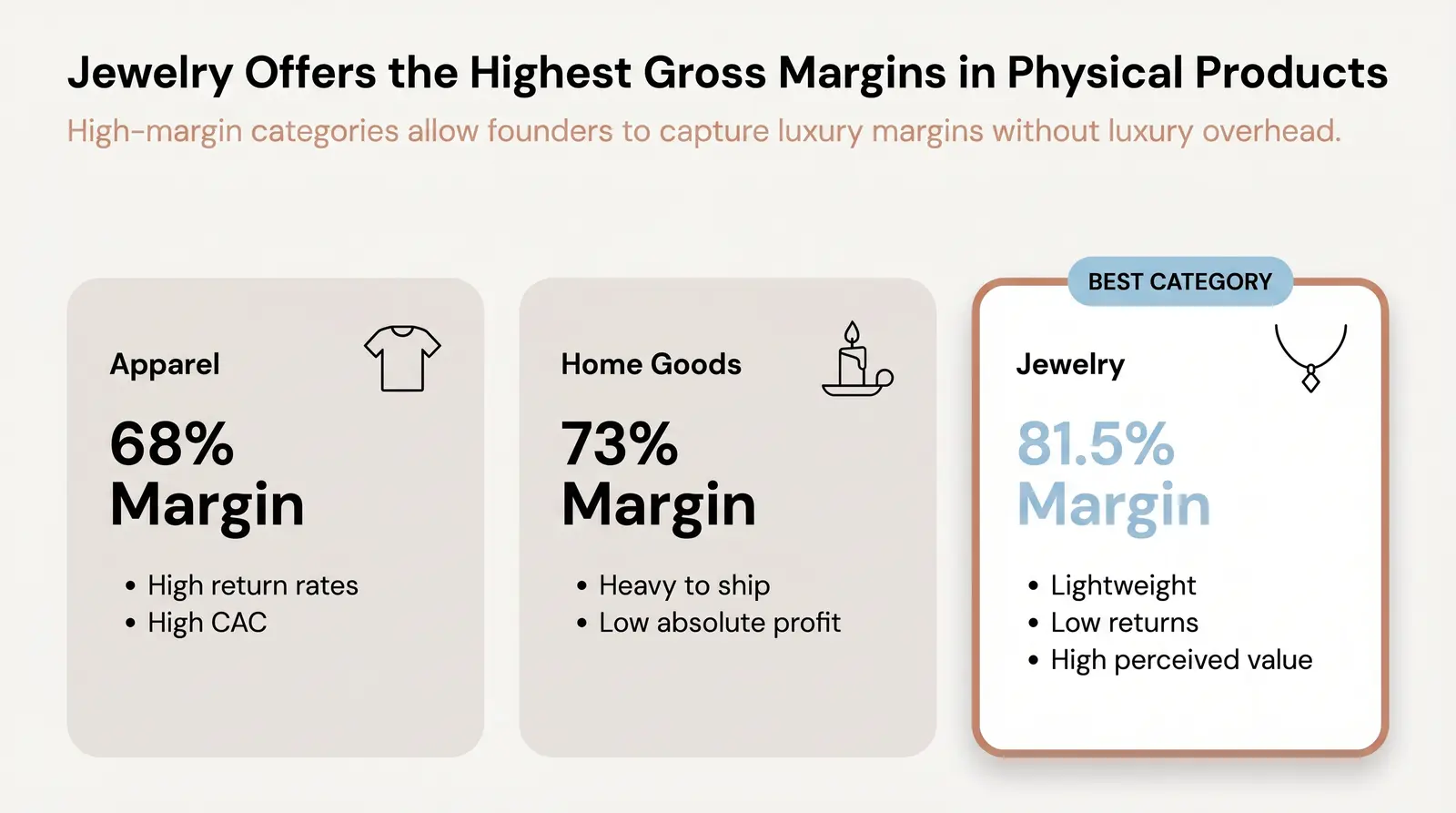
Apparel is notoriously competitive, with high return rates and sizing complexities.
Candles are heavy (expensive to ship) but relatively cheap to produce.
Jewelry has among the highest gross margins of any physical product category. It is lightweight, cheap to ship, has low return rates, and carries high perceived value.
This is exactly why jewelry, accessories, and similar high-margin categories are where smart ecommerce founders are focusing right now. The infrastructure to launch a branded jewelry line has become dramatically more accessible, allowing founders to capture luxury margins without luxury overhead.
If you're exploring jewelry as a category, Branvas's profit calculator can model your exact margins before you source a single unit.
If you plan to sell your products to other stores (B2B) in addition to selling directly to consumers, you must understand the structural difference between retail and wholesale pricing.
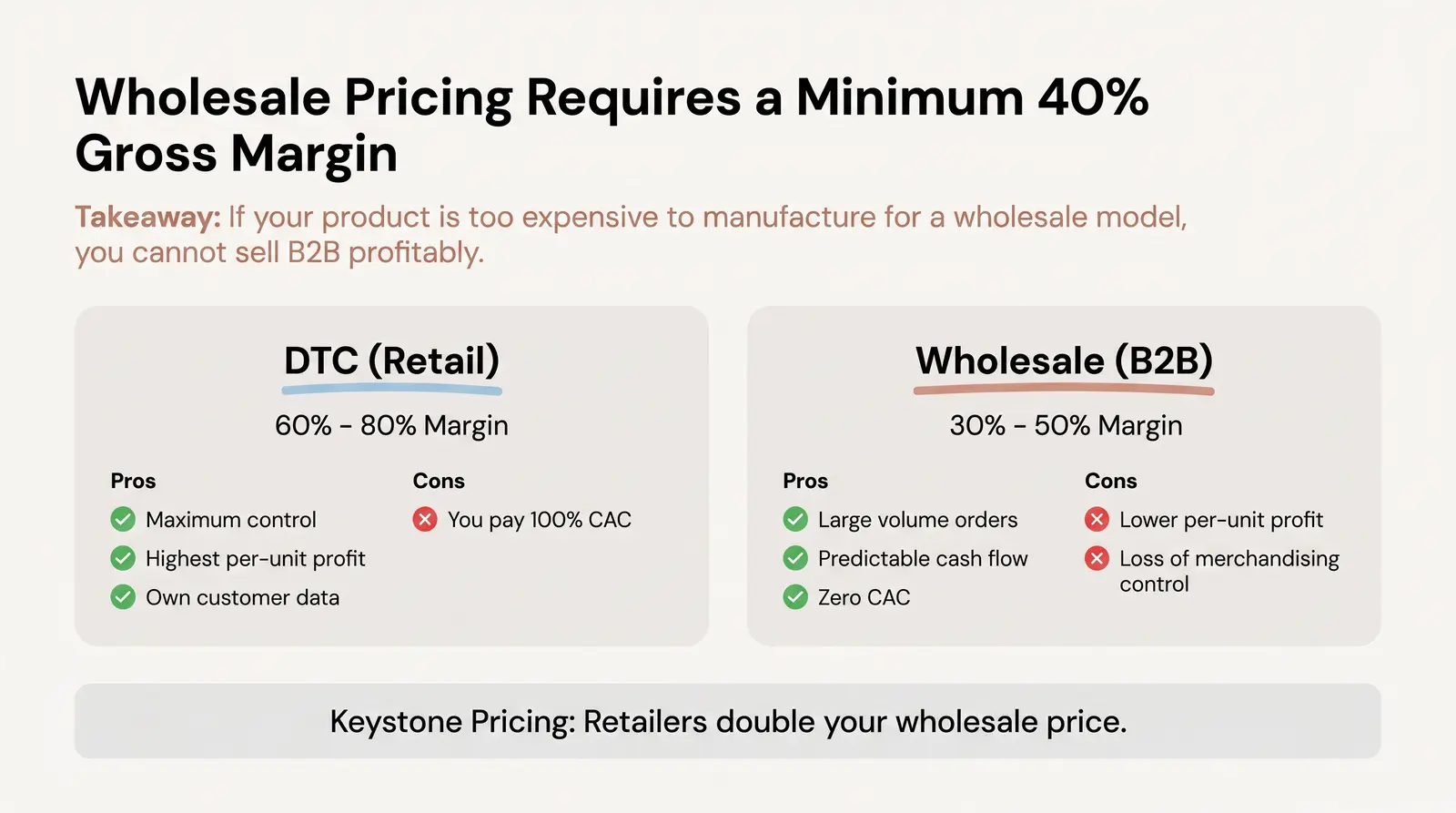
Retailers expect to make money when they sell your product. The industry standard is keystone pricing, which means the retailer will double your wholesale price to set the final retail price. If your retail price is $100, your wholesale price must be $50.
This means your product must be cheap enough to produce that you can sell it for $50 and still make a profit.
| Pricing Model | Typical Margin | Pros | Cons | Best For |
|---|---|---|---|---|
| DTC (Retail) | 60% – 80% | Maximum control, highest per-unit profit, own the customer data. | You pay 100% of the marketing and acquisition costs. | Brands building community and recurring revenue. |
| Wholesale (B2B) | 30% – 50% | Large volume orders, predictable cash flow, zero CAC. | Lower per-unit profit, loss of control over merchandising. | Brands with efficient manufacturing and high production capacity. |
The Minimum Viable Wholesale Margin: Going below a 40% gross margin on wholesale orders is usually a red flag. If your product costs $35 to make, your wholesale price should be at least $58 (a 40% margin), which means the final retail price will be $116. If the market won't support a $116 retail price, your product is too expensive to manufacture for a wholesale model.
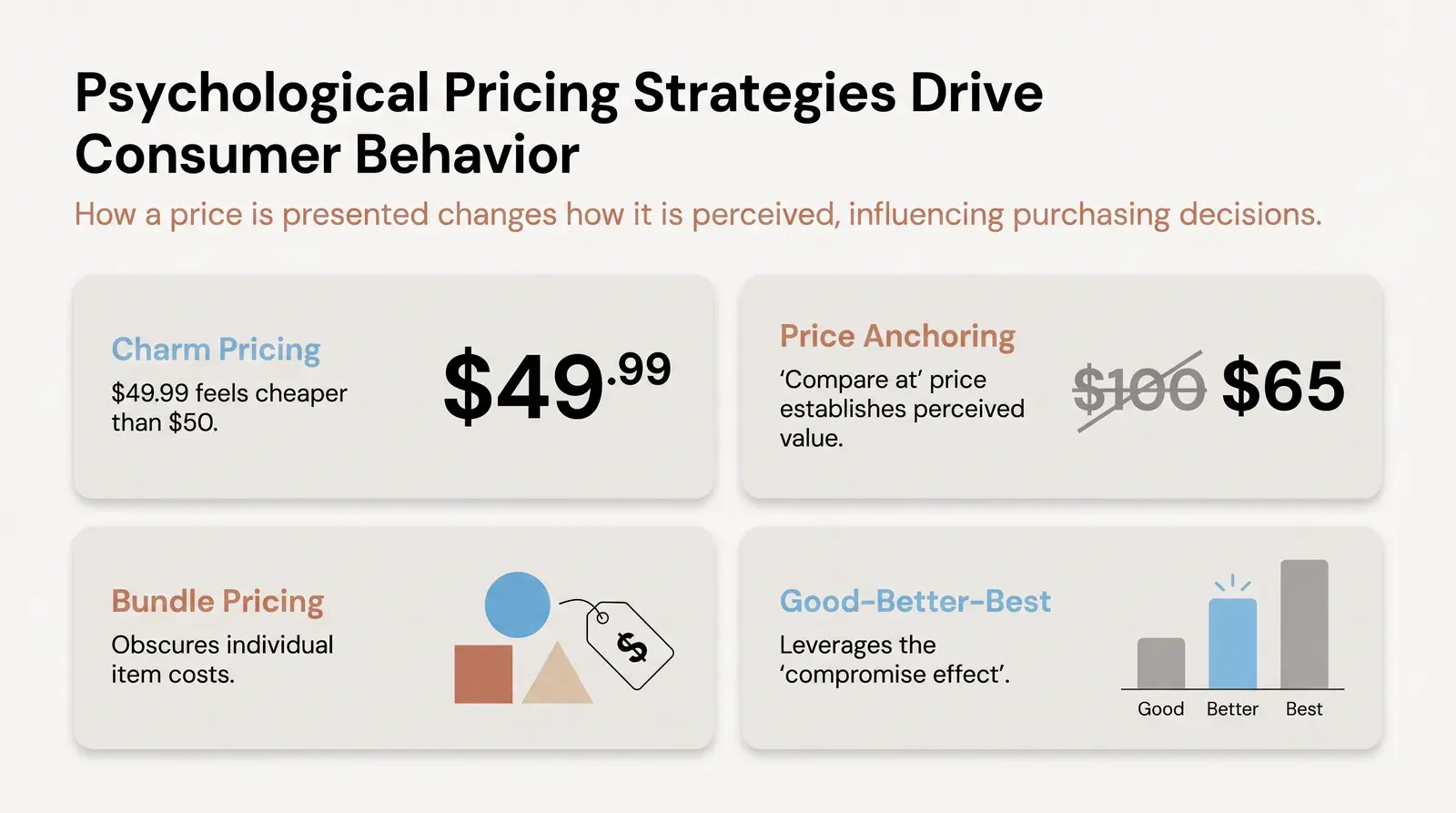
Pricing is not just math; it is psychology. How a price is presented changes how it is perceived. Here are the strategies backed by behavioral economics that actually move the needle.
Charm Pricing and the Left-Digit Effect
As mentioned in the CAPA framework, pricing an item at $49.99 instead of $50.00 works. Research published in the Journal of Consumer Research confirms that consumers read prices from left to right, anchoring heavily on the first digit. The brain processes $49.99 as "forty-something," making it feel significantly cheaper than $50 [7].
Price Anchoring
Anchoring relies on the cognitive bias where humans rely too heavily on the first piece of information offered. By displaying a higher "Compare at" price (e.g., "$100 $65"), you establish the product's value at $100, making the $65 price feel like a compelling discount rather than an absolute cost.
Bundle Pricing
Bundling obscures the individual cost of items, making it harder for consumers to comparison shop. Selling a necklace, bracelet, and earrings together for $120 feels like a better deal than buying them individually for $45 each, while simultaneously increasing your Average Order Value.
The "Good-Better-Best" Tiered Structure
Offering three tiers of a product leverages the "compromise effect." Consumers tend to avoid the cheapest option (fear of low quality) and the most expensive option (fear of overspending), naturally gravitating toward the middle "Better" option. This strategy effectively guides customers to your target price point [8].
Scarcity and Urgency
Limited-time pricing or limited-quantity drops trigger FOMO (Fear Of Missing Out). While highly effective, there are ethical limits. Fake countdown timers or artificial scarcity erode brand trust. Use urgency honestly — such as true limited-edition runs or seasonal pricing windows.
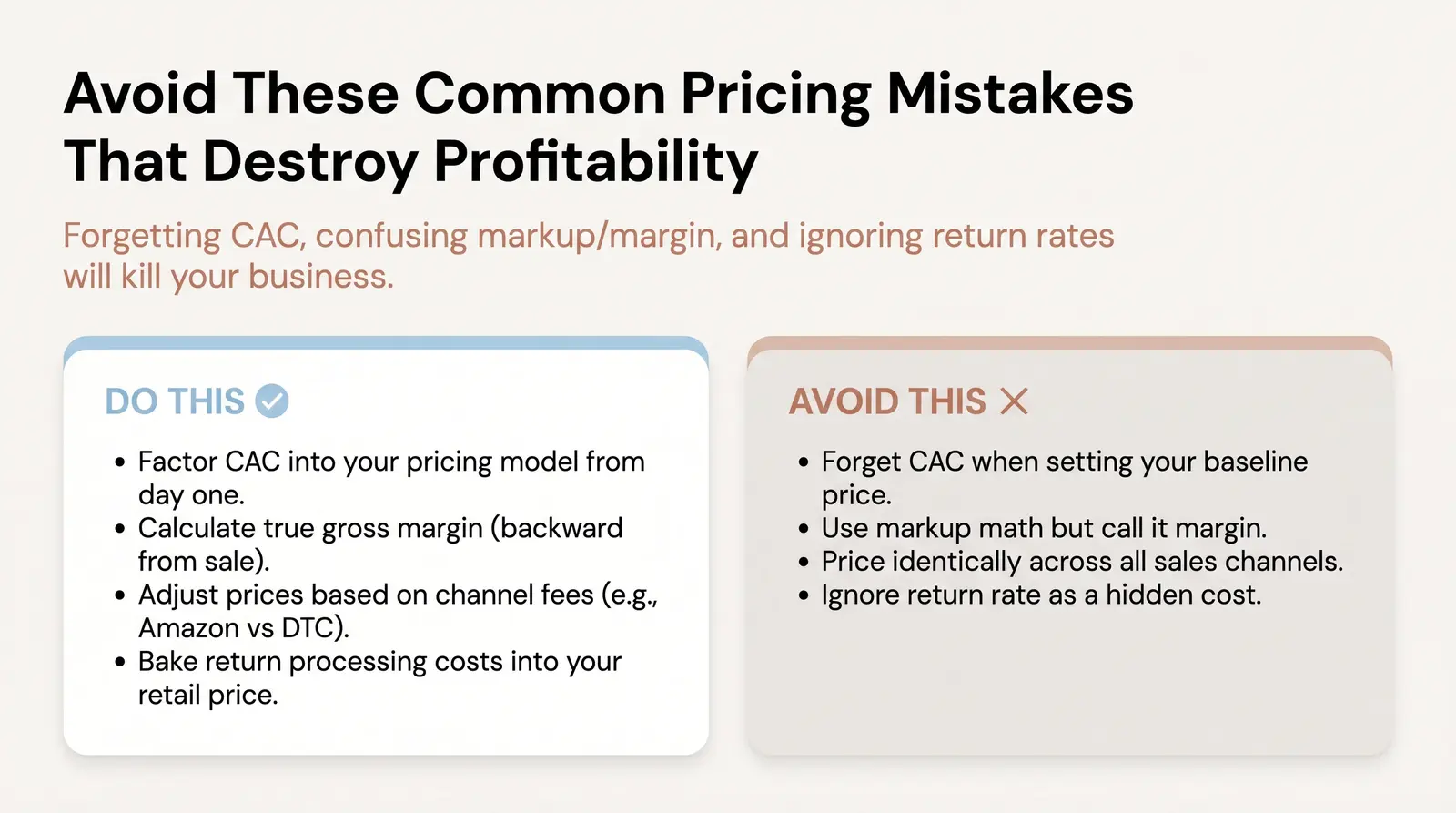
Even experienced operators get pricing wrong. Here are the most common mistakes that destroy profitability:
1. What is the difference between retail price and wholesale price?
Retail price is the final price paid by the end consumer when buying from a store or website. Wholesale price is the discounted price charged to retailers or distributors who buy in bulk with the intention of reselling the product. Wholesale prices are typically 50% of the retail price.
2. What is a good profit margin for an online store?
For a direct-to-consumer (DTC) ecommerce brand, a healthy gross profit margin typically falls between 60% and 80%. This leaves enough room to cover customer acquisition costs (CAC), platform fees, and operational overhead while still generating a net profit of 10% to 20%.
3. How do I calculate retail price from cost?
To calculate retail price based on a target margin, use the formula: Retail Price = Cost / (1 - Target Margin Percentage). For example, if your product costs $20 and you want a 60% margin, the calculation is $20 / (1 - 0.60) = $50.
4. What is MSRP and do I have to follow it?
MSRP stands for Manufacturer's Suggested Retail Price. It is the price the manufacturer recommends retailers charge for the product to maintain brand value and standardize pricing. While retailers are generally not legally required to follow MSRP, consistently pricing below it may cause the manufacturer to stop supplying you.
5. How does pricing change across different ecommerce platforms?
Different platforms charge different fees, which impacts your net margin. Shopify charges around 2.9% + 30¢ per transaction, while Amazon takes a 15% referral fee plus FBA fulfillment costs. To maintain profitability, sellers often adjust their retail prices or offer different product bundles depending on the channel.
Retail price is not a guess — it's a system. Setting the right price requires a deep understanding of your true costs, the mathematical difference between markup and margin, and the psychological triggers that drive consumer behavior.
By applying the CAPA Pricing Stack — establishing your Cost floor, setting a competitive Anchor, layering on Psychology, and Adjusting for the channel — you can build a pricing strategy that protects your margins and fuels sustainable growth.
If you're ready to launch a product brand in one of the highest-margin categories available to ecommerce sellers today, explore how Branvas works at branvas.com/how-it-works — or head to the Branvas Academy for more free resources on building a profitable brand from scratch. You can also explore our catalog and pricing to see how we support influencers and creators as well as ecommerce and boutique store owners.


