


This supplier-written guide explains what dropshipping is, how the order flow works, realistic margin structures, common misconceptions, and why private-label branding is the key to profitability.
Published:
April 25, 2026
Author:
Yi Cui
Most "what is dropshipping" articles are written by affiliate bloggers trying to sell courses. This one is written by an actual supplier, which means you'll learn what the model really looks like from the inside, not from the sales pitch.
That difference matters. When you read about dropshipping from someone who profits from your confusion, you get a curated version of the truth. When you read it from someone who actually fulfills the orders, you get the full picture: the mechanics, the margins, the misconceptions, and the parts most guides quietly skip over.
Dropshipping is a retail fulfillment method where a seller lists and sells products online without holding any inventory, forwarding each customer order to a third-party supplier who ships the item directly to the buyer. The seller collects the retail price, pays the supplier the wholesale cost, and keeps the difference as profit [1].
That definition is designed to stand on its own. But here is a slightly fuller picture for those who want more context.
The seller operates the customer-facing storefront: the website, the product listings, the checkout, and the customer service. The supplier operates everything behind the scenes: the warehouse, the quality control, the packaging, and the physical shipment. The two parties never need to be in the same room, or even the same country.
It is worth being clear about what dropshipping is not. It is not a pyramid scheme or a multi-level marketing model. It is not the same as affiliate marketing, where you earn a commission by sending traffic to someone else's store. In dropshipping, you are the merchant of record: you set your own prices, process payments in your own name, and own the customer relationship. It is also not a model where you pre-purchase inventory in bulk. You only pay for a product after a customer has already paid you.

The dropshipping process involves four nodes and three transfers. Understanding what moves between each node, and when, is the foundation of understanding the business model.
+------------------+
|    CUSTOMER      |
+------------------+
        |
        | (1) Pays retail price ($65)
        |     Provides shipping address
        v
+------------------+
|  YOUR STOREFRONT |
+------------------+
        |
        | (2) Forwards order details
        |     Pays wholesale cost ($16.50)
        v
+------------------+
|    SUPPLIER      |   <-- Branvas
| (Branvas)        |
+------------------+
        |
        | (3) Picks, packs, and ships
        |     Physical product in your branded packaging
        v
+------------------+
|    CUSTOMER      |
+------------------+
Step 1: Customer to Storefront. The customer discovers your store, browses your product listings, and completes a purchase at your retail price. From their perspective, they are buying from your brand. They provide their payment details and shipping address.
Step 2: Storefront to Supplier. Once the payment clears, your store forwards the order details to your supplier. If you use an integration like Shopify with a dropshipping app, this step is automated. You pay the supplier their wholesale price plus shipping. The difference between what the customer paid and what you pay the supplier is your gross margin.
Step 3: Supplier to Customer. The supplier picks the product from their warehouse, packs it (ideally in your branded packaging), and ships it directly to the customer using a carrier like FedEx, UPS, or a regional postal service. The tracking number is passed back to your store and on to the customer.
In our experience at Branvas, the step most new sellers underestimate is the handoff between order confirmation and fulfillment. That is exactly where supplier reliability separates profitable stores from frustrating ones. A supplier who takes four days to process an order and uses slow untracked shipping will generate customer service tickets that eat your margins and your time.

One of the most appealing aspects of dropshipping is the cash flow structure. You collect the customer's payment before you pay the supplier. That means you are never out of pocket for inventory. You do not need a credit line to stock a warehouse. You do not tie up capital in products that might not sell.
However, that low barrier to entry does not mean the model is without cost. You still pay for marketing, platform fees, transaction fees, and packaging. Understanding how these layers stack up is the difference between a profitable store and a store that looks busy but loses money.
The Branvas Margin Stack Model is a simple layered framework that shows exactly how a retail price breaks down into actual take-home profit. Every layer represents a real cost that must be accounted for before you can call something a margin.
| Layer | What It Covers | Jewelry Example: Private-Label Necklace |
|---|---|---|
| Retail Price | What the customer pays at checkout | $65.00 |
| (1) Supplier Cost | Wholesale cost of the physical product | -$12.00 |
| (2) Packaging and Branding | Custom box, branded insert card, tissue paper | -$2.50 |
| (3) Shipping Cost | Postage from supplier warehouse to customer | -$4.00 |
| (4) Platform and Transaction Fees | Shopify subscription + credit card processing (~3%) | -$1.95 |
| (5) Marketing / CAC Allocation | Cost to acquire this customer via ads or influencer spend | -$20.00 |
| Net Margin | Your actual profit after all expenses | $24.55 (37.7%) |
These numbers are realistic for a private-label jewelry brand with a moderate customer acquisition cost. If your CAC is lower (for example, because you have an organic social following), your net margin improves significantly. If your CAC is higher because you are running cold traffic ads with no brand recognition, it compresses fast.
Across general merchandise dropshipping categories, average net margins typically range from 10% to 20% [2]. Jewelry sits in a more favorable position. Because it is an emotional, gift-driven purchase with high perceived value, jewelry can support gross margins of 60% to 80%, leaving net margins of 20% to 40% after marketing costs, depending on your acquisition efficiency [3].
The key variable is always customer acquisition cost. A product with a 70% gross margin and a $40 CAC is less profitable than a product with a 50% gross margin and a $10 CAC. Build your margin model before you build your store.

Most dropshipping guides are written from the seller's perspective. Here is what the supplier side actually looks like.
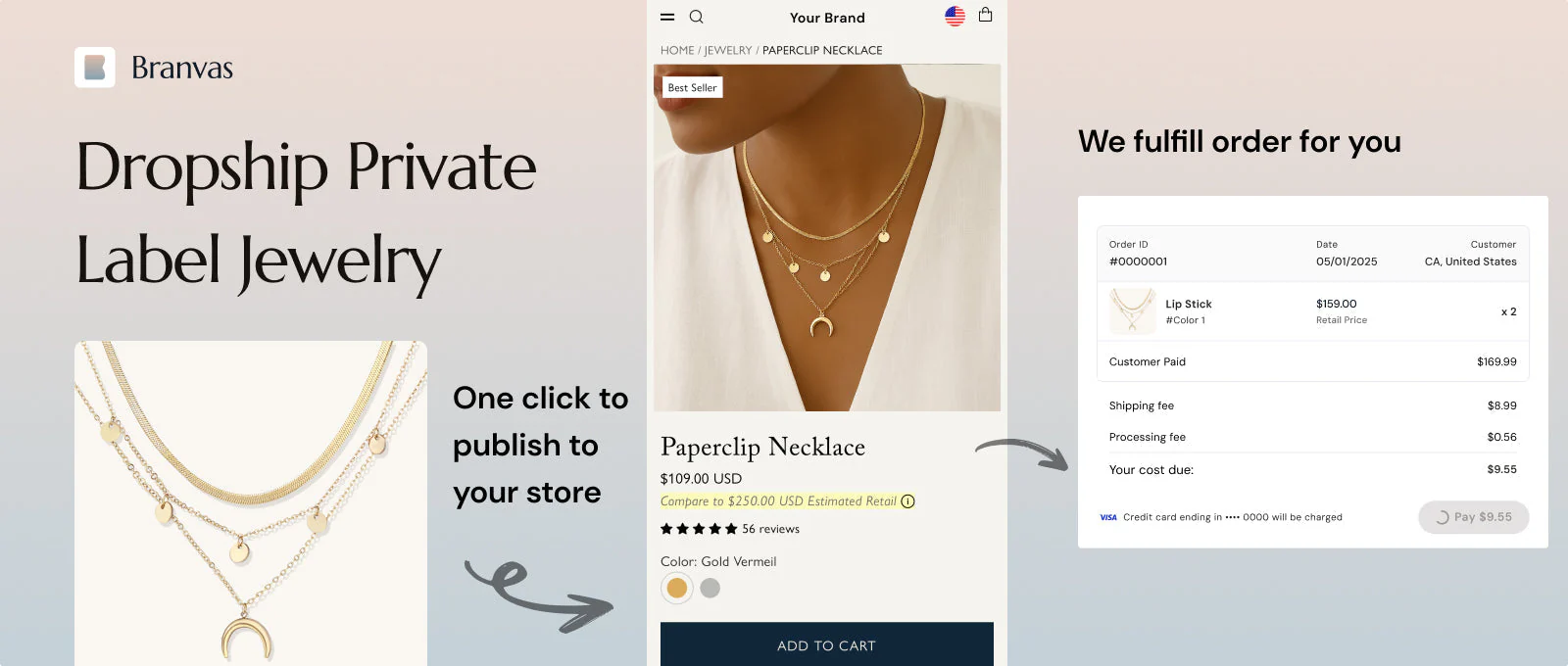
When an order comes in, the supplier's team (or their warehouse management system) receives the order data, locates the correct SKU in their inventory, and initiates the pick-and-pack process. For a private-label order, this means pulling the product, placing it in a branded box with custom inserts, applying the correct shipping label, and handing it to the carrier. For a high-volume supplier, this happens dozens or hundreds of times per day, across multiple seller accounts.
A critical part of this process is blind shipping. Blind shipping is a logistics method where the supplier ships the product directly to the customer, but the supplier's identity is completely hidden from the package [4]. The return address, packing slip, and any documentation show your brand's name and address, not the supplier's. The customer receives the package and believes it came directly from your brand. This is standard practice in dropshipping and is essential for maintaining brand credibility.
The distinction between generic dropshipping and private-label dropshipping matters enormously here.
Generic dropshipping means the supplier ships a product in a plain polymailer or generic brown box. The product itself is unbranded. Anyone with access to the same supplier can sell the exact same item in the exact same packaging. There is no brand differentiation. The only lever you have is price, and that is a race you cannot win.
Private-label dropshipping, which is what Branvas provides, means the supplier ships the product in your custom-branded packaging: your logo on the box, your insert card inside, your brand's return address on the label. The customer's experience is entirely consistent with your brand identity, even though you never touched the package. This is how you build a real brand on a dropshipping infrastructure.
If you want to understand how private-label fulfillment actually works in practice, Branvas's How It Works page walks through the exact process step by step.

The internet has produced a remarkable volume of bad advice about dropshipping. Most of it comes from people who profit from selling you the idea of dropshipping, not from people who actually run the supply chain. Here is the reality, from the supplier side.
Myth 1: "Dropshipping is passive income."
Reality: Dropshipping is an active retail business. The fulfillment is outsourced, but the marketing, customer service, product research, supplier management, and store optimization are entirely your responsibility. Industry data consistently shows that over 90% of dropshipping businesses fail within their first few months, and the primary reason is not competition or bad products. It is founders treating the model as a passive investment rather than a real business [5]. If you are not prepared to work on your store daily, dropshipping will not work for you.
Myth 2: "You don't need to worry about product quality. That's the supplier's problem."
Reality: The customer does not know your supplier exists. When a necklace arrives tarnished, when a ring breaks after two wears, or when a package arrives looking like it was packed by someone who did not care, the customer blames your brand. You are the merchant of record. You own the customer relationship and the reputation. Poor quality leads to chargebacks, negative reviews, and eventually banned ad accounts. Vetting your supplier's quality control process is not optional. It is the most consequential operational decision you will make.
Myth 3: "Margins are always thin and it's not worth it."
Reality: Margins are thin when you sell commoditized products in a race-to-the-bottom market. If you sell generic phone cases or unbranded phone chargers, you will be undercut by Amazon on day one. But if you sell high-perceived-value products like jewelry and invest in brand presentation, the margin picture changes entirely. Private-label jewelry sellers can achieve net margins of 25% to 40% on well-optimized stores [3]. The margin problem is a product and positioning problem, not a structural problem with the model.
Myth 4: "Anyone can succeed at dropshipping quickly."
Reality: The barrier to entry is low, which is precisely why the barrier to success is high. Because anyone can open a Shopify store and list products from a supplier, the market is flooded with undifferentiated stores competing on the same products. Sustainable success requires mastering paid advertising, SEO, email marketing, conversion rate optimization, and customer retention. None of those skills are acquired quickly. The founders who succeed treat dropshipping as a long-term brand-building exercise, not a shortcut.
Myth 5: "The biggest competitive advantage is finding a secret winning product."
Reality: This is the most dangerous myth in dropshipping, and it is worth spending a moment on it. The idea of a secret product, one that nobody else has found yet, is almost entirely fictional. Product spy tools like Minea and AdSpy surface winning products within days of their first ad run. If a product is selling, your competitors know about it.
The actual biggest competitive moat in dropshipping is brand perception. A customer who trusts your brand will pay more, return more often, and refer others. Custom packaging and private-label presentation are the lowest-cost levers available to build that trust. Research from ScaleOrder found that investing in brand presentation, including custom packaging and story-driven visuals, can justify 10% to 30% higher pricing without increasing ad spend [3]. That is a direct margin improvement with no additional cost per acquisition. The sellers who understand this are the ones still operating profitably three years from now.

Dropshipping is not the right model for every seller or every situation. The honest answer depends on your starting point, your goals, and your tolerance for the specific risks the model carries.
To help you think through the fit, we built The Branvas Dropshipping Fit Matrix: a straightforward assessment of how the model performs for different seller profiles across the factors that matter most.
| Seller Profile | Capital Required | Brand Control | Time to First Sale | Supplier Dependency Risk | Recommended Model |
|---|---|---|---|---|---|
| Influencer / Creator with existing audience | Low | High | Fast (days to weeks) | Moderate | Private-label dropshipping. Your audience already trusts you. Branded packaging converts that trust into revenue. |
| First-time ecommerce entrepreneur | Low to Moderate | Medium | Moderate (weeks to months) | High | Start with dropshipping to learn marketing and operations without inventory risk. Transition to private-label once you find a winning product. |
| Boutique or ecommerce store owner expanding online | Low | High | Fast | Low | Hybrid model: keep your core inventory in-house, use dropshipping to expand your catalog without upfront stock. |
| Side hustler with limited capital | Low | Low to Medium | Slow (months) | High | Generic dropshipping to test product-market fit. Reinvest early profits into private-label branding once a niche is validated. |
We often see founders struggle with the gap between their first few sales and building something sustainable. The ones who close that gap are the ones who recognize early on that dropshipping is a fulfillment method, not a business model in itself. The business model is the brand you build on top of it.

This article is the starting point. Here is where to go depending on what you need next.
If you are just getting started and want to understand the fundamentals before you spend a dollar, the Branvas Academy has step-by-step guides covering everything from setting up your first store to writing product descriptions that convert.
If you want to understand your costs before you commit, the Pricing page shows exactly what Branvas charges, and the Profit Calculator lets you model your margin stack with real numbers before you launch.
If you want to see what you can actually sell, the Branvas Catalog shows the full range of private-label jewelry and accessories available for dropshipping, with wholesale pricing visible after signup.
If you are a creator or influencer with an existing audience, the Influencers and Creators solutions page explains how to turn your following into a revenue stream with a branded jewelry line, without holding a single piece of inventory.
If you run a boutique or ecommerce store and want to add jewelry to your catalog, the Ecommerce and Boutique Store Owners page covers how to integrate Branvas with your existing Shopify or WooCommerce store.
If you are starting from scratch with no store, no audience, and no experience, the Aspiring Entrepreneurs page is the right place to start. It covers the minimum viable setup and realistic timelines.
If you want to see the full end-to-end process, the How It Works page walks through every step from product selection to customer delivery, with no steps skipped.
If you are ready to build your brand identity, the Brand Studio is where you upload your logo, choose your packaging, and create the visual identity that will show up in every customer's mailbox.
Ready to launch your own jewelry brand without holding inventory? See how Branvas works, from first product to first sale.
Q: What is dropshipping in simple terms?
A: Dropshipping is a way to sell products online without buying or storing any inventory. When a customer places an order on your store, you forward that order to a supplier who ships the product directly to the customer. You keep the difference between what the customer paid and what you paid the supplier.
Q: How does dropshipping work step by step?
A: The process has three core steps. First, a customer purchases a product from your online store at your retail price. Second, you forward the order details to your supplier and pay the wholesale cost. Third, the supplier packs and ships the product directly to the customer, often in your branded packaging. The customer receives the order and the transaction is complete.
Q: Is dropshipping still profitable in 2026?
A: Yes, but the conditions for profitability have changed. Selling generic, unbranded products with long shipping times is no longer a viable strategy. Profitable dropshipping in 2026 requires a clearly defined niche, high-margin products (jewelry is a strong example), private-label branding to justify premium pricing, and disciplined customer acquisition. Sellers who treat it as a brand-building exercise rather than a product arbitrage game are the ones generating consistent returns.
Q: What is the difference between dropshipping and private-label dropshipping?
A: Standard dropshipping involves selling generic products that any other seller can list from the same supplier, with no branding differentiation. Private-label dropshipping means the products ship in your custom-branded packaging with your logo, inserts, and brand identity. The supplier still handles fulfillment, but the customer experience is entirely consistent with your brand. Private-label dropshipping commands higher prices and builds customer loyalty in a way that generic dropshipping cannot.
Q: How do I start dropshipping with no money?
A: The inventory cost is eliminated in dropshipping, but other startup costs remain. You will need a budget for your ecommerce platform (Shopify starts at around $39 per month), a domain name, and some form of marketing. If you have no ad budget, organic social media and content marketing can substitute, but they require a significant time investment. Starting with zero dollars is not realistic. Starting with a few hundred dollars and a clear niche is.