


Dropshipping is a fulfillment method where suppliers ship directly to customers under your brand, and this guide covers how it works, real margins, and supplier selection.
Published:
May 2, 2026
Author:
Yi Cui
Dropshipping is a retail fulfillment method where a store doesn't keep the products it sells in stock. Instead, when a store sells a product, it purchases the item from a third-party supplier who ships it directly to the customer. The seller never touches the inventory.
Most "what is dropshipping" articles are written by affiliate bloggers trying to sell you a course. This one is written by an actual supplier. That means you'll learn what the model really looks like from the inside, not from the sales pitch.
At Branvas, we handle product sourcing, branding, packaging, and fulfillment for jewelry brands every single day. We see the real margins, the real challenges, and the real reasons why some brands scale to seven figures while others fail in their first month. This guide is built on that operational experience, not on recycled blog content.
Dropshipping is fundamentally a fulfillment model, not a business model in isolation. It is a logistical choice about how products move from a warehouse to a customer's door. It is not a business plan. It is not passive income. And it is certainly not a guaranteed margin.
The distinction matters because most people enter dropshipping thinking the hard part is finding a product. The hard part is actually building a brand that customers trust enough to buy from, return to, and recommend to others.
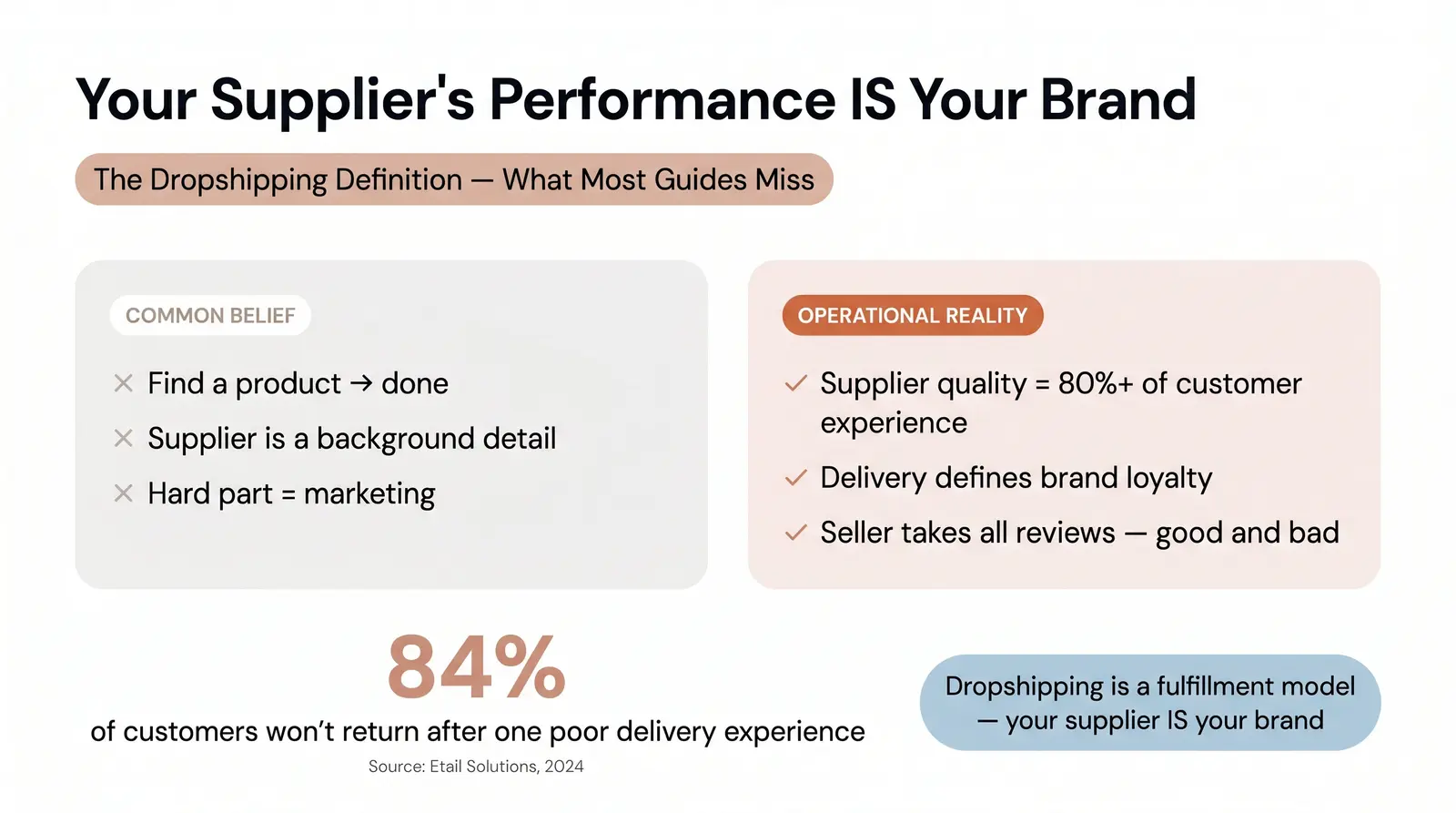
Here is the insight that most "what is dropshipping" content completely ignores: the supplier's quality, reliability, and packaging determine 80% or more of the customer experience, yet the seller gets all the reviews, good and bad. The supplier is invisible to the customer, but their performance is what the customer actually experiences.
This is not a minor operational detail. Research shows that 98% of ecommerce consumers say their delivery experience directly affects their loyalty toward a brand, and 84% will not return after just one poor delivery experience [1]. If your supplier ships a scratched necklace in a plain poly bag, your brand takes the one-star review. Not the supplier.
In our experience at Branvas, the sellers who struggle most aren't the ones with bad marketing. They're the ones who underestimated how much the supplier relationship defines their brand.
The dropshipping process is a three-party system involving the customer, the seller, and the supplier. Understanding each step helps you see where value is created and where risk lives.
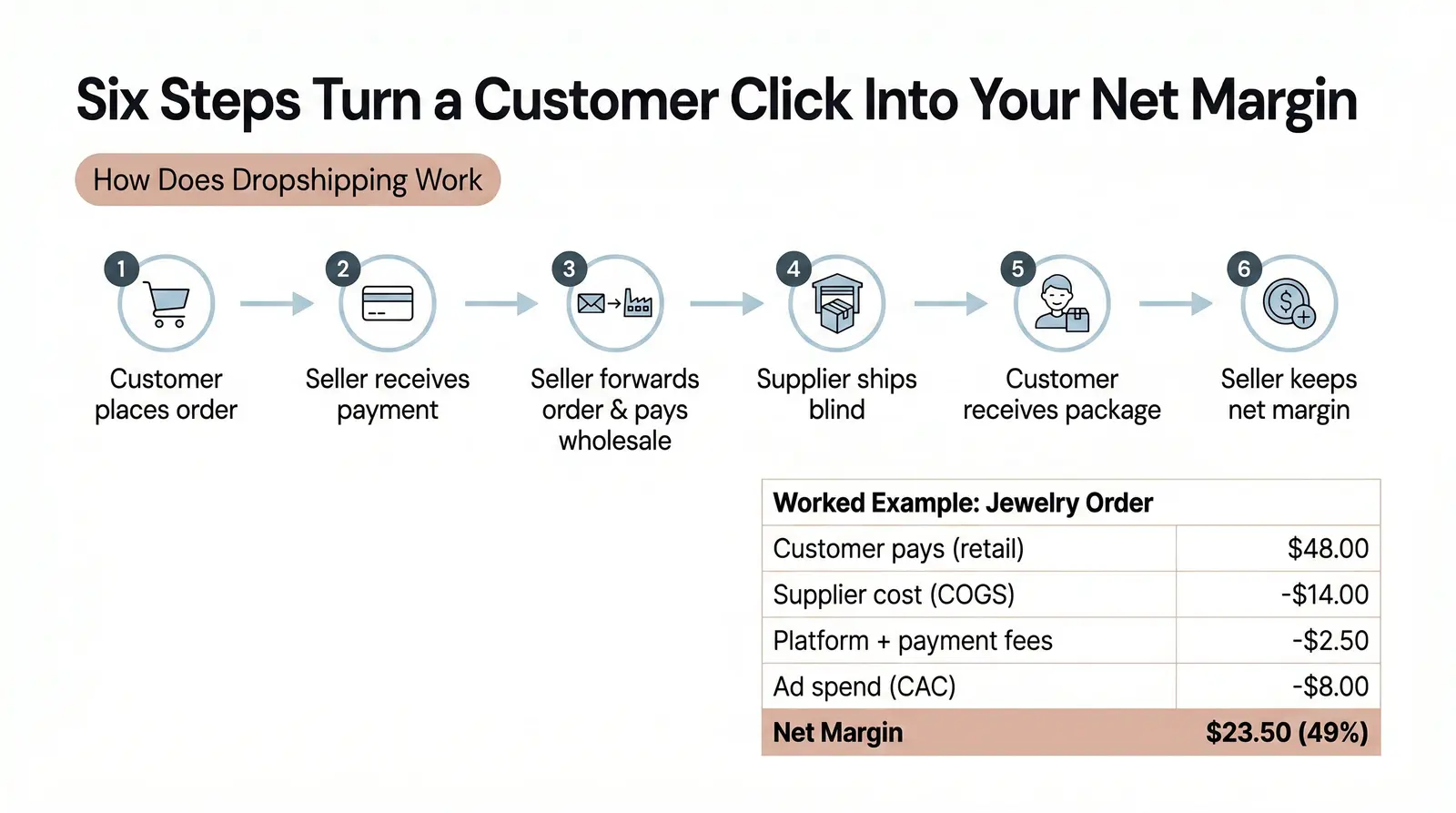
Step 1: Customer places order on seller's store. The customer browses your website, selects a product, and completes checkout. From their perspective, this is a completely normal online shopping experience.
Step 2: Seller receives payment at full retail price. The funds land in your merchant account. You now hold the customer's money before you have spent anything on fulfillment.
Step 3: Seller forwards the order and pays the supplier at wholesale cost. You transmit the order details to your supplier and pay them the agreed-upon wholesale price. The difference between what the customer paid and what you pay the supplier is your gross margin, before fees and ad spend.
Step 4: Supplier picks, packs, and ships directly to the customer using blind shipping. The supplier prepares the package using your branded materials. "Blind shipping" means the supplier's name, logo, and contact details are entirely absent from the package. The customer has no idea who fulfilled the order.
Step 5: Customer receives the package as if it came from your brand. The unboxing experience reinforces your brand identity. Done well, this is indistinguishable from a brand that owns its own warehouse.
Step 6: Seller keeps the net margin. Your profit is the retail price minus the wholesale cost, platform fees, payment processing, and the ad spend attributed to acquiring that customer.
[Customer] ----places order----> [Seller's Store]
                                        |
                              Seller forwards order
                              + pays wholesale cost
                                        |
                                        v
                               [Supplier / Branvas]
                                        |
                         Picks, packs, ships blind
                         (seller's branding only)
                                        |
                                        v
                               [Customer's Door]
Let's make this concrete with a realistic jewelry dropshipping scenario.
A customer visits a Shopify store called "Lumiere Jewels" and buys a gold-plated minimalist necklace for $48. They pay at checkout, receive an order confirmation email, and expect their package in about a week.
Here is what happens behind the scenes:
The seller receives the $48 payment. They then forward the order to Branvas, their private-label jewelry supplier, and pay $14 for the necklace, which includes the product itself and Lumiere Jewels-branded packaging. Shopify and payment processing fees come to approximately $2.50. The seller had been running Instagram ads, and the cost to acquire this specific customer is attributed at roughly $8.
The math looks like this:
| Item | Amount |
|---|---|
| Customer pays (retail price) | $48.00 |
| Supplier cost (product + packaging) | -$14.00 |
| Platform + payment fees | -$2.50 |
| Ad spend (attributed CAC) | -$8.00 |
| Net margin | $23.50 (49%) |
The package arrives at the customer's door in Lumiere Jewels-branded tissue paper and a custom jewelry box. There is no mention of Branvas anywhere on the package. This is the essence of blind shipping: it protects your brand equity and ensures the customer's relationship is entirely with your store, not with your supply chain.
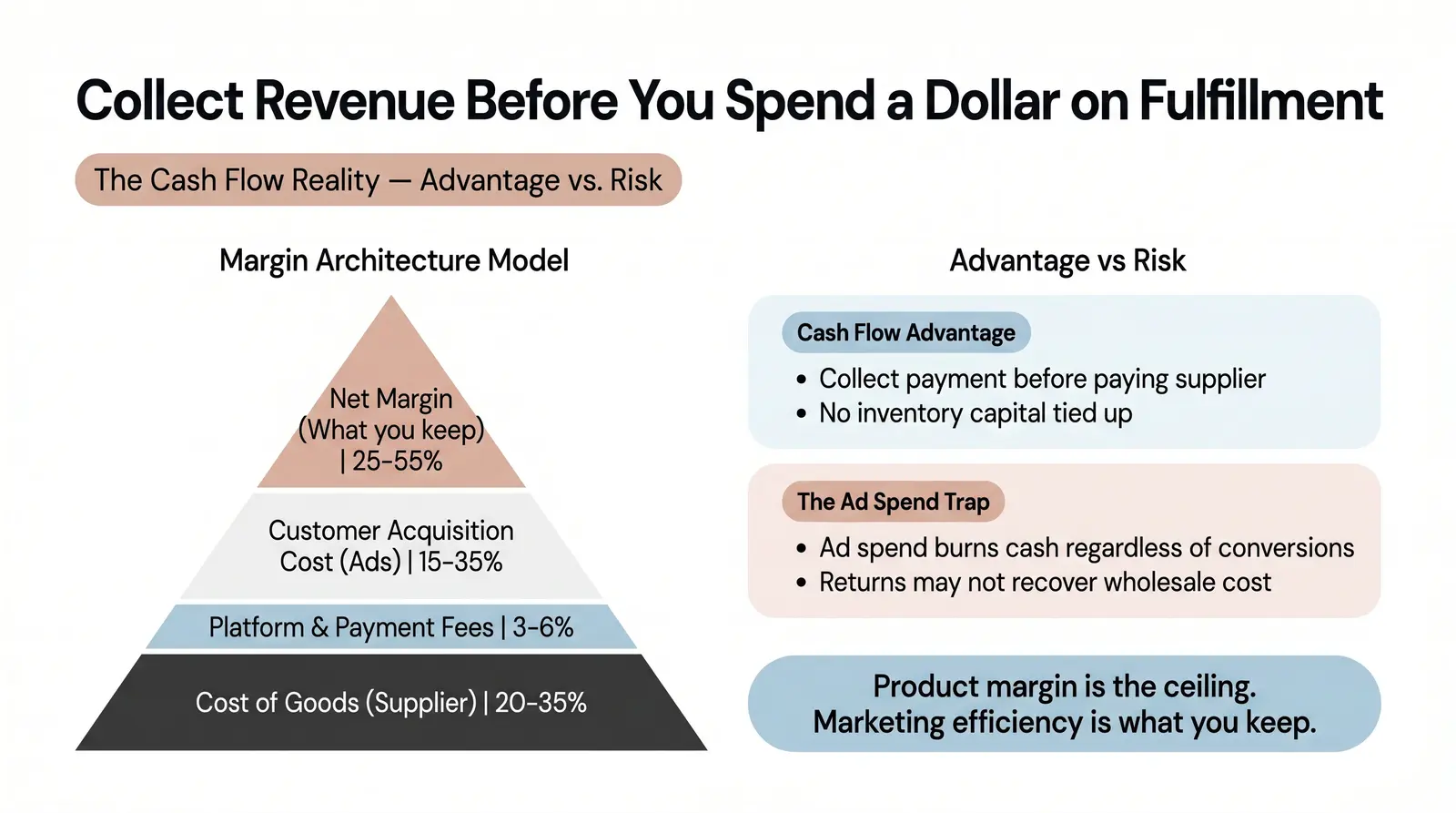
One of the most structurally attractive features of dropshipping is the cash flow timing advantage. You collect revenue from the customer before you pay the supplier. In traditional retail, you buy inventory upfront, sometimes months in advance, and then wait to sell it. In dropshipping, the customer funds each order before you spend a dollar on fulfillment.
This is a genuine advantage, especially for early-stage brands with limited capital. It means you can test products, validate demand, and generate revenue without tying up cash in a warehouse.
However, the model also carries a real cash flow risk that first-time founders consistently underestimate. Advertising spend is not tied to order conversion. You pay for clicks, impressions, and influencer placements regardless of whether those efforts produce sales. A seller running $500 per day in Facebook ads can go cash-flow negative very quickly if their conversion rate drops or their cost per acquisition spikes.
The other cash flow trap is returns. When a customer returns a product, you typically refund them in full. Depending on your supplier agreement, you may or may not recover the wholesale cost. In jewelry, return rates are generally lower than in apparel, which is one of the reasons the category is attractive for dropshipping.
To understand the true economics of a dropshipping business, we use the Branvas Margin Architecture Model.
The Branvas Margin Architecture Model
A simple 4-layer framework for understanding dropshipping unit economics:
Layer What It Is Typical % of Retail Price 1. Cost of Goods (COGS) What you pay the supplier 20-35% 2. Platform and Payment Fees Shopify, Stripe, etc. 3-6% 3. Customer Acquisition Cost (CAC) Paid ads, influencer cuts 15-35% 4. Net Margin What you keep 25-55% Jewelry and accessories consistently land in the upper range of net margin (40-55%) when sourced at private-label wholesale prices, making it one of the highest-margin dropshipping categories available.
We often see first-time founders focus entirely on the product margin and forget CAC entirely, then wonder why they're not profitable at $10,000 in revenue. The product margin tells you the ceiling. Your actual marketing efficiency tells you what you'll keep.
Most dropshipping content treats the supplier as a commodity. Find the cheapest one, plug it into your store, and move on. This is the single most common reason dropshipping businesses fail.
A dropshipping supplier is the operational backbone of your brand. They manage inventory levels, conduct quality control on outgoing products, execute pick-and-pack operations, coordinate carrier relationships, and often handle returns processing. Every one of these functions directly affects what your customer experiences.
The critical distinction in 2026 is between two fundamentally different types of suppliers.
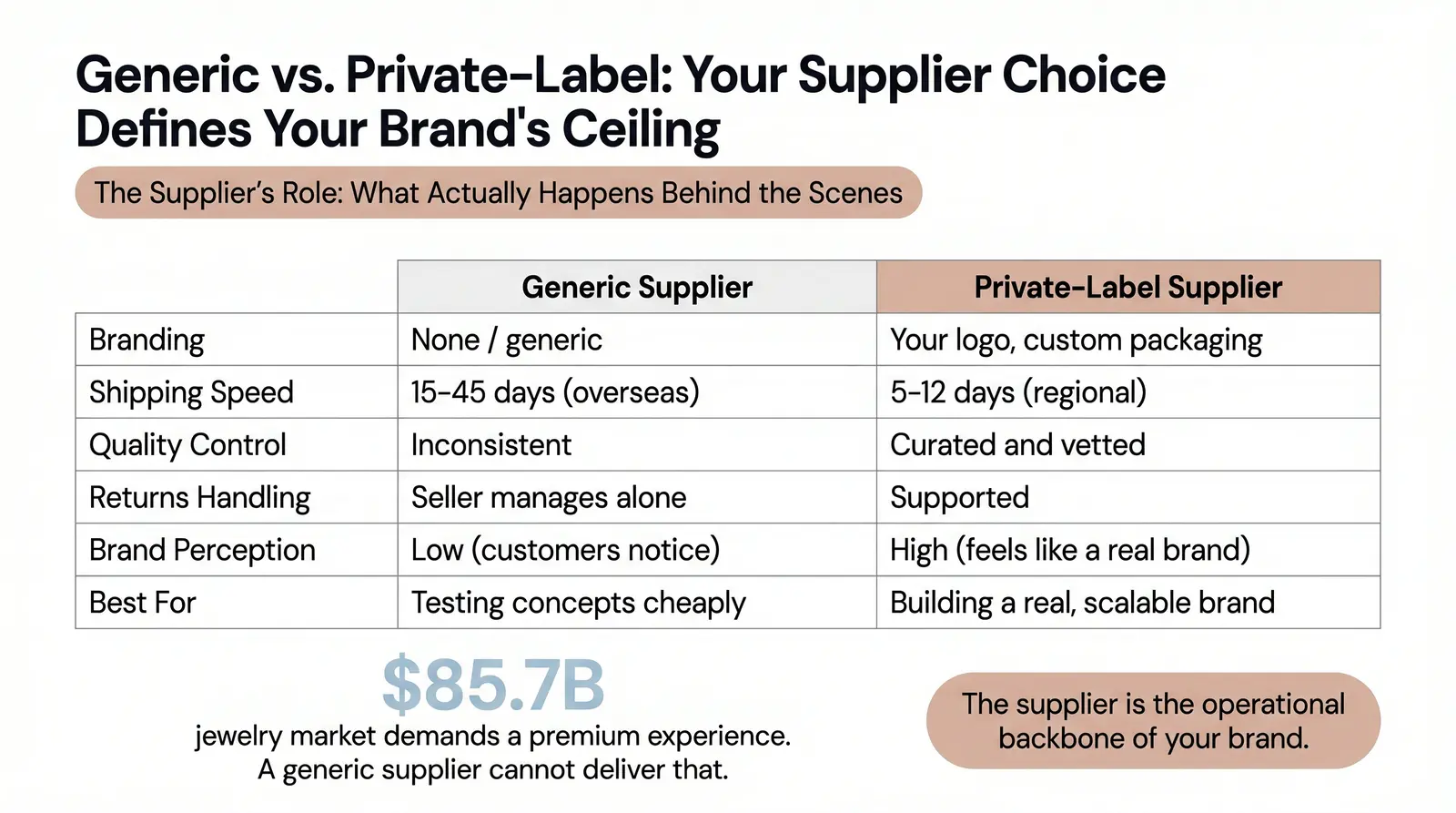
Generic or commodity suppliers, most commonly associated with AliExpress-style platforms, offer access to a vast catalog of products at very low wholesale prices. The trade-offs are significant: no branding capability, shipping times that routinely run 15 to 45 days from overseas warehouses, inconsistent product quality from batch to batch, and no support infrastructure when something goes wrong. This model can work for rapid product testing, but it is very difficult to build a brand on top of it.
Private-label suppliers like Branvas operate on a different premise entirely. The product arrives in your branded packaging. Fulfillment is handled from regional warehouses, bringing shipping times down to 5 to 12 days. Products are curated and quality-checked before they enter the catalog. And when a customer has a problem, there is a support process in place.
| Factor | Generic Supplier | Private-Label Supplier (e.g., Branvas) |
|---|---|---|
| Branding | None / generic | Your logo, custom packaging |
| Shipping Speed | 15-45 days (often overseas) | 5-12 days (varies by region) |
| Product Quality Control | Inconsistent | Curated and vetted |
| Returns Handling | Seller manages alone | Supported |
| Brand Perception | Low (customers notice) | High (feels like a real brand) |
| Best For | Testing concepts cheaply | Building a real, scalable brand |
The global online jewelry market is projected to reach $85.7 billion in 2026, growing at a CAGR of approximately 13% [5]. That growth is being driven by consumers who expect a premium experience even when shopping online. A generic supplier cannot deliver that experience. A private-label partner can.
If you're evaluating jewelry suppliers, Branvas's catalog includes curated private-label pieces ready to ship under your brand, with no minimum order quantity required to get started.
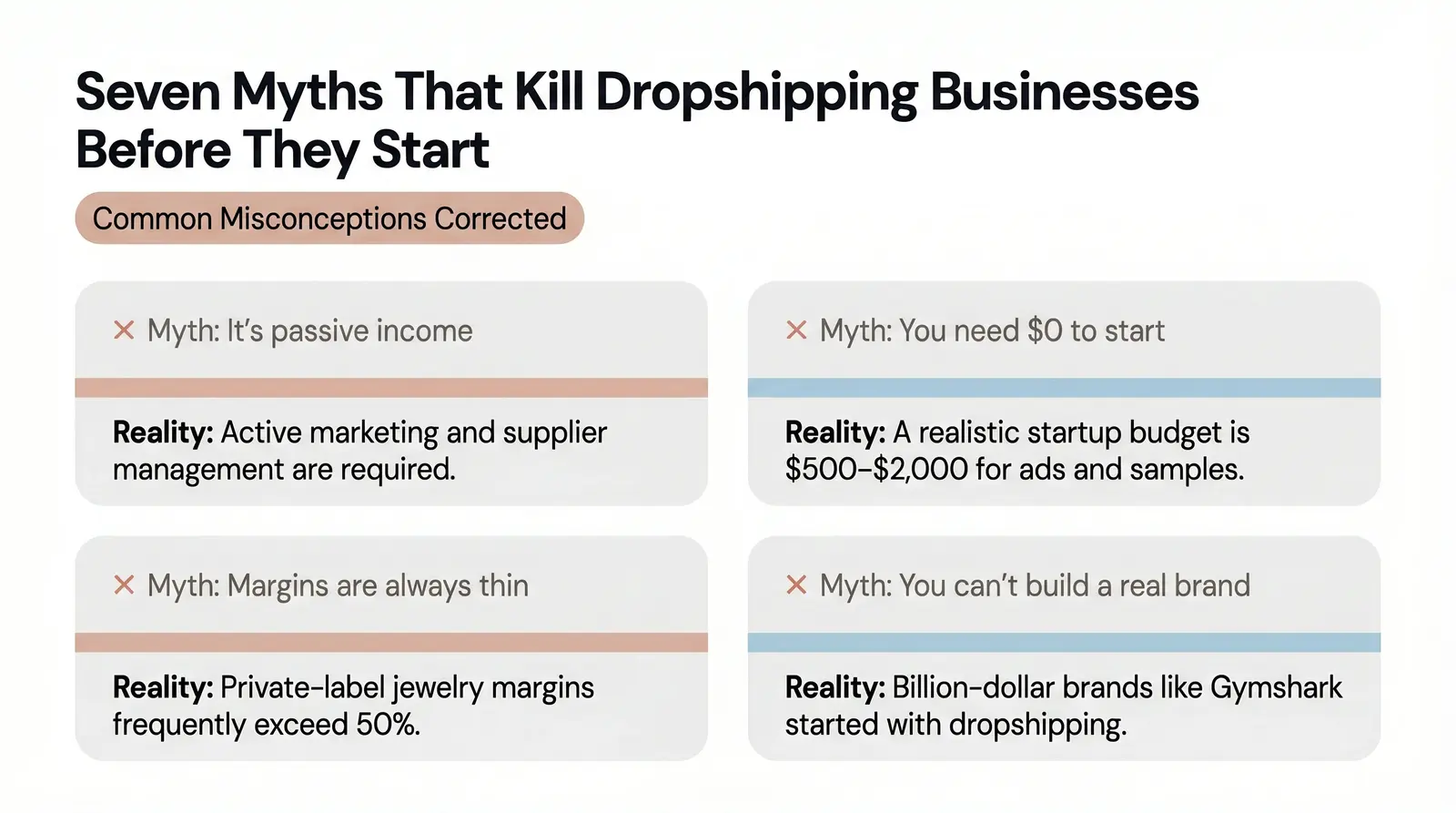
The dropshipping industry attracts more misinformation than almost any other area of ecommerce. Here are the seven misconceptions we encounter most often, corrected with honest context.
1. "Dropshipping is passive income."
It is not. While you don't handle physical inventory, you are actively managing marketing campaigns, customer service inquiries, supplier relationships, and store optimization. The sellers who treat it as passive income are the ones who fail. The sellers who treat it as a real business are the ones who scale.
2. "You need no money to start."
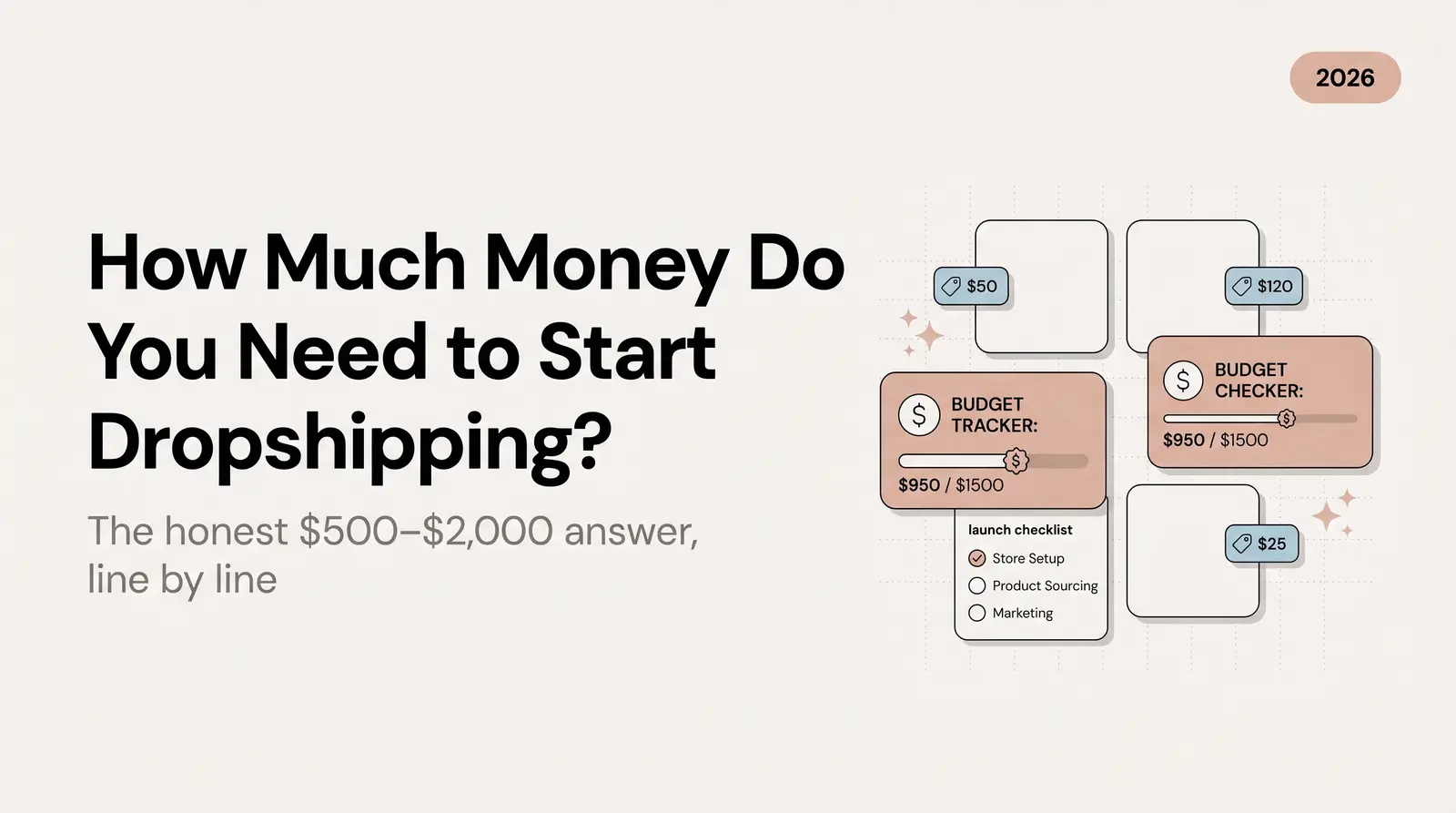
You don't need capital for inventory, but you absolutely need money for advertising, Shopify subscription fees, domain registration, email marketing tools, and product samples to verify quality before you sell. A realistic startup budget for a focused jewelry dropshipping store is $500 to $2,000, depending on your marketing approach.
3. "Anyone can do it with no skills."
Brand positioning, product selection, copywriting, paid media management, and customer retention are real, complex skill sets. The barrier to entry is lower than traditional retail, but the barrier to profitability is not zero. The skills required are learnable, but they take time.
4. "The margins are always thin."
This depends entirely on the product category and the type of supplier you use. In jewelry, margins can frequently exceed 50% when using a private-label supplier at wholesale pricing. The Branvas Margin Architecture Model above shows exactly how this works. Thin margins are a symptom of poor supplier selection and high CAC, not an inherent feature of the model.
5. "Dropshipping means cheap AliExpress products."
Private-label dropshipping is a fundamentally different model. It focuses on higher-quality, curated products shipped in branded packaging, with regional fulfillment and supplier accountability. The AliExpress model and the private-label model share the same fulfillment mechanic but produce entirely different customer experiences and brand outcomes.
6. "The supplier ships whatever they want."
Good supplier agreements specify packaging standards, service level agreements, blind shipping requirements, and quality benchmarks. You have the right and the responsibility to define what your customer receives. If your supplier won't agree to documented standards, find a different supplier.
7. "You can't build a real brand with dropshipping."
The evidence says otherwise. Gymshark, now a billion-dollar fitness brand, used dropshipping to fund its early operations before transitioning to owned inventory and manufacturing. Kylie Cosmetics launched using a dropshipping-adjacent model before scaling into a $200 million annual revenue business [2]. Dropshipping is a starting point, not a ceiling.
The biggest risk in dropshipping is not the model itself. It's choosing the wrong supplier.
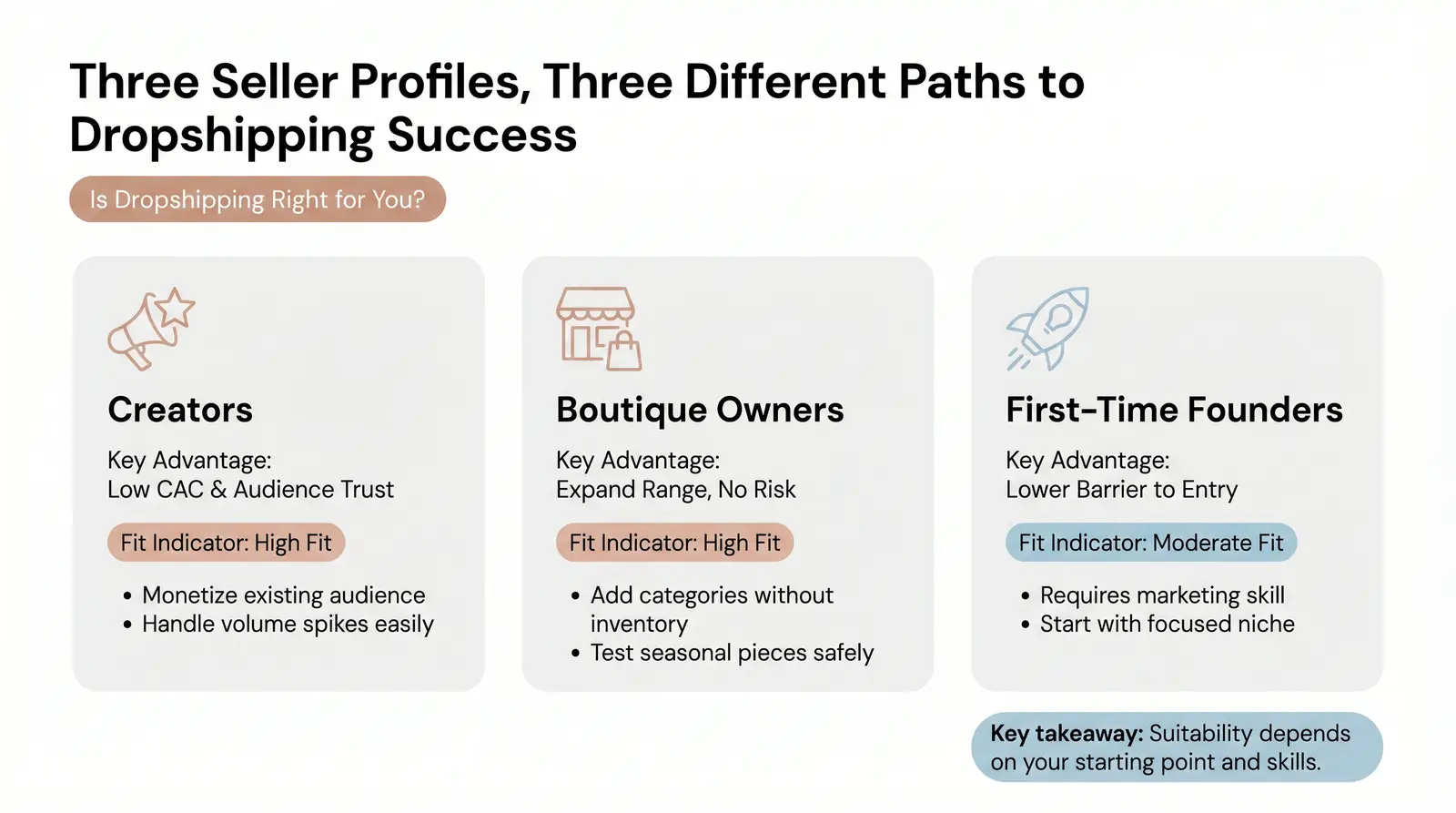
Dropshipping is not a one-size-fits-all solution. Its suitability depends on your starting position, your skills, and your goals. Here is an honest assessment for three common reader profiles.
Influencers and Creators
If you have an existing audience, dropshipping offers significant upside. Your followers already trust your recommendations, which means your Customer Acquisition Cost is dramatically lower than a cold-traffic store. Jewelry and accessories are particularly well-suited to creator audiences because they are visual, giftable, and impulse-friendly. A single well-placed Instagram story or TikTok video can generate hundreds of orders in hours. The key is choosing a supplier who can handle volume spikes without compromising fulfillment quality. Explore the Branvas solution for creators
Ecommerce Sellers and Boutique Owners
If you already run an online store, dropshipping is an excellent mechanism for expanding your product range without taking on inventory risk. You can test new categories, add seasonal pieces, and offer a wider selection to existing customers without committing to minimum order quantities. Private-label dropshipping is the natural upgrade path for boutique owners who have been sourcing generic products and want to build a more defensible brand. Explore the Branvas solution for ecommerce sellers
Aspiring Entrepreneurs and First-Time Founders
Dropshipping genuinely lowers the barrier to entry. You don't need a warehouse, you don't need to buy inventory in advance, and you can start with a relatively modest budget. But it does not remove the need for marketing skill, brand thinking, and supplier diligence. If you are starting from scratch, begin with a focused niche rather than a broad general store. Jewelry is a strong choice: high perceived value, strong social media performance, and excellent margin potential when sourced correctly. Explore the Branvas solution for first-time founders
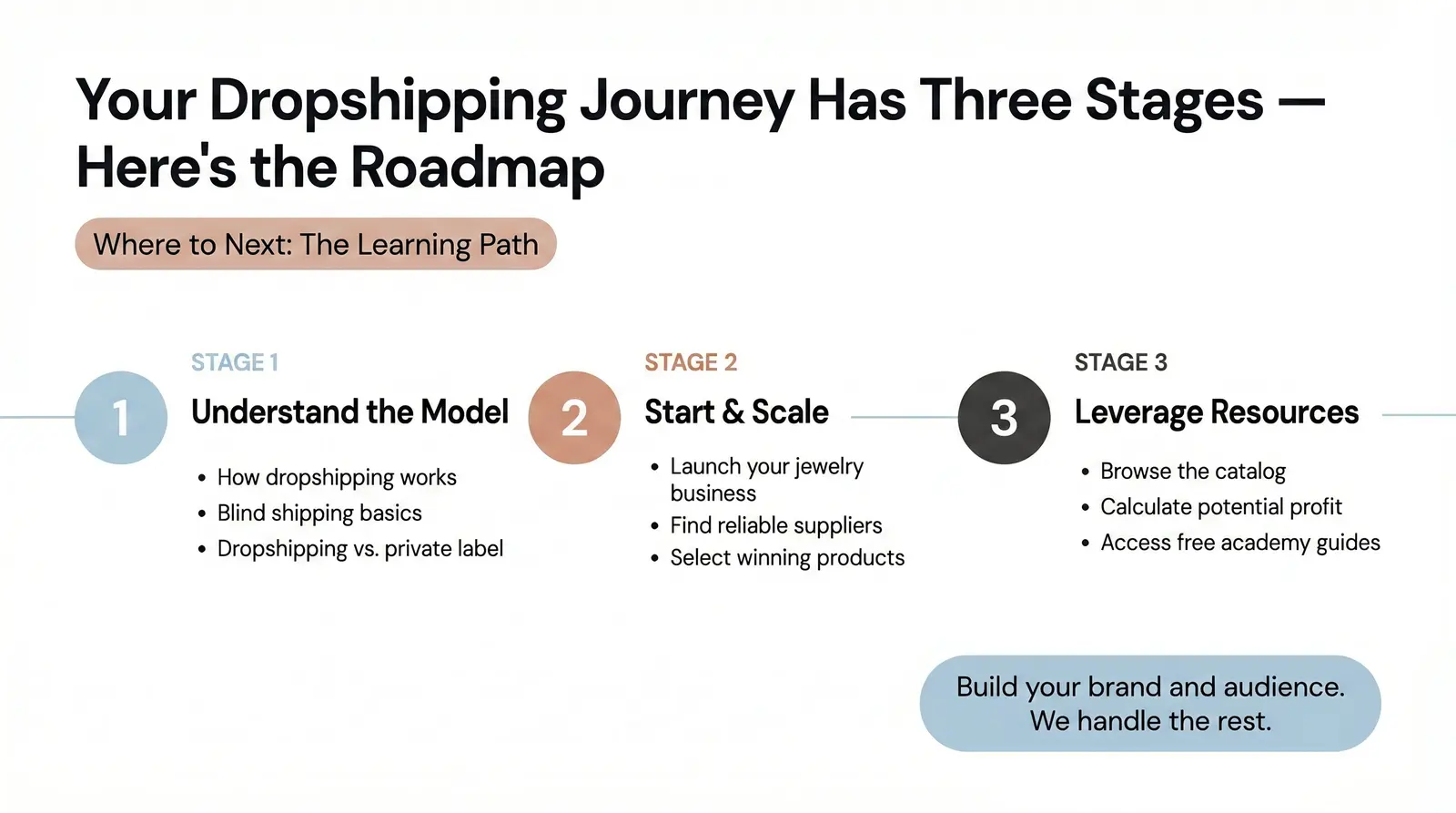
This guide is the starting point. Below is the full learning path we recommend for anyone building a dropshipping jewelry brand, organized by where you are in the process.
Understand the model deeper:
Start or scale your store:
Branvas resources:
Ready to launch your own jewelry brand without holding inventory?
Branvas handles sourcing, private-label packaging, and blind fulfillment, so you can focus on building your brand and your audience. See how it works
Dropshipping is a retail method where a store doesn't keep the products it sells in stock. When a customer places an order, the store purchases the item from a third-party supplier, who then ships it directly to the customer. The seller never handles the product physically. The customer receives the package as if it came directly from the store.
Dropshippers make money by selling products at a retail price that is higher than the wholesale price they pay the supplier. The profit is the difference between the retail price and the combined costs of the product, platform fees, payment processing, and marketing. In high-margin categories like jewelry, net margins of 40 to 55% are achievable with the right supplier.
Yes, dropshipping is a completely legal and widely practiced fulfillment model. Sellers must comply with applicable consumer protection laws. In the United States, the FTC's Mail, Internet, or Telephone Order Merchandise Rule requires sellers to have a reasonable basis for stated shipping timeframes and to notify customers promptly of any delays [3]. Blind shipping, where the supplier's identity is omitted from the package, is also entirely legal.
The primary difference is inventory ownership and timing. In regular retail, a business purchases products in bulk, stores them in a warehouse, and ships them to customers. Capital is tied up in inventory before a single sale is made. In dropshipping, the seller only purchases a product from the supplier after the customer has already paid for it. The supplier handles storage and shipping, and the seller's capital is not locked in unsold stock.
Yes, but the version that worked in 2016 is largely obsolete. Slow shipping from overseas, generic products with no brand identity, and low-quality packaging no longer meet customer expectations. The global dropshipping market is projected to reach $476.1 billion in 2026 [4], and the growth is concentrated in sellers who have moved toward private-label models, faster regional fulfillment, and genuine brand building. If you approach dropshipping as a brand-building exercise rather than a quick arbitrage play, it remains one of the most accessible paths to building a real ecommerce business.