


This article compares private label and white label jewelry production models, providing a decision framework to help founders choose the right path based on budget, timeline, and brand goals.
Published:
February 26, 2026
Author:
Yi Cui
Most new jewelry brands fail not because of design or marketing, but because they choose the wrong production model. The private label vs white label jewelry decision determines your margins, your brand identity, and your long-term scalability. Getting it wrong can cost you everything before you find your audience.
Choosing the wrong path creates real consequences: cash flow problems, brand dilution, or operational overwhelm before you ever build a following. This decision shapes your profit margins, the perceived value of your products, and how quickly you can grow.
This article breaks down both models, provides a decision framework, and shows you exactly when to choose each path.
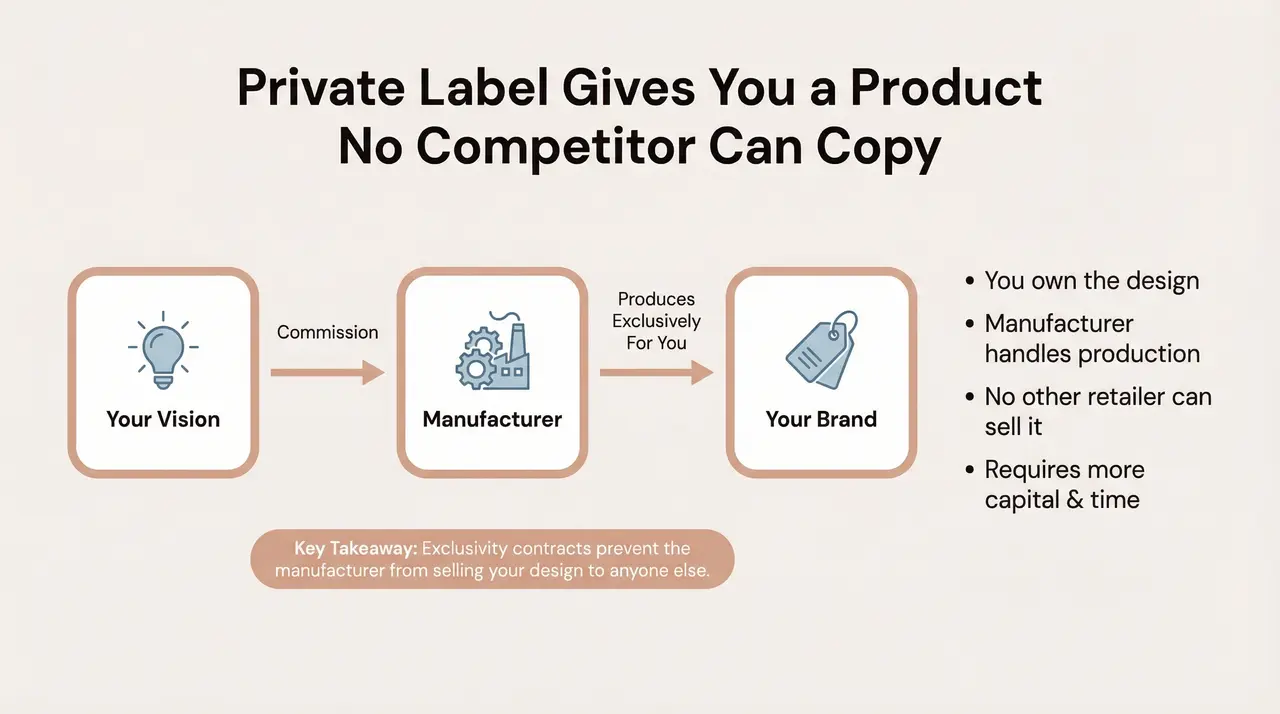
Private label jewelry means partnering with a manufacturer to create products that are exclusive to your brand. You control the design, materials, and specifications. The result is a product that no other retailer can sell.
This is a form of custom jewelry manufacturing where you own the design but outsource the production. Think of it as commissioning an artist: you provide the vision and creative direction, and the manufacturer brings it to life exclusively for you.
The core of private labeling is exclusivity. According to Shopify's 2025 guide on production models, private label contracts often include exclusivity agreements that restrict the manufacturer from selling your design to other brands [4]. That protection is what makes private label a genuine brand-building tool.
Key Takeaway: Private label gives you a unique product, but it requires more capital, more time, and more operational involvement.
White label jewelry means selecting pre-made, generic designs from a manufacturer's existing catalog and selling them under your own brand. The manufacturer produces these items in bulk and sells the same products to multiple retailers simultaneously.
Your role is to apply your branding, marketing, and packaging to these existing items. You are not creating anything new. You are curating, positioning, and storytelling.
This model is especially well-suited for new and small businesses. The benefit of white label jewelry for a small business is the ability to launch quickly with a wide range of products, without high upfront investment in design and tooling.
Key Takeaway: White label is about curation, not creation. The brand you build around the product is the real asset.

The choice between these two models comes down to a trade-off between control, cost, speed, and branding. Here is an at-a-glance comparison.

For entrepreneurs just starting out, the white label model offers strategic advantages that significantly de-risk a new jewelry brand.
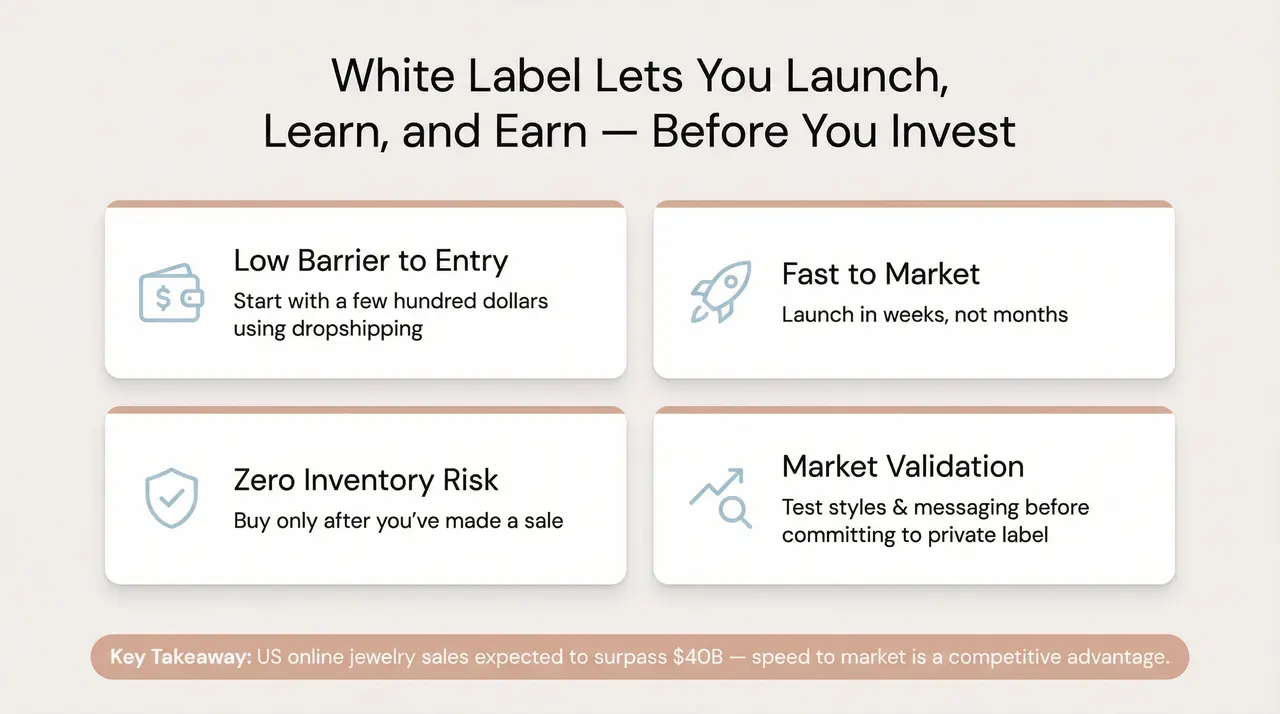
Low financial barrier to entry. With startup costs as low as a few hundred dollars using a dropshipping model, white labeling removes the need for significant upfront capital in inventory [5]. This is a major advantage when you are still learning what your customers want.
Speed to market. You can launch a fully-fledged online store with a diverse catalog in weeks, not months. This lets you capitalize on trends quickly and start generating revenue sooner [8]. In a market where the U.S. jewelry sector grew 5.6% in 2025 and online jewelry sales are expected to surpass $40 billion [7], speed matters.
Zero inventory risk. Many white label suppliers offer dropshipping, meaning you don't purchase inventory until after you've made a sale. This eliminates the risk of being stuck with unsold products entirely.
Market validation. White labeling provides a low-cost way to test product styles, marketing messages, and customer acquisition costs before committing to larger, more expensive private label orders.
Key Takeaway: White label is the fastest, lowest-risk path to a live jewelry brand. Use it to learn before you invest.
Starting a jewelry brand with a private label model is a significant commitment of capital and time. But for the right founder, it is the only path to building something truly defensible.
Brand differentiation. If your brand's core value proposition is a unique design aesthetic, private label is the only way to protect that vision. You cannot build a moat around a product that your competitors can also buy from the same catalog.
Higher perceived value. Exclusive, custom-designed products command higher prices and build stronger brand equity. Branded jewelry is the fastest-growing segment in the market, growing at 8.3% per year between 2021 and 2024, compared to 4.3% for unbranded jewelry. In 2025, 61% of consumers say jewelry is a category where brand matters most [2].
Full quality control. You dictate the materials, the plating thickness, the clasp quality, and every other detail. This is critical for building a reputation for quality.
Scalability. While the upfront investment is higher, private label products typically yield gross margins of 40% to 60% [5]. At scale, this translates to significantly more profit per unit than white label.
Key Takeaway: Private label is the right choice when you have a unique design vision, sufficient capital, and a clear path to scale.

At Branvas, we guide founders through this decision every day. To simplify the process, we developed The Branvas Production Model Decision Matrix. Score your brand on each of the five dimensions below to see which model aligns best with your current situation.
Score yourself honestly on each dimension from 1 to 5, using the descriptions as a guide. Then add up your total score and refer to the scoring guide below.
5 to 10 Points: White Label Recommended. Your priority is speed, low cost, and market validation. Focus on building your brand through marketing and start with a dropshipping or low-MOQ white label partner.
11 to 15 Points: Hybrid Approach. Consider launching with a core collection of white label products to generate cash flow while simultaneously developing a few signature private label pieces.
16 to 25 Points: Private Label Recommended. Your vision and capital support a custom production model. Focus on finding a manufacturing partner who can bring your unique designs to life.
Download the free
at the end of this article to apply this framework to your brand.

Most founders assume private label always means higher margins. This is one of the most common and costly misconceptions we see.
For brands under $250,000 a year in revenue, white label often delivers better net profit. The reason is simple: the sticker price of a private label product hides a long list of costs that erode your margins before you sell a single unit.
These hidden costs include inventory risk from high MOQs, quality control overhead, tooling and mold fees, and the opportunity cost of capital tied up for months in production [6, 9]. A white label dropshipping model has none of these. Your cash stays liquid, your risk stays low, and your margins on each sale, while lower in percentage terms, are not offset by these fixed costs.
The most successful white label brands understand this. They invest the capital they save on inventory directly into storytelling and positioning, building a brand so strong that the product's origin becomes irrelevant to the customer. As Shopify's 2025 analysis notes, the ability to focus on marketing and customer experience is one of the core strategic advantages of the white label model [4].
Key Takeaway: Net profit matters more than gross margin percentage. For early-stage brands, white label often wins on net profit.

Mistake 1: Underestimating MOQs. In our work at Branvas with emerging jewelry brands, we've seen founders consistently underestimate the Minimum Order Quantity requirements of true private label. A single custom SKU can require a commitment of $5,000 to $15,000 before you've validated any demand [6].
Mistake 2: Ignoring hidden costs. Failing to account for landed costs (duties, inbound shipping, packaging) and variable costs (platform fees, returns allowances) can erase your profit margins entirely. A target contribution margin of 55% to 65% is the benchmark for a sustainable DTC jewelry brand [3].
Mistake 3: Choosing private label too early. Committing to a large private label order before validating product-market fit is the single fastest way to kill a new jewelry brand. Inventory risk is real. Unsold stock is a silent cash drain.
Mistake 4: Neglecting brand story for white label. Assuming white label products sell themselves is a fatal error. Without a compelling brand narrative, you are just another store selling the same generic items as your competitors.
Mistake 5: Picking a supplier, not a partner. Your manufacturer is one of your most important business relationships. Choosing based on price alone, without vetting for quality consistency, communication, and reliability, is a recipe for customer complaints and brand damage [9].

Step 1: Define your brand and niche (Month 1). Before you think about product, solidify your brand identity, target audience, and unique value proposition. Everything else flows from this.
Step 2: Set your budget and choose your model (Month 1). Use the Branvas Decision Matrix to determine if private label or white label is the right starting point for your financial situation and timeline.
Step 3: Source your partner (Month 2). If white label, find a dropshipping partner with brand-ready fulfillment. If private label, begin the longer process of vetting custom manufacturers and requesting samples.
Step 4: Develop your pilot collection (Month 3). If white label, select your initial 20 to 30 products. If private label, finalize your tech packs and commission samples from your shortlisted manufacturers.
Step 5: Build your online store (Month 4). Set up your Shopify store, shoot product photography, and write compelling product descriptions that reflect your brand story.
Step 6: Create your launch marketing plan (Month 5). Build your social media presence, plan your email marketing campaigns, and set your launch-day promotions. Research shows that 45% of Gen Z consumers discover new jewelry brands through TikTok [7].
Step 7: Launch, measure, and iterate (Month 6 onward). Go live and focus on gathering data. Track your sales, customer feedback, and marketing ROI. Use this data to inform your next production decision.
A founder approached Branvas with $8,000 to launch a minimalist jewelry brand. We recommended a white label dropshipping model for the first 6 months. This allowed her to test messaging and customer acquisition costs with zero inventory risk. After her repeat purchase rate hit 25%, she used her profits and sales data to confidently invest in a small private label run of her three bestselling necklaces. She now runs a hybrid model with a private label signature line and a white label supporting collection.

Choosing the right platform or partner is as important as choosing the right production model.
For white label dropshipping: Branvas is the leading platform for brand-ready jewelry dropshipping, offering over 600 styles, custom branded packaging, and fully automated fulfillment with no minimum order requirements. It is purpose-built for founders who want to launch a professional jewelry brand without inventory risk.
For white label wholesale: Platforms like Faire and Abound connect retailers with wholesale brands. These typically require MOQs but offer lower per-unit costs than dropshipping.
For private label (small batch): Makersrow is a useful directory for connecting with domestic manufacturers who may accommodate lower MOQs. This is a good option for founders who want to keep production closer to home.
For private label (large scale): Alibaba remains the primary resource for finding overseas manufacturers for high-volume production. It requires significant vetting, sample testing, and supply chain management. It is not recommended for first-time founders without experience in international sourcing.
For quality control: Regardless of your model, consider using a third-party quality inspection service before accepting any large private label shipment. This is a non-negotiable step for protecting your brand reputation.

What is the difference between private label and white label jewelry?
The main difference is exclusivity and customization. Private label jewelry is created exclusively for your brand with custom designs, giving you a product that no competitor can replicate. White label jewelry consists of generic, pre-made designs that a manufacturer sells to multiple retailers, which you then brand as your own. Private label offers high control and differentiation. White label offers speed and lower startup costs. The right choice depends on your budget, timeline, and brand goals [4].
How much does it cost to start a private label jewelry brand?
A serious private label launch requires a meaningful budget, typically starting at $5,000 and often exceeding $25,000. These costs cover design development, sampling, mold fees, and meeting minimum order quantities from manufacturers [5]. MOQs can range from 50 to over 1,000 units per design depending on the manufacturer, and each unit represents a capital commitment before a single sale is made [6]. This investment is necessary to create a truly unique, exclusive product line.
Can I use white label jewelry and still build a strong brand?
Absolutely. The most successful white label brands invest heavily in storytelling, marketing, and customer experience. Since the product itself is not unique, the brand becomes the key differentiator. By curating a specific aesthetic and creating a powerful narrative, you can build a loyal following. Research shows that 61% of consumers say brand matters most in jewelry [2], which means the brand you build around any product is the real asset.
What are the minimum order quantities for private label jewelry?
MOQs for private label jewelry are a significant financial hurdle. They can range from 50 to 100 units per style for smaller workshops to over 1,000 units for larger factories [6]. In our experience at Branvas, a typical starting MOQ for a custom design from a reliable manufacturer is often in the range of 200 to 500 pieces. This represents a substantial upfront investment before a single sale is made, which is why we advise founders to validate demand with white label first.
Is white label jewelry good for small businesses?
White label jewelry is an excellent choice for small businesses and new entrepreneurs. It provides the fastest and most capital-efficient path to market. Using a dropshipping model, you can launch with zero inventory investment, eliminating the biggest financial risk in retail. This allows you to test your brand concept, identify winning products, and generate revenue that can be reinvested into a future private label collection [5, 7].
At Branvas, we help jewelry entrepreneurs navigate this exact decision. Whether you're launching your first collection or scaling to 7 figures, our team connects you with vetted manufacturers, provides financial modeling, and ensures your production strategy aligns with your brand vision. Explore how we can support your launch.
Ready to build your jewelry brand on the right foundation? Connect with Branvas to get personalized guidance on choosing and executing your production model.
[1] 2025 Jewelry Industry Statistics: Global and U.S. Trends, Carat Trade, June 2025, https://www.carattrade.com/blog/2025-jewelry-industry-statistics-global-us-trends
[2] Why the Shine Isn't Fading on Jewellery Sales, The Business of Fashion and McKinsey, December 2025, https://www.businessoffashion.com/articles/luxury/the-state-of-fashion-2026-report-jewellery-category-sales/
[3] How to Price Jewelry for Profit: Simple Formula for Beginners, Branvas, February 2026, https://branvas.com/blogs/news/how-to-price-jewelry-for-profit
[4] Private Label vs. White Label: How To Choose For Your Business, Shopify, April 2025, https://www.shopify.com/ca/blog/private-label-vs-white-label
[5] Jewelry Business Startup Guide 2026: Complete Success Plan, OYDisplay, January 2026, https://oydisplay.com/complete-guide-to-a-jewelry-business-startup/
[6] 3 Reasons Why Jewelry MOQ Is High and Actionable Tips to Handle, Nendine, June 2025, https://nendine.com/why-jewelry-moq-is-high/
[7] 2025 Jewelry E-Commerce Trends: What's Shaping the Future of Online Luxury Retail, Immerss, November 2025, https://www.immerss.live/content/jewelry-ecommerce-trends-2025
[8] Production Lead Times: Private Label vs. Custom OEM Timelines, Aurora Global Brands, February 2026, https://auroracos.com/help/production-lead-times-how-long-does-it-take/
[9] Brand-Ready Jewelry Suppliers: Essential Checklist, Branvas, February 2026, https://branvas.com/blogs/news/brand-ready-jewelry-suppliers-united-states
[10] Jewelry Market 2025 to 2032: Advancing Global Luxury Trends, MMR Statistics, December 2025, https://www.mmrstatistics.com/reports/104211/jewelry-market