


Permanent jewelry wholesale offers 85% gross margins with minimal overhead. This guide covers suppliers, equipment, pricing, and profit strategies for 2026.
Published:
May 12, 2026
Author:
Yi Cui
Permanent jewelry went from Instagram novelty to $1B category in 36 months. Here's what the opportunity actually looks like in 2026, what you need to start, and where the market is heading.
If you are evaluating the permanent jewelry business model, you are looking at one of the highest-margin, lowest-overhead opportunities in the modern retail space. What began as a viral trend in boutique salons has matured into a stable, highly profitable service category. The appeal is simple: a custom-fit, clasp-less bracelet, anklet, or necklace micro-welded directly onto the customer. It is an experience as much as it is a product, driving foot traffic, group bookings, and exceptional word-of-mouth marketing.
This guide breaks down the permanent jewelry business model, the equipment and wholesale supplies required, and the exact profit margins you can expect in 2026.
Permanent jewelry is a custom-fitted chain micro-welded around a customer's wrist, ankle, or neck, with no clasp. The process takes around 10 to 15 minutes. A trained technician measures the chain, attaches a small jump ring, and uses a specialized micro-welder to fuse the ring closed with a brief pulse of electricity and argon gas.
The result is a seamless piece designed for continuous wear. Customers view it as a modern friendship bracelet, a commemorative experience for bridal parties, or simply a low-maintenance luxury accessory. Because the jewelry cannot be easily removed without cutting it, the materials must be durable, hypoallergenic, and tarnish-resistant. That makes solid gold, gold-filled, and sterling silver the industry standards [3].
The concept taps into several powerful consumer desires at once. Personalization: customers choose their chain style, metal type, and add charms or connectors. Shared experience: friends, couples, and families get permanent jewelry together to mark a moment. Convenience: the clasp-less design means the jewelry is always on, never tangles, and requires zero daily effort.
That combination of emotional resonance and low friction is why this category grew so fast and why it continues to hold.

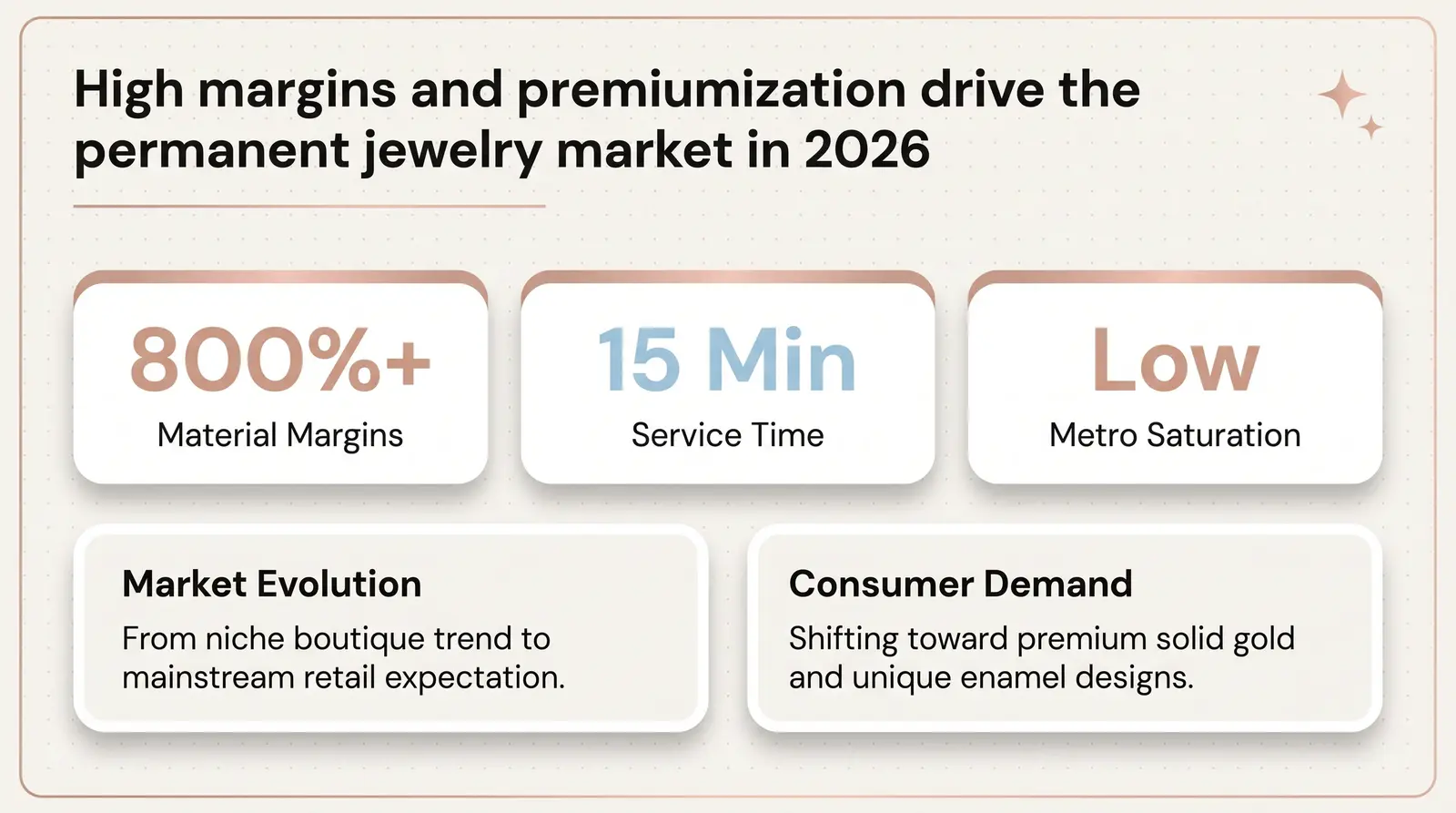
The permanent jewelry market has evolved from a niche boutique offering into a mainstream retail expectation. According to trend data, consumer search interest in permanent jewelry grew dramatically from 2021 through 2025, driven by social media visibility and the high perceived value of the in-person service [1].
For entrepreneurs, the appeal lies in the economics. The business requires minimal square footage, carries very low inventory risk, and commands premium pricing. A service that takes 15 minutes to perform can yield profit margins exceeding 800% on materials alone [2]. That makes permanent jewelry an ideal standalone business or a highly lucrative add-on for existing salons, boutiques, and med-spas.
The growth trajectory remains strong in 2026. Consumer awareness is high, but market saturation is still limited outside major metro areas. The industry is also shifting toward premiumization: early adopters were satisfied with basic cable chains, but today's customers increasingly seek unique designs, enamel finishes, and solid gold options. That trend creates room for businesses that invest in quality sourcing and brand differentiation.
The flexibility of the permanent jewelry business allows for several distinct operational models. Each has its own advantages and capital requirements.
This is the most common entry point for new permanent jewelry artists. Operating at local markets, bridal expos, and private parties requires minimal overhead. The entire business fits into a single carrying case. Pop-ups capitalize on impulse buys and group experiences, often generating thousands of dollars in a single weekend [3].
The model is highly scalable. Start with one setup, then add technicians and equipment as demand grows. It also provides built-in market research: you can test different locations, pricing, and chain styles before committing to a permanent space.
For existing retail or service businesses, permanent jewelry is a natural extension. Salons, estheticians, and clothing boutiques can use existing floor space and client bases to introduce the service. This model benefits from zero additional rent and the ability to cross-sell, turning a standard appointment into a higher-ticket experience.
Integration requires proper staff training, safe equipment placement, and clear marketing to your current clientele. Consider offering package deals or hosting a launch event to generate early momentum.
Dedicated permanent jewelry studios are becoming more prevalent in high-traffic urban areas. This model requires the highest initial investment due to lease and build-out costs, but it establishes strong brand authority and allows for consistent booking schedules.
A dedicated studio enables a fully immersive customer experience. You can design the space to reflect your brand, offer a wider selection of chains and charms, and host private events or parties.
While permanent jewelry is inherently an in-person service, savvy brands are integrating it with their online presence. Selling matching clasped versions, custom charms, or booking deposits online creates a hybrid model that captures revenue before the customer walks through the door.
If you are looking to launch a jewelry brand that spans both in-person experiences and online retail, Branvas provides the infrastructure to scale. From sourcing premium chains to handling blind-shipping for your e-commerce orders, Branvas lets you focus on the customer experience while we manage the supply chain. Learn how it works.

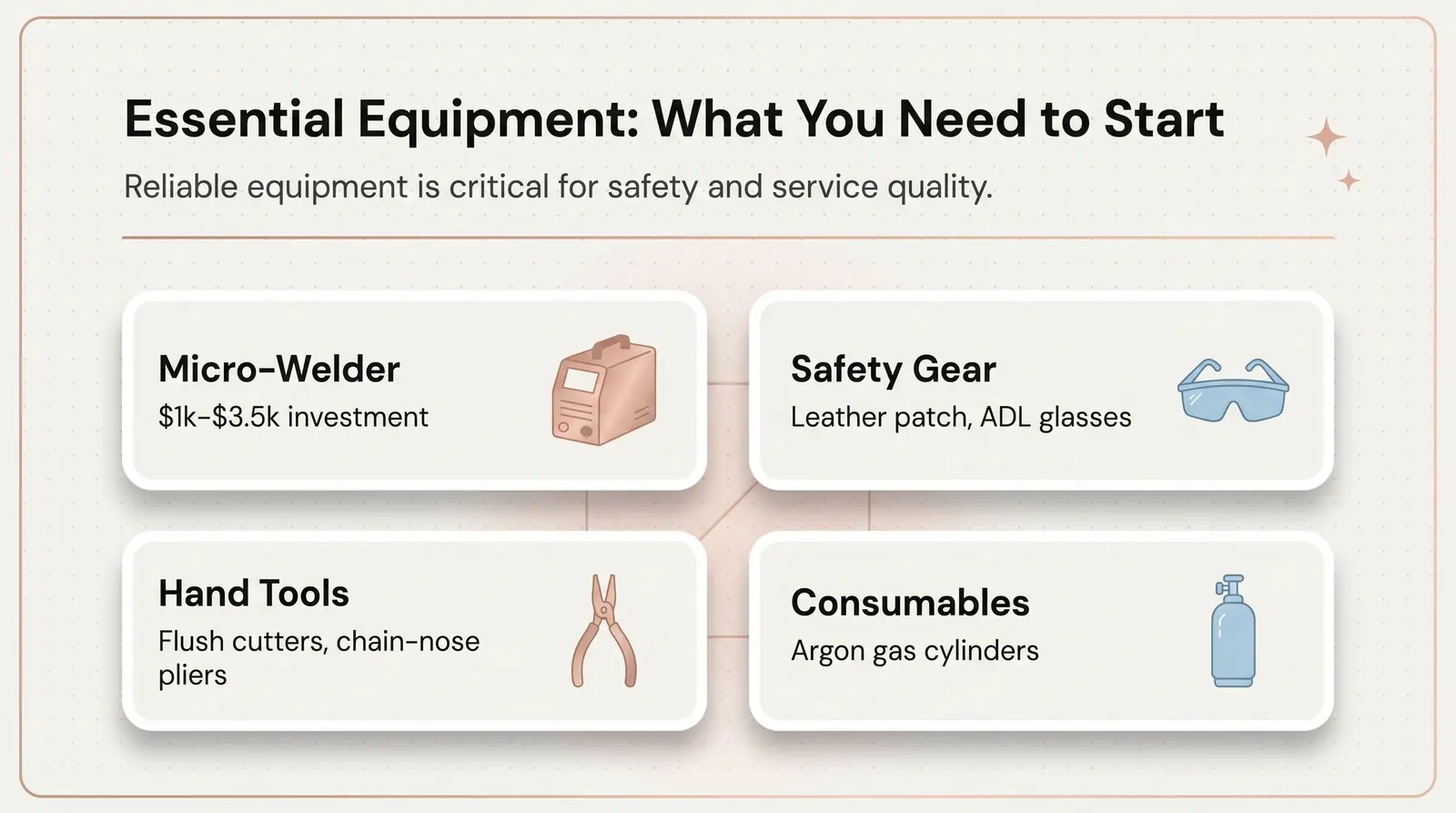
Launching a permanent jewelry business requires a specific set of tools. The barrier to entry is low compared to traditional retail, but investing in reliable equipment is critical for safety and service quality.
The micro-welder is the engine of your business. These machines use a brief electrical arc, often shielded by argon gas, to fuse a jump ring closed without generating excessive heat on the customer's skin.
| Tier | Example Models | Price Range | Best For |
|---|---|---|---|
| Entry-Level | Sunstone Zapp | $1,000 to $1,200 | Beginners, pop-ups, low volume |
| Mid-Range | Orion mPulse | $1,800 to $2,500 | Growing studios, higher volume |
| Professional | Orion PJ | $2,500 to $3,500+ | High-volume studios, advanced control |
Prices shown are approximate. Verify current pricing directly with suppliers, as costs fluctuate with demand and product updates [3].
When selecting a welder, prioritize warranty coverage, customer support, and the availability of replacement parts. A machine that goes down during a busy pop-up event is a costly problem.
Safety is non-negotiable. You must use a leather patch to protect the customer's skin during the weld. The technician requires specialized safety glasses or an auto-darkening lens (ADL) to protect their eyes from the welding arc [3].
Always ensure your workspace is well-ventilated. If you are operating in a small or enclosed space, a fume extractor is a worthwhile investment.
A precision toolkit is necessary for measuring, cutting, and preparing the chain. This includes flush cutters, chain-nose pliers, a ruler or measuring tape, and a fiberglass brush for polishing the finished weld.
Argon gas is used to shield the weld from oxygen, preventing oxidation and ensuring a clean, strong joint. Factor the ongoing cost of argon cylinders and a regulator into your pricing model.
Your choice of wholesale supplier directly impacts your profit margins and the quality of your product. Permanent jewelry requires chain sold by the foot or spool, not finished pieces with clasps. Jump rings, connectors, and charms are sourced separately.
Before committing to a supplier, evaluate four things: material consistency, weld compatibility, minimum order requirements, and fulfillment speed. A chain that looks identical in photos but welds inconsistently will cost you time, materials, and customer trust.
Prioritize suppliers who clearly label their metal content (gold-filled versus gold-plated versus solid gold) and who offer weld-tested certification where available [4].
| Supplier | Best For | Metals Offered | Notes |
|---|---|---|---|
| Sunstone / Orion | Certified weld-tested chains | Gold-filled, Sterling Silver, 14k Gold | Membership discounts available; by the inch or spool [4] |
| Halstead | Broad selection and reliability | Gold-filled, Sterling Silver | Wholesale account required; by the foot or spool [5] |
| Rio Grande | Professional jewelers | 14k Gold, Gold-filled, Sterling Silver | Wholesale account required; by the inch or foot [6] |
| AZ Findings | Competitive bulk pricing | Gold-filled, Sterling Silver, Plated | Wholesale account required; by the foot [7] |
| Stones & Findings | Premium components and charms | Gold-filled, Sterling Silver, Solid Gold | Wholesale account required; by the foot [8] |
| Harper Crown | Trend-focused styles (Paperclip, Enamel) | Gold-filled, Sterling Silver | No minimums on many items; by the foot [9] |
Note: Pricing on precious metal chains fluctuates with spot gold and silver prices. Always verify current pricing before building your cost model.
Here is how the math works when you buy wholesale and sell at retail.
Assume you purchase a 50-foot spool of 14k gold-filled cable chain. At a typical wholesale rate of approximately $15 to $20 per foot (verify current pricing with your supplier), a 50-foot spool costs roughly $750 to $1,000 [2].
Each bracelet uses approximately 7 inches of chain. A 50-foot spool contains 600 inches, yielding approximately 85 bracelets per spool.
At a retail price of $75 per bracelet, that spool generates $6,375 in revenue. Subtract the $1,000 spool cost plus jump rings and consumables (approximately $75 total), and your gross profit from one spool is approximately $5,300. That is a gross margin of around 83% before labor and overhead.
This is why experienced operators emphasize buying in volume. The per-foot cost drops significantly as order size increases, and the impact on margin is immediate.

The economics of permanent jewelry are highly favorable. The markup on materials is substantial, allowing for rapid return on investment.
The following example uses a standard 14k gold-filled bracelet. The average wrist requires approximately 6.5 to 7 inches of chain.
| Item | Estimated Cost |
|---|---|
| 14k Gold-Filled Chain (7 inches) | $8.75 to $11.67 |
| 14k Gold-Filled Jump Ring | $0.50 to $1.00 |
| Argon Gas and Consumables | $0.25 |
| Total COGS Per Bracelet | $9.50 to $12.92 |
Chain cost is calculated from a $15 to $20 per foot wholesale rate. Verify current pricing before building your model, as precious metal prices change [2].
In most markets, a 14k gold-filled permanent bracelet retails for $65 to $85 [10].
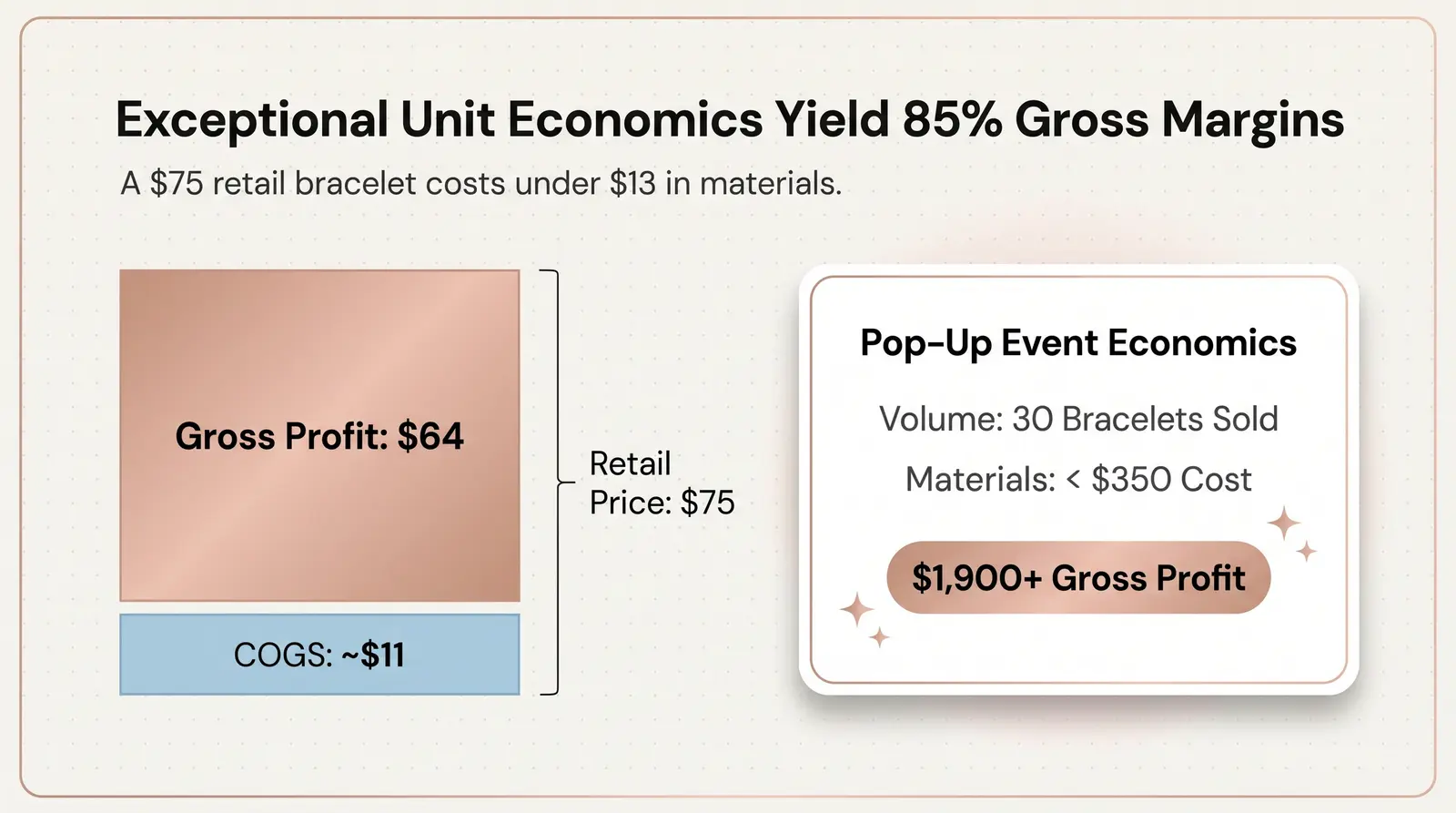
| Metric | Value |
|---|---|
| Retail Price | $75.00 |
| Total COGS | $11.00 |
| Gross Profit | $64.00 |
| Gross Margin | 85% |
A single pop-up event selling 30 bracelets generates over $1,900 in gross profit from less than $350 in materials. This does not include the cost of your time or overhead, but it illustrates the exceptional unit economics of the service.
Sterling silver offers a lower entry price point for customers ($50 to $70 per bracelet in most markets) with a similarly strong margin, since sterling silver chain costs approximately $8 to $12 per foot at wholesale [2].
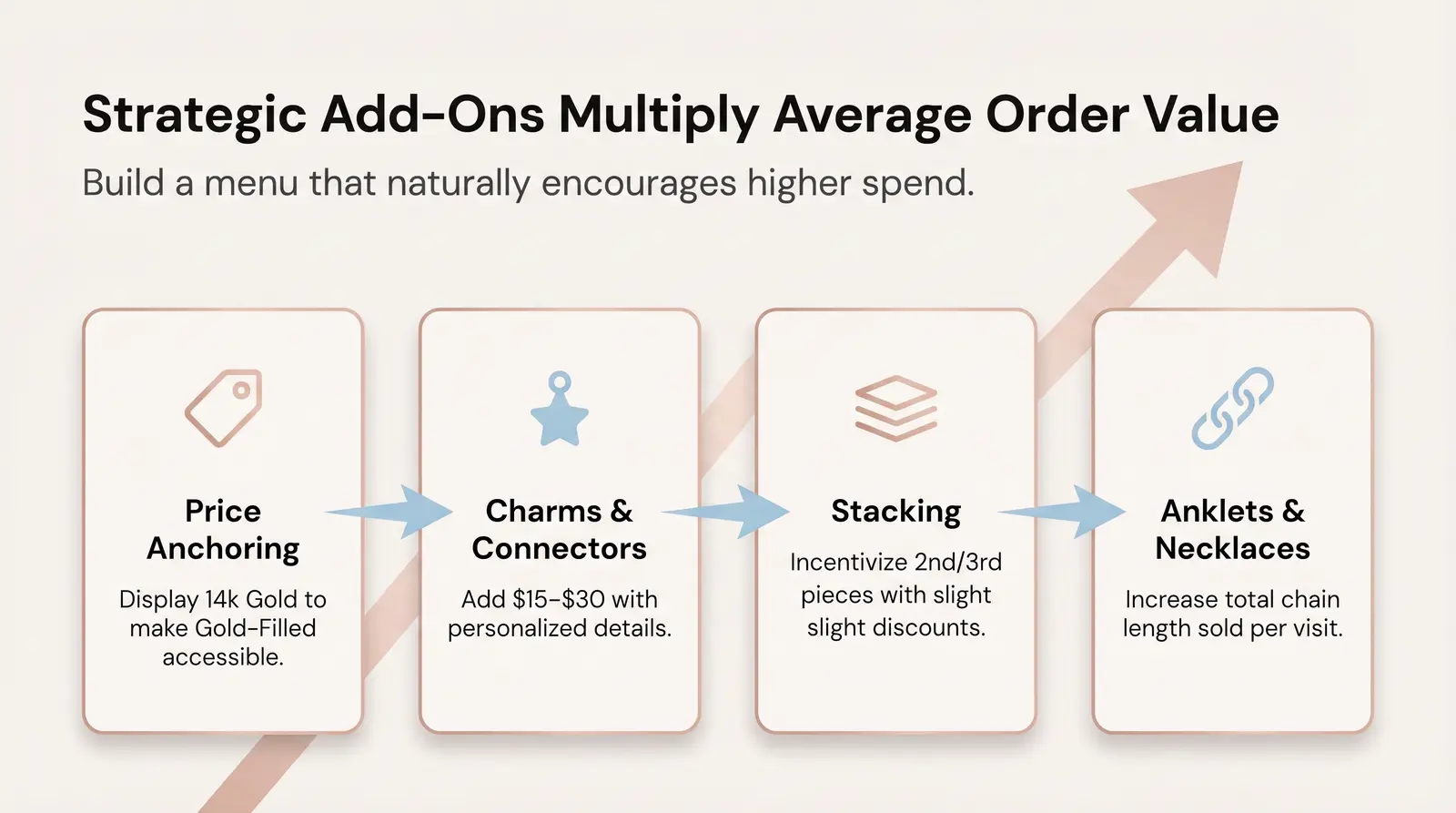
The most profitable permanent jewelry businesses do not rely on a single bracelet sale. They build a menu of options that naturally encourages customers to spend more.
Charms and Connectors. Personalized charms, birthstones, and custom connectors add $15 to $30 to the ticket price with minimal additional material cost. Customers who are already committed to a purchase are highly receptive to adding a meaningful detail.
Stacking. Encouraging customers to purchase multiple chains is highly effective. Offering a slight discount on the second or third piece incentivizes larger purchases and increases the total chain sold per transaction.
Anklets and Necklaces. Expanding beyond bracelets increases the length of chain sold per customer. An anklet typically uses 10 to 11 inches of chain, and a necklace can use 16 to 18 inches, significantly increasing the revenue per visit.
Price Anchoring. Displaying a solid 14k gold option alongside gold-filled makes the gold-filled option appear more accessible. This is a proven retail technique that increases the average sale without discounting your core product [2].
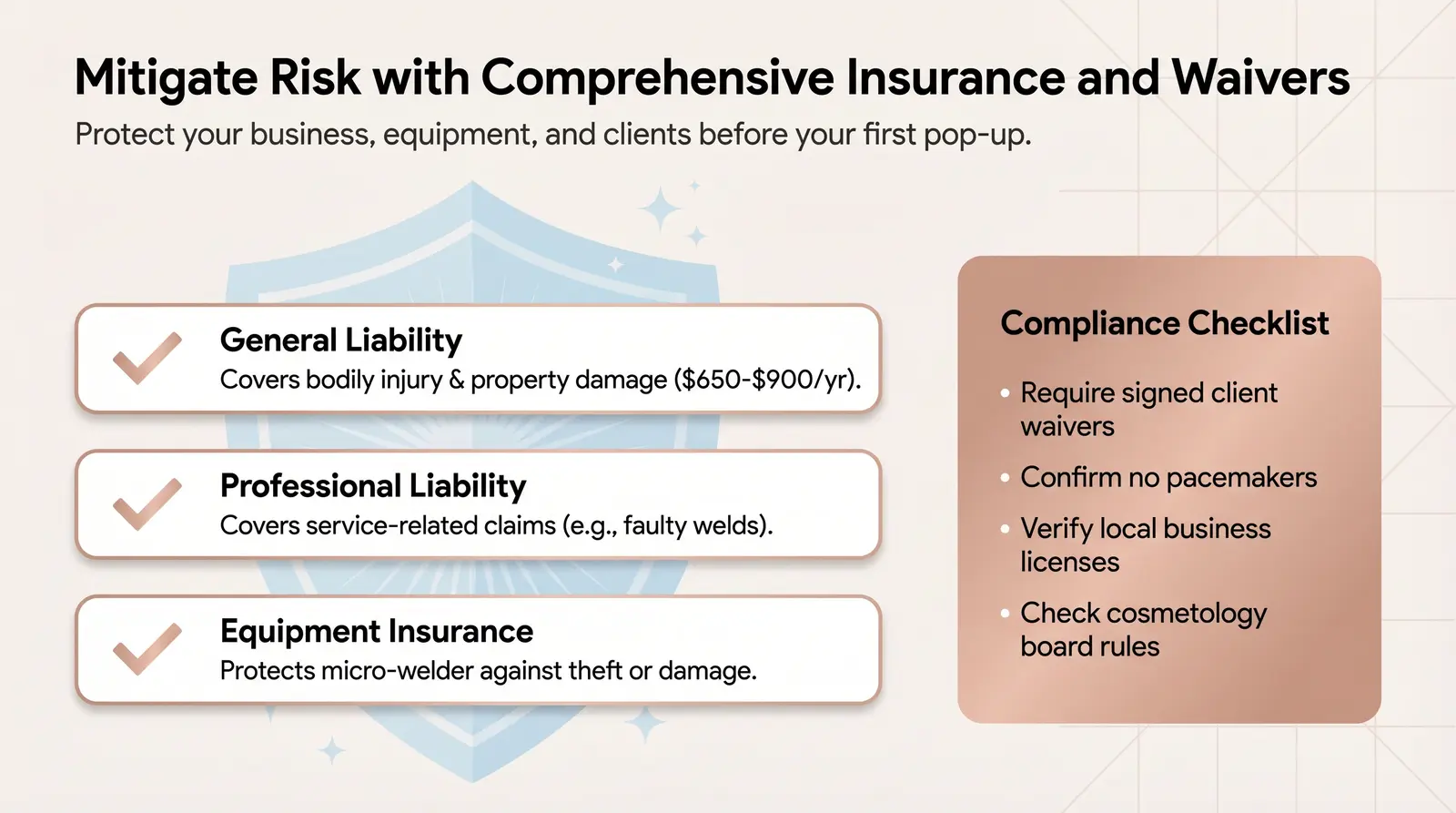
Operating a permanent jewelry business requires proper risk management. Because you are performing a physical service on a customer, general liability insurance is not optional [11].
General Liability Insurance protects against claims of bodily injury or property damage. Most event organizers and landlords require proof of coverage before you can set up. Policies typically start around $650 to $900 per year [11].
Professional Liability Insurance covers claims related to the service itself, such as a faulty weld or an allergic reaction to the metal. This is separate from general liability and is a smart addition for any artist working directly on clients [11].
Equipment Insurance protects your micro-welder and inventory against theft or damage, particularly important if you are traveling to events or operating a mobile business [11].
In addition to insurance, ensure your clients sign a waiver acknowledging the risks and confirming they do not have a pacemaker or other contraindications for micro-welding. Consult with an insurance professional to determine the specific coverage requirements for your business model and location.
The permanent jewelry market in 2026 offers a clear path to profitability for driven entrepreneurs. Whether you are launching a mobile pop-up or expanding an existing boutique, the combination of high margins and experiential retail is a proven formula.
As your business grows, managing inventory, sourcing new styles, and fulfilling online orders can become a bottleneck. This is where Branvas steps in. We provide the backend infrastructure for jewelry brands: premium wholesale sourcing, custom packaging, and blind-shipping fulfillment. You focus on the customer experience. We handle the rest.
Ready to scale your jewelry business beyond the pop-up tent? Explore our catalog of premium supplies, or see how we support influencers and creators and ecommerce and boutique store owners in building lasting brands. For in-depth training and resources, visit the Branvas Academy.
Gold-filled chain contains a legally defined minimum of 5% solid gold by weight, bonded to a base metal core. It is durable, tarnish-resistant, and safe for most skin types. Gold-plated chain has a much thinner layer of gold and will wear off over time, making it unsuitable for permanent jewelry. Always use gold-filled or solid gold for pieces intended for continuous wear.
Most experienced operators recommend a starting budget of $5,000 to $10,000. The largest single expense is the micro-welder, which ranges from $1,000 to $3,500 depending on the model. The remainder covers initial chain inventory, jump rings, hand tools, safety equipment, and display materials [3]. You can start lean and reinvest profits to expand your chain selection.
Pricing varies by market and metal type. Sterling silver bracelets typically retail for $50 to $70. Gold-filled bracelets range from $65 to $120, depending on chain style and local market conditions. Solid gold commands a significant premium. Research pricing in your specific area before setting your menu [10].
Licensing requirements vary by state and locality. In most jurisdictions, permanent jewelry does not require a cosmetology or esthetics license because it does not involve the skin. However, you should verify the regulations in your specific area. A business license and general liability insurance are standard requirements regardless of location [11].
The most popular styles are cable, rolo, figaro, paperclip, and curb chains in gold-filled and sterling silver. The best chain for your business depends on your target customer and price point. Start with two or three proven styles and expand your selection based on customer feedback. Ensure any chain you purchase is weld-compatible before buying in bulk [4].
[1] Meet Glimpse. "Permanent Jewelry Trend Data." https://meetglimpse.com/trend/permanent-jewelry/
[2] Linked Permanent Jewelry Training. "Complete Guide to Pricing and Profit for Permanent Jewelry." https://linkedpermanentjewelrytraining.com/blogs/news/complete-guide-to-pricing-and-profit-for-permanent-jewelry
[3] Sunstone Welders. "What Does It Cost to Start a Permanent Jewelry Business." https://permanentjewelry.sunstonewelders.com/blogs/news/what-does-it-cost-to-start-a-permanent-jewelry-business
[4] Sunstone Welders. "Top Wholesale Permanent Jewelry Chain Suppliers." https://permanentjewelry.sunstonewelders.com/blogs/news/top-wholesale-permanent-jewelry-chain-suppliers
[5] Halstead Bead. "Wholesale Jewelry Chain." https://www.halsteadbead.com/jewelry-chain
[6] Rio Grande. "Gold, gold-filled and sterling silver jewelry chain styles." https://www.riogrande.com/category/chains/
[7] AZ Findings. "Wholesale jewelry chain bulk by the foot." https://www.azfindings.com/wholesale-jewelry-making-chain-bulk-by-the-foot
[8] Stones and Findings. "Wholesale Chain for Jewelry and Permanent Jewelry." https://stonesandfindings.com/wholesale-chains/
[9] Harper Crown. "Wholesale Jewelry Chain: Bulk Pay Per Foot Uncut Spools For Jewelers." https://www.harpercrown.com/collections/chain/chain-length_sold-per-foot
[10] Sunstone Welders. "How Much Does Permanent Jewelry Cost?" https://permanentjewelry.sunstonewelders.com/blogs/news/how-much-does-permanent-jewelry-cost
[11] Stella and Rose Jewelry Supply. "Do You Need Permanent Jewelry Insurance?" https://stellarosejewelrysupply.com/blogs/blog/do-you-need-permanent-jewelry-insurance