



Launch a profitable jewelry brand by starting with 12 to 18 focused SKUs using the Minimum Viable Jewelry Catalog framework to maximize conversions.
Published:
March 17, 2026
Author:
Yi Cui
More SKUs is not more sales. It's more confusion. That feeling of staring at a supplier spreadsheet with thousands of products, trying to decide which ones will define your brand, is a unique form of analysis paralysis. It stops countless talented founders before they even start. You're worried that too few products will make your store look empty, but too many will drain your budget and overwhelm your customers. What's the magic number?
This isn't a theoretical question. It's the most practical decision you'll make in your pre-launch phase. Get it right, and you create a clear, compelling offer that converts visitors into customers. Get it wrong, and you risk a confusing brand, wasted capital, and a launch that fizzles out. By the end of this article, you will have a concrete, actionable answer. We'll give you a data-backed framework for choosing your starter catalog, a blueprint with exact SKU counts by category, and a clear system for knowing when to expand.
Before we define the ideal starting size, it's worth understanding the psychological traps that lead founders to build oversized catalogs. In our experience at Branvas, new sellers often treat catalog size as a proxy for legitimacy. They believe a larger collection signals a more established brand. It doesn't. A 12-SKU store with a clear identity will always outperform a 60-SKU store with an identity crisis.
This instinct to add more stems from a few common fears:
The price of overbuilding is steep. It leads to a diluted brand identity, higher operational complexity, and, most critically, lower conversion rates. A confusing store is an empty store.

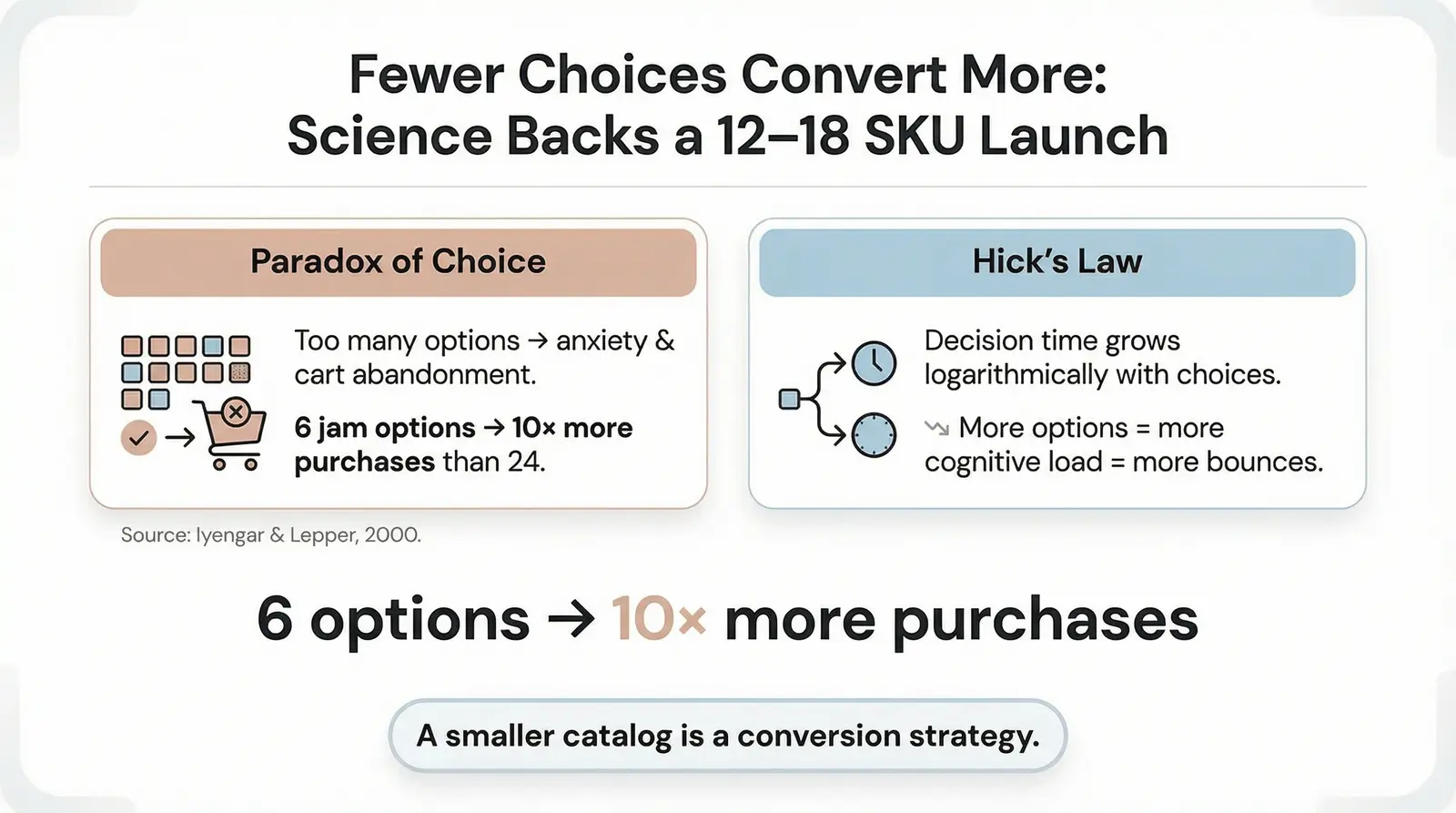
Launching with fewer SKUs doesn't just feel better; it performs better. The prevailing wisdom that "more choice is always better" has been repeatedly debunked by both psychological research and ecommerce data. Two key concepts explain why a focused catalog is a more profitable catalog at launch.
The first is the Paradox of Choice. Psychologist Barry Schwartz argued that while some choice is good, too much choice leads to anxiety, indecision, and dissatisfaction [2]. A famous study on this phenomenon, often called the "jam study," found that a display with 6 types of jam was ten times more likely to result in a purchase than a display with 24 types [8]. For a new jewelry brand, a 60-SKU catalog can paralyze a potential customer, causing them to abandon their cart rather than commit to a decision.
The second is Hick's Law, a foundational principle in user experience design. The law states that the time it takes to make a decision increases logarithmically with the number of choices available [3, 5]. When a visitor lands on your Shopify store, you have seconds to capture their attention. If they are immediately presented with an overwhelming number of options, cognitive load increases and the likelihood of a quick, confident purchase drops. A 12-SKU store often outsells a 60-SKU store at launch because the buyer completes a purchase instead of bouncing.
This is the contrarian insight most new founders miss. A smaller catalog is not a weakness. It is a conversion strategy. The global jewelry market is valued at over USD 381 billion [1], which means the opportunity is enormous. The brands that capture it fastest are the ones with the clearest offer, not the longest product list.
In our experience at Branvas, founders who launch with 12 to 18 focused SKUs reach their first sale faster than those who try to perfect a 50-piece catalog first. The data is clear: clarity converts.
To move from theory to action, you need a system for making objective decisions about which products earn a spot in your launch catalog. At Branvas, we use the Minimum Viable Jewelry Catalog (MVJC) Framework when helping new founders select their starter catalogs. It's a five-point test that filters out the "maybes" and focuses your investment on the SKUs most likely to drive initial sales and profitability.
Before adding any product to your launch collection, run it through this checklist. A product must pass at least four of the five criteria to make the cut.
| SKU Criterion | Why It Matters | Pass/Fail Threshold |
|---|---|---|
| Trend and Search Demand | Your products need a built-in audience. You are validating that people are actively looking for this style right now. | Pass: The product style has consistent, high search volume on Google Trends or a rising trend on Pinterest or TikTok. |
| Margin Profile | Your first sales need to be profitable. Low-margin items require huge volume to be viable, which is a difficult goal for a new store. | Pass: The product allows for at least a 2.5x markup (60% gross margin). Use the Branvas Profit Calculator to model this before committing. |
| Production Simplicity | Complex products with many components or variations increase the risk of quality issues and fulfillment delays. | Pass: The product is a single unit with a reliable fulfillment history from your supplier. |
| Stylistic Versatility | A versatile product can be worn across multiple outfits and occasions, broadening its appeal without broadening your catalog. | Pass: You can clearly picture a customer wearing this product in at least three different scenarios (work, weekend, evening). |
| Cross-Sell Potential | Your catalog should feel cohesive. A good SKU naturally encourages the purchase of other items in your collection. | Pass: The product directly complements at least two other items in your proposed catalog (e.g., a stacking ring pairs with a minimalist band and a layering necklace). |
If you're not sure which specific products to start with, the Branvas catalog is pre-vetted for margin, trend signal, and brand versatility. You can browse it at branvas.com/catalog and filter by category to build your starter set.

Using the MVJC Framework, we can build a balanced, high-potential starter catalog. The goal is not to offer everything, but to offer the right things. This blueprint covers 12 to 18 core styles, which can expand to 25 SKUs when you account for simple variants like gold vs. silver. This is the sweet spot for a new jewelry brand based on product assortment strategy principles and real-world launch data.
| Category | Recommended SKU Count | Example Styles | Why Start Here |
|---|---|---|---|
| Stud Earrings | 3–4 | Classic gold hoops, pearl studs, geometric studs | High search volume, low return rate, perfect for impulse buys. |
| Pendant Necklaces | 3–4 | Layering chain, birthstone pendant, initial necklace | Strong gifting demand, evergreen search traffic, high perceived value. |
| Statement Earrings | 2–3 | Huggie hoops, drop earrings, minimalist threaders | High AOV, visually powerful on social media and influencer content. |
| Rings | 2–3 | Stacking rings, signet ring, minimalist band | Growing trend category with strong repeat purchase potential. |
| Bracelets / Stackables | 1–2 | Chain bracelet, beaded set | Easy upsell or cross-sell item to increase average order value. |
| Sets / Bundles | 1–2 | Earring + necklace gift set, stacking ring trio | AOV booster, especially strong during gifting seasons (Q4, Valentine's Day). |
| TOTAL | 12–18 core / up to 25 with variants | A focused, versatile, and profitable launch catalog. |
Earrings, necklaces, and rings are consistently the top-performing jewelry categories online and represent the core of any jewelry best sellers list [4]. Starting your product assortment strategy with these three pillars gives you the best chance of early sales, because you are selling into proven demand rather than creating it.
This blueprint also applies directly to starting inventory for dropshipping. Even without holding stock, a focused jewelry catalog size of 12 to 18 SKUs gives your store a clear identity and makes your paid advertising far more efficient. You're not spreading your budget across 60 products; you're concentrating it on 15 proven winners.

Let's make this real. Meet Sofia, a lifestyle influencer with 42K Instagram followers known for her minimalist aesthetic. She's ready to launch her own jewelry brand, "Aura Collective," but is stuck on product selection. Here is how she applied the MVJC Framework to build her 16-SKU launch catalog.
Sofia starts by browsing the Branvas catalog, aiming for a collection that reflects her personal style. She initially curates a list of 30 potential products.
Applying the MVJC Framework:
Chunky Chain Necklace: Sofia loves this bold style, but it fails the Margin Profile test. The cost is higher, and to price it competitively, her margin would drop to 45%, below the 60% threshold. Decision: Cut.
Elaborate Gemstone Ear Cuff: This piece is visually stunning but fails the Stylistic Versatility test. It's a niche item for specific occasions, not an everyday staple. It also has lower search volume compared to classic hoops. Decision: Cut.
Simple Gold Hoop Earrings: This passes all five criteria. It has massive Trend and Search Demand, a strong Margin Profile, high Production Simplicity, endless Stylistic Versatility, and clear Cross-Sell Potential with her planned necklaces. Decision: Keep.
Initial Pendant Necklace: This also passes all five tests. It's a consistent top-seller, highly giftable, and personalizable. Decision: Keep.
Sofia repeats this process for all 30 items and ends up with a focused, 16-SKU catalog:
The Result:
Sofia launches Aura Collective. Her focused catalog feels curated and high-end. Customers aren't overwhelmed. In her first month, two products drive 60% of her revenue: the Initial Pendant Necklace and the Stacking Band Set. This data is invaluable. She now knows exactly which categories to double down on and which to test next, all without the wasted effort of a bloated starting inventory.
For aspiring entrepreneurs like Sofia, this focused approach is not just a strategy; it's a lifeline. You can learn more about launching your brand at branvas.com/solutions/aspiring-entrepreneurs. If you want to see how the sourcing and fulfillment side works, the Branvas Academy has step-by-step guidance for first-time founders.

Once you've successfully launched your Minimum Viable Jewelry Catalog, the temptation to add more products will be strong. Resist it. Adding SKUs prematurely is the number one catalog mistake we see at Branvas. Instead of guessing, use a data-driven system to tell you when it's time to expand.
We call this the SKU Expansion Trigger Checklist. Do not add new SKUs until at least two of the following six triggers are active. This ensures you are responding to real market signals, not just your own excitement.
Hero SKU Sell-Through: A specific product consistently sells out or has a meaningful back-in-stock notification list. This is the strongest signal you have. Before adding a new category, consider adding variants (silver version, different stone) of this proven winner.
Repeated Customer Requests: Customers are asking for a specific product or category via DMs, emails, or reviews. Track these requests. If five or more different customers ask for the same thing (e.g., "Do you have anklets?"), that's a clear demand signal.
High Add-to-Cart, Low Conversion: A product has a high add-to-cart rate (above 3%) but a lower conversion rate. This often signals a missing variant. Customers may want a ring but can't find their size, or they love a necklace but want it in a different metal.
Strong Repurchase Signal: You notice customers returning to buy a second or third time within a 30 to 60 day window. This indicates trust in your brand and a readiness to explore more of what you offer.
Seasonal Data Gap: Your analytics show a clear opportunity for a seasonal product. Heading into Q4 with no gift sets or holiday-positioned items is a strategic gap you can fill with confidence.
Healthy Store Metrics: Your store's bounce rate is below 55% and average session duration exceeds 2.5 minutes. These metrics indicate your brand and current offerings are resonating. Your store is healthy enough to absorb new SKUs without creating confusion.
Ready to stop planning and start selling? Branvas handles sourcing, branding, and fulfillment so you can launch your 12-SKU jewelry brand in days, not months. See how it works →

1. How many products should I have before launching my Shopify store?
For a niche ecommerce store in jewelry, the ideal range is 12 to 25 SKUs. This provides enough variety to create a compelling offer without overwhelming customers or your budget. For a focused brand, a curated collection of 12 to 18 core products is the sweet spot. Research on consumer psychology consistently shows that fewer, well-chosen options lead to higher conversion rates than large, unfocused catalogs.
2. What is the ideal jewelry catalog size for a new brand?
The ideal catalog size for a new jewelry brand is 12 to 18 core styles, which can expand to around 25 total SKUs when you include variants like gold and silver options. This size is large enough to look professional and offer variety across key categories (earrings, necklaces, rings) but small enough to manage effectively. It lets you test the market, identify your bestsellers, and build a strong brand identity without the financial burden of a large inventory.
3. How many SKUs do I need to start dropshipping jewelry?
Even when dropshipping, where you don't hold physical inventory, the principle of a focused catalog still applies. Start with 12 to 25 SKUs. While it's tempting to add hundreds of products since there's no inventory cost, this creates a confusing customer experience and makes marketing difficult. A smaller, curated catalog allows you to build a stronger brand, write better product descriptions, and focus your advertising on proven styles.
4. What jewelry products sell best online?
The best-selling jewelry categories online are consistently rings, necklaces, and earrings [4]. Within these categories, specific styles are perennial winners: stackable rings, initial or birthstone pendant necklaces, and classic stud or hoop earrings. These items have high search demand, broad appeal, and are popular for both self-purchase and gifting. Starting your catalog with a strong mix of these core categories is the most reliable strategy for driving initial sales.
5. When should I expand my product catalog after launch?
Expand your catalog only after receiving clear data signals from the market. Do not add new products based on guesswork. Wait for at least two of the following triggers: a hero product is consistently selling out, you are getting repeated customer requests for a specific item, a product has a high add-to-cart rate but low conversion (suggesting a need for variants), or you see a strong repurchase rate from your initial customers. This data-driven approach ensures you expand profitably.