


This guide shows how to curate a profitable jewelry subscription box under $20/month using smart sourcing, private-label branding, and the Branvas CURATION STACK framework.
Published:
March 31, 2026
Author:
Yi Cui
Monthly magic delivered to your door.
That phrase sells a lot of subscription boxes. But building a subscription box business that actually stays profitable? That's a different conversation.
The global subscription box market stood at over $30 billion in 2024 and is projected to surpass $113 billion by 2033, growing at a compound annual growth rate of 14.18% [1]. Jewelry and accessories are among the fastest-growing niches within that market. The demand is real. The opportunity is real. But most new curators bleed margin because they don't source strategically, and the $20/month price point is where this problem hits hardest.
This guide is built for the aspiring entrepreneur, the influencer turning an audience into a brand, and the ecommerce seller who wants to add a recurring revenue stream. If your goal is to launch or scale a jewelry subscription box at the sub-$20/month price point while maintaining real margins and perceived value, this is the practical playbook you need.
Twenty dollars a month is a powerful psychological price point. For the subscriber, it feels like a low-risk indulgence. It doesn't require a budget conversation. It's the price of two lattes, a streaming service, or a single lipstick. That low friction is why the $15–$25 price tier consistently drives the highest conversion rates for new subscription box launches.
For the operator, $20/month means predictable recurring revenue and a low enough barrier to attract a large subscriber base quickly. But here is where the trap springs.
When you subtract the real costs of running a $20 box, the margin picture gets uncomfortable fast. Shipping alone can run $4–$5.50 for a small poly mailer or lightweight box. Packaging materials add another $1–$2. An insert card or branded tissue paper adds another $0.50–$1. Before you've spent a single dollar on the actual jewelry, you've consumed $6–$8.50 of your $20 in overhead. That leaves roughly $11.50–$14 for product COGS and profit. If you're not sourcing with discipline, that number disappears.
The contrarian insight most subscription box guides miss is this: more product variety does not reduce churn. According to research from McKinsey, the top reason consumers cancel a subscription box is not receiving enough value for the money (cited by 29% of cancelers), followed by product or experience dissatisfaction (25%) [2]. Notably, "finding a better subscription service" was the least cited reason. Subscribers aren't leaving for competitors. They're leaving because the experience didn't feel worth it.
This means that sourcing fewer, better-branded items and investing in the unboxing experience consistently outperforms stuffing a box with cheap filler to hit a product count. The $20 price point forces you to make smart choices, and that discipline is actually an advantage if you approach it correctly.

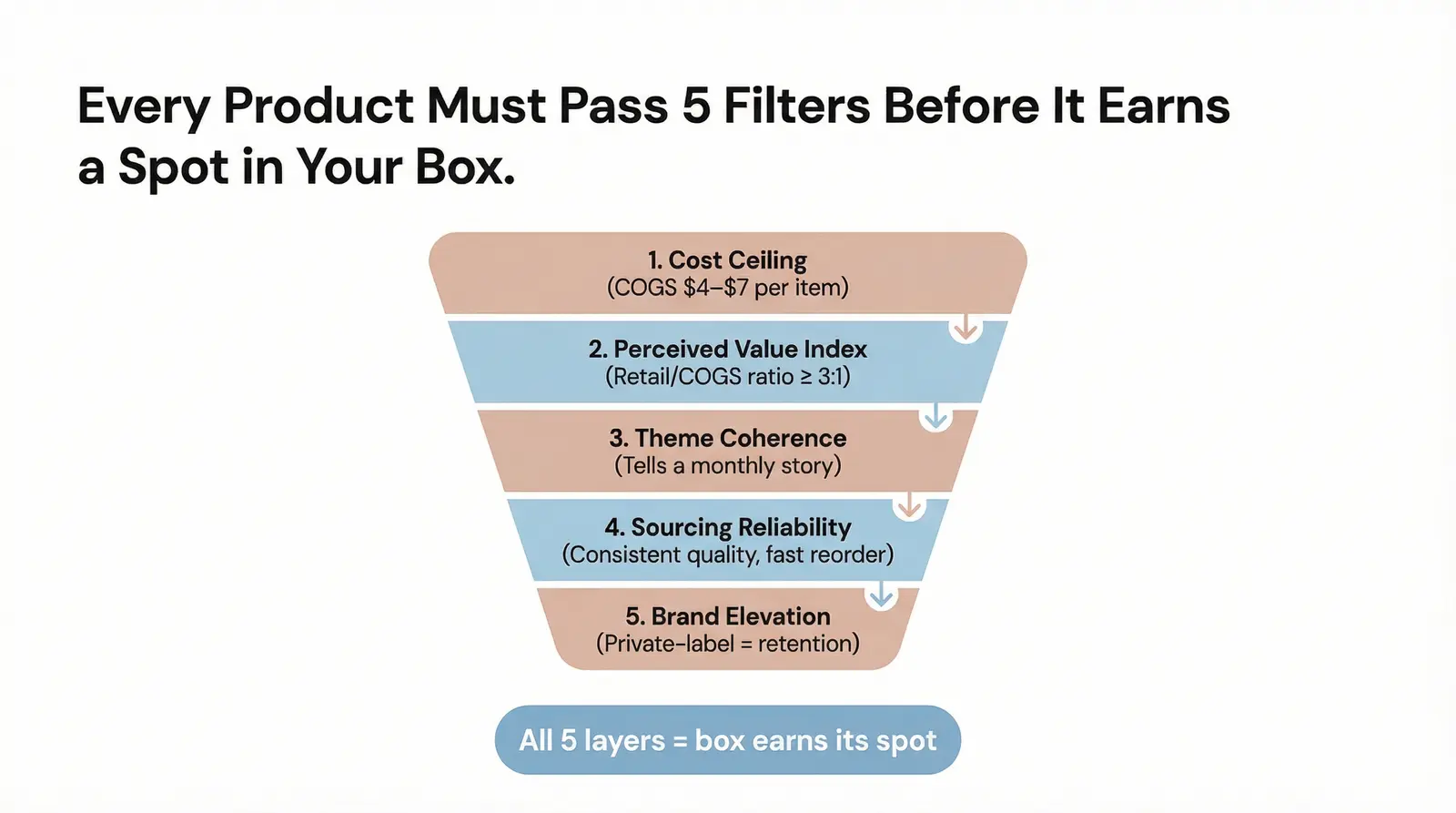
To navigate the tight economics of a $20/month box, you need a systematic approach to every product decision. At Branvas, we apply the Branvas CURATION STACK™, a 5-layer decision model for subscription box product selection. It works as a filter: every item you consider for a box must pass through all five layers before it earns a spot.
Set hard per-unit cost rules before you start sourcing. For a $20 box with three items, your target COGS per item should be $4–$7. This is non-negotiable. If a product costs $9 at wholesale, it doesn't matter how beautiful it is. It breaks the economics of the box.
Your cost ceiling should account for the full landed cost of the item, including any import duties, quality inspection fees, and inbound shipping from your supplier to your warehouse or fulfillment center.
The Perceived Value Index (PVI) is a simple score that measures how much "unboxing wow" an item delivers relative to its cost. A $4.50 dainty chain necklace that looks like an $18 retail piece has a high PVI. A $6 ring that looks like a $6 ring has a low PVI.
To score an item's PVI, ask yourself: if this item appeared in a boutique retail store, what price would it carry? Divide that perceived retail value by your actual COGS. A ratio of 3:1 or higher is your target. Items with a ratio below 2:1 should be replaced.
Every box should tell a monthly story. A "Coastal Summer" box should feel cohesive from the necklace to the earrings to the ring. If one item feels out of place, it breaks the narrative and undermines the curation.
Theme coherence also drives social sharing. Subscribers who feel like they received a thoughtfully curated set are far more likely to post an unboxing video than subscribers who received three unrelated pieces. That organic social content is free marketing.
A beautiful box that ships two weeks late is a cancellation waiting to happen. Before committing to a supplier, evaluate their lead times, MOQs, and reorder consistency. Can they fulfill 500 units in 10 days? What happens if you need to reorder mid-cycle? Do they have a track record of consistent quality across multiple production runs?
We often see new subscription box operators lock in a supplier for their launch box and then discover that the second reorder looks nothing like the first. Quality control is not a one-time check. It's an ongoing relationship.
The final layer is about turning a product into a brand experience. Private-label packaging, custom hang tags, branded tissue paper, and blind fulfillment (where your brand name appears on the shipping label, not your supplier's) all contribute to brand equity.
Brand elevation is what separates a subscription box that subscribers tell their friends about from one they quietly cancel after three months. It's also what justifies a price increase when you're ready to move from $20 to $25 or $30 per month.
With your CURATION STACK™ filters in place, the next step is finding suppliers who can meet your cost ceiling and quality standards. Here are the primary sourcing channels for jewelry subscription box operators.
Platforms like Alibaba and IndiaMart offer the lowest per-unit costs available, often $1–$3 per piece for fashion jewelry. However, they come with significant trade-offs. Minimum order quantities (MOQs) are typically 500 units or more per style, lead times run 4–8 weeks, and quality control is entirely your responsibility. For a subscription box operator managing monthly themes, the inflexibility of high MOQs creates real inventory risk.
US-based jewelry wholesalers offer shorter lead times (often 5–10 business days) and easier quality control, but per-unit costs are higher, typically $5–$12 for fashion jewelry. Directories like RangeMe and trade shows like the JCK Las Vegas show are good starting points for finding domestic suppliers.
Attending jewelry trade shows gives you the ability to see and feel products before committing to an order, negotiate directly with suppliers, and discover new trends. The downside is the time and cost involved. Trade shows are better suited for operators who are already scaling and need to diversify their supplier base.
A private-label platform handles sourcing, branding, and fulfillment in a single integrated workflow. For subscription box operators, this is the most efficient model because it eliminates the need to manage multiple supplier relationships, quality control processes, and fulfillment logistics.
Branvas simplifies this entire sourcing layer. Explore the catalog at branvas.com/catalog to see private-label jewelry and accessories available for subscription box operators, with no minimum order quantities and built-in branded packaging.

Let's walk through a realistic 3-item box scenario to see exactly how the math works for a $20/month subscription.
The Box:
On a $20 retail subscription, this leaves a gross margin of $2.50–$4.00 per box, or roughly 12.5%–20%. That's thin, but it's not the full picture.
The real profitability of a subscription box comes from customer lifetime value (LTV). If a subscriber stays for 12 months, they generate $240 in revenue against a cumulative COGS of $192–$210. That's $30–$48 in gross profit per subscriber, before factoring in the reduced per-unit costs you'll negotiate as your volume grows.
Private-label branding accelerates this math. Subscribers who feel a strong brand connection cancel at a lower rate, which extends LTV and improves the return on your customer acquisition cost (CAC). You can use the Branvas profit calculator at branvas.com/profit-calculator to model these scenarios for your specific box.
| Sourcing Strategy | COGS per Unit | Branding Control | MOQ | Fulfillment Complexity | Brand Equity Built |
|---|---|---|---|---|---|
| DIY Wholesale (Alibaba) | $1–$3 | Low (generic packaging) | High (500+ units) | High (self-pack and ship) | Low |
| Traditional Dropship | $3–$6 | None (supplier branding) | None | Low (automated) | None |
| Private-Label Platform (Branvas) | $4–$7 | High (custom packaging and inserts) | None | Low (blind fulfillment) | High |
The table above illustrates the core trade-off. DIY wholesale gives you the lowest per-unit cost but requires significant capital, storage, and labor. Traditional dropship eliminates inventory risk but builds zero brand equity. A private-label platform like Branvas sits in the optimal position for subscription box operators: competitive COGS, full branding control, no MOQ, and automated fulfillment.
If you're an ecommerce seller already running a Shopify store, branvas.com/solutions/ecommerce-and-boutique-store-owners shows how to add a subscription layer to your existing business. If you're starting from scratch, branvas.com/solutions/aspiring-entrepreneurs is the right starting point.

When your product budget is capped at $7 per item, you have to find other ways to make the box feel expensive. The good news is that the highest-leverage upgrades are also the cheapest.
Custom packaging is the most impactful investment you can make. A matte black box with a gold foil logo feels like a luxury product. The same jewelry in a plain brown mailer feels like a clearance purchase. The packaging sets the emotional tone for everything inside.
Themed insert cards add narrative value at almost no cost. A card that reads "This month's collection was inspired by the golden hour light of late summer" gives the subscriber a story to connect with. It transforms a ring into a memory.
Branded tissue paper and ribbon slow down the unboxing experience in a good way. The act of unwrapping creates anticipation. Subscribers who spend more time unboxing are more likely to photograph and share the experience.
Personalization is the next frontier. Even a simple "Curated for [Name]" sticker on the outside of the box increases perceived value and reduces churn. Data from McKinsey shows that personalization is one of the strongest drivers of subscription sign-ups, with "good variety of items or experiences" and "high quality" both ranking in the top three factors [2].
In our experience at Branvas, the single highest-leverage move a new subscription box operator can make is upgrading their packaging before upgrading their product. Subscribers remember the feeling of opening the box as much as the jewelry itself. A well-designed insert card that explains the inspiration behind the month's theme adds narrative value that costs pennies to produce but delivers dollars in retention.

Even experienced ecommerce sellers make critical errors when transitioning to a subscription model. Here are the five most common sourcing mistakes, and how to avoid them.
1. Thin margins from reactive sourcing. Buying inventory at the last minute forces you to pay premium prices and expedited shipping costs. Build your sourcing calendar 60–90 days in advance. Know what your next three boxes will contain before you ship the current one.
2. Inconsistent quality across months. A great box in January followed by a cheap-feeling box in February is the fastest way to drive churn. Establish quality benchmarks for every item category and stick to them. If a supplier can't consistently meet your standards, replace them before they damage your brand.
3. No contingency supplier. If your primary supplier faces a production delay or a shipping disruption, you need a backup plan. Identify at least one alternative supplier for each product category before you need them. We often see new subscription box operators scramble to find replacement products at the last minute, which invariably means paying more and compromising on quality.
4. Ignoring shipping weight and dimensional weight pricing. A box that is slightly too large can double your shipping costs due to dimensional (DIM) weight pricing, where carriers charge based on the size of the package rather than its actual weight. Before finalizing your box dimensions, calculate the DIM weight and compare it to the actual weight. Use the smaller number to select your box size.
5. Undervaluing private-label branding in retention. Generic products are easily forgotten. A necklace that arrives in a branded box with a custom card is a brand experience. A necklace that arrives in a plain poly mailer is a commodity. Branding is not a luxury for subscription box operators. It is a retention tool.

In the early days, packing boxes in your living room is a rite of passage. It keeps costs low, gives you direct quality control, and keeps you close to the product. But as your subscriber count grows, self-fulfillment becomes a bottleneck that limits your ability to focus on growth.
Most operators find that once they cross the 200–500 subscriber mark, the time spent packing boxes outweighs the cost savings of doing it yourself. At 5,000 orders per month, self-fulfillment is no longer viable for most small teams, and outsourcing to a third-party logistics (3PL) provider becomes a business necessity [3].
The signs that it's time to outsource are clear: you're spending more time packing than marketing, your shipping costs are inconsistent, your quality control is slipping, or you're missing your monthly ship date. Any one of these is a signal. All four together mean you needed a fulfillment partner yesterday.
A specialized fulfillment partner or a private-label platform with built-in blind fulfillment allows you to focus on what actually grows your business: content creation, community building, and subscriber acquisition.
If you're ready to launch or scale a branded jewelry subscription box without the sourcing and fulfillment headache, see how Branvas works at branvas.com/how-it-works. We handle product, branding, and blind shipping so you can focus on growing your audience.

For a $20/month subscription box, you should aim to keep your total product COGS between $10 and $12 for a 3-item box, or roughly $3–$5 per item. This leaves room for packaging ($1–$2), shipping ($4–$5.50), and a gross margin of $2–$4. As your volume grows and you negotiate better supplier rates, your COGS will decrease and your margins will improve.
A healthy gross profit margin for a subscription box is typically 40–60% [4]. For lower-priced boxes under $20, initial margins may be tighter (12–25%), which makes customer retention and lifetime value (LTV) the most critical metrics for long-term profitability. A subscriber who stays for 12 months is worth far more than the margin on a single box.
Subscription box operators source products from overseas wholesale marketplaces (like Alibaba and IndiaMart), domestic trade shows, niche ecommerce sites, and private-label platforms. For jewelry specifically, private-label platforms offer the best combination of competitive pricing, branding control, and fulfillment automation. Branvas's catalog at branvas.com/catalog is purpose-built for subscription box operators who need reliable, brandable jewelry at scale.
You can start a subscription box with zero inventory by partnering with a private-label dropshipping platform. Services like Branvas allow you to curate products from a catalog, apply your custom branding, and have items blind-shipped directly to your subscribers. This eliminates upfront inventory investment and storage costs, making it an ideal model for first-time box curators. See branvas.com/solutions/aspiring-entrepreneurs for a step-by-step starting point.
Churn is driven more by perceived value and thematic consistency than by price alone. Subscribers are less likely to cancel if the unboxing experience feels premium and the items align with a cohesive monthly story. That said, the $20–$25 range consistently shows strong retention because it sits below the threshold where subscribers feel they need to justify the expense. The key is ensuring that the perceived retail value of the box is at least 2–3 times the subscription price.