


Learn how boutique stores can select, price, and launch stacking rings using private-label fulfillment to maximize margins and repeat purchases.
Published:
March 7, 2026
Author:
Yi Cui
If you're targeting boutique stores, here's the fastest way to pick, price, and launch stacking rings — without getting stuck in sourcing or inventory.
Stacking rings are one of the best categories a boutique can carry. A customer buys one ring, then comes back for another because building a collection is the whole point. That repeat purchase behavior is baked into the format, which means your customer acquisition cost works harder than it does for one-and-done SKUs. Most stacking rings retail between $18 and $85 depending on metal and finish, comfortably in impulse-buy territory, and multi-unit baskets happen naturally.
The trend tailwinds are real and sustained. The global stackable rings sets market was valued at $3.6 billion in 2024 and is projected to reach $8.4 billion by 2033, growing at a CAGR of 11.80% [^1]. The Business of Fashion and McKinsey's State of Fashion 2026 report found that jewelry is set to be the fastest-growing fashion category by unit sales through 2028, at nearly four times the rate of clothing [^2], with stacking and layering called out as a defining consumer behavior across all price segments.
Giftability rounds out the case. A curated three-ring set in a small gift box is a natural birthday, graduation, or holiday purchase — it photographs well, ships easily, and doesn't require sizing precision the way a solitaire does. Platforms like Branvas make it possible to launch the category on a private-label, on-demand basis without committing to upfront inventory.

The primary buyer skews female, aged 25 to 44, with Millennials leading. A 2025 BriteCo nationwide survey found that 86% of Americans aged 30 to 44 self-purchase fine jewelry — the highest rate of any age group [^3]. The motivation is self-expression and milestone celebration, not waiting for a gift. Gen Z (ages 18 to 29) is the secondary buyer and a fast-growing one: rings represent 43% of the U.S. jewelry market share, with stackable rings particularly strong among younger consumers who value the ability to build and remix their look over time [^3]. The gift occasion still matters, especially in the $30 to $60 range — a curated set in a gift box is an easy birthday or holiday purchase that boutiques near the register consistently see convert.
Use this table to match your buyer type to the right positioning angle before building your assortment or writing product copy.
| Buyer Type | Primary Occasion | Price Sensitivity | Recommended Positioning |
|---|---|---|---|
| Millennial self-purchaser (30–44) | Everyday wear, milestone reward | Medium: willing to spend $40–$80 per ring | "Build your stack" — self-expression, layering freedom, quality metals |
| Gen Z style explorer (18–29) | Trend-driven, social-first | Low to medium: prefers $18–$45 per ring | Mix-and-match, texture play, affordable entry with room to grow |
| Gift buyer (any age) | Birthday, holiday, graduation | Low to medium: wants a complete gift under $60–$80 | Curated sets, gift-ready packaging, occasion anchoring |
| Boutique loyalist (35–55) | Self-treat, seasonal refresh | Medium to high: open to $50–$120 for quality | Demi-fine or sterling silver, brand story, tarnish-resistant materials |
Branvas Boutique Positioning Heuristic — for planning purposes only.
"Build your own stack" invites the customer into a creative process, positions your store as a curator, and encourages multi-unit purchases. Display rings in groups of three to five with a small card that says "start here." Minimalist everyday jewelry works well for the 25 to 40 demographic who wants pieces they can wear to the office and dinner without changing. Gifting occasion anchoring is the easiest conversion play for holiday and birthday windows: a three-ring set in a branded box at $48 to $65 is a complete gift that requires no decision-making from the buyer.

Stacking rings offer some of the best margin structure in boutique jewelry because the per-unit cost is low and perceived value scales with presentation. The ranges below are illustrative estimates based on typical market data, not guarantees — your actual margins will depend on sourcing method, landed costs, packaging, and operating overhead.
Entry (base metal, gold-plated or stainless steel, dainty bands): $1.50–$4.00 landed cost | $14–$28 retail | approximately 70%–85% gross margin. Volume drivers and impulse buys. Margin is high, but perceived value depends heavily on packaging and display.
Mid-range (gold-filled or sterling silver, simple bands and textures): $5–$12 landed cost | $28–$55 retail | approximately 60%–75% gross margin. The sweet spot for most boutiques. Sterling silver and gold-filled pieces hold up to daily wear and are the most commonly reordered SKUs.
Demi-fine (925 sterling silver with 14k or 18k gold vermeil, gemstone accents): $10–$22 landed cost | $45–$85 retail | approximately 55%–70% gross margin. Where boutiques build brand credibility. Customers perceive these as investment pieces, which reduces price sensitivity and increases gifting conversion.
Premium (solid gold fill, birthstone or CZ-set bands, engraved or signet styles): $18–$35 landed cost | $75–$140 retail | approximately 50%–65% gross margin. Anchor SKUs that justify the brand and pull up average order value. They sell more slowly but carry the perception of the entire assortment.
Fine and demi-fine jewelry typically commands a 2x to 2.5x markup, while fashion and base-metal jewelry supports 3x to 4x or higher [^4]. A private-label or dropship model — like Branvas Pricing — shifts the cost structure so you pay per unit fulfilled rather than holding stock, which changes your cash flow profile even if the per-unit cost is slightly higher.

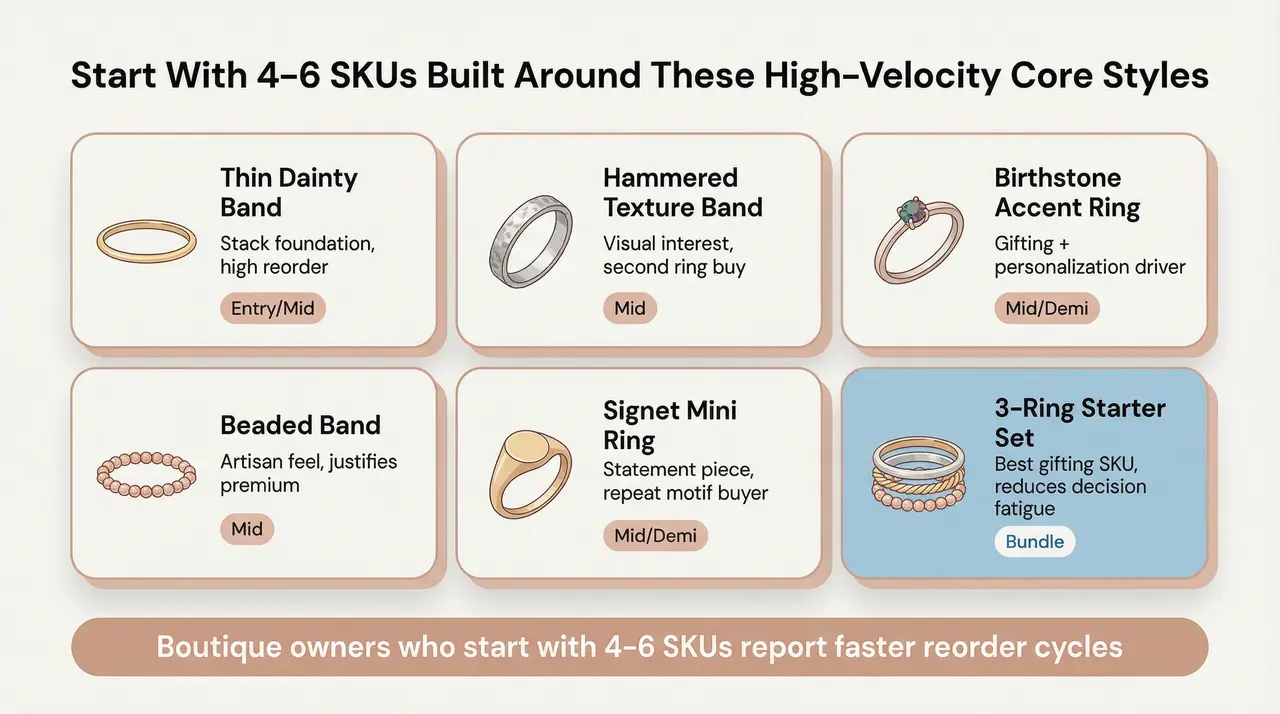
Start with four to six SKUs. Boutique owners who launch with a focused assortment report cleaner sell-through and faster reorder cycles than those who start with twelve or more styles. Once you know what your customer reaches for first, expand. For a full view of available styles, Browse the Branvas Catalog.
Thin dainty band (gold-plated or gold-filled): A 1–2mm smooth band in yellow gold finish. The foundation of any stack and a spacer between more textured pieces. High velocity, high reorder rate.
Hammered texture band (sterling silver or gold vermeil): A slightly wider band with a hand-hammered finish. Adds visual interest without bulk. Sells well as a "second ring" purchase to customers who already own a dainty band.
Twisted wire or rope band: A thin ring with a twisted or braided wire design. Adds texture contrast to a smooth stack. Boutique-friendly because it photographs distinctively and is easy to style in display.
Birthstone or gemstone accent ring: A thin band with a single small stone — cubic zirconia, genuine birthstone, or colored glass. Drives gifting and personalization purchases. Offer in multiple stone colors to increase SKU variety without increasing sourcing complexity.
Beaded band (gold-filled or sterling silver): A band with evenly spaced beads or granules along the shank. Adds a tactile, artisan quality that justifies a slightly higher price point. Works well in the mid-range tier.
Enamel accent band: A thin band with a small section of colored enamel. Seasonal colorways give you a reason to refresh the assortment without changing the core style.
Signet-style mini ring: A small flat-top ring with a minimal engraved or embossed detail — a star, moon, initial, or geometric shape. Sells as a statement piece within a stack. Customers who buy one often return for a second in a different motif.
Mixed-metal two-tone band: A ring that combines yellow gold and silver tones in a single band. Solves the "I can't decide between gold and silver" objection and works in any stack.
Curated three-ring starter set: Three coordinated bands — typically one smooth, one textured, one with a small accent — packaged together in a gift box. Priced at $42–$68 as a set. The single most effective gifting SKU in the category. Reduces decision fatigue and increases average order value in one move.
Seasonal gift bundle (five rings plus packaging): A larger set built around a theme — "everyday minimalist," "celestial stack," or "birthstone collection" — packaged in a branded box with a style card. Priced at $65–$95. Best suited to holiday and gifting windows.
Stacking rings are small. That's a logistical advantage — they ship cheaply and store easily — but it also means the product doesn't carry much visual weight at the point of sale. Packaging closes the gap between a $22 ring and a $22 ring that feels worth $40. A ring in a plain poly bag communicates nothing. The same ring on a branded jewelry card in a matte box with tissue paper communicates quality and brand identity before the customer has even touched the piece.
Five packaging moves that improve conversion for boutique stacking rings:
Branded jewelry card with a brand story. A small card with your brand name, a one-line story, and care instructions. The lowest-cost, highest-impact upgrade available. Boutique owners who invest in branded packaging — even just a custom jewelry card — report higher perceived value and fewer price objections.
Stacking display insert or ring roll. A small foam or velvet insert that holds three to five rings in a row, showing the customer how the rings look stacked and making the multi-unit purchase feel intentional.
Matte box or kraft box with ribbon. A small rigid box in matte black, white, or kraft finishes with ribbon or a wax seal. The packaging format that converts best for the gifting occasion buyer.
Tissue paper and branded sticker. A branded sticker seal on tissue paper adds an unboxing moment customers share on social media for roughly $0.15 per order.
Sizing guide insert. A small card explaining how to measure ring size and how to style a stack. This reduces returns and positions your boutique as knowledgeable rather than just transactional.
Branvas's private-label service includes branded packaging options so boutique owners don't have to source cards, boxes, and inserts separately. Explore Branvas's Brand Studio. [^5]

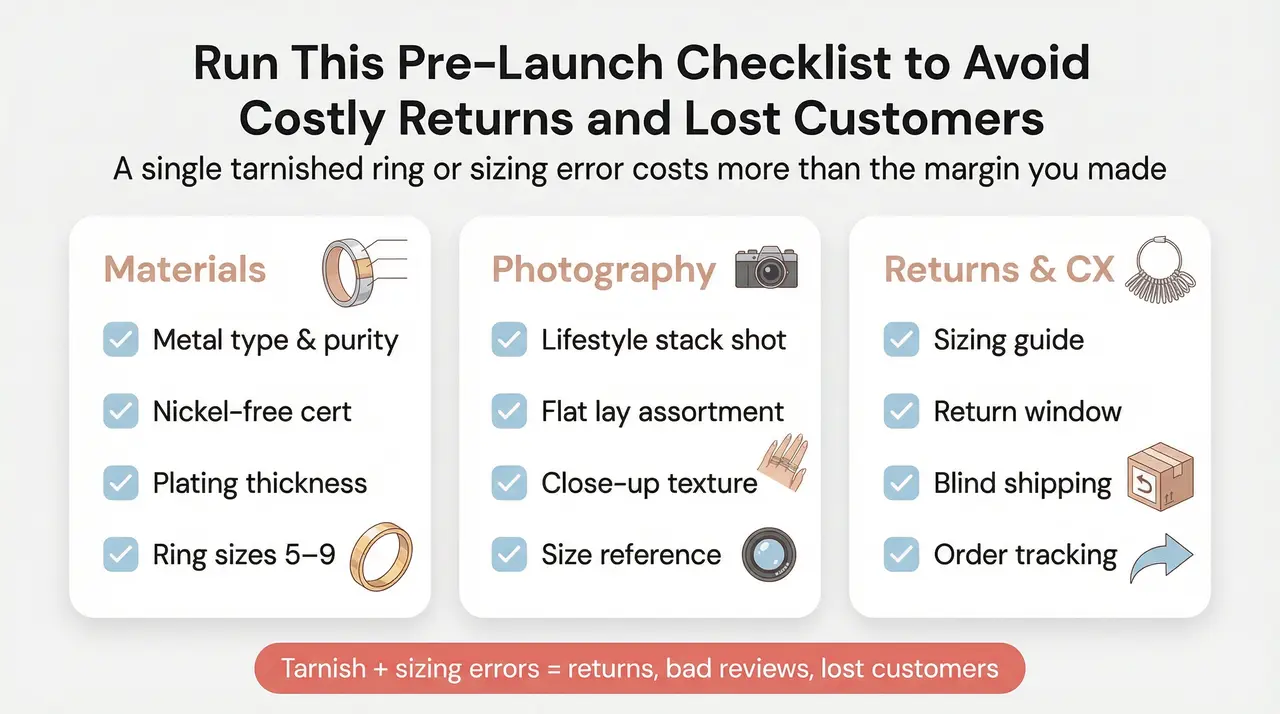
Before you commit to a supplier or launch a new SKU, run through this checklist. A ring that tarnishes in three weeks or arrives in the wrong size costs far more than the margin you made on the sale.
A ring that tarnishes or causes a skin reaction generates a return, a negative review, and a lost customer from a single unit. A flat, poorly lit product shot suppresses conversion even on a well-priced SKU. Stacking rings carry a higher-than-average sizing return rate — customers who are unsure of their size will guess wrong often enough to create a pattern. [^6]
Ready to launch stacking rings without managing inventory? See How Branvas Works
Four to six SKUs is a practical starting point. This gives you enough variety to demonstrate the stacking concept — typically one smooth band, one textured band, one accent or birthstone style, and one set or bundle — without overcommitting to inventory or visual clutter. Once you identify your two or three fastest sellers, expand from there.
Gross margins typically range from 50% to 85%, depending on the metal tier and your sourcing model. Entry-level base metal rings can support margins at the higher end of that range, while demi-fine gold vermeil or sterling silver pieces tend to land in the 55% to 70% range. These are market estimates, not guarantees — your actual margin will depend on landed costs, packaging, and operating overhead.
No. Private-label fulfillment and dropship models allow boutique owners to sell stacking rings without holding physical stock. Platforms like Branvas handle sourcing, branding, and blind shipping so you can list products, take orders, and fulfill them without a warehouse or minimum order commitment — particularly useful for testing new styles before committing to bulk inventory. For more, see Branvas for Boutique and eCommerce Store Owners.
US sizes 5 through 9 cover the majority of female customers and is the minimum range you should offer. Size 7 is the most common women's ring size in the US, followed by sizes 6 and 8. Extending to sizes 4 through 10 reduces sizing-related returns and makes the category more accessible. For sets and bundles, offering small, medium, and large is a practical alternative to full half-size increments.
The most effective lever is metal quality combined with packaging. A 925 sterling silver or 14k gold vermeil ring in a branded matte box with a jewelry card reads as a premium product even at a $55 to $75 retail price. Pair that with copy that emphasizes metal purity, tarnish resistance, and the "build your stack" narrative, and you've given the customer a reason to pay more than they would for an unbranded equivalent. In our experience at Branvas, boutique owners who lead with material quality and brand story see fewer price objections than those who lead with style alone.
[^1]: Global Stackable Rings Sets Market Scope and Changing Dynamics 2024–2033 — HTF Market Insights, 2025.
[^2]: Why the Shine Isn't Fading on Jewellery Sales — Business of Fashion / McKinsey State of Fashion 2026, December 2025.
[^3]: 80% of Americans Now Buy Fine Jewelry for Themselves Instead of Waiting for a Gift — BriteCo, December 2025.
[^4]: How to Buy Jewelry Wholesale and Sell Retail Profitably — JewelPin, January 2026.
[^5]: The Power of Packaging: How Luxury Presentation Improves Jewelry Sales and Customer Experience — CaratX, April 2025.
[^6]: On Data: How Did Independent Jewelers Fare in 2024? — National Jeweler / Edge Retail Academy, January 2025.