



Over 50 gemstone jewelry brand name ideas organized by style with meanings, plus a proven naming framework and availability checklist to launch confidently.
Published:
May 16, 2026
Author:
Yi Cui
Steal-worthy gemstone jewelry brand name ideas with meanings, organized by style so you can choose fast and feel confident.
Finding the right name is one of the most important decisions you will make when launching a gemstone jewelry brand. It is the first thing a customer sees, and it sets the tone for everything that follows: your pricing, your packaging, your social presence, and the story you tell. When people search for gemstone jewelry brand name ideas, they want a name that captures the energy of the stones they sell and gives them the confidence to move forward. This article gives you 50+ original, brandable names organized by style, each with a specific meaning, plus a practical framework and checklist to help you choose and launch.
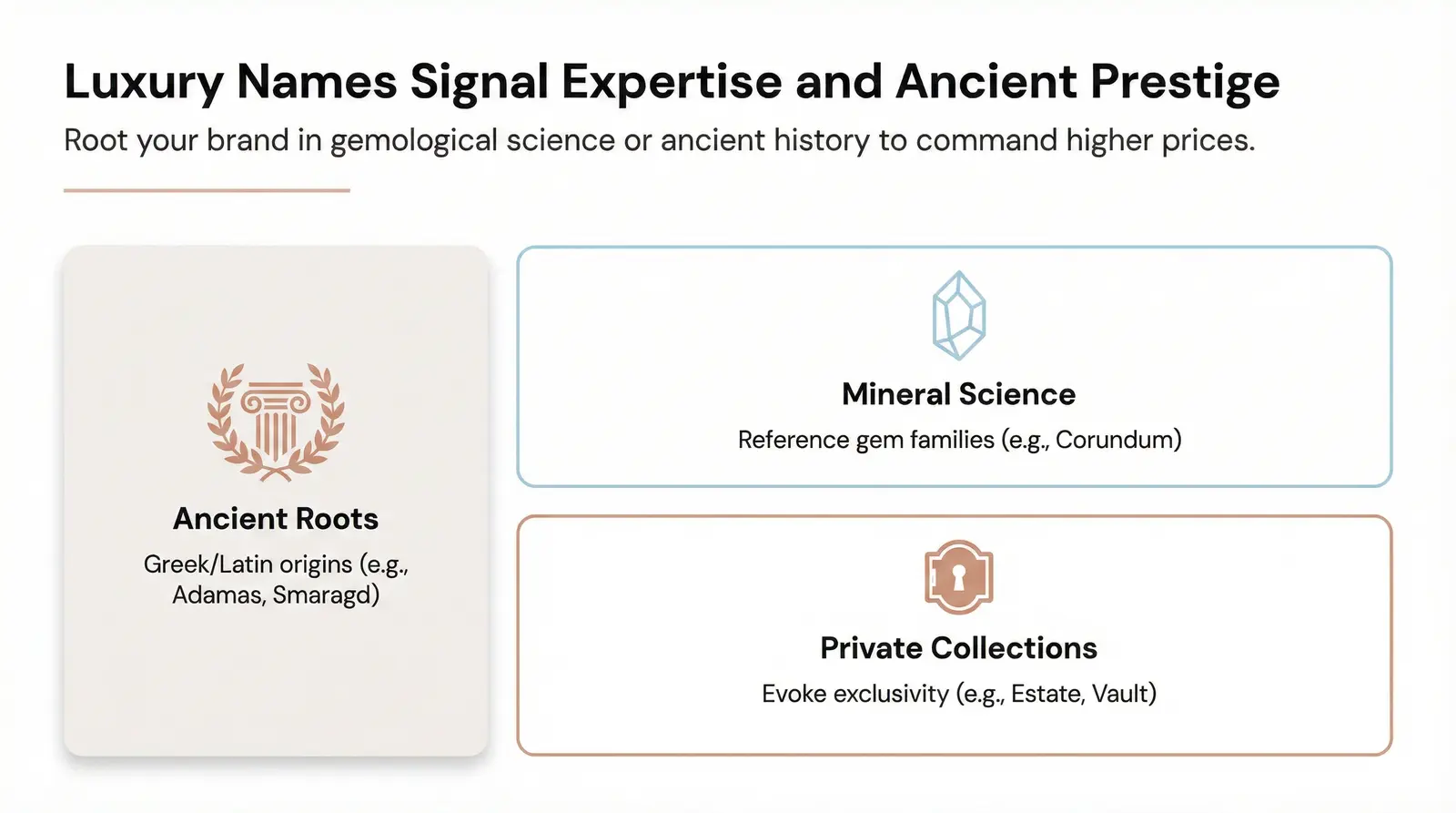
A luxury gemstone jewelry name needs to feel opulent, intentional, and rooted in something real. The best names in this category draw on gemstone etymology, ancient cultural references, or the prestige of rare minerals to signal that the pieces are worth investing in.
Adamas & Co. — Drawn from the ancient Greek word for diamond, "adamas," meaning unconquerable and indestructible, this name projects absolute strength and permanence.
Smaragd House — Derived from the Greek "smaragdos," the original word for emerald, this name carries the weight of ancient Egyptian royalty and the calming power of deep green stones.
Corundum Atelier — Corundum is the mineral family that produces both rubies and sapphires, making this a sophisticated, gemologically precise name that signals serious expertise.
Rubra Fine Gems — Rooted in the Latin "ruber," meaning red, this name evokes the fiery passion and ancient prestige of rubies, which were once considered more valuable than diamonds.
Lazuli & Roe — Inspired by lapis lazuli, the deep blue stone prized by Egyptian pharaohs and ground into ultramarine pigment by Renaissance painters, this name carries centuries of cultural resonance.
Chrysos Vault — Drawing from the Greek word "chrysos" for gold, this name suggests a private treasury of rare, precious pieces with an ancient Hellenic pedigree.
Periclase Jewels — References the mineral science behind gemstone formation, signaling a brand built on deep knowledge of the earth's rarest materials.
Viridian Estate — Inspired by the rich, blue-green hue of high-quality emeralds and tourmalines, this name evokes the grandeur of a private estate collection.
Auric & Croft — "Auric" derives from the Latin "aurum" for gold, and paired with the heritage feel of "Croft," it creates a name that sounds like a century-old British jeweler.
Rhodon Fine Jewelry — Taken from the Greek "rhodon," meaning rose, this name references the delicate pink of rhodonite and rhodolite garnets, stones associated with emotional healing and refinement.
Topazion — Built on the ancient Greek "topazos," the root of topaz, which was mined on a remote island in the Red Sea and traded by Egyptian pharaohs.
Heliodor House — Heliodor is a golden beryl whose name means "gift of the sun" in Greek, making this a name that radiates warmth, rarity, and classical prestige.
Spessart & Stone — Spessartite is one of the rarest and most vivid orange garnets, and this name uses it to signal a brand that sources exceptional, connoisseur-grade gemstones.
Minimalist gemstone jewelry names are short, clean, and quietly confident. The best names in this category borrow from gemstone science, crystal structure, or the visual simplicity of a single stone set in a plain band. They are designed for brands that let the stone do the talking.
Facet — A direct reference to the flat, polished surfaces cut into a gemstone to maximize light reflection, this name is crisp, visual, and instantly understood by jewelry lovers.
Cleavage Studio — In gemology, cleavage is the precise way a crystal breaks along its natural planes, making this a technically elegant name for a brand built on geometric design.
Luster & Co. — Luster is the gemological term for the way light interacts with a stone's surface, and this name captures that quiet, understated brilliance in two syllables.
Mohs — Named after the Mohs hardness scale used to measure a gemstone's durability, this single-word name is bold, scientific, and deeply rooted in the craft of gemology.
Inclusions — In gemology, inclusions are the natural internal characteristics that make each stone unique, and this name celebrates imperfection and authenticity in a minimal way.
Refrakt — A stylized take on refraction, the optical phenomenon that gives gemstones their brilliance and fire, this name is short, visual, and easy to build a brand identity around.
Vein & Stone — Inspired by the mineral veins that run through raw gemstones, this name evokes the organic beauty of stones before they are cut and polished.
Silt — A quiet, earthy name that references the geological sediment in which many gemstones are found, perfectly suited for a brand with a raw, nature-forward aesthetic.
Axial — Drawn from the crystallographic axes that define a gemstone's internal structure, this name is precise, technical, and visually clean.
Pale Fire — A name inspired by the optical phenomenon of fire in gemstones, the dispersion of white light into spectral colors, kept minimal and poetic for a modern audience.
Stratum — References the geological layers in which gemstones form over millions of years, suggesting depth, patience, and the quiet power of natural processes.
Grain & Gem — References the crystalline grain structure of minerals, suited for a brand that values the natural, unadorned qualities of gemstones over heavy embellishment.

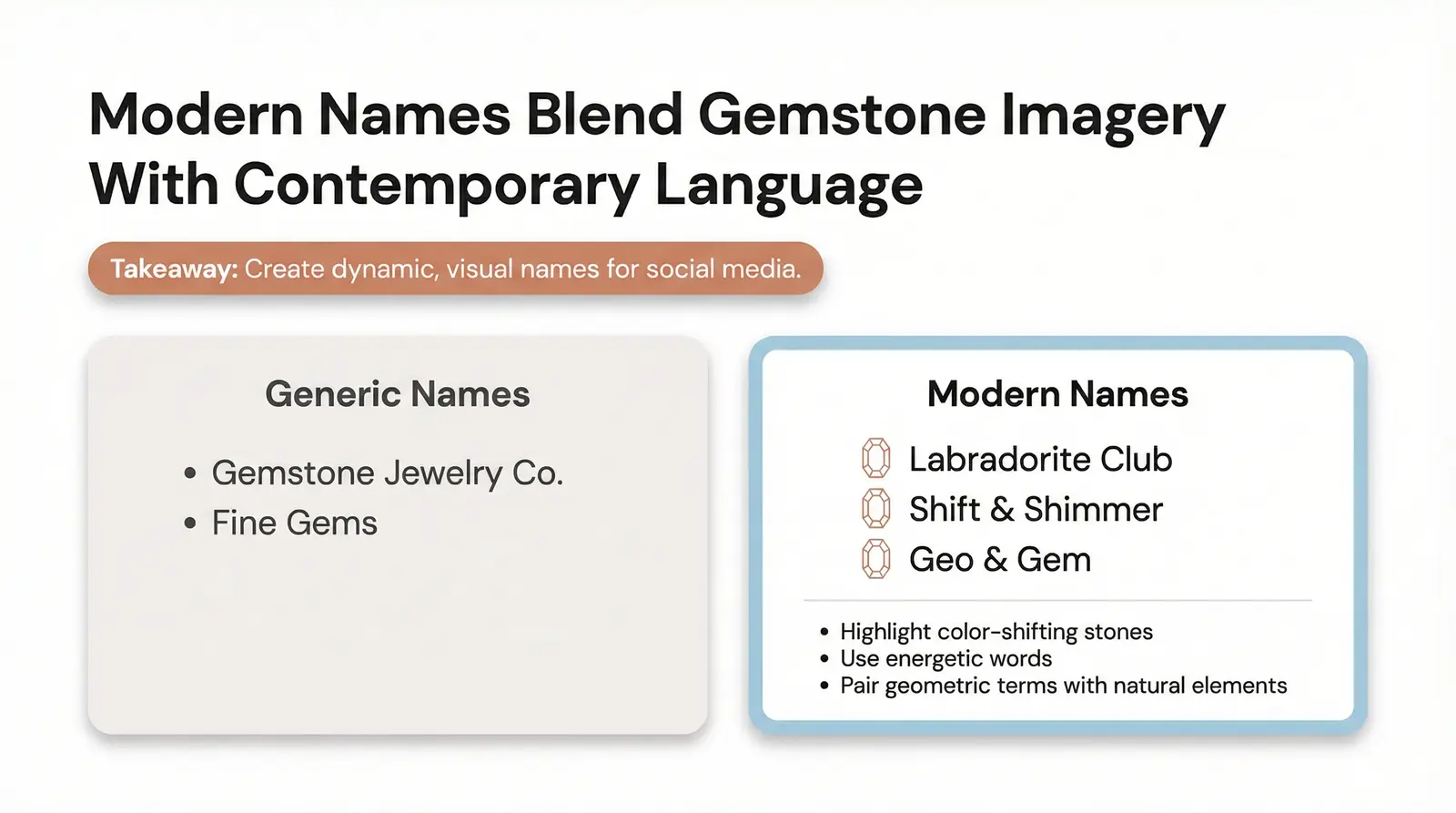
Modern gemstone jewelry brands need names that work as hard on TikTok as they do on a product tag. These names blend gemstone imagery with contemporary language to create something that feels both current and credible.
Labradorite Club — Labradorite is famous for its iridescent "labradorescence," a shifting play of color that mirrors how modern jewelry brands constantly evolve and surprise.
Shift & Shimmer — A name that captures the color-change phenomenon seen in alexandrite, a rare gemstone that shifts from green in daylight to red under incandescent light, symbolizing adaptability and transformation.
Prismatic — Inspired by the way a gemstone acts as a prism, splitting light into its full spectrum of colors, this name is energetic, visual, and perfectly suited for a brand with a bold, colorful identity.
Geo & Gem — A name that merges the geometric precision of modern jewelry design with the natural world of gemstones, ideal for a brand that bridges art and science.
Tourmaline Drop — Tourmaline is one of the most color-diverse gemstones in the world, occurring in virtually every hue, making this a name that signals variety, vibrancy, and creative range.
Citrine Studio — Citrine's warm golden-yellow color is associated with optimism, energy, and abundance, and this name channels that sunny, forward-moving energy into a clean, modern brand identity.
Moonveil — Inspired by the adularescence of moonstone, the soft, billowing glow that appears to float beneath the surface of the stone, this name is dreamy, digital-friendly, and highly visual.
Tanzanite & Co. — Tanzanite is found only near Mount Kilimanjaro, making it one of the rarest gemstones on earth, and this name uses that exclusivity to signal a brand with a strong point of view.
Alexandrite Era — Named after the color-change alexandrite discovered in Russia's Ural Mountains in 1830, this name signals a brand that is always shifting, always relevant, and built for a new generation.
Spinel Society — Spinel was historically confused with ruby and sapphire by royalty for centuries, making this a name that plays on hidden value and the idea that the best things are often overlooked.
Opal Current — Opal's play-of-color, the way it flashes different hues as the viewing angle changes, makes this a name that feels alive and dynamic.
Aqua & Arc — Inspired by aquamarine, whose name comes from the Latin "aqua marina" meaning "water of the sea," this name is clean, modern, and evokes the clarity and calm of deep ocean water.
Romantic gemstone jewelry names evoke love, devotion, and the emotional weight of a piece given at a meaningful moment. They draw on the emotional symbolism of specific stones and the poetic imagery of love and connection.
Ruby Reverie — Rubies have been called the "king of precious stones" in ancient Hindu texts, and this name pairs that fiery symbolism with the softness of a daydream.
Amethyst & Vow — The ancient Greeks believed amethyst protected against intoxication and promoted clarity of mind, making this a name that suggests a love that is clear-eyed, intentional, and lasting.
Sapphire Devotion — Sapphire has been linked to loyalty and fidelity since the Middle Ages, when clergy wore blue sapphires to symbolize heaven, making this a name with deep romantic and spiritual resonance.
Pearl & Promise — Pearls are the only gemstones created by a living organism, formed layer by layer over years, making this a name that speaks to the slow, patient building of a lasting relationship.
Garnet Bloom — Garnets were carried by medieval travelers as protective talismans, and their deep red color has long been associated with love and devotion, making this name feel both protective and tender.
Rosé Quartz — Rose quartz is universally recognized as the stone of unconditional love in crystal healing traditions, and this name uses its soft pink energy to create a brand identity built entirely around romance.
Vellichor Gems — "Vellichor" is a coined word for the strange wistfulness of a used bookshop, and paired with gems, it evokes the romantic nostalgia of antique jewelry and inherited stones.
Morganite & Moon — Morganite, a pink beryl that has become one of the most popular engagement ring stones of the past decade, is paired here with the soft, cyclical symbolism of the moon.
Tender Facet — Combines the emotional warmth of romantic love with the precision of gemstone cutting, suggesting every piece is crafted with both technical skill and genuine feeling.
Serenade & Stone — Positions jewelry as a form of musical expression, a gift that carries a melody of emotion and devotion.
Blush Mineral — Uses the soft, warm blush of rose quartz and pink tourmaline to create a brand identity that feels feminine, intimate, and quietly luxurious.
Eternelle Gems — Drawn from the French word for eternal, this name is perfectly suited for a brand specializing in engagement rings and anniversary pieces designed to last a lifetime.

Choosing a name is not about finding the prettiest word. It is about finding the right word for your specific brand, your specific customer, and your specific market position. To make that process faster and more strategic, we created the GEMS Naming Framework, a four-step decision process built specifically for gemstone jewelry founders.
G: Grounded in Gemstone Meaning
The most powerful gemstone jewelry brand names are not just brandable, they are meaningful. Every gemstone has a documented history, an etymology, and a set of cultural associations your brand can draw from. Amethyst comes from the Greek "amethystos," meaning "not intoxicated," and was worn by ancient Greeks to promote clarity. Sapphire has been linked to devotion since the ancient Greeks associated it with Apollo. When your name is grounded in real gemstone meaning, you have an authentic story to tell on your website, in your packaging, and across your social content. That story builds trust.
E: Easy to Say, Spell, and Search
A name that is hard to pronounce is a name that does not get recommended. In the gemstone jewelry space, many founders are tempted to use rare mineral names or foreign-language words to sound premium. That can work, but only if the name passes the "say it aloud" test. If you have to spell it out every time you mention it, you are creating friction at every touchpoint. The best names are intuitive: they sound exactly the way they look and are easy to type into a search bar.
M: Memorable Without Being Generic
In our experience at Branvas, the names that perform best are specific without being limiting. A name like "Gemstone Jewelry Co." tells the customer what you sell, but it does not give them a reason to remember you. A name like "Labradorite Club" or "Pale Fire" creates a distinct mental image and an emotional hook. The goal is to be memorable, not just descriptive. The DTC jewelry brands that have built real audiences rarely use keyword strings. They use names that feel like a world you want to enter.
S: Scalable Beyond a Single Stone
This is the step most founders skip. You may be launching with a moonstone collection, but if your brand grows, you will want to add sapphires, tourmalines, and opals. A name too tightly tied to one stone or one color will feel limiting as your catalog expands. Choose a name that describes the feeling of your brand, not just the inventory. If you are building a full private-label gemstone jewelry line, you can explore Branvas's catalog to see the range of stones and styles available before you commit to a name that might box you in.

Before you fall in love with a name, you need to verify that you can actually own it. Run through this checklist before making any decisions.
This checklist is for informational purposes only and does not constitute legal advice. Trademark law is complex and jurisdiction-specific. Always consult a qualified trademark attorney before filing an application or making business decisions based on a name search.

You have a name. You have verified it is available. Now the work begins. Here is how to move from a name on a page to a real gemstone jewelry brand that sells.
Step 1: Lock in your digital assets immediately. Register your .com domain and claim your social handles on the same day you decide on a name. Names disappear fast, and losing your handle to a squatter is an avoidable problem.
Step 2: Register your business entity. Set up an LLC or sole proprietorship in your local jurisdiction. This protects your personal assets and makes it easier to open a business bank account before you start taking payments.
Step 3: Build your brand identity. Your name is the foundation, but your brand is the full picture: your logo, your color palette, your packaging, and the voice you use in every piece of copy. These elements should reinforce the meaning behind your name.
Step 4: Source your products. This is where most first-time founders get stuck. Sourcing quality gemstone jewelry, getting it branded, and managing fulfillment is a significant operational challenge. Platforms like Branvas are built to solve exactly this problem. You select the products, upload your branding, and Branvas handles the rest, including blind-ship fulfillment directly to your customers. You can see how it works and explore the full product range without any upfront commitment.
Step 5: Launch your store and start building an audience. Set up your Shopify storefront, write product descriptions that reference the meaning and symbolism of each stone, and start creating content that tells the story behind your brand name. The founders who grow fastest treat their brand name as a content asset, not just a label.
Ready to launch your gemstone jewelry brand? Explore Branvas →
Q: How do I know if a gemstone jewelry brand name is legally available?
A: Start by searching the USPTO trademark database at tmsearch.uspto.gov for registered names in International Class 14, which covers jewelry and precious stones. Also check domain registrars and social platforms to confirm no active business is already using the name. For a definitive answer, consult a trademark attorney before filing.
Q: Should my gemstone jewelry brand name include the word "gemstone" or a specific stone name?
A: It is not necessary, and it can actually limit your brand's long-term flexibility. Names that include a specific stone like "Ruby" or "Sapphire" can feel narrow as your product line grows. Instead, focus on names that evoke the feeling, aesthetic, or cultural meaning of gemstones without being tied to a single material.
Q: How many words should a jewelry brand name be?
A: One to two words is the sweet spot for most jewelry brands. Short names are easier to remember, easier to stamp on packaging, and easier to type into a search bar. Three-word names can work if they tell a clear story, but anything longer tends to lose memorability and create problems with social handles.
Q: What makes a gemstone jewelry brand name memorable?
A: The most memorable names combine easy pronunciation with a specific emotional or visual hook. They create a mental image or feeling the moment you hear them. Names rooted in gemstone etymology, rare mineral science, or vivid sensory imagery tend to stick because they give the listener something concrete to hold onto.
Q: Can I change my jewelry brand name later if I need to?
A: Yes, rebranding is possible, but it is costly and risks losing the audience and search equity you have built. It is far better to invest time upfront choosing a name that is legally available, emotionally resonant, and scalable. If you are unsure, test a shortlist of names with your target audience before committing.


