

Use the FIND Framework to choose between dropshipping, print-on-demand, wholesale, and private label based on your capital, inventory tolerance, niche, and brand goals.
Published:
May 5, 2026
Author:
Yi Cui
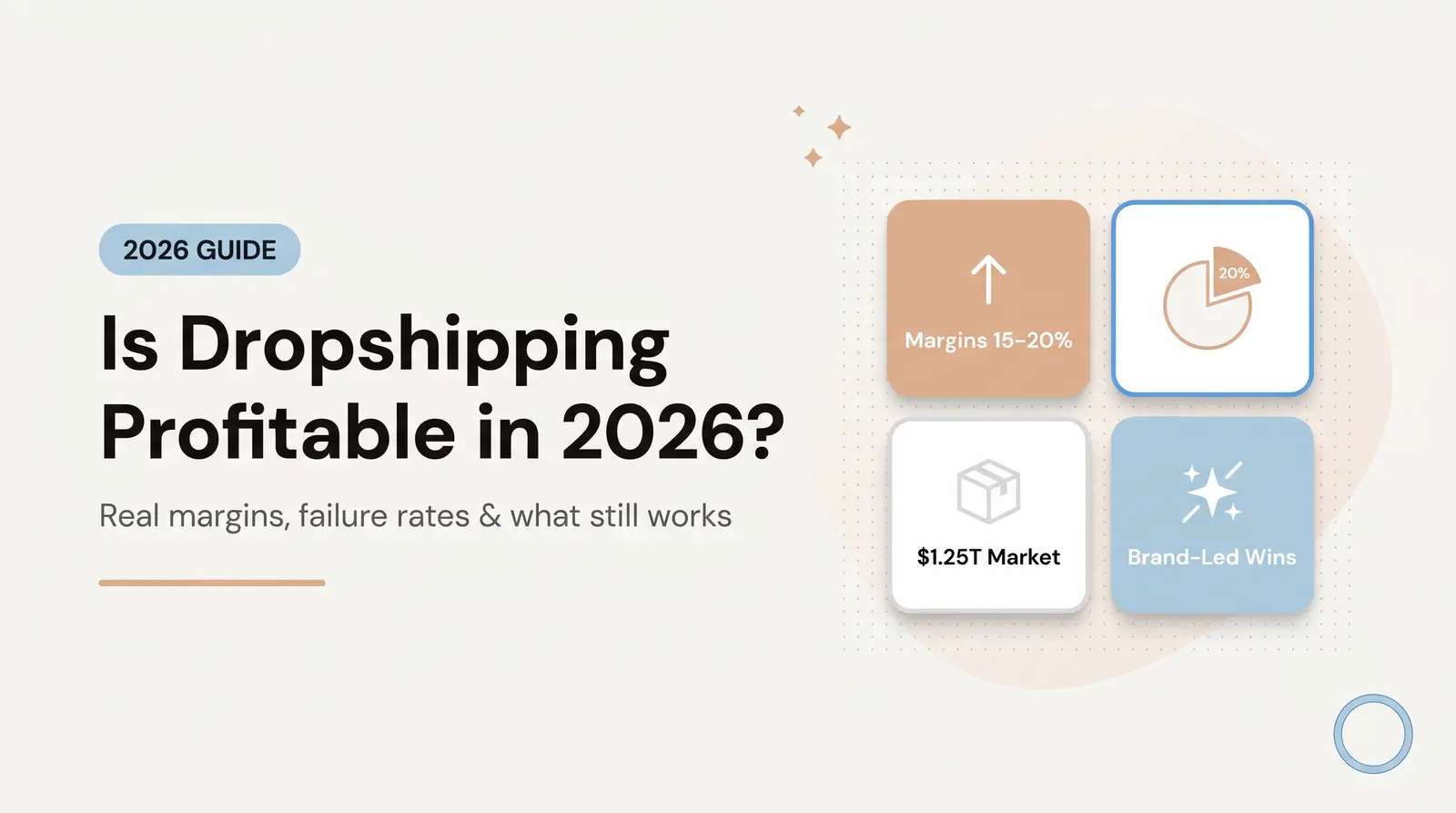
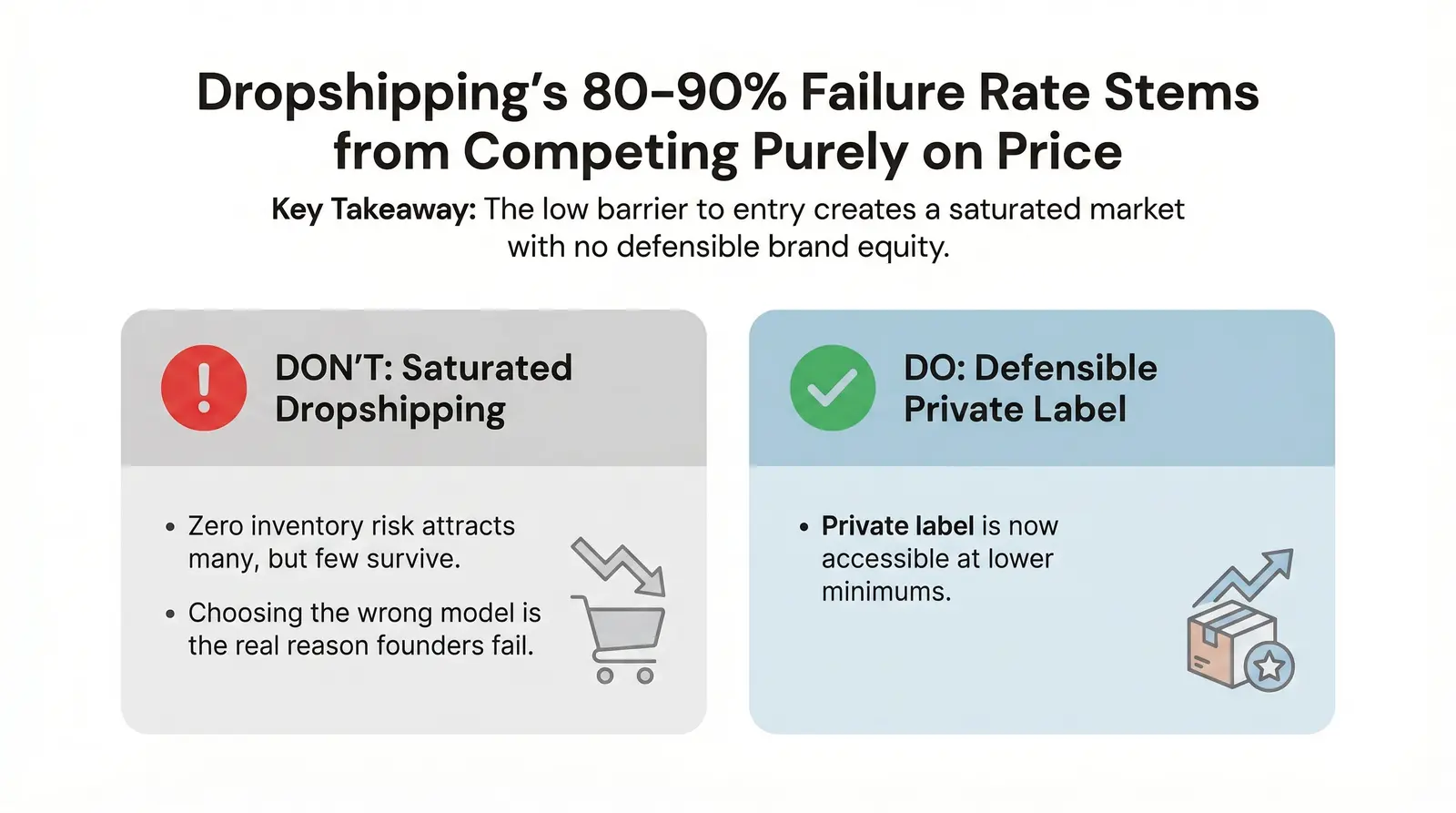
Most first-time founders default to dropshipping because it is the loudest model online. The promise of zero inventory risk and instant launch appeals to anyone looking to build an ecommerce business from their laptop. However, dropshipping is the right choice for far fewer people than the internet suggests. The low barrier to entry that makes dropshipping so attractive is exactly what creates its staggering failure rate. Industry data consistently shows that 80 to 90 percent of dropshipping businesses fail within their first year, largely because founders are competing purely on price in a saturated market without any defensible brand equity. [1] [2]
The contrarian reality is that private label, despite its reputation for requiring massive upfront capital and complex manufacturing relationships, is now accessible at lower minimums than ever before. With the rise of Brand-as-a-Service (BaaS) platforms, founders can launch custom-branded product lines without the traditional $10,000 inventory commitment. In our experience at Branvas, the founders who struggle most aren't the ones who picked the wrong product. They're the ones who picked the wrong model for their situation. Choosing the right ecommerce structure is the foundational decision that dictates your margins, your daily operations, and ultimately, your survival.
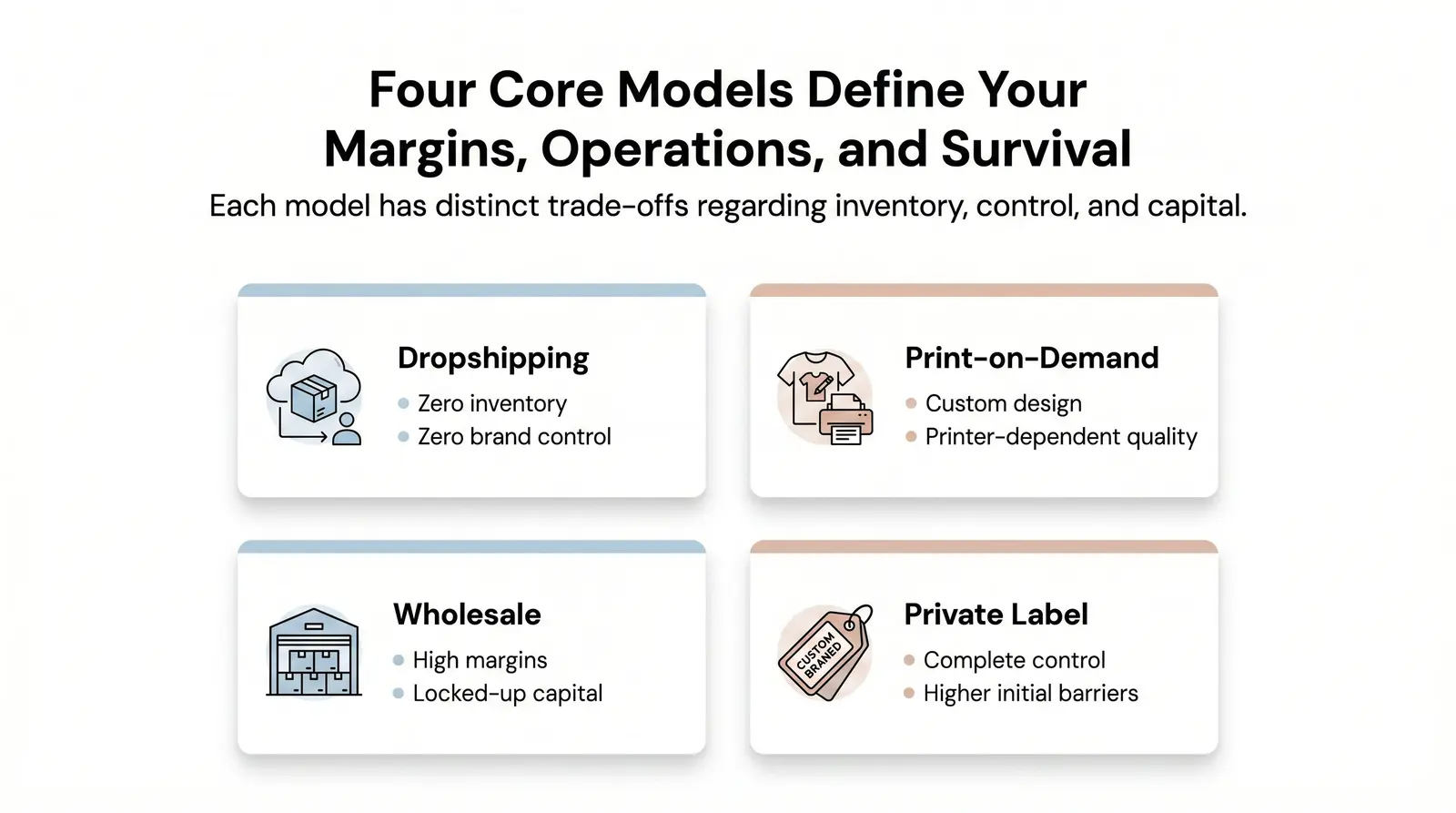
Dropshipping allows you to sell products without holding inventory, as the supplier ships items directly to your customer when an order is placed. This model is best for founders with minimal capital who want to test product-market fit quickly. However, the trade-off most articles gloss over is that you have zero control over the unboxing experience, and your supplier relationship is incredibly fragile. If they run out of stock or ship a defective product, your brand takes the hit.
Print-on-Demand (POD) involves selling custom-printed products (like apparel or mugs) that are manufactured only after a customer places an order. This model is ideal for creators, artists, and influencers with an existing audience who want to monetize their designs. The hidden trade-off is that while you control the design, you are still at the mercy of the printer's base garment quality and production times, which can vary wildly during peak seasons.
Wholesale / Bulk Buying requires purchasing inventory upfront at volume discounts and reselling it at retail prices. This model is best for founders with significant capital who want higher margins and immediate control over shipping times. The major trade-off is the cash conversion cycle. Your working capital is locked up in physical goods that may take months to sell, creating severe cash flow pressure during slow seasons.
Private Label involves manufacturing or sourcing products under your own brand name, complete with custom packaging and exclusive rights. This model is best for entrepreneurs focused on building long-term brand equity and defensible market positioning. The trade-off is that it traditionally requires higher minimum order quantities (MOQs) and longer lead times, though modern BaaS platforms have drastically reduced these barriers.
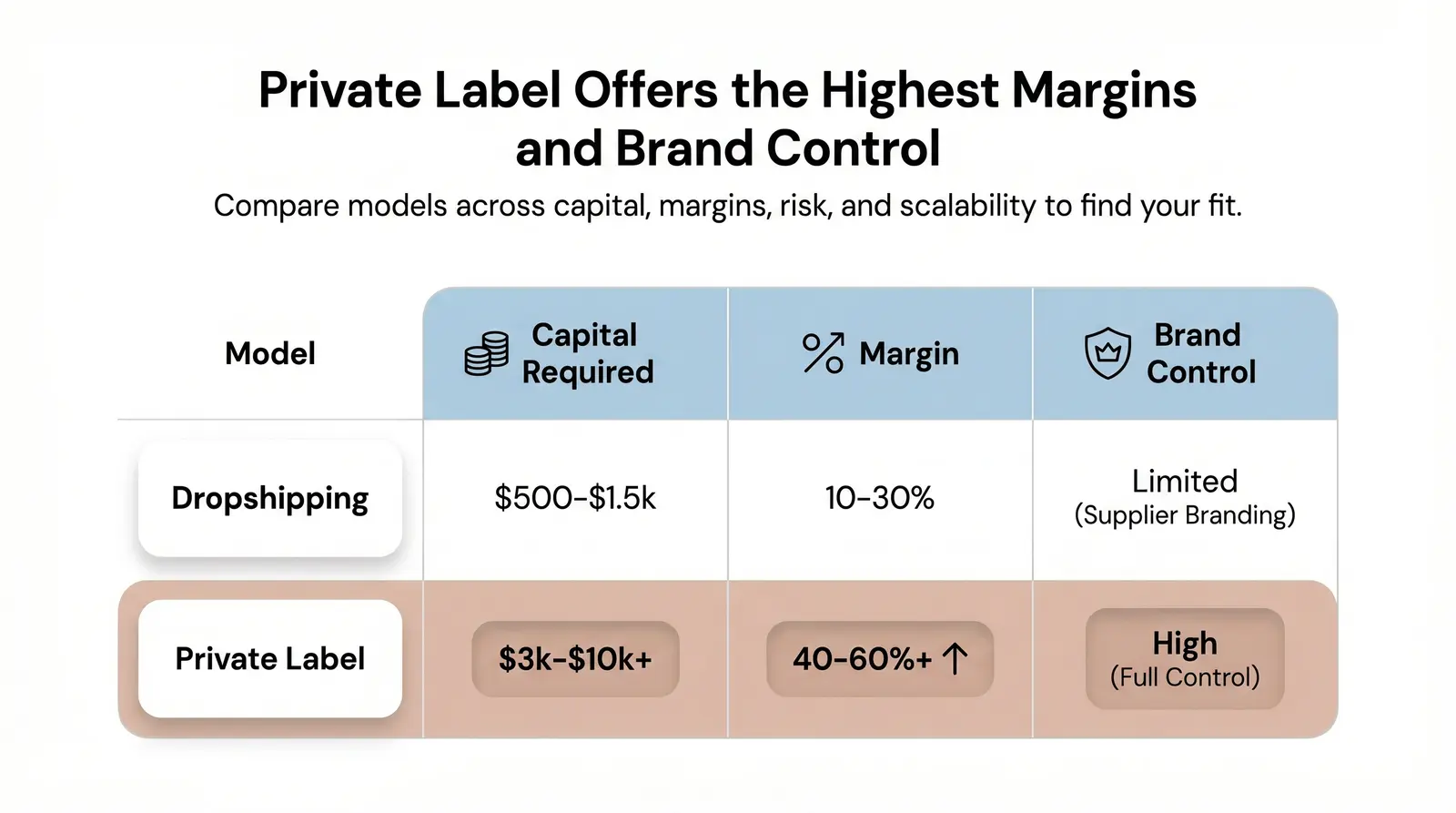
| Dimension | Dropshipping | Print-on-Demand | Wholesale | Private Label |
|---|---|---|---|---|
| Startup Capital Required | $500 – $1,500 | $500 – $1,000 | $5,000 – $15,000+ | $3,000 – $10,000+ (or $0 with BaaS) |
| Typical Gross Margin Range | 10% – 30% | 20% – 40% | 20% – 50% | 40% – 60%+ |
| Inventory Risk | Zero | Zero | High | Medium to High |
| Brand Control | None | Low (Design only) | Low (Reselling others) | Complete |
| Scalability Ceiling | Low (Price competition) | Medium (Niche dependent) | High (Capital dependent) | Very High (Brand equity) |
| Time-to-First-Sale | 1 – 2 weeks | 1 – 2 weeks | 4 – 8 weeks | 8 – 12 weeks (or 1 day with BaaS) |
| Differentiation Potential | None (Commodity) | High (Visual design) | Low (Commodity) | Very High (Product & Brand) |
| Best For | Testing markets quickly | Creators & Artists | Capital-rich operators | Long-term brand builders |
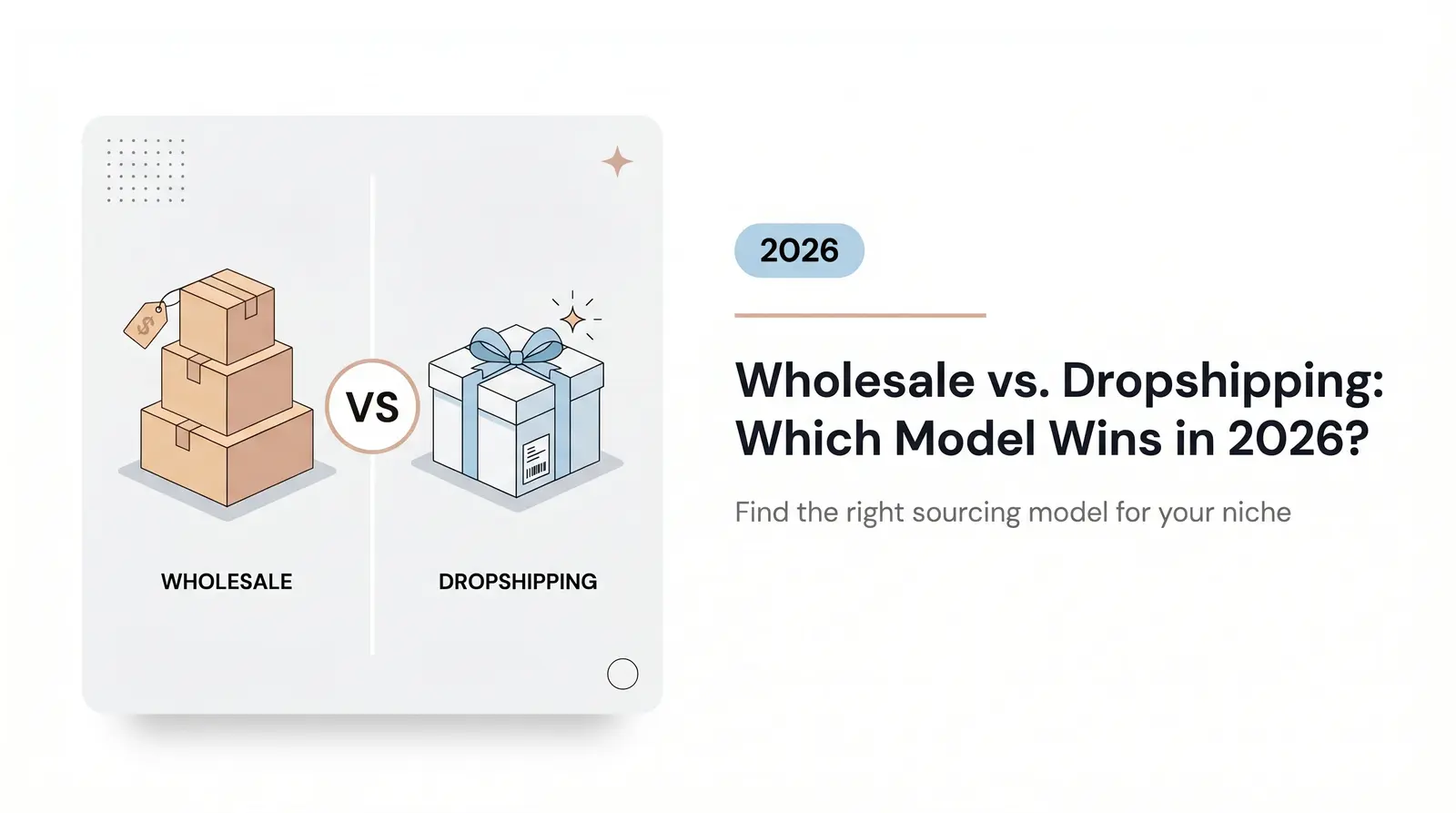
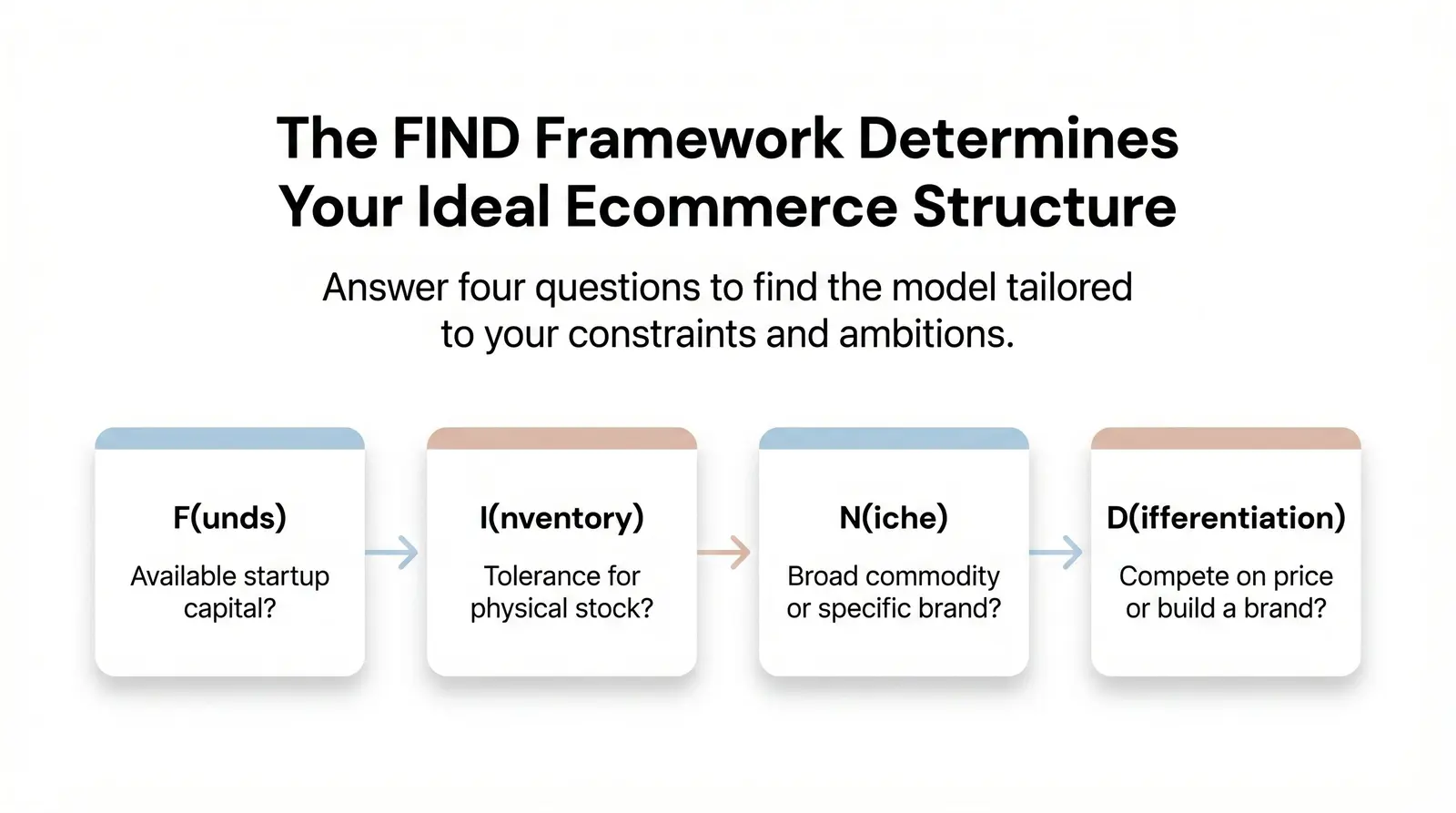
The FIND Framework™ is a four-question decision model for choosing your ecommerce business structure:
- F (Funds): How much startup capital can you realistically deploy?
- I (Inventory Tolerance): Are you willing and able to hold physical stock?
- N (Niche Depth): Are you selling into a broad commodity market or a specific branded niche?
- D (Differentiation Goal): Is your goal to compete on price, or to build a brand with defensible identity?
Answering these four questions in sequence produces a clear model recommendation tailored to your specific constraints and ambitions.
START
│
├── F: Capital available < $500?
│    ├── YES → Go to I
│    │         ├── I: Can you tolerate zero inventory risk?
│    │              ├── YES → DROPSHIPPING or POD
│    │              │         └── N: Is your niche visual/creative (art, apparel, merch)?
│    │              │               ├── YES → PRINT-ON-DEMAND
│    │              │               └── NO → DROPSHIPPING
│    │              └── NO → (Reconsider budget or model — see Private Label Lite options)
│
├── F: Capital available $500–$5,000?
│    ├── Go to I
│    │   ├── I: Willing to hold some inventory?
│    │         ├── YES → Go to N
│    │         │         ├── N: Broad/commodity niche? → WHOLESALE
│    │         │         └── N: Specific/branded niche? → PRIVATE LABEL (low MOQ)
│    │         └── NO → POD or Dropshipping (revisit capital threshold)
│
└── F: Capital available $5,000+?
      └── Go to D
            ├── D: Compete on price/volume? → WHOLESALE
            └── D: Build a brand? → PRIVATE LABEL
                  └── (Consider Branvas for jewelry + accessories private label)
We often see founders skip the 'D' question entirely. It is the one that determines whether you will still be in business in year two.
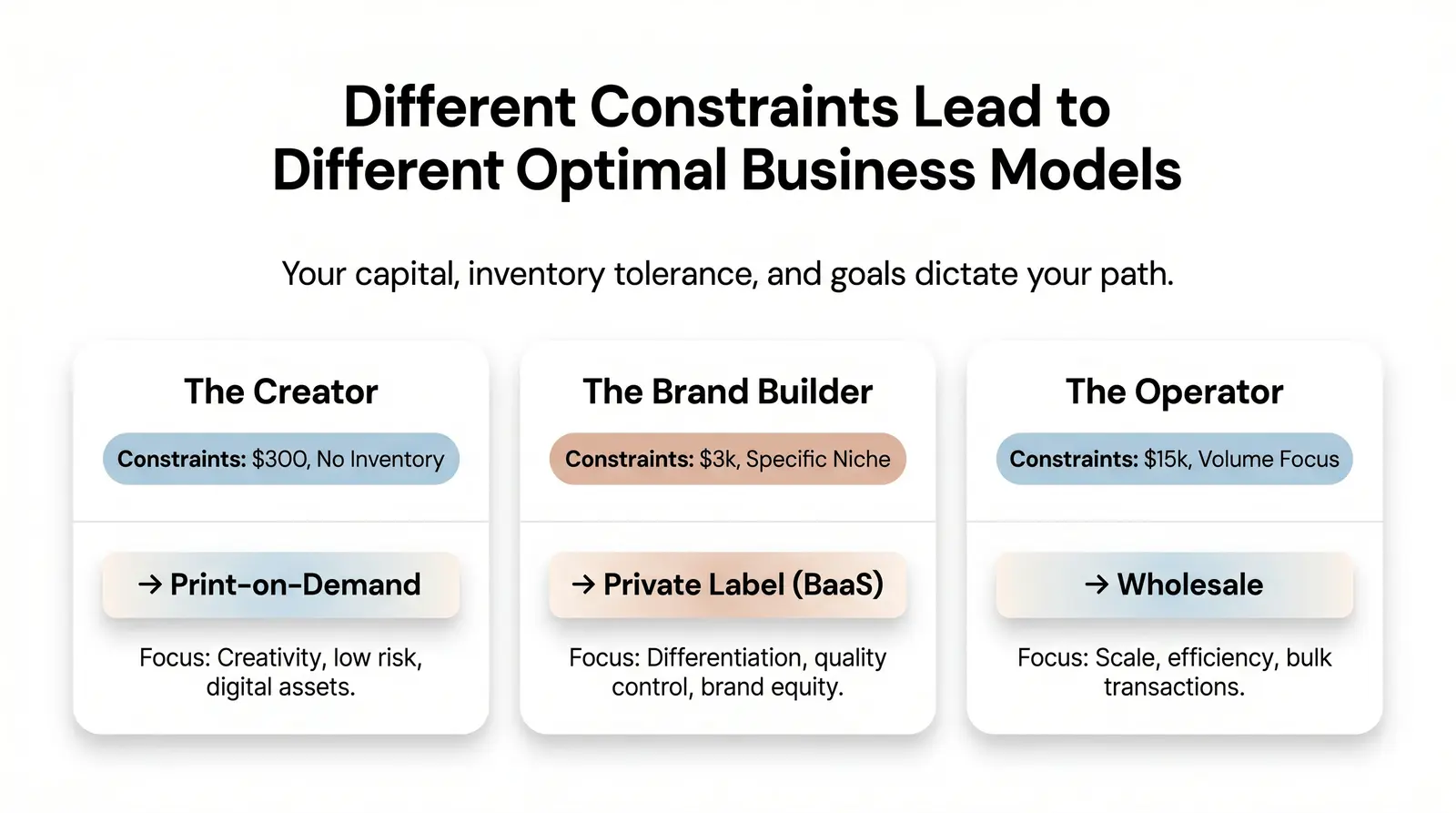
Founder A: The Creator
Sarah is a college student with $300 in savings and a growing TikTok following of 50,000 users interested in streetwear and digital art. Running her constraints through the FIND Framework, she has under $500 (Funds), cannot hold inventory in her dorm room (Inventory Tolerance), operates in a highly visual niche (Niche Depth), and wants to monetize her specific aesthetic (Differentiation Goal). The clear answer is Print-on-Demand. She launches a Shopify store integrated with a POD app, allowing her to sell custom hoodies without touching a single box. Her margins are modest at 25 percent, but her customer acquisition cost is near zero thanks to her organic audience. For creators in this position, Branvas also offers a dedicated path for influencers and creators who want to step up from POD into private-label accessories as their following grows.
Founder B: The Brand Builder
Marcus owns a successful local boutique and has $3,000 to expand online. He wants to launch a line of branded accessories to complement his apparel sales. He has moderate capital (Funds), but does not want the operational headache of managing hundreds of small jewelry SKUs in his back room (Inventory Tolerance). His niche is highly specific (Niche Depth), and his entire goal is building a cohesive brand identity (Differentiation Goal). The answer is Private Label via a BaaS platform. Marcus uses Branvas to launch his jewelry line. Because Branvas handles the sourcing and blind shipping with custom packaging, Marcus gets the 50 percent margins and brand equity of private label without the traditional inventory risk. He integrates the Branvas catalog directly into his store, offering premium pieces that look and feel exactly like his boutique's aesthetic.
Founder C: The Operator
Elena spent five years as a buyer for a regional retail chain and is going independent with $15,000 in startup capital. She has significant funds (Funds), is comfortable managing a warehouse space (Inventory Tolerance), plans to sell everyday home goods (Niche Depth), and intends to compete on operational efficiency and volume rather than brand identity (Differentiation Goal). The answer is Wholesale. Elena uses her capital to buy bulk inventory at steep discounts, securing 40 percent margins. She manages her own fulfillment, ensuring two-day shipping that dropshippers cannot match, and steadily grows her cash flow to eventually fund her own private label manufacturing.
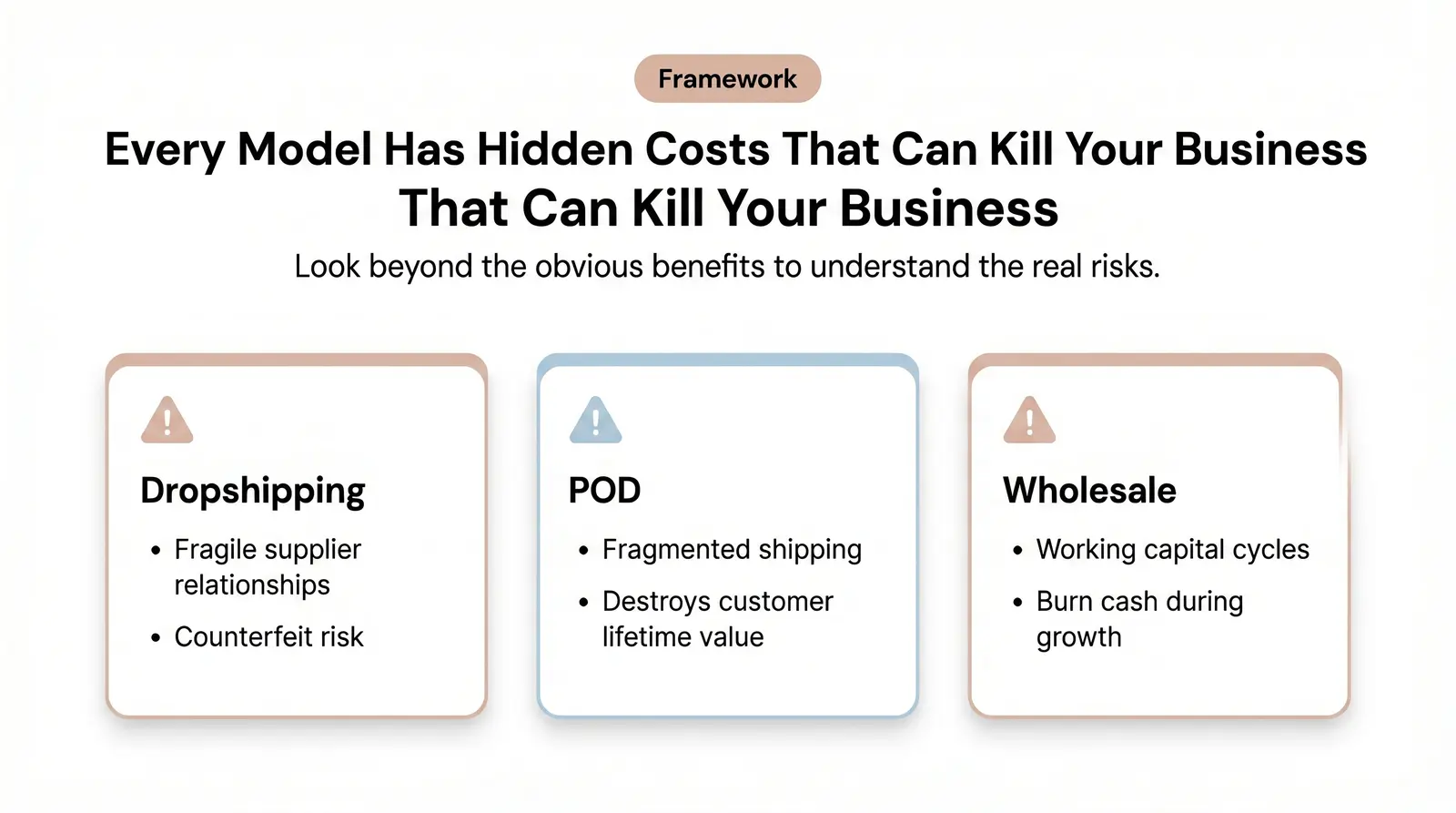
Dropshipping: The supplier relationship is your moat, and it is paper-thin. While everyone talks about low margins, the real killer is quality control and counterfeit risk. If your AliExpress supplier quietly swaps your winning product for a cheaper, defective version, you will not know until the chargebacks and negative reviews destroy your payment processor account. Furthermore, selling generic goods means you are building the manufacturer's brand equity, not your own. [3]
POD: Shipping times destroy customer lifetime value (LTV). When you scale a POD store, you often need multiple print providers to handle different product types. If a customer orders a mug and a t-shirt, they receive two separate packages arriving days apart, often with inconsistent packaging. This disjointed experience erodes trust, and in ecommerce, a repeat customer is worth three to four times more than a one-time buyer. Slow, fragmented shipping directly kills the repeat purchase rate. [4]
Wholesale: Working capital cycles kill growth. The irony of the wholesale model is that the faster you grow, the more cash you burn. According to recent industry data, 35 percent of US online retailers experienced cash flow difficulties in 2024 despite reporting revenue growth. [5] If your cash conversion cycle is 45 days, every dollar of revenue ties up a dollar of cash for a month and a half. During seasonal spikes like Q4, founders often find themselves entirely illiquid, unable to fund marketing because all their cash is sitting in a warehouse.
Private Label: The perception of complexity is higher than reality. The contrarian truth about private label is that the traditional barriers, such as $10,000 minimum orders and months of factory negotiations, are largely obsolete. With the rise of Brand-as-a-Service platforms and low-MOQ suppliers, the capital barrier has dropped significantly. Founders can now launch private label brands with minimums as low as 100 units, or zero units if utilizing platforms that offer on-demand blind shipping with custom branding. [6] [7]
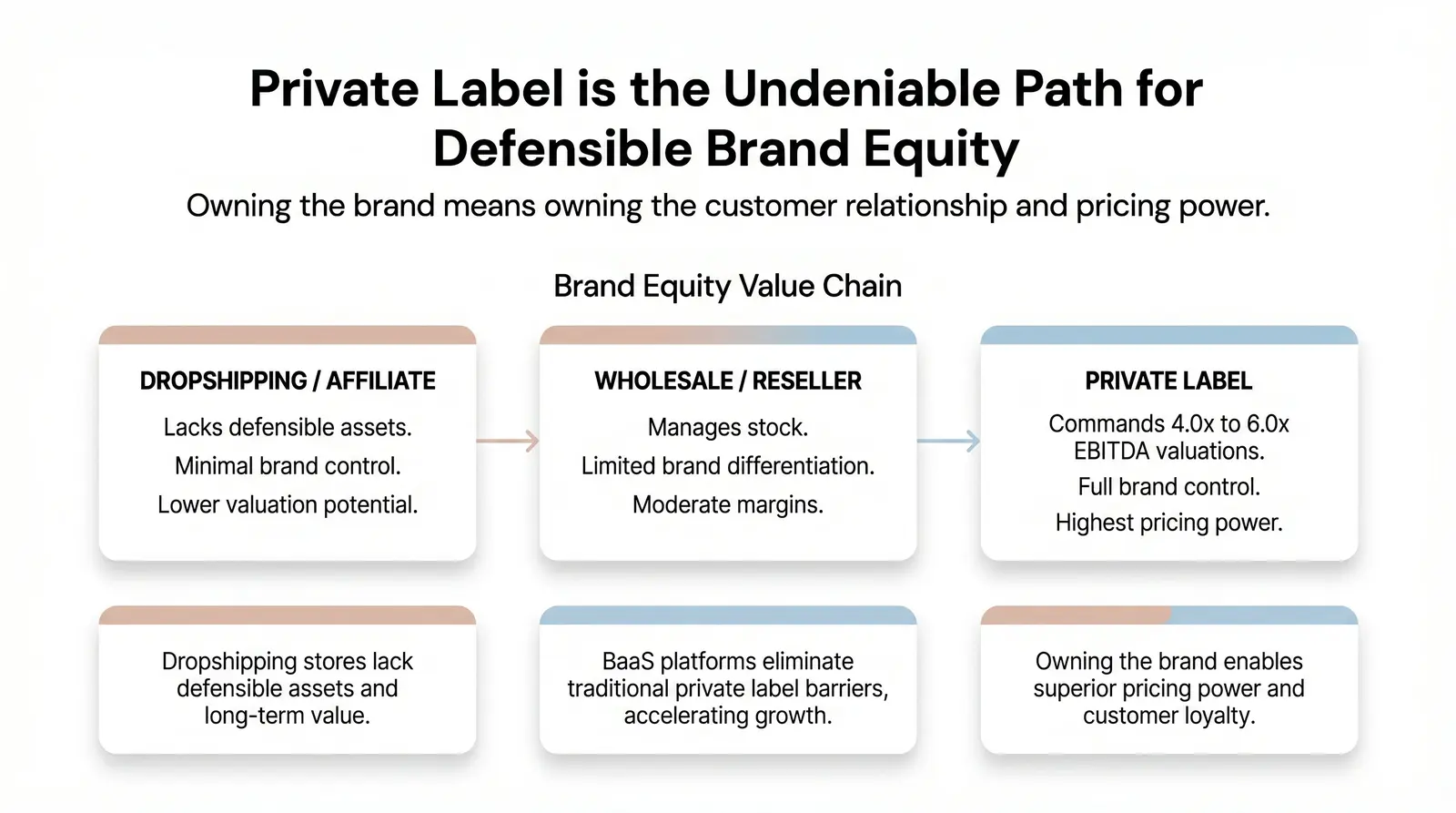
Private label wins on brand equity, POD wins on creative flexibility, dropshipping wins on pure speed-to-market, and wholesale wins on margin certainty if you have capital. But for anyone whose goal is building a differentiated, defensible brand, private label is the undeniable path.
When you own the brand, you own the customer relationship, the pricing power, and the eventual resale value of the business. Private label brands consistently command higher valuation multiples, often 4.0x to 6.0x EBITDA, because they possess actual intellectual property and customer loyalty. Dropshipping stores are often valued at a fraction of that because they are temporary marketing engines without defensible assets. [6] The excuse that private label is too expensive or complex is no longer valid.
If private label is on your radar, especially for jewelry or accessories, Branvas's How It Works page breaks down exactly how the model works, from sourcing to blind shipping.
Ready to launch your private-label brand without the usual complexity?
Branvas handles sourcing, branding, packaging, and blind shipping, so you can focus on selling.
Explore Branvas's Private Label Model →
1. What is the best ecommerce business model for beginners?
For beginners with limited capital, Print-on-Demand (POD) or dropshipping are the safest entry points. They require minimal upfront investment and eliminate inventory risk, allowing you to learn marketing, customer service, and store optimization. However, founders should view these as stepping stones; once you find a winning product, transitioning to private label is essential for long-term profitability and brand survival.
2. How do I choose between dropshipping and private label?
Choose dropshipping if you have under $1,000 and need to test product ideas quickly without inventory risk. Choose private label if you have $3,000+ (or access to a BaaS platform), want gross margins of 40 to 60 percent, and intend to build a defensible brand. Dropshipping is a marketing exercise; private label is a business asset.
3. What is the difference between wholesale and private label?
Wholesale involves buying existing, branded products from other manufacturers in bulk and reselling them at a markup. You are selling someone else's brand. Private label involves contracting a manufacturer to produce products exclusively for your brand, with your logo and custom packaging. Private label offers higher margins and brand equity, while wholesale offers proven product demand.
4. Is print-on-demand still profitable in 2026?
Yes, print-on-demand remains profitable, with the global market projected to reach over $100 billion by 2034. However, success requires moving beyond basic t-shirts. Profitable POD stores target specific niches, focus on unique, high-quality designs, and utilize premium products to maintain gross margins between 20 and 40 percent. Competing on generic designs is no longer viable.
5. How much money do I need to start a private label ecommerce business?
Traditionally, starting a private label business required $3,000 to $10,000 for minimum order quantities, branding, and initial marketing. Today, that number can be significantly lower. By utilizing low-MOQ suppliers or Brand-as-a-Service platforms that handle blind shipping and custom packaging, founders can launch a private label brand for under $1,000.