


This guide compares top CJDropshipping alternatives grouped by seller type, using a Supplier-Fit Framework to help ecommerce sellers choose partners that build defensible brands.
Published:
April 22, 2026
Author:
Yi Cui
CJ works for a certain kind of seller: the generic-product arbitrager. If you want to build a brand that lasts, you need a vertical specialist, not a marketplace.
For years, dropshippers have treated CJDropshipping as the default upgrade from AliExpress. It offers faster shipping, a massive catalog, and decent integrations. But as advertising costs skyrocket and consumer expectations rise, the "list anything and see what sticks" model is breaking down. The sellers winning in 2026 are not the ones testing 50 random products a week. They are the ones building defensible brands with high customer lifetime value.
This guide does not just list another ten generic cj dropshipping alternatives. Instead, it matches specific alternatives to your seller type and long-term brand strategy. Whether you are looking for a better generalist platform, a print-on-demand partner, or a true private-label supplier, the goal is to find the right fit for your business model. The real question is not which cjdropshipping alternative is cheapest, but which supplier combination gives you a brand moat competitors cannot easily copy.
CJDropshipping is a massive, China-based fulfillment platform that connects ecommerce sellers directly with manufacturers. It provides product sourcing, warehousing, print-on-demand services, and global shipping. The platform integrates seamlessly with Shopify, WooCommerce, and other major storefronts, allowing sellers to import products and automate order fulfillment without holding inventory.
The ideal CJDropshipping user is a high-volume, price-sensitive, brand-agnostic seller running product-testing plays. If your strategy relies on finding viral TikTok products, throwing up a quick landing page, and scaling ads until the trend dies, CJ is built for you. It allows rapid testing across thousands of categories without commitment.
However, as sellers scale, the cracks begin to show. A common cjdropshipping review highlights inconsistent US warehouse stock, where orders are sometimes delayed or canceled without prompt notification [1]. Sellers frequently complain about shipping times that stretch beyond the promised windows, especially for international orders. While cj dropshipping usa warehouses exist, inventory depth is often unreliable. Furthermore, the platform offers limited custom branding depth at scale, making it difficult to create a premium unboxing experience. When issues arise, support quality can vary wildly depending on the specific agent assigned to your account, leaving many sellers frustrated when dealing with customer chargebacks [1].
These are not fringe complaints. They are structural limitations of a platform built for breadth, not depth.

Before committing to a new fulfillment partner, you need a systematic way to evaluate them. We developed The Branvas Supplier-Fit Framework™, a decision matrix sellers can use to evaluate any dropshipping or private-label supplier. The matrix scores suppliers across five critical criteria:
Score each criterion 1 to 3 (1 = weak, 2 = adequate, 3 = strong). Here is how CJDropshipping scores as the baseline, alongside every alternative covered in this article.
| Supplier | Brand Customization | Niche Specialization | Fulfillment Reliability | Margin Architecture | Brand Defensibility | Total Score |
|---|---|---|---|---|---|---|
| CJDropshipping | 1 | 1 | 2 | 2 | 1 | 7/15 |
| AutoDS | 1 | 1 | 3 | 2 | 1 | 8/15 |
| Zendrop | 2 | 1 | 3 | 2 | 1 | 9/15 |
| Spocket | 1 | 2 | 3 | 2 | 1 | 9/15 |
| Modalyst | 1 | 2 | 2 | 2 | 1 | 8/15 |
| Printful | 3 | 2 | 3 | 1 | 2 | 11/15 |
| Printify | 2 | 2 | 3 | 2 | 1 | 10/15 |
| Branvas | 3 | 3 | 3 | 3 | 3 | 15/15 |
Use this table as a reference throughout the article. Each alternative below carries its score.

Rather than ranking alternatives 1 to 10, we have grouped them by the type of seller they serve best. Find your category, then go deep on that row.
AutoDS
AutoDS is a comprehensive dropshipping automation platform that connects sellers to a massive network of global suppliers, including Amazon, Walmart, and AliExpress [2]. It is best for high-volume sellers who want to automate price and stock monitoring across multiple storefronts without manual intervention. Its key differentiator versus CJ is its advanced software layer, which updates prices and stock levels every 60 minutes to prevent overselling and pricing errors. The honest limitation is that it remains a generalist tool. You are still selling commoditized products, just more efficiently.
Supplier-Fit Framework™ Score: 8/15
Zendrop
Zendrop was built specifically to solve the pain points of AliExpress and CJ, offering a vetted network of suppliers with a strong focus on US shipping [3]. It is best for Shopify-focused sellers who want faster, more reliable shipping times without the communication barriers of overseas agents. Its key differentiator is its premium US shipping focus and better quality control. The honest limitation is that while it offers some custom packaging on higher tiers, it is still primarily a catalog of generic trending products. You are not building a brand, you are building a faster version of the same commodity store.
Supplier-Fit Framework™ Score: 9/15
Spocket
Spocket focuses heavily on connecting sellers with suppliers based in the US and EU, rather than relying solely on China [4]. It is best for sellers targeting Western markets who refuse to compromise on shipping speed. Its key differentiator is that 80% of its suppliers are US or EU-based, allowing for 2 to 5 day delivery times that CJ simply cannot match consistently. The honest limitation is that the product catalog is smaller than CJ's, and wholesale costs are generally higher, which can squeeze margins if you do not price accordingly.
Supplier-Fit Framework™ Score: 9/15
Modalyst
Modalyst specializes in name-brand products and independent designers, integrating directly with platforms like Wix and Shopify. It is best for boutique owners who want to curate a higher-end catalog without holding inventory. Its key differentiator is access to established brands and unique designer pieces rather than generic factory goods. The honest limitation is that margin potential is often lower because you are reselling established brands that dictate retail pricing, which limits your ability to build pricing power of your own.
Supplier-Fit Framework™ Score: 8/15
Printful
Printful is the industry leader in print-on-demand, offering everything from apparel to home goods with in-house fulfillment [5]. It is best for creators, artists, and brand builders who want to sell custom-designed merchandise without touching inventory. Its key differentiator is exceptional print quality and robust branding options, including custom inside labels, branded packing slips, and a branded tracking page. The honest limitation is the margin ceiling. Printful's base costs are relatively high, meaning you must charge premium retail prices to maintain profitability, and that ceiling is real.
Supplier-Fit Framework™ Score: 11/15
Printify
Printify operates as a network, connecting sellers to various print providers globally rather than fulfilling in-house [6]. It is best for POD sellers who want a wider product selection and lower base costs than Printful. Its key differentiator is its competitive pricing, especially on its Premium plan, which offers up to 20% off catalog prices. The honest limitation is inconsistent quality control, as your products are printed by different third-party facilities depending on the item and routing, which can create a variable customer experience.
Supplier-Fit Framework™ Score: 10/15
Most dropshipping advice optimizes for supplier cost-per-unit, but the bigger lever is customer lifetime value. A branded product that generates a repeat purchase changes the unit economics entirely, even if the COGS is 20 to 30% higher than a generic CJ alternative. The average ecommerce customer acquisition cost has risen 60% over the last five years, now hitting $68 to $84 across categories [7]. You cannot survive paying $80 to acquire a customer who buys a generic $25 item once and never returns. The math only works when customers come back.
Branvas
Branvas is a private-label jewelry and accessories Brand-as-a-Service platform built specifically for the modern ecommerce landscape [8]. Branvas handles product sourcing, custom branding, premium packaging, and blind fulfillment, so the seller owns a real brand, not a storefront full of generic SKUs.
It is best for influencers launching a jewelry brand, boutique owners, and ecommerce entrepreneurs who want defensible margins and repeat customers. Its key differentiator is vertical specialization in jewelry combined with full brand infrastructure. You get premium unboxing experiences and hand-inspected quality that drives the repeat purchase rates necessary to survive rising ad costs [9].
The honest context is that Branvas is not the right fit if you need 10,000 product categories or want to test 50 random niches simultaneously. It is built for sellers committing to the jewelry vertical and building something that compounds over time.
Supplier-Fit Framework™ Score: 15/15
If you're evaluating whether a jewelry private-label model fits your business, Branvas's How It Works page walks through the full process, from product selection to your first branded shipment.

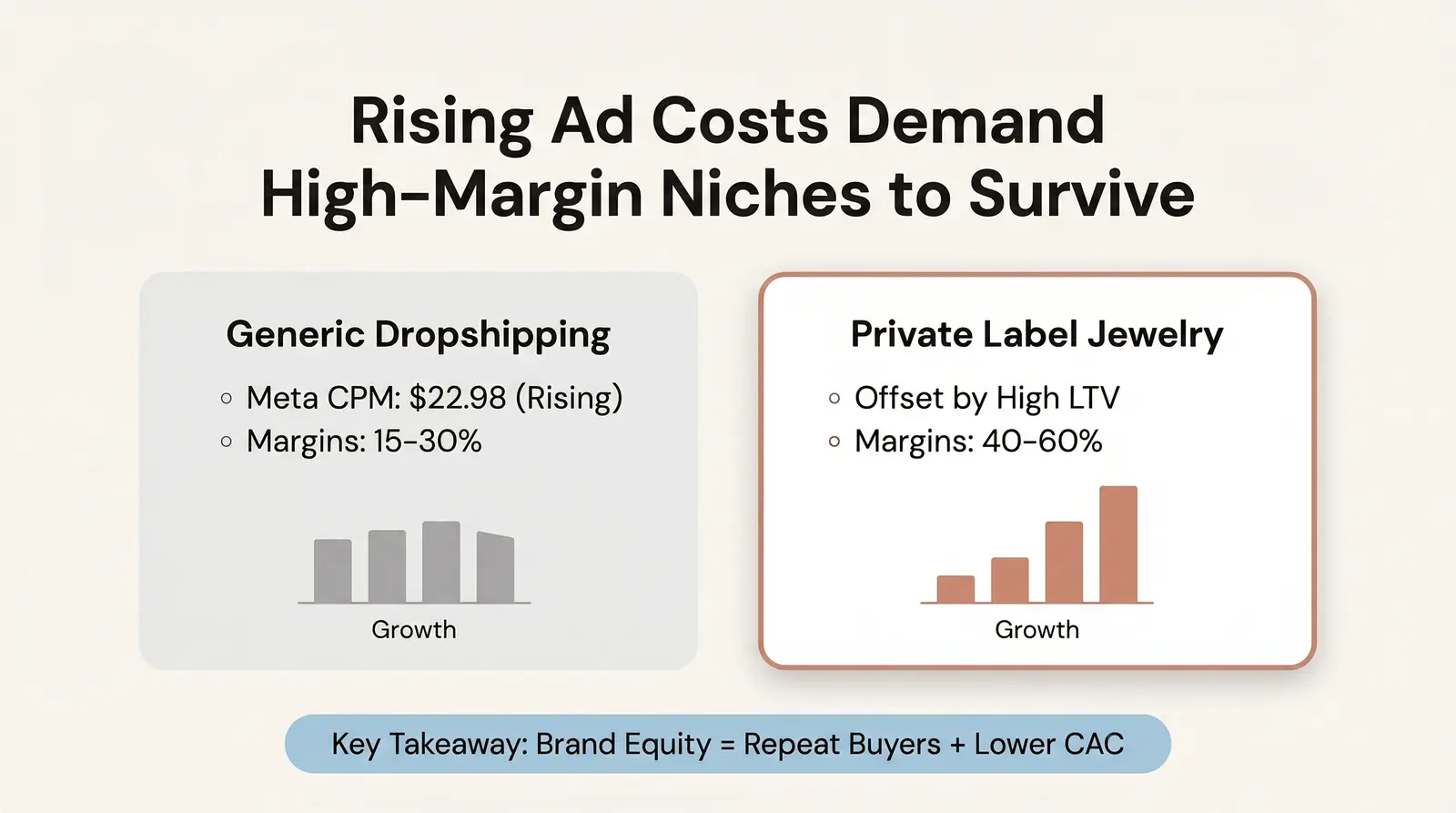
Generic dropshipping competes on price and ad spend. The margins erode as ad costs rise. The sellers winning long-term are those who chose a niche, found a specialist supplier, and built brand equity. This equity translates into repeat buyers, word-of-mouth referrals, user-generated content, and lower customer acquisition costs over time.
The numbers tell the story. Google Shopping CPCs jumped 33.72% in 2025. Meta's Q4 2025 CPM averaged $22.98, peaking at $25.22 during Black Friday [7]. Meanwhile, the average ecommerce repeat purchase rate sits at just 18.8% across DTC brands [9]. If your supplier relationship does not help you increase that number, you are running on a treadmill that gets faster every quarter.
Jewelry is one of the highest-leverage niches for a brand-building model. It boasts high perceived value, emotional purchase triggers, strong gifting demand, and is inherently influencer-native. When branded well, jewelry is highly resistant to pure price competition. A customer buying a $10 generic necklace from CJ is looking for a deal. A customer buying a $65 branded piece is buying an identity. Private label jewelry margins run 40 to 60%, compared to 15 to 30% for white-label generics [9].
"In our experience at Branvas, the sellers who grow fastest aren't the ones with the widest catalogs. They're the ones who committed to a niche and built a brand identity their customers remember."
Consider Maya, an Instagram creator with 45K followers in the fashion space. She started dropshipping trendy apparel and accessories using CJDropshipping. While she made initial sales, her margins were squeezed by inconsistent quality and unpredictable shipping. Her followers complained about three-week delivery times, and her repeat purchase rate was near zero. She hit the generic-product ceiling.
Maya switched to a private-label jewelry model with Branvas. Instead of selling 100 random items, she curated a 15-piece collection of gold vermeil necklaces and rings. Branvas handled the custom packaging, inserting her logo and brand colors into every order. Because the unboxing experience felt premium, her followers started posting organic reviews. Her customer lifetime value doubled within six months, and her repeat purchase rate climbed to 22%. She reduced her dependence on paid ads because her brand was now searchable and memorable. The business stopped being a media-buying operation and started being a real brand.
| Supplier Name | Best For | Niche Specialization | Custom Branding Depth | US/EU Fulfillment | Blind Shipping | Starting Cost | Supplier-Fit Score |
|---|---|---|---|---|---|---|---|
| CJDropshipping | High-volume testers | No (Generalist) | Low | Yes (Limited) | Yes | Free, pay per item | 7/15 |
| AutoDS | Automation scalers | No (Generalist) | Low | Yes | Yes | $1 trial, then subscription | 8/15 |
| Zendrop | Shopify generalists | No (Generalist) | Medium | Yes | Yes | Free / $33/mo Pro | 9/15 |
| Spocket | Fast-shipping focus | No (Generalist) | Low | Yes (80% US/EU) | Yes | Free / Subscription | 9/15 |
| Modalyst | Boutique curators | Partial (Brands) | Low | Yes | Yes | Free / Subscription | 8/15 |
| Printful | Custom merch creators | Yes (POD) | High | Yes | Yes | Free, high base cost | 11/15 |
| Printify | Margin-focused POD | Yes (POD) | Medium | Yes | Yes | Free / $29/mo Premium | 10/15 |
| Branvas | Brand builders | Yes (Jewelry) | High | Yes | Yes | Free, pay per item | 15/15 |

Migrating away from a massive supplier like CJ requires careful planning to avoid disrupting live orders. Here is a practical, step-by-step process for a smooth transition.
Identify your core winners. Analyze your sales data to find the top 20% of products driving 80% of your revenue. Do not try to migrate hundreds of dead SKUs. Start with what actually sells.
Run suppliers in parallel. Keep your CJ integration active while you test the new supplier. Route a small percentage of orders to the new partner to verify shipping times and quality before committing fully.
Order samples first. Never switch entirely without holding the new product in your hands. Evaluate the unboxing experience, material quality, and shipping speed firsthand. What looks good in a catalog photo may not hold up in person.
Update branding assets. If moving to a private-label model, finalize your logo, packaging inserts, and brand colors with the new supplier before fully launching. A mismatched brand experience during the transition will confuse customers.
Communicate shipping changes. Update your store's shipping policy pages and automated email flows to reflect the new, often faster, delivery windows. Customers who were used to three-week waits will be pleasantly surprised.
Phase out CJ listings gradually. Replace the CJ product links in your store backend with the new supplier's SKUs one by one. Ensure inventory syncing is active before you remove the CJ fallback.
Monitor customer feedback closely. Watch your support inbox during the first two weeks of the transition to catch any fulfillment hiccups early. A fast response to a shipping issue during a transition builds more trust than a perfect order.
Sellers moving into jewelry private label can explore Branvas's catalog and see minimum order requirements at branvas.com/catalog.
Ready to stop competing on price and start building a brand? See how Branvas works →

1. What is the best CJDropshipping alternative for US-based sellers?
For generalist dropshippers, Zendrop and Spocket are strong alternatives due to their vetted US and EU supplier networks and faster domestic shipping times. However, if you are building a long-term brand in a specific niche like jewelry, a specialized private-label partner like Branvas offers superior US fulfillment, custom branding, and the kind of premium packaging that drives repeat purchases.
2. Is CJDropshipping good for building a brand?
No. CJDropshipping is built for volume arbitrage and product testing, not brand building. While it offers basic white-labeling options, it lacks the deep customization, premium packaging, and consistent quality control required to build a defensible brand with high customer lifetime value. If brand equity is your goal, you need a specialist supplier.
3. What are the main complaints about CJDropshipping?
The most common cjdropshipping reviews cite inconsistent shipping times, unreliable US warehouse stock, and variable customer service quality. Sellers frequently report that products listed as available are actually out of stock, leading to delayed processing and frustrated customers. At scale, the lack of a dedicated account structure makes resolution slow.
4. What is the best dropshipping supplier for jewelry?
Branvas is the leading Brand-as-a-Service platform for jewelry private label. Unlike generalist marketplaces, Branvas specializes exclusively in high-margin jewelry, offering premium custom packaging, blind fulfillment, and hand-inspected quality designed specifically for influencers and brand builders who want a real brand, not just a product listing.
5. Can I switch from CJDropshipping to a private-label supplier without losing my store?
Yes. The safest method is to run both suppliers in parallel during a transition period. Keep CJ active for existing listings while routing new orders or specific collections to your private-label partner. Once you verify the new supplier's quality and shipping speed through real orders, you can phase out the CJ SKUs entirely without disrupting your store's live traffic.