


This MBTI jewelry style guide uses a 4-Axis Personality Framework to help you choose jewelry that authentically reflects who you are.
Updated:
April 1, 2026
Author:
Yi Cui
Most style guides start with what's trending. This one starts with you. It's a guide to choosing jewelry not just for how it looks, but for how it feels: a subtle, powerful form of nonverbal self-expression. The pieces that feel most "right" are rarely random. They reflect how we think, socialize, decide, and move through the world. This guide uses the Myers-Briggs Type Indicator (MBTI) as a fun, accessible self-discovery lens, not a rigid label or clinical diagnosis, to help you translate your unique personality into a jewelry style that's authentically yours.
Think about the last time you put on a piece of jewelry and felt immediately, completely right. Chances are, it wasn't because it was trending. It was because something about it resonated with who you are. That's the feeling this guide is designed to help you replicate, consistently, across every piece you own.
At Branvas, we work with hundreds of brand founders building jewelry lines around a specific aesthetic identity, and the ones who succeed fastest are those who know exactly what "feels right" to their audience and why. This framework is designed to help you do the same for yourself.
The connection between what we wear and who we are is explained by a psychological concept called "self-concept congruence." Research shows that consumers are drawn to products and brands that reflect or extend their sense of identity [1]. We choose items that feel like us, and jewelry, being so personal and often worn daily, is a potent form of this self-expression. A 2021 consumer study by The Plumb Club found that 67% of consumers agree that when they wear jewelry, they wish to express their personality and mood [7]. That's not a niche preference. It's the majority.
The most common mistake is buying jewelry for how it looks on others, not for how it resonates with who you are. This often leads to a collection of beautiful but unworn pieces: rings that felt exciting in the store but feel wrong on your finger, bracelets that looked perfect on a model but sit in a drawer. The goal is to build a signature style, not just chase trends.
This is supported by the concept of "dopamine dressing," which suggests that wearing clothes and accessories that genuinely align with your identity can boost your mood and confidence [2]. Psychologist Dr. Dawnn Karen, who popularized the term, connects this to the broader principle of "enclothed cognition," the idea that what we wear systematically influences our psychological processes [6]. When your jewelry aligns with your personality, it becomes more than an accessory. It's a tool for self-expression and a source of quiet, daily confidence.
A quick but important note: MBTI is used here as a practical vocabulary for personality, not as a clinical instrument. Psychologists have noted that MBTI has limitations as a predictive scientific tool, and it's best understood as a framework for self-reflection rather than a definitive personality diagnosis [3]. The Big Five personality model is considered more scientifically robust, but MBTI's four-axis structure provides a clear, accessible language for the kind of self-discovery this guide is built around. Use it as a lens, not a label.

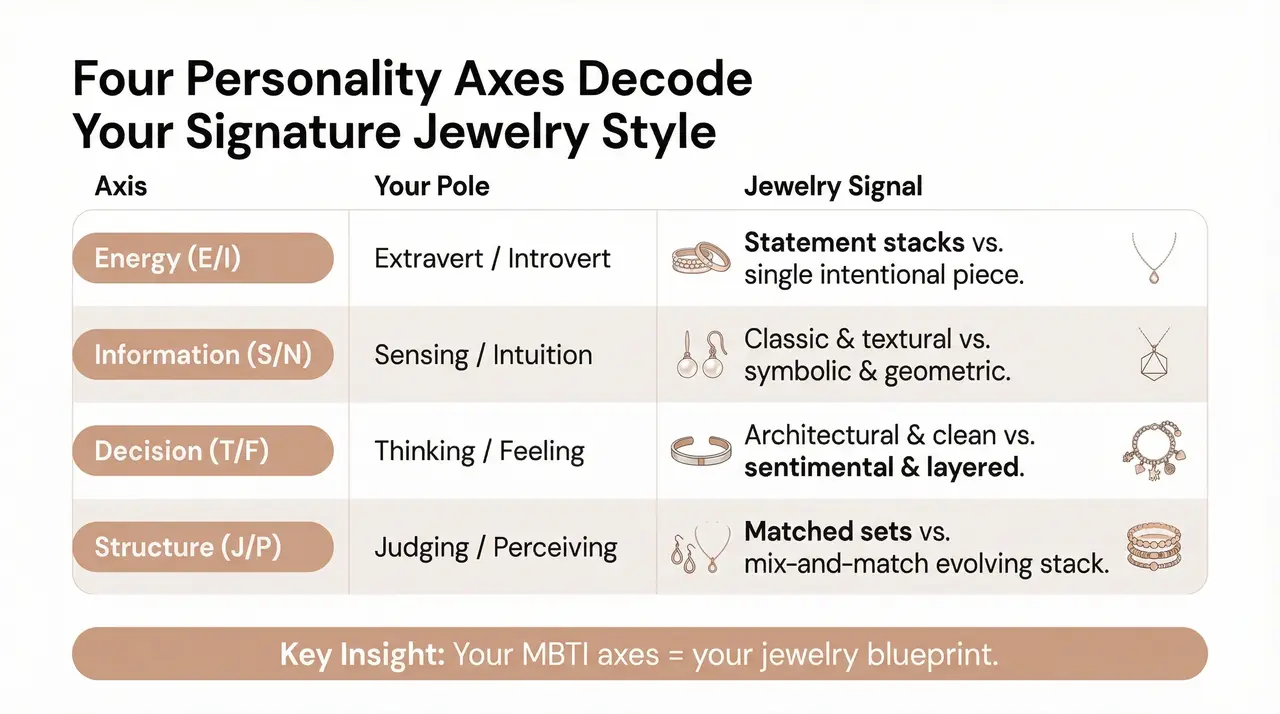
To help you decode your jewelry style, we've created The Branvas Personality-Jewelry Alignment Framework™ (4-Axis Style Decoder). This tool uses four MBTI-inspired axes, each mapped to a specific jewelry style dimension. It's a decision tool, not a horoscope, designed to help you understand why certain pieces feel more "you" than others.
| Axis | Personality Pole A | Personality Pole B | Jewelry Style Signal | Example Pieces |
|---|---|---|---|---|
| Energy Source (E vs. I) | Extraversion: expressive, social, outward energy | Introversion: reflective, selective, inward energy | Statement and stacked vs. single, intentional | Bold layered chains, colorful cocktail rings vs. thin bands, one meaningful pendant |
| Information Style (S vs. N) | Sensing: concrete, tactile, present-focused | Intuition: abstract, symbolic, future-focused | Classic and textural vs. conceptual and unconventional | Pavé settings, polished metals, familiar motifs vs. geometric asymmetry, symbols, mixed materials |
| Decision Style (T vs. F) | Thinking: structured, logical, precise | Feeling: values-driven, expressive, emotional resonance | Clean lines and architectural vs. sentimental and layered meaning | Architectural cuffs, clean solitaires vs. birthstone rings, charm bracelets, engraved pieces |
| Lifestyle Structure (J vs. P) | Judging: organized, consistent, curated | Perceiving: flexible, spontaneous, eclectic | Matched sets, cohesive aesthetic vs. mix-and-match, evolving stack | Matching earring and ring sets, uniform metals vs. mismatched metals, evolving charm stacks |
To use the framework, identify where you land on each of the four axes. This creates a style profile (e.g., I-N-F-P) that maps to a specific jewelry aesthetic. An INFP, for example, would lean toward single, meaningful pieces (I) with symbolic or unconventional designs (N), chosen for emotional resonance (F), and worn in an ever-evolving, personal way (P). That's a very different profile from an ESTJ, who might prefer bold, structured statement pieces in a cohesive, consistent set.
These axes are not strictly either/or. Most people are a blend of both poles, and that's exactly what makes a personal jewelry aesthetic layered and interesting. Someone who is 60% Extraverted might love a bold statement necklace but prefer a single, minimal ring. That's not a contradiction. It's a nuanced personal style. Use the framework to identify your dominant tendencies and build from there.
Rings are one of the most personal and symbolic forms of jewelry. They are always in our line of sight, a constant reminder of our style and commitments. Unlike a necklace or earring, a ring is something we see dozens of times a day. That visibility makes it a powerful vehicle for self-expression. Here are five ring style archetypes that emerge naturally from the 4-Axis Style Decoder:
The Minimalist Architect tends to be logical, structured, and drawn to clean, functional design. This archetype gravitates toward simple, architectural rings: a single, unadorned band in a high-quality metal, a solitaire with a geometric cut, or a ring with a clean, linear silhouette. Materials tend to be solid gold or sterling silver, polished to a high shine. Settings are minimal, bezel or flush-set, never fussy. The "why this feels right" explanation is rooted in psychology: the ring's clean, logical design mirrors their internal world of structure and order. Wearing something ornate would feel like noise.
The Symbolic Seeker is deeply intuitive and values-driven, choosing rings with personal meaning over aesthetic trend. They are drawn to symbolic motifs: a crescent moon, a geometric form with cultural resonance, a birthstone chosen for its meaning rather than its color. An INFP might wear a delicate ring with a tiny, intricate symbol, while an INFJ might choose a vintage-inspired piece with a hidden detail only they know about. The ring functions as a private talisman, a reflection of their rich inner world. For this archetype, the story behind the piece matters as much as the piece itself.
The Bold Expressionist is social, energetic, and sees jewelry as a direct channel for communicating their vibrant personality. They love statement rings, bold colors, and stacks of multiple rings worn across several fingers. An ESFP might wear a large, colorful cocktail ring as their daily anchor, while an ESTP might sport a chunky, sculptural design that reads as confident and modern. For this archetype, jewelry is a conversation starter. Research supports this: consumers who prefer bold, expressive styles are often motivated by a desire to signal their personality outward [10].
The Sentimental Curator is warm, caring, and deeply connected to tradition and relationships. This individual collects rings that represent people and moments rather than trends. They love family heirlooms, engraved bands, and charm-like rings that hold memories. An ISFJ might wear a single, treasured ring passed down from a grandparent, while an ESFJ might have a carefully curated collection of rings from meaningful travels and milestones. Their rings are a wearable history of their relationships and experiences. Each piece is a chapter.
The Eclectic Stacker is creative, spontaneous, and open to possibilities. This archetype is not bound by rules and enjoys creating unique, ever-changing combinations of metals, styles, and textures. An ENTP might pair a vintage ring with a modern, geometric design, while an ENFP might have an ever-evolving stack of delicate bands and symbolic charms that shifts with their mood. For this archetype, the stack itself is the art form. It's a daily creative exercise.
Worked Example: Meet Sasha, an INFJ who works in design. She is intentional in her choices and rarely follows trends. Using the 4-Axis Style Decoder, she identifies as Introverted (I), Intuitive (N), Feeling (F), and Judging (J). This profile points to a preference for single, meaningful pieces (I), symbolic and unconventional designs (N), sentimental value (F), and a cohesive, curated aesthetic (J). A perfect ring for Sasha would be a thin, geometric gold band with a small, ethically sourced moonstone, symbolically chosen, worn alone, and timeless in its design. She doesn't need five rings. She needs one that means something.

Bracelets occupy a different psychological space than rings. Where rings are intimate and often symbolic, bracelets are social and kinetic. They move with you, catching the light, drawing attention to your gestures in conversation. The wrist is more visible in motion than the hand at rest, which means bracelet choices often reflect a more outward-facing dimension of personality.
Extraverts, for example, might be drawn to bold, layered stacks of bangles that announce their presence before they even speak. Introverts might prefer a single, meaningful cuff or a delicate chain with a private charm, something that holds meaning without demanding attention. Sensing types often love the tactile satisfaction of a heavy, polished bangle or a textured chain they can feel against their skin. Intuitive types might collect symbolic charms over time, building a bracelet that tells a story only they fully understand.
The "stack builder" versus "one statement piece" divide is one of the clearest personality signals in jewelry. A Perceiving type, who is flexible and spontaneous, might enjoy remixing their bracelet stack daily, creating new combinations to match their mood or outfit. A Judging type, who prefers structure and consistency, might have a single, signature bracelet that they wear every day. The same piece, every morning, without question. Both approaches are valid. Both are deeply personal.
Here are a few bracelet personality signals worth noting:
If you always reach for the same single bracelet regardless of outfit, that's a Judging and Introvert pattern: consistency, intentionality, and a preference for coherence over variety. If you remix your stack daily and feel restless wearing the same combination twice, that's Perceiving and Extravert energy: adaptability, expressiveness, and a love of variety. If you are drawn to bracelets with texture, weight, and a satisfying physical presence, you might be a Sensing type who values the concrete and tactile. If your bracelets are full of symbolic charms, letters, and meaningful pendants, you might be an Intuitive type who uses jewelry as a private language.

Fine jewelry is not just about the price tag. It's about intentionality. Because it is chosen to last, to be worn for years, passed down, repaired rather than replaced, fine jewelry is inherently personality-forward. The decision to invest in a fine piece is itself a personality signal. It says: I am choosing something that will grow with me.
Thinking types tend to approach fine jewelry with a logical, investment-oriented mindset. They research craftsmanship, compare settings, consider resale value, and choose pieces with a clean, timeless design that will hold up across decades. For them, a well-chosen fine piece is a smart decision as much as an aesthetic one. They are drawn to architectural designs in solid gold, precision-cut stones, and settings that prioritize quality over decoration.
Feeling types, on the other hand, are more likely to choose fine jewelry for deep personal meaning. An heirloom piece, a ring that marks a milestone, a necklace with a stone that carries significance: these are the purchases that resonate. For a Feeling type, the story behind the piece is inseparable from the piece itself. A 2024 consumer study by Jewelers Mutual found that "love" and "joy" are the strongest emotions tied to buying or receiving jewelry, and that over half of respondents would feel a significant sentimental loss if they misplaced a treasured piece [8]. That's the Feeling type's relationship with fine jewelry, in data.
Fine jewelry is also increasingly a self-purchase, not just a gift. A 2025 BriteCo survey found that 80% of American adults now buy fine jewelry for themselves, with Millennials leading the trend at 86% [9]. The top motivations: enhancing personal style and celebrating a milestone. Fine jewelry has become a form of self-investment, a way of honoring your own identity and marking the moments that matter.
At Branvas, we see this play out constantly when founders are building their jewelry line. The ones who lead with a personality-driven aesthetic, not just "pretty pieces," build deeper customer loyalty, because their buyers aren't just purchasing jewelry, they're purchasing a reflection of themselves. Explore the Branvas catalog to see how different personalities are reflected in curated collections built around a specific aesthetic identity.

Understanding your personality is the first step. Building a cohesive jewelry identity from that understanding is the work. Here's a step-by-step guide:
To support this process, here is a Jewelry Identity Builder matrix you can fill in based on your self-assessment:
| Style Axis | Your Pole | Jewelry Signal | Pieces to Prioritize | Pieces to Avoid |
|---|---|---|---|---|
| Energy Source | E or I | Statement/stacked vs. single/intentional | ||
| Information Style | S or N | Classic/textural vs. conceptual/symbolic | ||
| Decision Style | T or F | Architectural/clean vs. sentimental/layered | ||
| Lifestyle Structure | J or P | Matched sets vs. mix-and-match |
If you're an influencer, boutique owner, or aspiring entrepreneur thinking about launching a jewelry brand around your own aesthetic identity, Branvas makes this surprisingly approachable. See how it works or explore the Branvas Academy for brand-building resources.

Here's a perspective that doesn't get enough attention: most people build aesthetic boards based on their aspirational self, not their actual self. They save images of jewelry that looks stunning on a model, or a style they associate with who they want to become. This is natural. But it leads to a specific, frustrating problem: buying pieces that look right in theory but feel wrong in practice.
Consumer psychology research on self-concept confirms this gap between our actual and ideal selves [4]. The "ideal self" is who we aspire to be; the "actual self" is who we are right now. When we shop from our aspirational identity, we often end up with jewelry that requires a different version of us to wear it, more confident, more minimalist, more maximalist, more something we're not quite yet. The pieces sit unworn.
The fix is not to abandon aspiration. Aspiration is a healthy and generative force in personal style. The fix is to use personality as a filter first, then let aspiration inform the aesthetic layer second. Start with who you are. Then ask: within that authentic frame, what's the most beautiful, elevated, exciting version of that style?
The Branvas rule of thumb: if a piece requires a different version of you to wear it, it belongs on your mood board, not in your jewelry box.

Your jewelry style is a reflection of your unique personality traits, not a trend cycle. Use the Branvas Personality-Jewelry Alignment Framework™ in this article to decode your preferences across four key axes: energy source, information style, decision style, and lifestyle structure. For example, if you are an Extravert, you might be drawn to bold, statement pieces that communicate your outward energy, while an Introvert might prefer delicate, meaningful jewelry that holds private significance. The key is to start with your actual self, not your aspirational one.
Start by identifying which of the five ring archetypes in this guide resonates most with you: The Minimalist Architect, The Symbolic Seeker, The Bold Expressionist, The Sentimental Curator, or The Eclectic Stacker. Each archetype is linked to a different combination of personality traits and gravitates toward specific ring styles, materials, and settings. From there, use the 4-Axis Style Decoder to refine your profile and identify the specific design elements, silhouette, material, setting, and symbolism, that feel most authentically "you."
The jewelry you wear communicates a great deal about your personality, values, and lifestyle, often more than you intend. Research consistently shows that accessory selection reflects the traits and intentions of the wearer [10]. Wearing a single, timeless piece every day might suggest a consistent, organized personality (Judging trait), while frequently changing your jewelry and mixing styles might indicate a more flexible, spontaneous nature (Perceiving trait). Bold, colorful pieces often signal an outward-facing, expressive personality, while delicate, symbolic pieces tend to signal a more reflective, meaning-driven one.
Start by understanding your core personality preferences using the 4-Axis Style Decoder. Then, choose a single signature piece that anchors your style identity: the piece that feels most like you when you put it on. Build your collection outward from that anchor, adding complementary pieces that express other dimensions of your personality. The most important step is editing ruthlessly. A personality-driven jewelry collection is about coherence, not quantity. A collection of five pieces that all feel deeply "you" is more powerful than twenty pieces that feel like different versions of someone else.
MBTI is not a predictive scientific instrument, and it's important to use it as a self-discovery tool rather than a definitive personality diagnosis. That said, research has shown that personality traits do meaningfully influence aesthetic preferences and style choices. A 2021 study published in Frontiers in Psychology found that the Big Five trait of "openness to experience" significantly predicted whether women would adopt a more urban, sophisticated style of dress [5]. Other research has linked personality dimensions to fashion consumption tendencies and brand sensibility [3]. MBTI provides a widely understood vocabulary for these tendencies, making it a useful practical framework even if it lacks the scientific precision of other models.
The best jewelry isn't what's trending. It's what resonates with who you actually are. By understanding your personality, how you gain energy, how you process information, how you make decisions, and how you structure your life, you can build a jewelry collection that feels authentic, makes getting dressed easier, and turns your accessories into a subtle, daily form of storytelling.
The Branvas Personality-Jewelry Alignment Framework™ is a reusable tool. Return to it whenever your style feels off, whenever you're standing in a store unsure whether to buy something, or whenever you're building a new collection from scratch. The four axes don't change. Your relationship to them might evolve, and that's exactly how your jewelry identity should grow.
Thinking about turning your personal aesthetic into a jewelry brand? Branvas is built for exactly that: private-label jewelry, custom branding, and fulfillment handled for you. Explore Branvas for Influencers and Creators or Explore Branvas for Aspiring Entrepreneurs.
[1] Sirgy, M. J. (1982). Self-concept in consumer behavior: A critical review. Journal of Consumer Research, 9(3), 287-300. https://doi.org/10.1086/208924
[2] Travers, M. (2025, February 4). 2 Reasons To Start 'Dopamine Dressing' This Year, By A Psychologist. Forbes. https://www.forbes.com/sites/traversmark/2025/02/04/2-reasons-to-start-dopamine-dressing-this-year-by-a-psychologist/
[3] Simkus, J., McLeod, S., & Guy-Evans, O. (2025, October 20). Myers-Briggs Type Indicator (MBTI). Simply Psychology. https://www.simplypsychology.org/the-myers-briggs-type-indicator.html
[4] Zogaj, A., et al. (2024). The pursuit of the ideal self: authenticity and ideal self-congruity. Journal of Consumer Behaviour. https://doi.org/10.1002/cb.2342
[5] Stolovy, T. (2021). Styling the Self: Clothing Practices, Personality Traits, and Body Image Among Israeli Women. Frontiers in Psychology, 12. https://doi.org/10.3389/fpsyg.2021.719318
[6] Adam, H., & Galinsky, A. D. (2012). Enclothed cognition. Journal of Experimental Social Psychology, 48(4), 918-925. https://doi.org/10.1016/j.jesp.2012.02.008
[7] The Plumb Club. (2021, July 28). Consumer Jewelry Preferences Revealed by New Research. The Plumb Club. https://plumbclub.com/new/consumer-jewelry-preferences-revealed-by-new-research/
[8] Jewelers Mutual. (2024, August 27). Jewelry buying behaviors: Consumer study. Jewelers Mutual. https://www.jewelersmutual.com/resources/individuals/how-buy/jewelry-buying-behaviors-consumer-study
[9] BriteCo. (2025, December 2). 80% of Americans Now Buy Fine Jewelry for Themselves Instead of Waiting for a Gift, New BriteCo Survey Finds. BriteCo. https://brite.co/news/jewelry-for-themselves/
[10] Patrick, W. L. (2022, September 12). What Your Jewelry Says About You. Psychology Today. https://www.psychologytoday.com/us/blog/why-bad-looks-good/202209/what-your-jewelry-says-about-you