


Custom jewelry manufacturing offers design ownership and brand differentiation but requires higher investment and longer timelines. Private label provides faster market entry with lower costs but limited exclusivity.
Published:
January 29, 2026
Author:
Yi Cui
Launching a jewelry brand shouldn't feel like choosing between creative freedom and speed to market. Understanding the difference between custom jewelry manufacturing vs. private label can help you build a brand that matches your vision, budget, and growth timeline. The wrong choice can delay your launch, dilute your brand, or strain your finances. The right one sets you up for sustainable success.
This guide breaks down both models, compares them across six key dimensions, and gives you a decision framework to choose confidently. We will explore the core differences, brand identity implications, cost structures, and which model best fits your business stage—from initial validation to scaling a globally recognized brand.
The stakes are real. The global jewelry market is valued at $348 billion in 2025 and is projected to grow at 4.1% annually through 2028 [2]. Branded jewelry is growing at nearly double the rate of unbranded [5]. The brands that win will be the ones that make smart, strategic manufacturing decisions early.
Custom jewelry manufacturing is the process of creating unique jewelry pieces from scratch based on a brand's original designs. This model involves a deep collaboration between the brand and a manufacturing partner to translate a concept into a finished product. It starts with a unique idea, moves to technical drawings (like CAD—Computer-Aided Design), creating a master mold, and then producing the piece. This path is for brands that want to offer something truly unique and build a strong, defensible brand identity around exclusive designs [1].
In 2025, the adoption of 3D printing and CAD in jewelry manufacturing has grown by 34%, with custom orders now representing 18% of all fine jewelry sales [2]. This technology allows for intricate, precise designs that were once difficult or impossible to achieve, empowering more brands to pursue full customization.

Private label jewelry manufacturing (often called white-labeling) is a model where a brand selects existing, pre-designed jewelry from a manufacturer's catalog and sells it under its own brand name. The manufacturer handles the entire production process, and the brand's primary role is to curate a collection and market it. Customization is typically limited to branding elements like logos, packaging, or minor modifications like changing a stone color [3].
This approach offers a significantly faster and more affordable entry into the market. It's an ideal path for entrepreneurs who want to test market demand, validate a brand concept, or prioritize speed and a lower upfront investment over design exclusivity. With private label, you can launch a collection in as little as 2-4 weeks, compared to the 8-20 weeks typical for a fully custom project [3].

Choosing between these two models comes down to a series of trade-offs. Here’s how they stack up across the most critical business dimensions.
Key takeaway: Custom manufacturing is an investment in long-term brand equity and uniqueness, while private label is an investment in speed, agility, and lower-risk market entry.

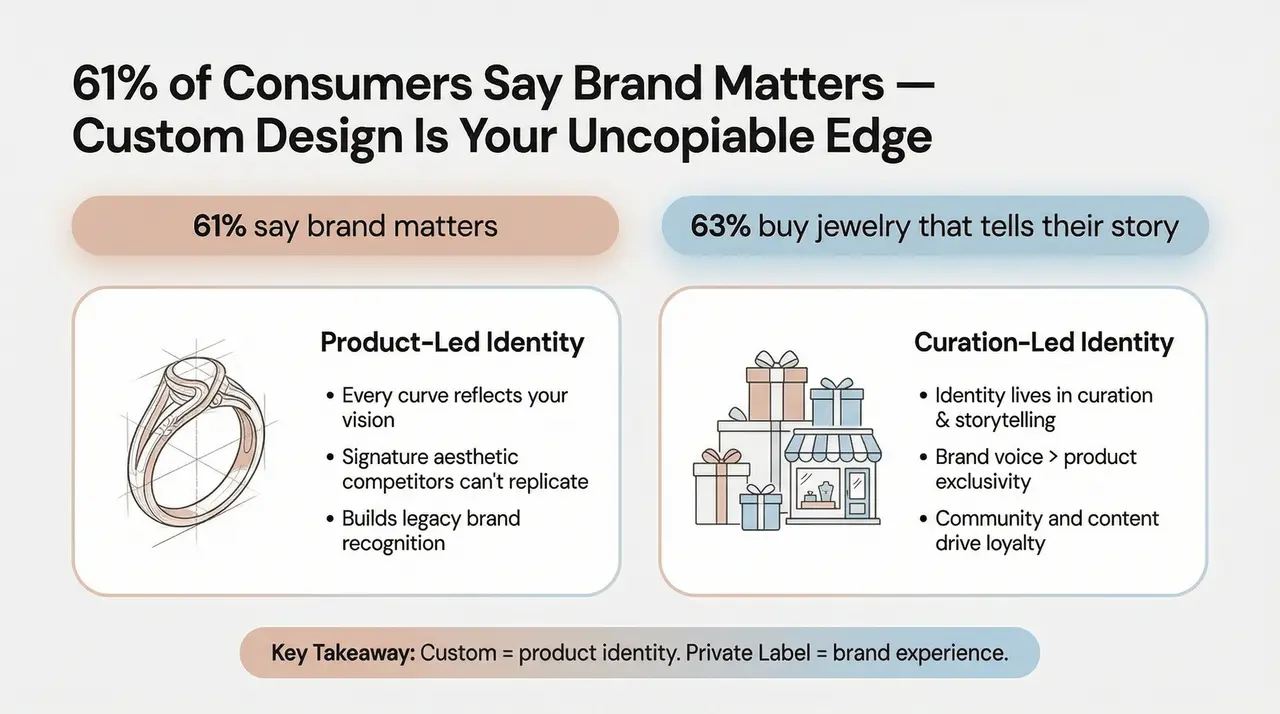
Your manufacturing choice is fundamentally a brand identity decision. In a market where 61% of consumers say brand matters [5], and with branded jewelry growing at nearly double the rate of unbranded [5], your ability to stand out is paramount.
Custom manufacturing offers the ultimate control over your brand identity. Every curve, finish, and detail reflects your unique vision. This is how you build a legacy brand that customers recognize instantly. It allows you to create a signature aesthetic that can't be replicated by competitors browsing the same catalogs. With 63% of consumers more likely to buy jewelry that "tells their story" [6], custom design is a powerful tool for connection.
Private label, in contrast, shifts the focus of brand identity from the product itself to the curation, storytelling, and customer experience. Your brand becomes about how you sell, not just what you sell. Success depends on your ability to build a community, create compelling content, and offer exceptional service. While the products may not be exclusive, your brand's voice and the lifestyle you represent can be.
Financials are often the deciding factor for new entrepreneurs. The two models present vastly different investment profiles.
Custom Manufacturing Costs:
Private Label Manufacturing Costs:
Many assume custom manufacturing always leads to higher margins. However, brands often underestimate the hidden costs of design iterations, multiple sample rounds, and the inventory risk of holding unique but unproven designs. A private label bestseller with strong marketing can often yield a healthier cash flow in the early stages.

In the fast-paced world of e-commerce, timing is everything. Your ability to launch, test, and iterate quickly can be a major competitive advantage.

The right choice often depends on where you are in your entrepreneurial journey. Here’s a framework for aligning your manufacturing strategy with your business stage.
Many successful jewelry brands don’t stick to one model. They start with private label to validate their market and generate cash flow. Once they identify their top-selling products, they transition those specific designs to custom manufacturing. This hybrid strategy is a pragmatic approach that most guides overlook, balancing risk and brand-building effectively.

Regardless of the model you choose, avoiding these common pitfalls is crucial for a successful partnership:

Ready to take the next step? Here’s a simplified guide to getting started.

To make these trade-offs concrete, consider this scenario. You want to launch a minimalist ring brand. You have $15,000 to invest and want to launch within 6 months.
You browse manufacturer catalogs and select 5 minimalist ring designs. You order 100 units of each at $12 per unit ($6,000 total inventory). You spend $1,500 on packaging, $1,000 on photography, and $2,000 on your website and initial marketing. You launch in 4 weeks with a full collection, spending roughly $10,500 total. You have $4,500 remaining as a safety net. If a design sells out, you restock in 2-3 weeks. If a design flops, you've lost a small amount on a small batch.
You hire a CAD designer for $800 and create 3 unique ring designs. Mold fees cost $900 ($300 x 3). Samples cost $450. You order 100 units of each at $18 per unit ($5,400 total inventory). Shipping and tariffs add $900. Packaging, photography, and marketing bring the total to approximately $11,450. Your launch takes 14-16 weeks. You have $3,550 remaining, but you own the IP and have a truly unique product line.
The Verdict: With a $15K budget and a 6-month timeline, private label is the lower-risk path. It preserves capital, allows for faster learning, and leaves room to pivot. However, if your brand's entire premise is design uniqueness and you have a clear, validated audience, custom manufacturing is the right investment from day one.

The typical MOQ for private label jewelry is between 50 and 100 pieces per design. This is ideal for small businesses and startups looking to test the market without a large financial commitment [3].
Yes, and this is a highly recommended strategy. Start with private label to validate your designs and generate cash flow. Once you identify your bestsellers, you can invest that revenue into custom manufacturing those specific pieces to create an exclusive, ownable product line.
For most new brands, private label is the better starting point. It minimizes financial risk, allows for quick market entry (2-4 weeks), and helps you validate your brand concept before investing heavily in unique designs. Custom manufacturing is better for established brands or founders with deep industry experience and funding.
Private label production is very fast, typically taking 2-4 weeks from order to shipment. Custom jewelry takes much longer, usually 8-20 weeks, due to the multi-step process of design, sampling, mold creation, and production [3, 7].
There is no single "best" choice in the custom jewelry manufacturing vs. private label debate. The right path depends entirely on your brand's goals, budget, and timeline. Private label offers speed and affordability, making it the perfect vehicle for market validation. Custom manufacturing provides creative control and long-term brand differentiation, the cornerstones of a legacy brand.
By using the 3-Stage Manufacturing Pathway, you can make a strategic choice that aligns with your current business needs while paving the way for future growth. Many successful brands don't choose one or the other; they leverage both.
Whether you're leaning toward custom manufacturing for full creative control or private label for speed, platforms like Branvas can connect you with vetted partners for both paths. Explore manufacturers that fit your vision and budget.
Your brand's success starts with the right manufacturing partner. Make the choice that aligns with your goals.
[1] The Rise of Direct-to-Consumer (DTC) Jewelry Brands: What Entrepreneurs Can Learn. Business Money. March 2025. [https://www.business-money.com/announcements/the-rise-of-direct-to-consumer-dtc-jewelry-brands-what-entrepreneurs-can-learn/]
[2] 2025 Jewelry Industry Statistics: Global and U.S. Trends. Carat Trade. June 2025. [https://www.carattrade.com/blog/2025-jewelry-industry-statistics-global-us-trends]
[3] Private Label Jewelry Manufacturers for Small Businesses: Affordable Solutions That Work. Lancui Jewelry. September 2025. [https://www.lancui-jewelry.com/post/private-label-jewelry-manufacturers-for-small-businesses-affordable-solutions-that-work]
[4] Jewelry Mold Fee Explained: Ownership, Storage and Rights. HonHo Jewelry. December 2025. [https://www.honhojewelry.com/jewelry-mold-fee/]
[5] Why the Shine Isn’t Fading on Jewellery Sales. The Business of Fashion & McKinsey. December 2025. [https://www.businessoffashion.com/articles/luxury/the-state-of-fashion-2026-report-jewellery-category-sales/]
[6] Why Personalized Jewelry Is Gaining Popularity in 2025. CustomJewelry.com. June 2025. [https://www.customjewelry.com/why-personalized-jewelry-is-gaining-popularity-in-2025/]
[7] Jewelry Manufacturing: Trends and Best Practices. HonHo Jewelry. November 2025. [https://www.honhojewelry.com/jewelry-manufacturing/]
[8] The Impact of Broad Tariffs on the U.S. Jewelry Industry. Jewelers of America. July 2025. [https://www.jewelers.org/images/member-center/representation/JA-PositionStatement-Tariffs-2025.pdf]
[9] DTC Trends: 9 Tips, Insights & Notable Stats for 2025. Shopify. July 2025. [https://www.shopify.com/enterprise/blog/dtc-trends]
[10] Looking Back on Jewelry Retail in 2025, and Ahead for 2026. JCK Online. December 2025. [https://www.jckonline.com/article-long/jewelry-retail-in-2025-and-2026/]
This worksheet is designed to help you clarify your goals and make a confident decision between custom and private label manufacturing.
Score each factor from 1 (Low Priority/Low Resource) to 5 (High Priority/High Resource) based on your brand's current situation.
Scoring Guide:
Disclaimer: This is a simplified example. Costs vary widely. Consult a legal professional for contract review.