



Most fashion stores plateau because they focus on traffic, not systems. Follow our 90-day roadmap to build a monetization engine that scales to $10k/month and beyond.
Published:
January 29, 2026
Author:
Yi Cui
For many aspiring fashion entrepreneurs, the journey begins with a burst of excitement. You launch your store, curate a collection, and make those first few sales. But then, something happens—or rather, something stops happening. The initial momentum fades, and you find yourself stuck in a frustrating plateau, far from the dream of a thriving, scalable business. If your revenue is hovering below the $10,000/month mark, you are not alone. In our experience at Branvas, this is the most common and critical hurdle where promising fashion ventures either find their footing or fade away.
The common advice at this stage is often a simplistic and expensive mantra: "run more ads." But scaling a fashion business is not a traffic problem; it’s a systems and leverage problem. Pouring money into ads to attract more visitors to a leaky bucket is the fastest way to drain your budget and your morale. True scaling, the kind that builds a resilient and profitable brand, comes from a different mindset. It’s about systematically monetizing the traffic you already have more effectively.

This article is not another guide on how to set up a basic dropshipping store or run a Facebook ad campaign. This is a strategic roadmap for founders who have already launched but are struggling to build consistent, meaningful revenue. We will deconstruct the scaling process, reframe your understanding of growth, and provide a clear, step-by-step framework to take your fashion business from sporadic sales to a reliable $10,000 per month and beyond. It’s time to stop chasing traffic and start building a monetization engine.
In the world of e-commerce, the words “growth” and “scale” are often used interchangeably, but they represent fundamentally different concepts. Growth is about increasing revenue by adding resources at a similar rate. For example, doubling your ad spend to double your sales is growth. Scale, on the other hand, is about increasing revenue without a proportional increase in costs or resources. It’s about creating systems that generate more output with less input, leading to exponential increases in profitability.
Fashion e-commerce behaves differently from generic dropshipping of commoditized products. While a store selling phone cases might compete solely on price and volume, a fashion brand is built on aesthetics, identity, and emotional connection. This presents both a unique challenge and a powerful opportunity. Viral traffic from a trending TikTok video might bring a surge of visitors, but it rarely builds a sustainable business. For fashion brands, the path to $10k/month and beyond is paved not with fleeting traffic spikes, but with a relentless focus on two core metrics: Average Order Value (AOV) and Customer Lifetime Value (LTV), which is driven by retention.
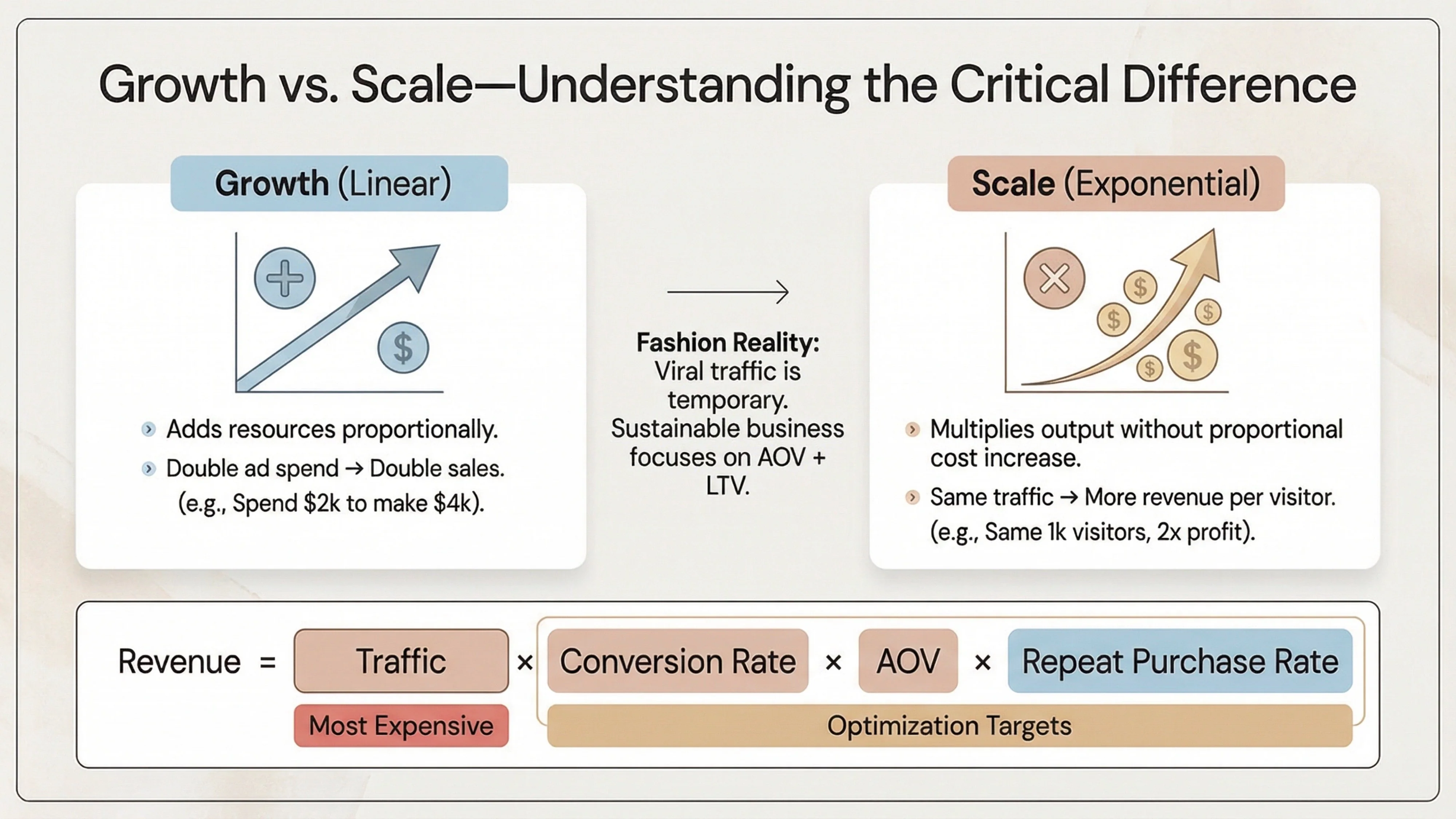
Why do these matter more than raw traffic? Because acquiring a new customer is expensive. The real profit is unlocked when you can persuade each customer to spend more per transaction (AOV) and to return to purchase from you again and again (retention). A business that masters these two levers can achieve scale, turning a modest traffic stream into a significant revenue engine. A business that ignores them will forever be trapped in the hamster wheel of expensive customer acquisition, struggling to break even on each sale.
To systematically scale a fashion business, you need to think like an architect, not just a marketer. You are building a revenue engine, and every component must be in the right place and functioning correctly. At Branvas, we use a framework we call The $10k Fashion Revenue Stack to diagnose and fix stalled growth. It visualizes the business as a series of dependent layers. Attempting to build a higher layer without a solid foundation beneath it is the primary reason most stores fail to scale.
Here is a breakdown of the stack:
|
Layer |
Focus |
Key Activities |
Why It Matters |
|---|---|---|---|
|
5. Acceleration |
Paid Traffic |
Google Ads, Meta Ads, TikTok Ads |
Only after the engine is optimized, ads become a profitable force multiplier, not a costly gamble. |
|
4. Retention |
Repeat Purchases |
Email Flows, SMS Campaigns, Loyalty |
It costs 5x more to acquire a new customer than to retain an existing one. This is where profit is maximized. |
|
3. Monetization |
AOV & LTV |
Upsells, Cross-sells, Bundles, Catalog Expansion |
This layer turns existing traffic into significantly more revenue, directly boosting profitability per visitor. |
|
2. Conversion |
Trust & Sales |
High-Quality PDPs, Social Proof, Sizing Guides, Smooth Checkout |
A visitor who doesn’t trust you or can’t easily buy from you will never become a customer. This is the core of the transaction. |
|
1. Foundation |
Brand & Operations |
Clear Niche, Compelling Visuals, Reliable Fulfillment |
Without a coherent brand identity and trustworthy operations, nothing else matters. This is your brand’s core promise. |
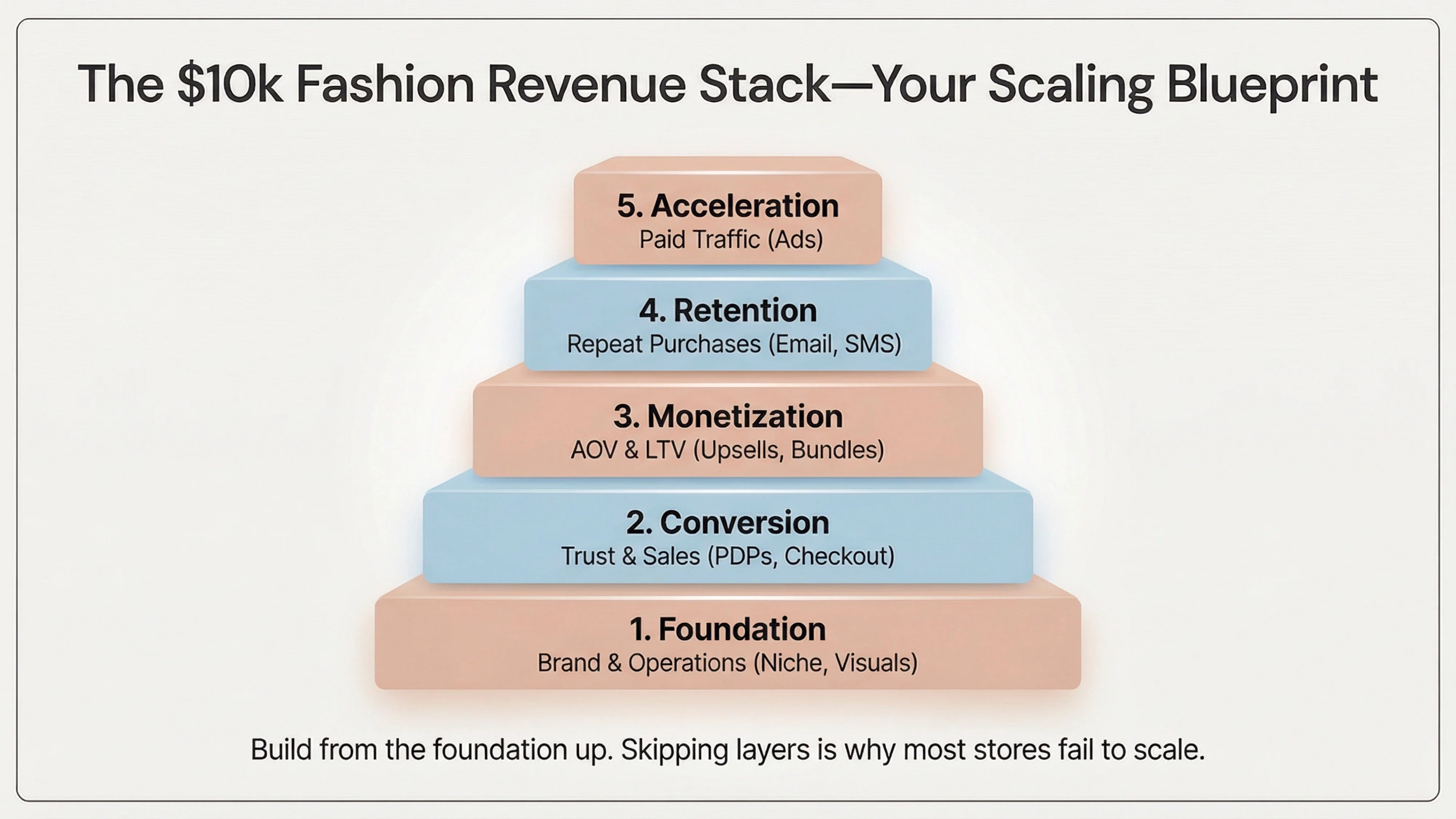
Most founders make the critical mistake of trying to jump straight to Layer 5 (Acceleration). They see a traffic problem and try to solve it with ads, only to find their Customer Acquisition Cost (CAC) is unsustainably high. The reason is simple: their monetization engine (Layer 3) is weak, their conversion process (Layer 2) is leaky, and their brand foundation (Layer 1) is shaky. The $10k Fashion Revenue Stack forces a more disciplined approach. Before you spend a dollar on ads, you must first ensure that every visitor you acquire has the maximum possible chance to convert, spend more, and come back. This is how you grow your dropshipping business sustainably.
At its core, the formula for e-commerce revenue is simple:
Revenue = Traffic × Conversion Rate × Average Order Value (AOV) × Repeat Purchase Rate
Most founders pour all their energy and resources into the Traffic variable, which is the most expensive and least defensible. The secret to scaling lies in systematically optimizing the other three variables—the monetization levers.
The question we hear most from founders is, “I’ve made some sales, now what? How to grow your dropshipping business past this initial, unpredictable phase?” The answer lies in shifting your focus from acquisition to optimization. The early dropshipping guides got you started, but they almost all stop too early. They teach you how to find a product and get traffic, but they don’t teach you how to build a brand and monetize an audience.
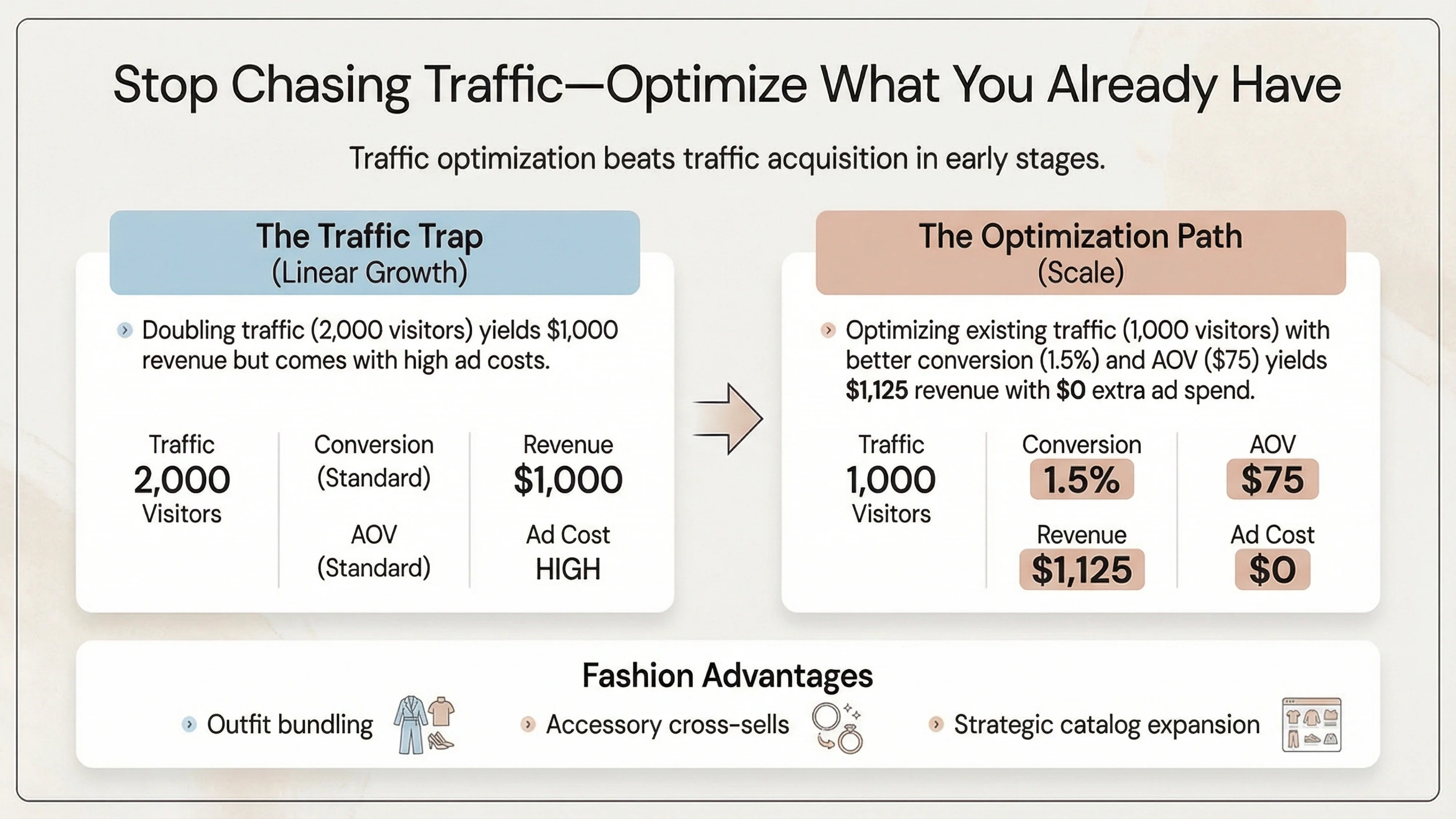
Traffic alone doesn’t scale revenue. If you have 1,000 visitors and a 1% conversion rate with a $50 AOV, you make $500. If you double your traffic to 2,000 visitors, you make $1,000. That’s linear growth, and it’s expensive. But what if, instead, you kept your 1,000 visitors but focused on optimization? By improving your conversion rate to 1.5% and increasing your AOV to $75 through strategic upsells, you now make $1,125 from the same traffic. That is the beginning of scale.
In our experience at Branvas, fashion stores don’t stall because of a lack of demand—they stall because they don’t extract enough value per visitor. They are sitting on a goldmine of untapped potential within their existing traffic. The key is to unlock the fashion-specific monetization opportunities that generic dropshipping stores can’t access: outfit bundling, accessory cross-sells, and strategic catalog expansion into high-margin categories. This is where you move beyond being just a product reseller and start becoming a true fashion curator and brand.
In an era of social media saturation, many founders underestimate the power of a direct, owned channel like email. A well-executed email strategy is a cornerstone of retention and a powerful revenue driver. However, the goal is not to blast your list with daily discounts, which devalues your brand. The goal is to build a relationship through visual storytelling and deliver the right message at the right moment.
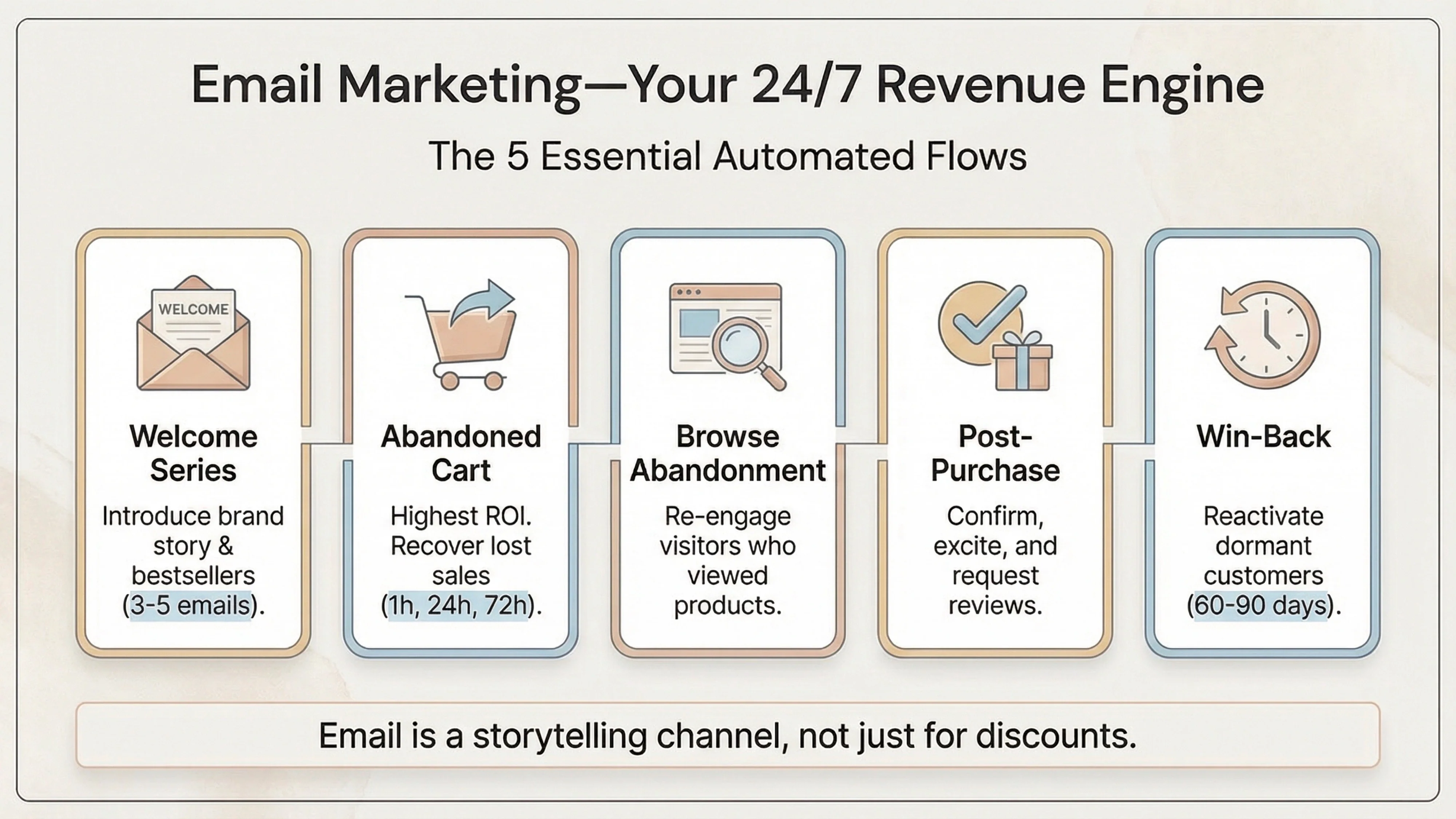
An effective email marketing engine for a fashion brand is built on a series of automated flows that trigger based on user behavior. These are not one-off campaigns; they are always-on assets that work for you 24/7. The core flows every fashion store must have are:
The most common mistake we see is treating email like a sales-only channel. For fashion, it’s a storytelling channel. Use high-quality visuals, share the inspiration behind your collections, and provide value beyond discounts. Show your customers how to style your pieces, tell them about your brand’s mission, and make them feel like part of an exclusive community.
If email is for storytelling, SMS (text message marketing) is for urgency and high-intent moments. With open rates as high as 90%—compared to around 20% for email—SMS is an incredibly powerful tool when used correctly and sparingly [3]. Its immediacy makes it perfect for time-sensitive communications, especially abandoned checkout recovery.
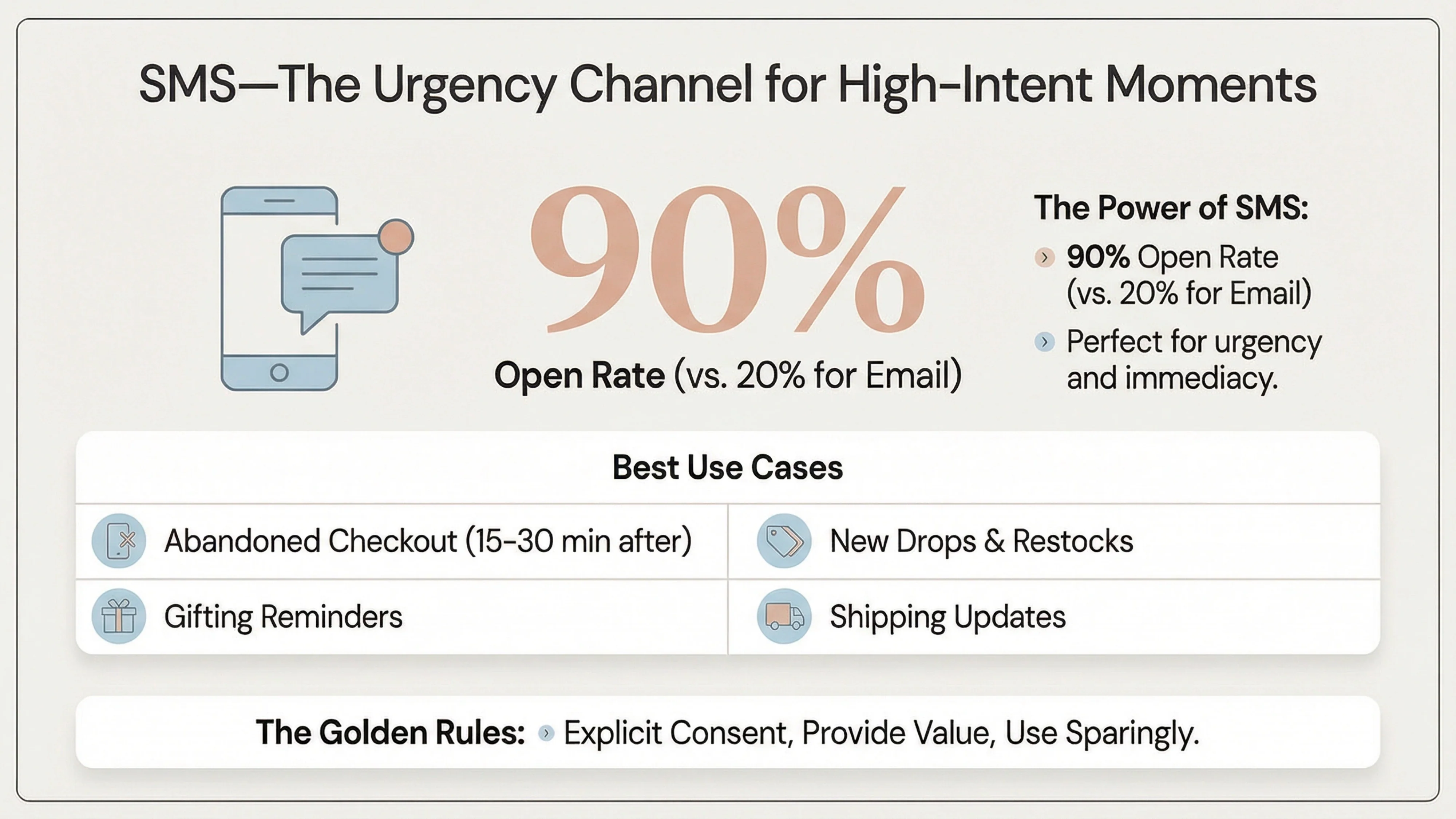
While an abandoned cart email is effective, an SMS sent 15-30 minutes after abandonment can be even more so, catching the customer while the purchase is still top of mind. The message should be short, direct, and helpful, often with a link that takes them directly back to their pre-filled cart.
Beyond cart recovery, SMS is effective for:
The key to SMS is restraint and compliance. You must have explicit consent (an opt-in that is separate from email), and you must provide clear value. Bombarding customers with daily texts is the fastest way to get an “unsubscribe.” Use it as a scalpel, not a sledgehammer, for the moments that matter most.
Average Order Value (AOV) is the single fastest lever you can pull to increase revenue without increasing your ad spend. The average AOV for a fashion brand is around $141, but this can vary dramatically [4]. The goal is to strategically increase this number with every transaction. This is achieved through a combination of upselling, cross-selling, and bundling.
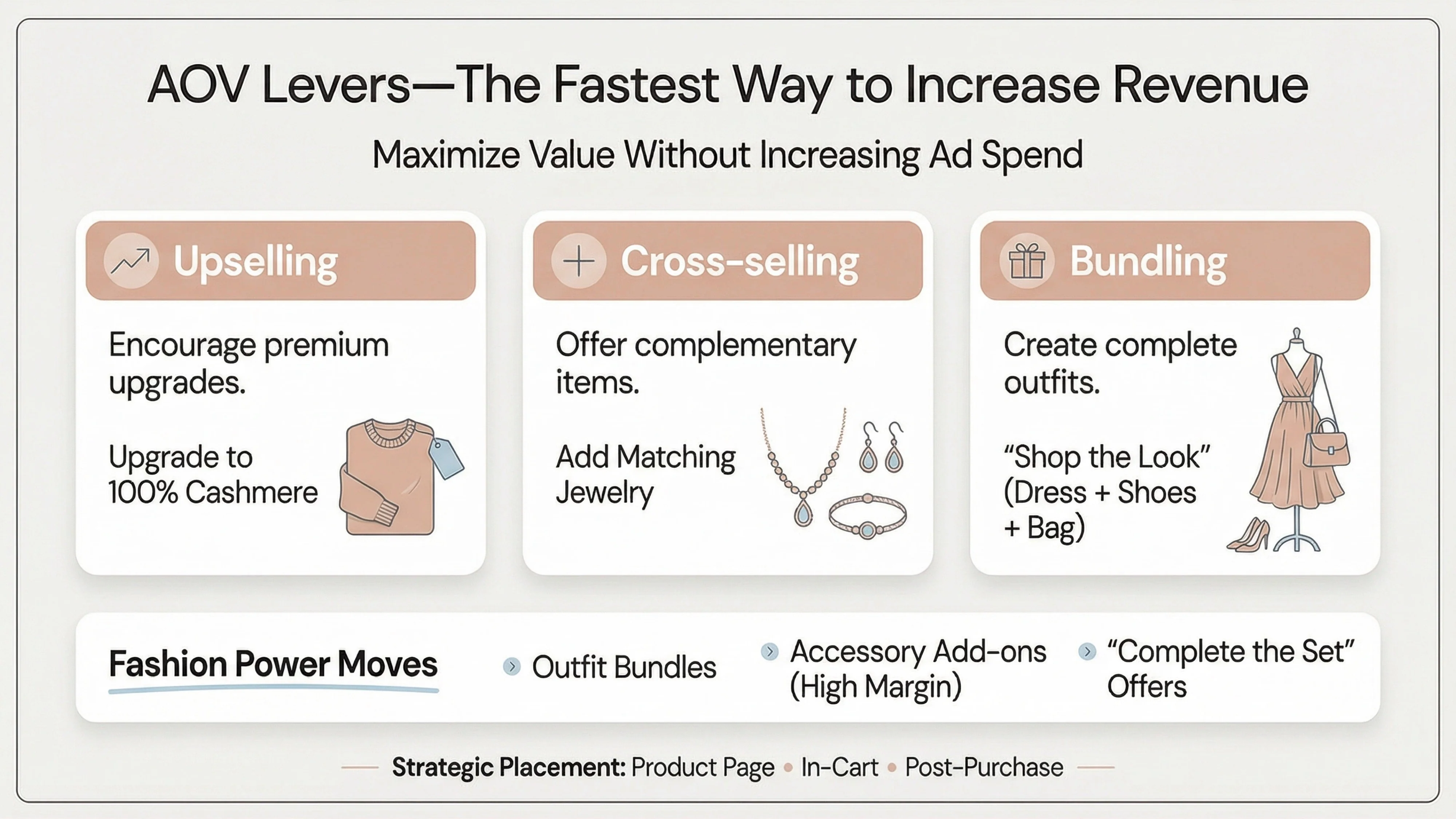
Fashion-specific tactics are particularly effective:
The placement of these offers is critical. You can and should place them at multiple points in the customer journey:
By systematically implementing these AOV levers, you are not just making more money per transaction; you are fundamentally increasing the value of every visitor to your site, which in turn makes your future ad spend more profitable.
In our analysis of hundreds of fashion stores, we’ve identified a powerful, often-missed catalyst for scaling: the strategic addition of jewelry to the product catalog. While many apparel-focused entrepreneurs see jewelry as a separate, complicated category, we see it as the single most effective lever for increasing AOV, boosting margins, and enhancing brand perception—all without the traditional risks of inventory.
This insight is backed by powerful market trends. While the broader fashion industry faces headwinds, the jewelry category is thriving. According to a 2026 McKinsey report, jewelry unit sales growth is outpacing all other fashion categories, growing at more than four times the rate of clothing [5]. This is driven by a consumer shift towards long-lasting investments, self-expression, and the rise of self-gifting.
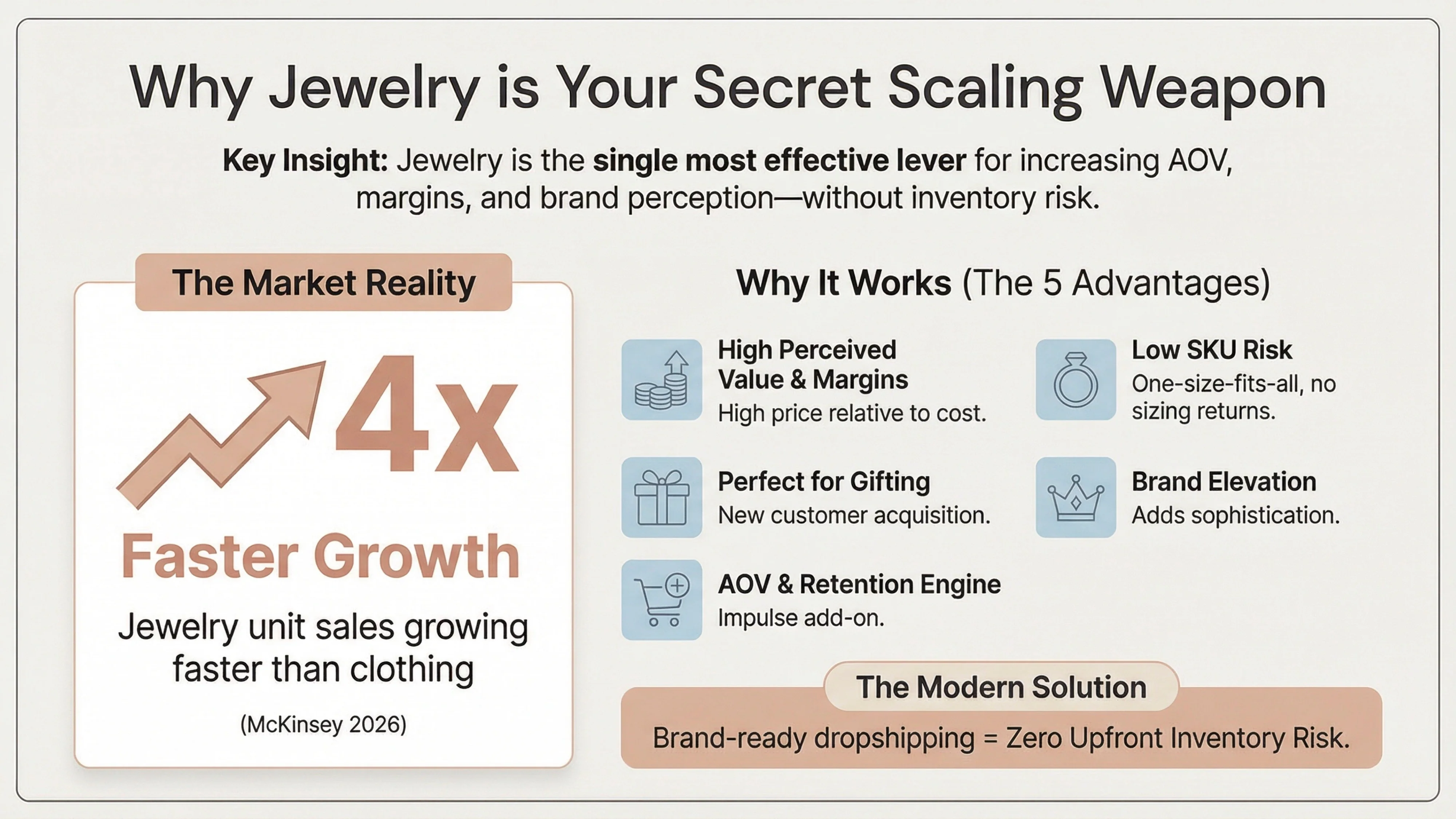
Why is jewelry such a powerful complement to a fashion catalog?
So why do most fashion sellers avoid it? The answer is almost always a single word: inventory. The fear of investing thousands of dollars in jewelry stock that might not sell is a major barrier. But this fear is based on an outdated model of retail. The modern alternative eliminates this risk entirely.
The traditional retail model required buying inventory, holding it, and hoping it sold. This model is dead, especially for a category as nuanced as jewelry. The modern, asset-light approach is to leverage brand-ready, dropshipped jewelry. This model allows you to offer a wide, curated selection of high-quality jewelry to your customers without ever touching the inventory yourself.
Here’s how it works:
This model transforms jewelry from a high-risk inventory investment into a pure, high-margin revenue opportunity. It allows you to instantly expand your catalog, increase your AOV, and tap into the fastest-growing segment of the fashion market with zero upfront cost. You can test different styles, see what resonates with your audience, and double down on winners—all without the financial risk. This is not just dropshipping; it’s strategic catalog expansion.
Here is a truth that many marketing agencies won’t tell you: paid ads are an amplifier, not a solution. They will amplify what is already working, or they will amplify what is broken. If your store has a weak monetization engine—low conversion rates, low AOV, and poor retention—pouring money into ads will only amplify your losses, faster.
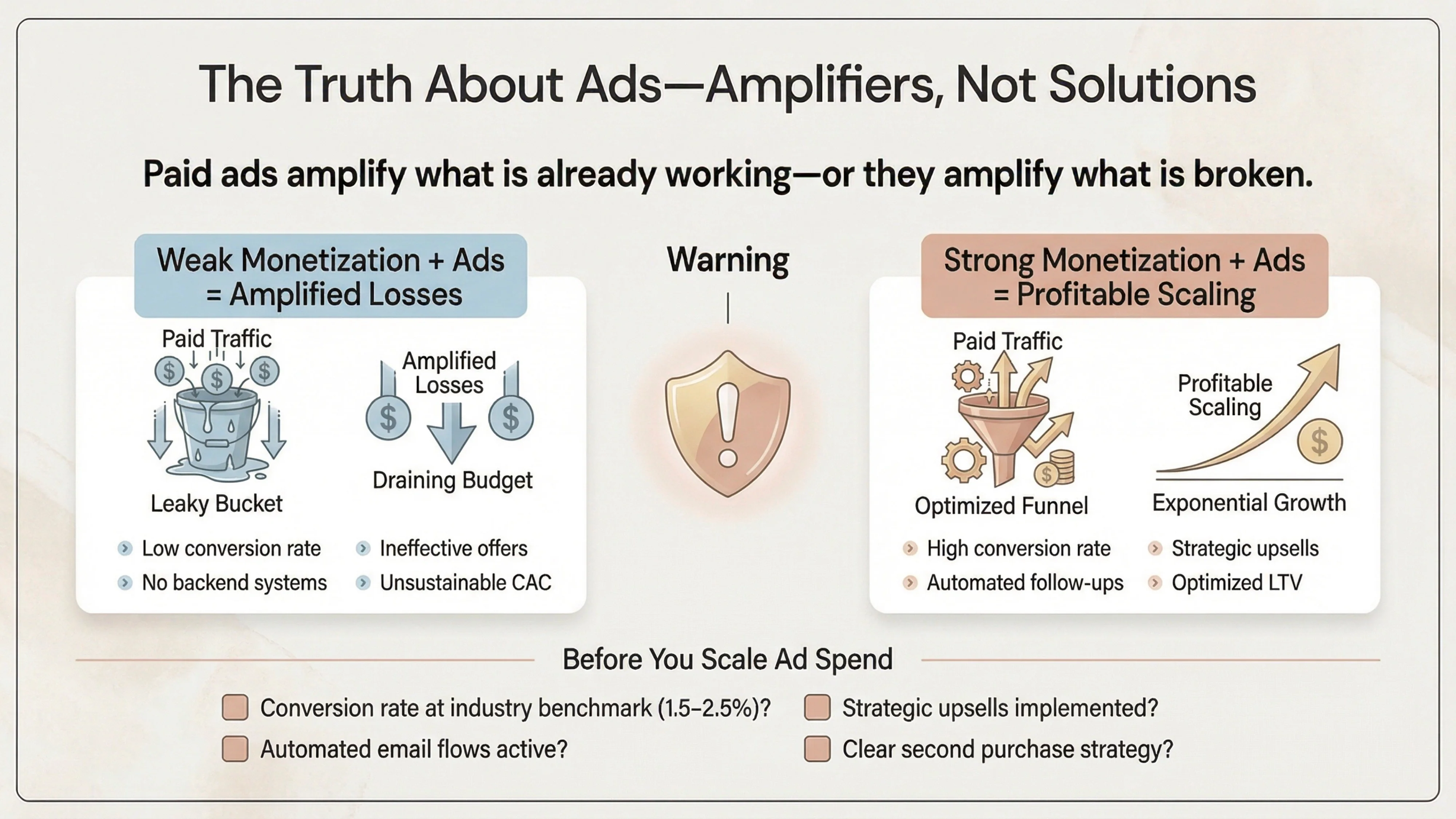
This is why we strongly advise fashion sellers to delay aggressive ad spend until they have systematically worked through the first three layers of the Fashion Revenue Stack. Your goal in the early stages is not to maximize traffic; it is to maximize the value of every visitor you get, even if that’s just a few hundred visitors per day. Before you scale your ad budget, you must be able to answer “yes” to these questions:
Once this monetization engine is built and optimized, your ad spend becomes dramatically more efficient. An increase in AOV and LTV means you can afford to pay more to acquire a customer (a higher CAC), which allows you to outbid competitors and scale your campaigns profitably. Ads don’t scale a broken business; they reveal how broken it is. A strong monetization and retention strategy is what truly unlocks the power of paid advertising.
Theory is useful, but execution is everything. Here is a practical, phase-based plan to apply these principles and drive your store toward the $10k/month milestone over the next 90 days.
Days 1–30: Fix Foundations & Conversion
Days 31–60: Monetization & Owned Marketing
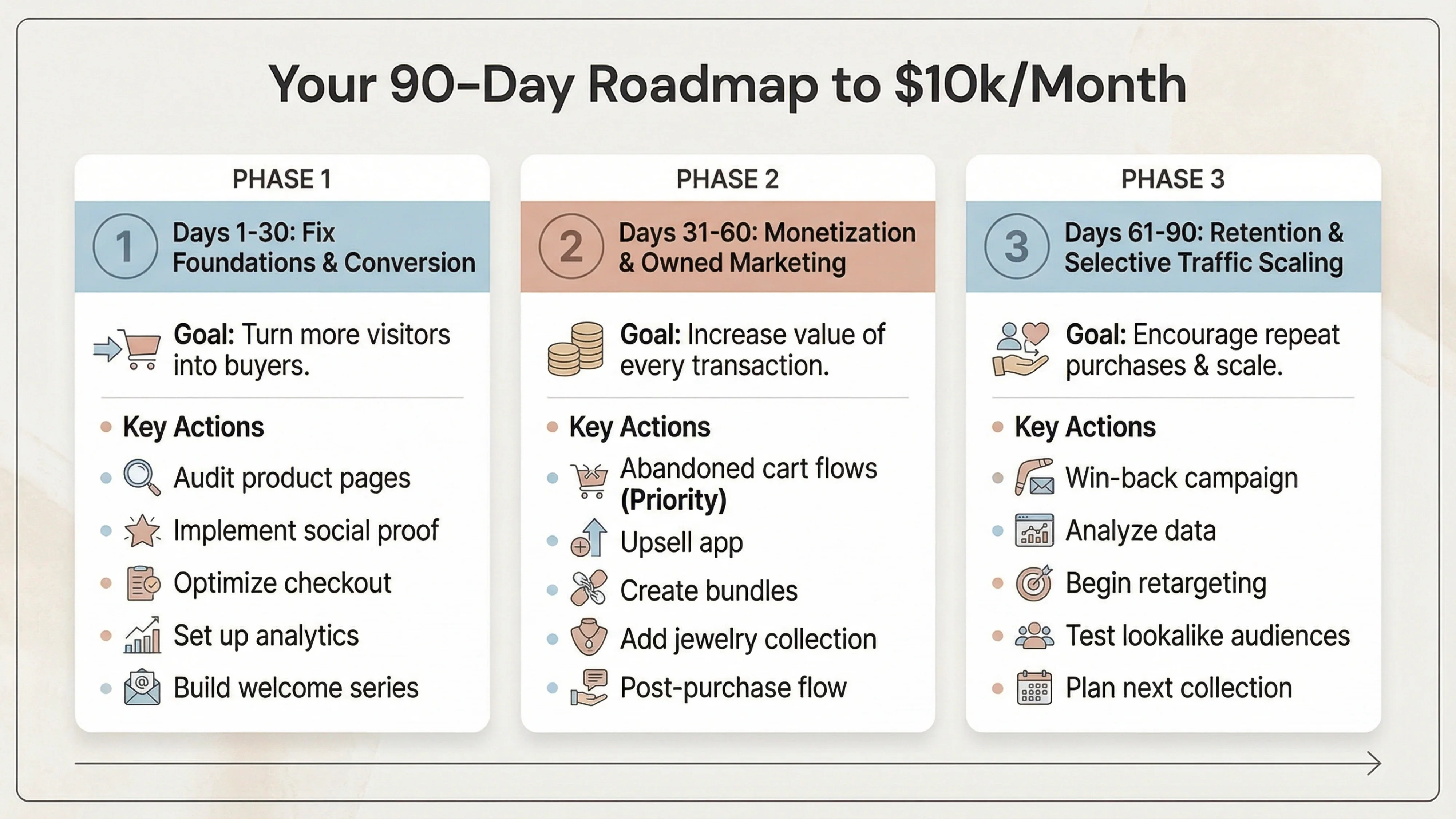
Days 61–90: Retention & Selective Traffic Scaling
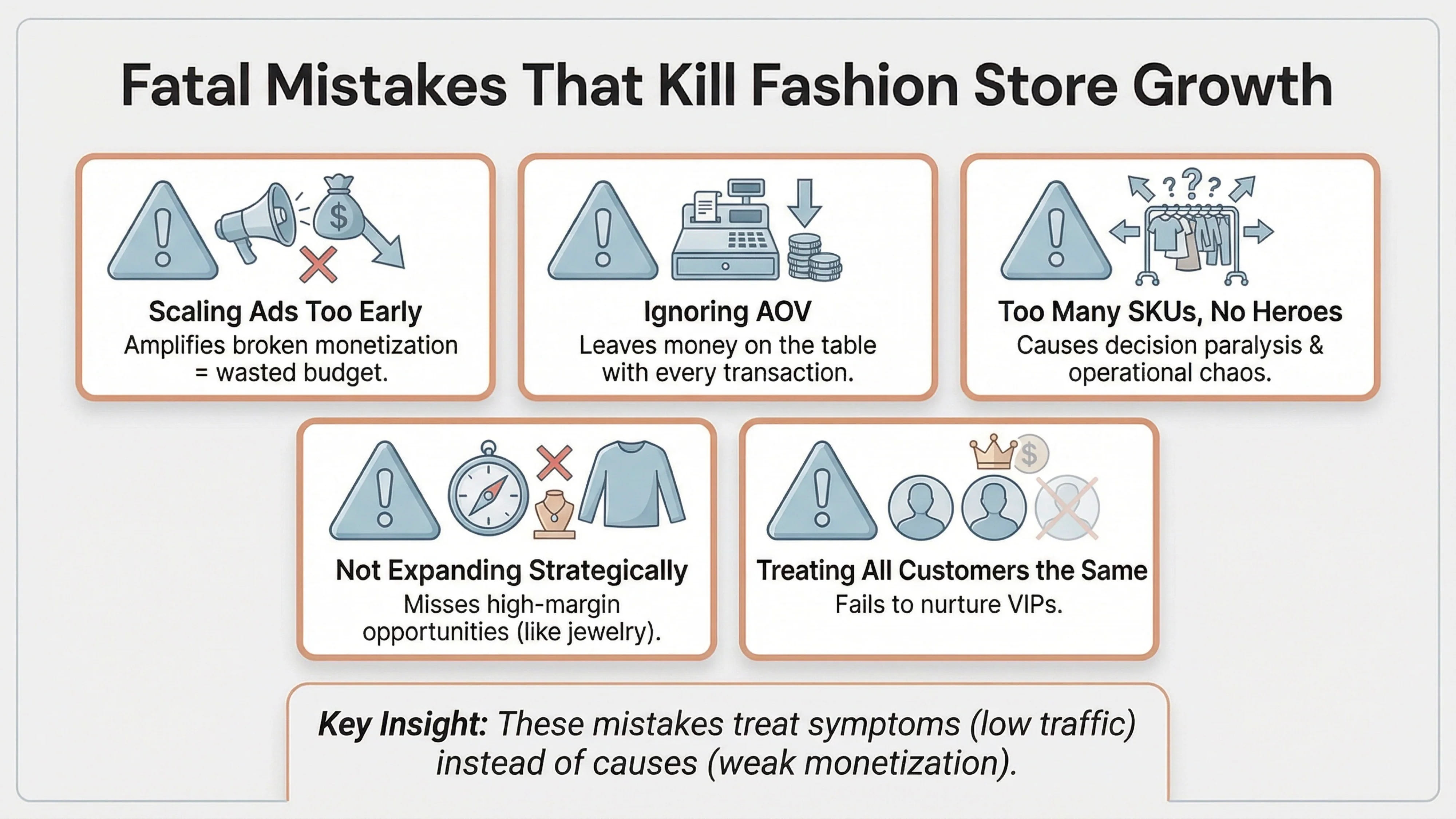
In our work with countless fashion founders, we see the same patterns and mistakes emerge. Avoiding these common pitfalls is as important as following the right strategies.
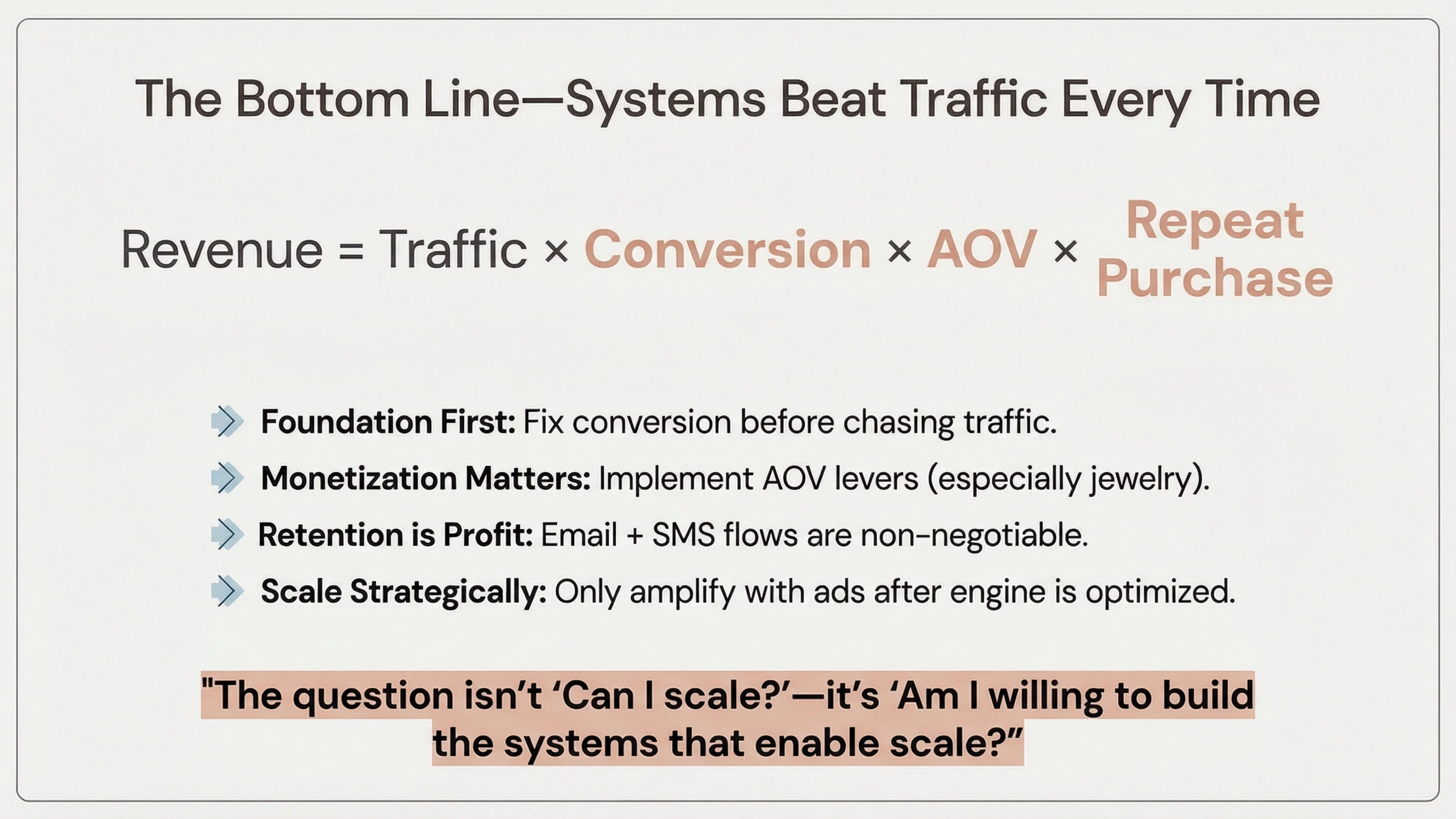
Focus on systems, not just traffic. The key is to increase your conversion rate and average order value (AOV) first. Implement automated email flows for abandoned carts, add strategic upsells and cross-sells (especially high-margin accessories like jewelry), and only then, begin to scale your paid ad spend.
With a focused, systematic approach, a store with existing traffic can see significant progress towards the $10k/month mark within 90 days. The timeline depends on your starting point and execution speed, but the key is to follow a structured plan, focusing on monetization before aggressive traffic acquisition.
Monetization, unequivocally. In the early stages, a 10% improvement in your conversion rate or AOV is far more valuable and sustainable than a 10% increase in traffic. Monetization improvements make your existing traffic more valuable and your future traffic acquisition more profitable.
Yes, they are critical. Email is your primary channel for brand storytelling and building customer relationships, while SMS is a powerful tool for high-urgency moments like cart recovery. Together, they form the backbone of a strong retention strategy, which is where long-term profitability is found.
Leverage brand-ready, dropshipped accessories. Adding a curated collection of high-margin jewelry to your apparel store is the single most effective way to increase AOV. This model allows you to expand your catalog and offer complementary products with zero upfront inventory investment or risk.
[1] Baymard Institute. (2025, September 22). 50 Cart Abandonment Rate Statistics 2026. Baymard Institute.
[2] Statista. (2025, November 28). Global fashion shopping cart abandonment rate 2021. Statista.
[3] Postscript. (2020, May 6). How Brands Reduce Abandoned Carts with SMS (Plus 8 Examples). Postscript.
[4] GetKard. (2025, September 11). 10 proven ways to increase average order value for ecommerce growth. GetKard.
[5] McKinsey & Company. (2025, November 17). The State of Fashion 2026: When the rules change. McKinsey & Company.
[6] Shopify. (2025, January 27). The State of the Ecommerce Fashion Industry: Statistics, Trends, and Strategies to Use in 2025. Shopify.
[7] Rivo. (2026, January 6). Ecommerce Customer Retention Statistics 2026. Rivo.