.avif)


DTC brands can increase average order value by adding curated jewelry through private-label dropshipping, achieving conservative AOV lifts of $4-8 per order without inventory risk.
Updated:
February 11, 2026
Author:
Yi Cui
Add jewelry to a DTC brands catalog the smart way—category picks, merchandising, and ops without tying up cash in inventory.
For direct-to-consumer (DTC) brand owners, sustainable growth is a perpetual challenge. While new customer acquisition is crucial, its rising cost—often exceeding $25 per customer—makes it an expensive lever to pull [1]. A more efficient path to profitability lies in increasing the value of each existing customer transaction. For brands in the apparel, beauty, wellness, and lifestyle sectors, adding a curated jewelry collection offers a powerful opportunity to significantly increase average order value (AOV) without the financial burden of holding inventory.
This playbook provides a comprehensive guide for DTC brand owners to strategically add jewelry to their stores. We will cover the most effective jewelry categories, a data-driven merchandising framework for maximizing attach rates, and an operational blueprint for launching a jewelry line with zero inventory risk. The goal is to provide an actionable guide to unlocking a new, high-margin revenue stream from your existing customer base.
The strategic case for adding jewelry extends beyond simple product line expansion. It directly addresses several core financial and marketing objectives for a growing DTC brand. By integrating a well-curated jewelry selection, you can enhance your brand's perceived value, increase customer loyalty, and improve your store's fundamental financial health.
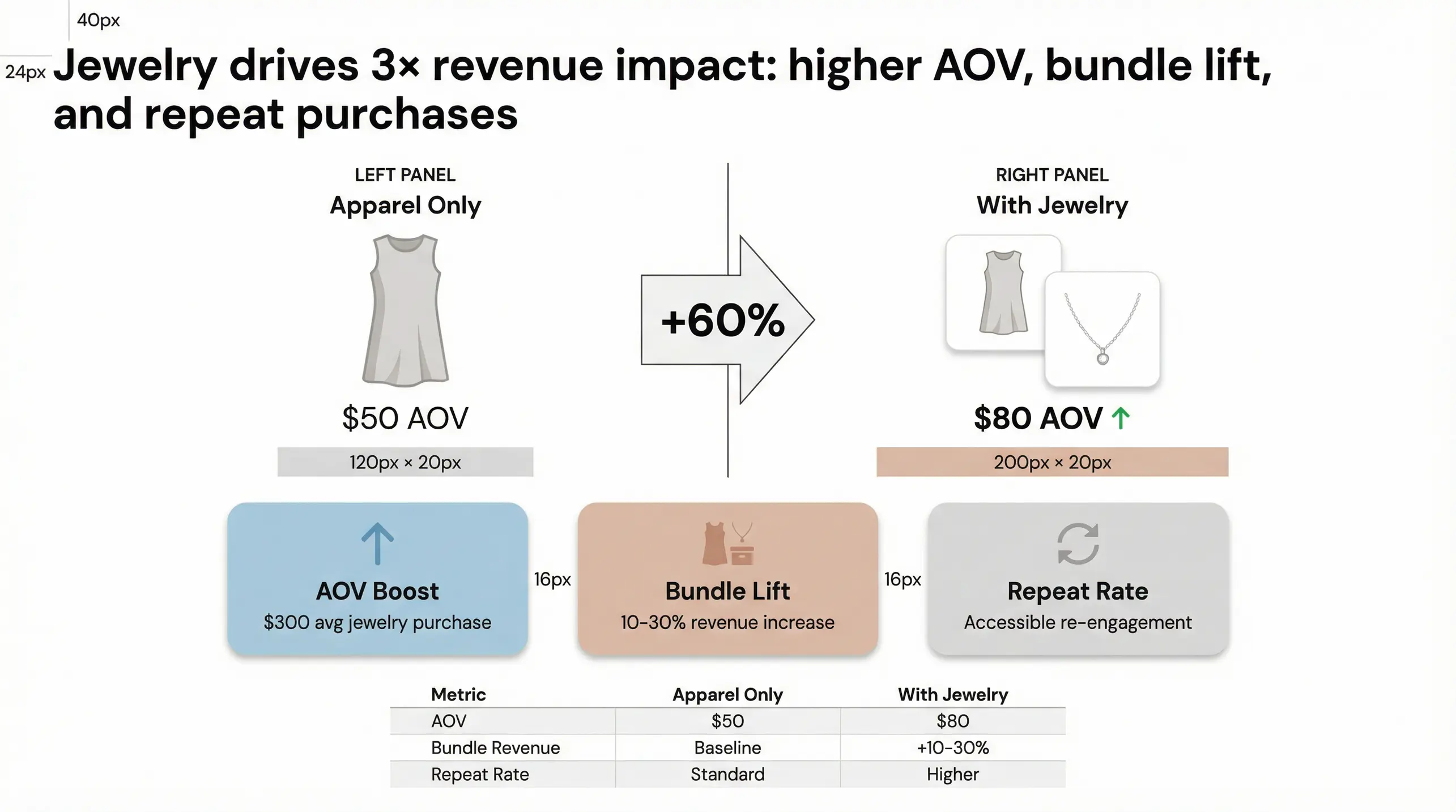
First and foremost, jewelry is a powerful AOV booster. Industry benchmarks show a significant gap between the AOV of typical DTC categories and that of jewelry. While apparel and accessories often see AOVs in the $40 to $170 range, luxury and jewelry purchases average over $300 [2]. By positioning jewelry as a complementary add-on, you can pull the entire transaction value upward. This incremental revenue has an outsized impact on profitability because it spreads fixed costs—such as packaging, labor, and payment processing fees—across a larger revenue base. An extra $30 from a necklace in an $80 order makes your margins significantly healthier than in a $50 order.
Second, jewelry is uniquely suited for bundling and cross-selling. The concept of the "complete look" is a powerful psychological driver. Customers who have already decided to purchase an apparel item are mentally primed to consider accessories that will enhance their new outfit. This makes jewelry a natural and low-friction cross-sell. Research from Practical Ecommerce shows that product bundling is the most common and effective cross-selling tactic used by top DTC brands [3]. By creating bundles—such as a dress paired with a recommended necklace—you simplify the purchasing decision and increase the perceived value, often leading to a 10-30% lift in revenue [1].
Finally, jewelry drives repeat purchases and increases customer lifetime value (LTV). Unlike a primary apparel purchase, which may only happen a few times a year, jewelry offers an accessible way for customers to re-engage with your brand. A customer might return to buy a matching pair of earrings for a necklace they previously purchased or to pick up a new piece from a seasonal collection. This transforms a one-time buyer into a loyal, repeat customer, which is critical for long-term, sustainable growth. In our experience at Branvas, we've seen DTC brands successfully use jewelry to build a stronger, more emotional connection with their customers, turning a transactional relationship into a lasting one.
Choosing the right jewelry categories is critical to the success of your new product line. The goal is not to become a full-fledged jewelry store but to offer a curated selection that complements your existing catalog and resonates with your target customer. The most successful DTC brands focus on a small, high-velocity assortment of 10-15 SKUs that align with their brand aesthetic and price point. Based on our analysis of the current market and data from top-performing brands, here are the best jewelry categories for DTC stores, complete with wholesale cost estimates and recommended retail price bands.
| Jewelry Category | Wholesale Cost | Retail Price Band | Why it works for DTC brands stores | Merchandising Note |
|---|---|---|---|---|
| Minimalist Necklaces | $8–$18 | $28–$58 | High perceived value, everyday wearability, complements minimalist apparel brands. Strong repeat-purchase item. | Offer as a "complete the look" upsell on PDP; bundle with matching earrings for +15% AOV lift. |
| Hoop & Huggie Earrings | $6–$15 | $24–$48 | Trending style (2025-2026), versatile across occasions, low price resistance. | Feature in lifestyle imagery and create a "buy 2, get 15% off" bundle to encourage multiple purchases. |
| Layering Bracelets | $5–$12 | $22–$42 | Encourages multi-piece purchases for a layered look, aligns with wellness and lifestyle brand positioning. | Create pre-styled bracelet stacks (3-4 pieces) and sell as a single SKU for a higher AOV. |
| Statement Rings | $7–$16 | $28–$52 | Strong visual impact in product photography, popular gift item, complements bold and fashion-forward brands. | Use as a hero item in email marketing and social media campaigns to drive traffic to the jewelry category. |
| Pendant Necklaces | $10–$22 | $38–$68 | Higher price point justified by design or personalization, strong emotional purchase driver, excellent for gifting. | Offer simple initial or birthstone personalization to increase perceived value and command a premium price. |
| Dainty Anklets | $4–$10 | $18–$35 | Perfect seasonal item for summer, low commitment price point, high potential for impulse adds in the cart. | Promote heavily during spring and summer months; bundle with sandals or swimwear. |
| Chunky Chain Bracelets | $8–$18 | $32–$58 | On-trend (2025-2026), appeals to fashion-forward customers, strong social media appeal. | Feature in "New Arrivals" and style with edgier apparel items to attract trend-focused shoppers. |
In our experience at Branvas, the most successful brands start with a core assortment of minimalist necklaces and hoop earrings in both gold and silver finishes. These two categories have the broadest appeal and consistently deliver the highest attach rates.
For DTC brands looking to explore this opportunity, a great next step is to Explore our curated jewelry catalog to see which styles might be a fit for your store.

Once you've selected your starter assortment, the next step is to strategically merchandise the jewelry across your online store. Effective merchandising is not about aggressively pushing products; it's about presenting the right offer to the right customer at the right time. We recommend a Three-Touchpoint Merchandising Playbook that integrates jewelry offers seamlessly into the customer journey.
The PDP is your first and best opportunity to introduce jewelry as a natural complement to your core products. The goal here is to plant the seed of a complete outfit.
Once a customer has added an item to their cart, they have shown strong purchase intent. This is the ideal moment for a low-friction cross-sell or a threshold-based incentive.
The customer journey doesn't end at checkout. The post-purchase phase is a valuable opportunity to drive repeat business and introduce customers to your new jewelry category.
By implementing this three-touchpoint strategy, you can systematically increase your jewelry attach rate. Now, let's look at a conservative AOV uplift scenario:
Scenario: A DTC wellness brand has a baseline AOV of $72 and 400 monthly orders. They add a curated selection of minimalist necklaces and layering bracelets with an average retail price of $38. By implementing the merchandising playbook, they achieve a conservative attach rate of 12–16%.
AOV Uplift Calculation:
- Low Estimate: 12% of customers add a $38 item = $4.56 increase in AOV
- High Estimate: 16% of customers add a $38 item = $6.08 increase in AOV
Incremental Monthly Revenue:
- Low Estimate: 400 orders × 12% attach rate × $38 = $1,824
- High Estimate: 400 orders × 16% attach rate × $38 = $2,432
Over the course of a year, this translates to $21,888–$29,184 in additional, high-margin revenue—all without any new ad spend.

The biggest operational hurdle for any brand looking to add a new product category is inventory. Tying up cash in unsold products is a risk that most DTC brands cannot afford to take. Fortunately, the modern ecommerce ecosystem offers a solution: private-label blind shipping.
This model allows you to partner with a fulfillment specialist (like Branvas) that manages the entire process—from product sourcing and branding to packaging and shipping—all under your brand name. The customer receives their order in your branded packaging, with no indication that it came from a third-party supplier. This allows you to test a new category with zero inventory risk and minimal operational overhead.
Here is a practical checklist for adding jewelry to your store without holding inventory:
By following this checklist, you can launch a new jewelry line in as little as 14 days with virtually no upfront investment. This approach allows you to test the market, gather data, and build a profitable new revenue stream without the traditional risks of product line expansion.
Ready to get started? Launch your jewelry line in 14 days—get a free assortment consultation.

To make the launch process even more straightforward, here is a 10-SKU starter assortment blueprint designed for a typical DTC apparel or lifestyle brand. This plan is optimized for a quick launch and a high probability of success.
| SKU # | Product Type | Price Band | Rationale | Priority |
|---|---|---|---|---|
| 1 | Dainty Gold Necklace | $32–$42 | The quintessential entry-level luxury piece. Everyday wearability and the highest potential attach rate. | CORE |
| 2 | Dainty Silver Necklace | $28–$38 | Provides a metal alternative to your top seller, instantly doubling your potential customer base. | CORE |
| 3 | Small Gold Hoop Earrings | $28–$38 | A timeless and trending style that is versatile and drives strong repeat purchases. | CORE |
| 4 | Small Silver Hoop Earrings | $24–$34 | The silver counterpart to your core gold hoops, offered at a slightly lower price point. | CORE |
| 5 | Layering Bracelet Set (3pc) | $38–$48 | Offers high perceived value and a higher AOV. Appeals to customers looking for a complete, styled look. | GROWTH |
| 6 | Statement Ring | $32–$42 | A bold piece with strong visual impact for marketing. A great gift item that complements fashion-forward styles. | GROWTH |
| 7 | Simple Pendant Necklace | $42–$58 | A slightly higher price point for customers looking for a more significant piece. Excellent for gifting. | PREMIUM |
| 8 | Dainty Anklet | $22–$32 | A low-commitment, seasonal item that is perfect for impulse buys, especially during warmer months. | SEASONAL |
| 9 | Chunky Chain Bracelet | $38–$52 | An on-trend, fashion-forward piece that appeals to a younger, social-media-savvy demographic. | TREND |
| 10 | Textured Huggie Earrings | $32–$42 | A variation on the classic hoop that offers a point of differentiation and a slightly more premium feel. | TREND |
This curated assortment provides a balanced mix of core bestsellers, growth-oriented pieces, and trend-driven items. By launching with this 10-SKU plan, you can quickly gather data on what resonates with your customers and make informed decisions about how to scale your collection.

How much does it cost to add jewelry to my DTC store?
With a private-label dropshipping model, the upfront cost is virtually zero. You only pay the wholesale cost of the product after a customer places an order, so there is no need to invest in inventory.
Do I need to hold inventory?
No. A private-label fulfillment partner like Branvas handles all inventory, packaging, and shipping. This eliminates inventory risk and allows you to focus on marketing and brand building.
What's a realistic AOV increase from jewelry?
Conservatively, you can expect a $4–$8 increase in AOV per order. With a well-executed merchandising strategy, this can climb to $10 or more, especially if you encourage bundles or multi-piece purchases.
How do I choose the right jewelry categories?
Start by analyzing your brand's aesthetic and your customers' style. For most apparel and lifestyle brands, minimalist necklaces, hoop earrings, and layering bracelets are the safest and most profitable categories to start with.
Can I white-label jewelry with my brand?
Yes. Private-label partners specialize in blind shipping, which means all packaging—from the box to the jewelry card—is customized with your brand's logo and design. Explore our Brand Studio to see the possibilities.
[1] Saras Analytics. (2025, July 10). AOV eCommerce: 11 Strategies for Driving Higher Sales in 2025. Retrieved from https://www.sarasanalytics.com/blog/increase-average-order-value-ecommerce
[2] Shopify. (2025, September 18). Average Order Value (AOV): Formula, Benchmarks and 7 Ways to Increase It (2026). Retrieved from https://www.shopify.com/blog/average-order-value
[3] Roggio, A. (2025, June 1). Cross-sell Tactics of Top DTC Brands. Practical Ecommerce. Retrieved from https://www.practicalecommerce.com/cross-sell-tactics-of-top-dtc-brands
[4] WisePIM. (2026). Jewelry & Watches E-commerce Insights and Trends 2026. Retrieved from https://wisepim.com/ecommerce-industry-insights/jewelry
[5] McKinsey & Company. (2025, June 9). State of the Consumer trends report 2025. Retrieved from https://www.mckinsey.com/industries/consumer-packaged-goods/our-insights/state-of-consumer