



You don’t need more traffic; you need more value per order. Learn how the “Outfit Completer” strategy uses bundles to boost AOV by 30% without damaging your brand.
Published:
January 29, 2026
Author:
Yi Cui
You already have the traffic. Your conversion rate is respectable. But when you look at the revenue dashboard, something feels off. The average order sits at $40 when it could easily be $55. You are leaving money on the table with every checkout.
This is the reality for most fashion store owners operating on Shopify. Traffic is expensive, margins are tight, and customer acquisition costs keep climbing. According to McKinsey's State of Fashion 2026 report, 46 percent of fashion executives expect conditions to worsen in the year ahead [1]. In this environment, the brands that win are not the ones chasing more visitors—they are the ones extracting more value from the customers they already have.
The solution is not to sell harder. It is to sell smarter. Instead of just selling a dress for $40, sell the Date Night Bundle: dress, earrings, and necklace for $85. This is not upselling in the traditional sense. It is outfit completion—a merchandising strategy that treats accessories as the natural finishing touches to a hero garment, not as afterthoughts.
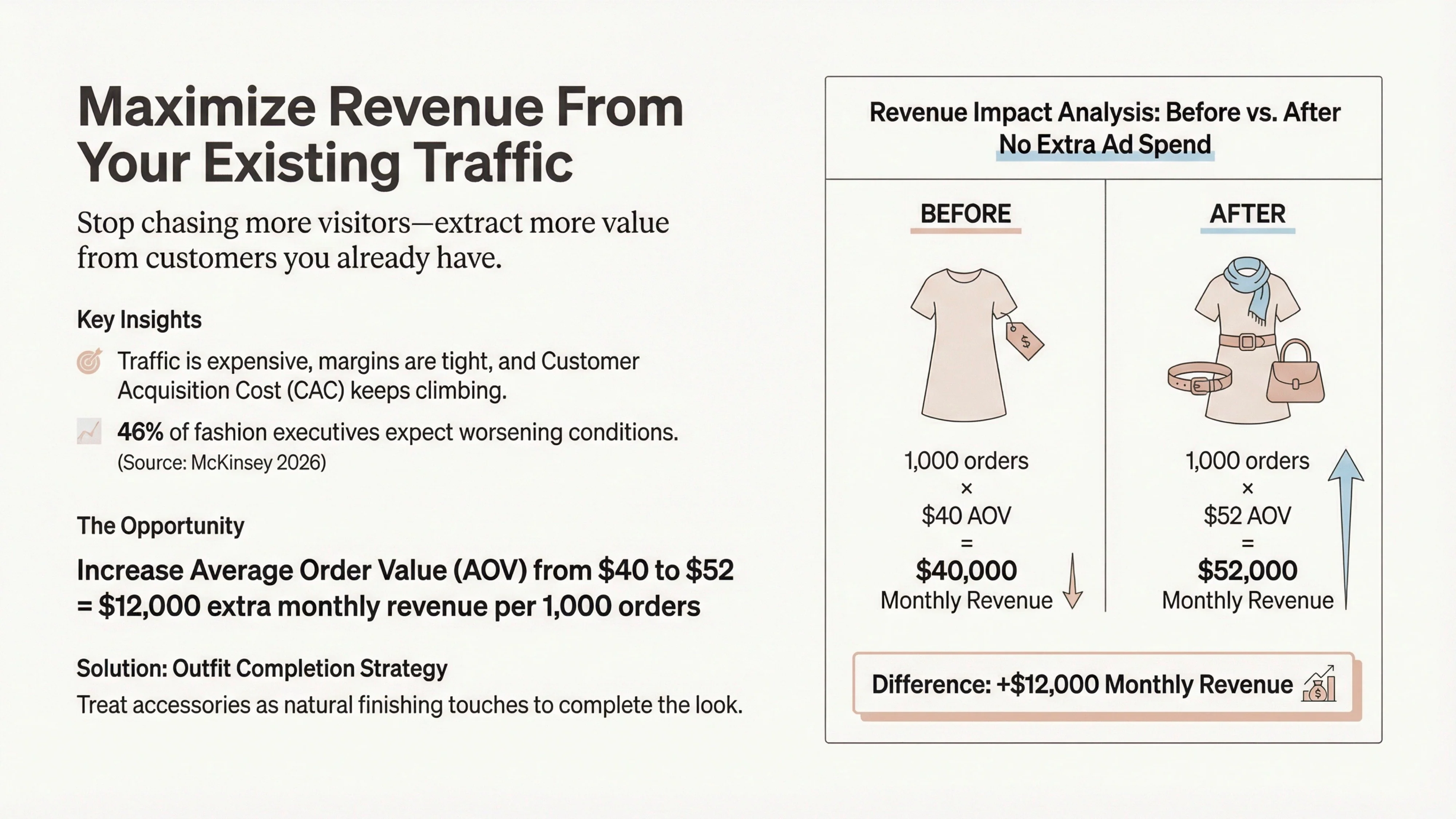
In our experience at Branvas, fashion stores that implement a structured outfit completer strategy can increase their average order value on Shopify by 20 to 30 percent within 90 days. This article will walk you through the exact framework, the math behind the uplift, and the step-by-step implementation process you can start today. By the end, you will have a repeatable system to raise AOV without killing conversion, using cross-selling strategies that feel like styling help rather than pushy add-ons.
Average order value (AOV) is one of the most powerful levers in ecommerce. It measures the average amount a customer spends per transaction. To calculate AOV, divide your total revenue by the number of orders in a given period.
AOV = Total Revenue / Number of Orders
For example, if your store generated $50,000 from 1,250 orders last month, your AOV is $40. Shopify's 2025 data shows that the global average order value across all industries is approximately $145, with fashion and apparel typically falling in the $40 to $170 range depending on positioning [2].
Why does AOV matter? Because it is a multiplier in your revenue equation:
Revenue = Sessions × Conversion Rate × AOV
Most store owners focus on the first two variables: driving more traffic and optimizing conversion. But AOV is often the easiest and most cost-effective lever to pull. Increasing AOV does not require more ad spend, more inventory, or more customer acquisition. It simply means getting each customer to add one or two more items to their cart before they check out.
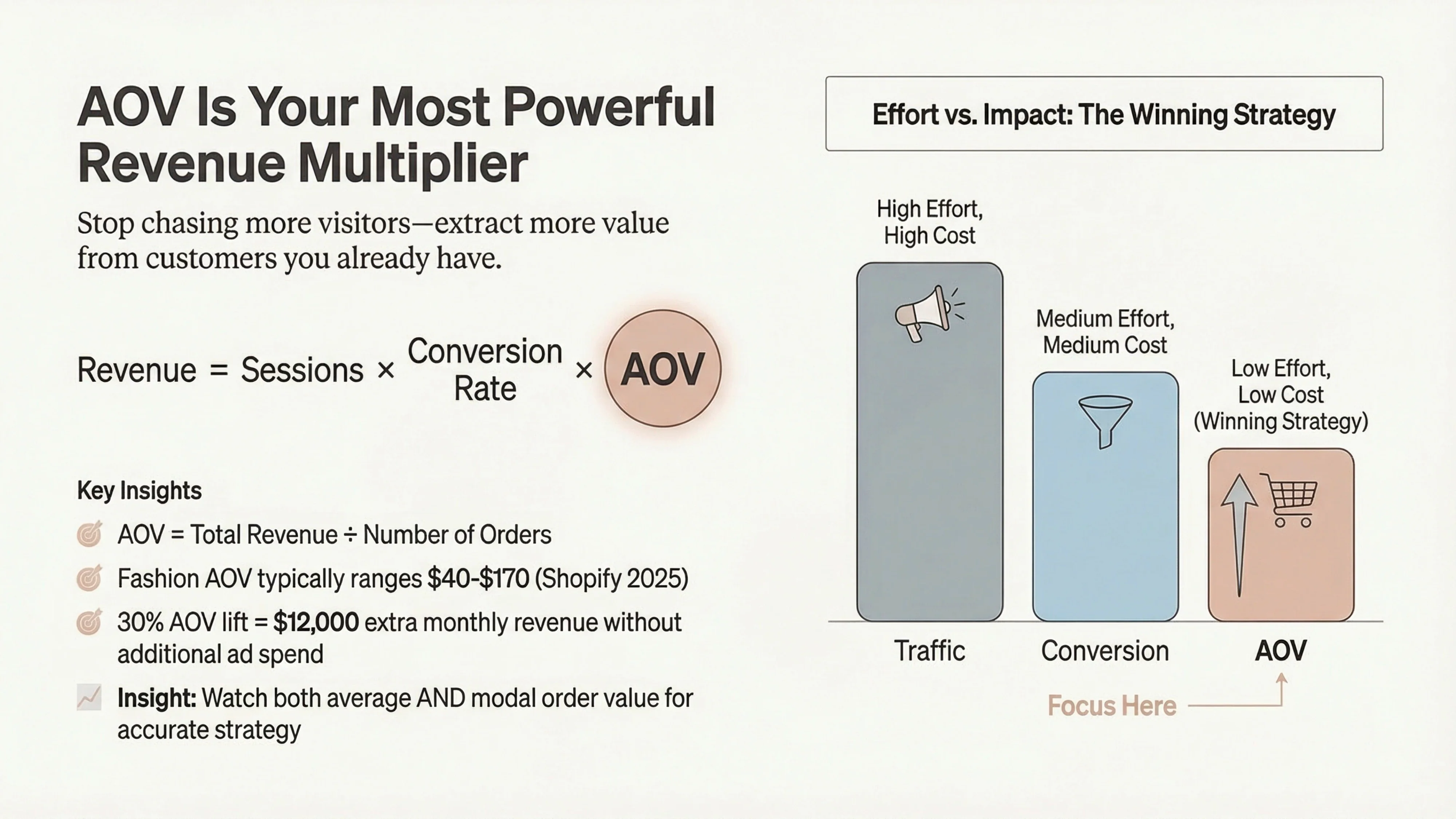
Consider the impact. If you increase AOV from $40 to $52 (a 30 percent lift), and you process 1,000 orders per month, you go from $40,000 to $52,000 in monthly revenue—an extra $12,000 without spending a dollar more on ads. That is the power of AOV optimization.
However, there is a critical nuance. Looking only at the mean (average) can give you a distorted view of customer behavior. Taylor Holiday, co-founder of marketing agency Common Thread Collective, cautions merchants to also consider the modal order value—the most frequently occurring order amount [2]. If your average is $40 but your mode is $28, a handful of high-value orders are skewing the data. In that case, your AOV strategy should focus on nudging the majority of customers from $28 to $35, rather than chasing outliers.
In fashion, the opportunity to increase average order value on Shopify is especially high because accessories and complementary items have strong natural affinity with hero garments. A customer who buys a dress is already in a buying mindset. The question is whether you present the right accessories at the right moment to complete the look.
Cross-selling is the practice of suggesting complementary products alongside a primary purchase. In fashion, cross-selling strategies are uniquely effective because clothing and accessories are inherently designed to be worn together. A dress is rarely worn alone—it is styled with earrings, a necklace, a bag, and shoes. When you cross-sell accessories, you are not interrupting the shopping experience; you are enhancing it.
The psychology behind this is rooted in what we call "complete the look" behavior. Shoppers do not just buy products—they buy outfits, identities, and occasions. When a customer adds a floral midi dress to her cart, she is not thinking about fabric composition. She is imagining herself at a garden party, a brunch, or a date night. Your job as a merchant is to make it effortless for her to assemble that complete look without leaving your store.
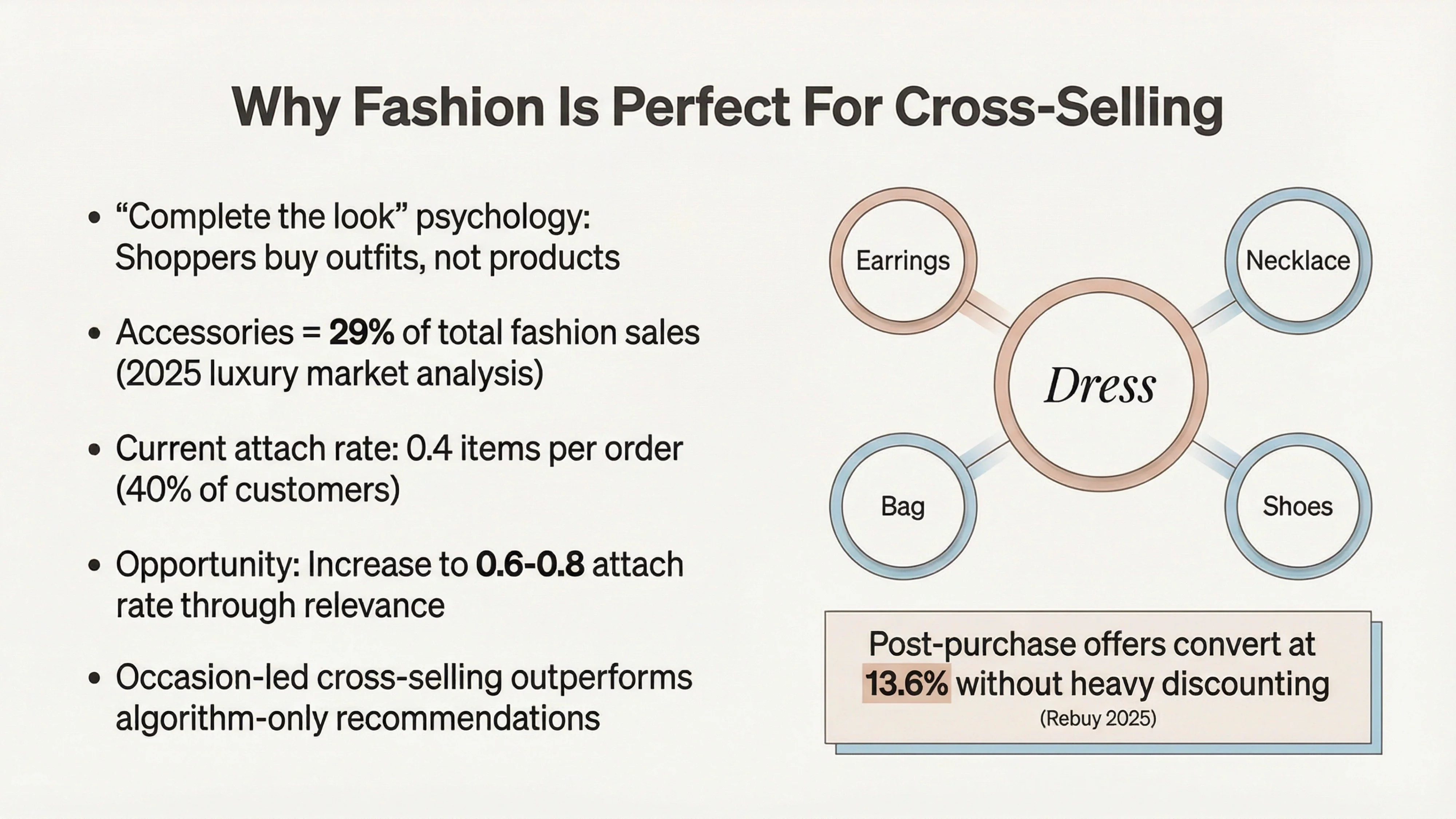
This is where accessories become the highest-leverage "completers." Accessories are lightweight, easy to ship, and carry high margins. According to a 2025 luxury fashion market analysis, accessories represent roughly 29 percent of total fashion sales, and in digital channels, the average accessory attach rate is approximately 0.4 items per order [3]. That means for every 10 orders, four customers are already adding an accessory. The opportunity is to increase that attach rate to 0.6 or 0.8 by making the cross-sell more relevant, visible, and frictionless.
What consistently works for fashion stores is occasion-led cross-selling rather than product-led cross-selling. Instead of showing "customers also bought" recommendations based on algorithm alone, frame the cross-sell around a specific use case: "Complete Your Date Night Look" or "Brunch Ready in 3 Clicks." This approach taps into the emotional context of the purchase and makes the add-on feel like a natural extension of the original intent.
Relevance matters more than discounts. A 2025 case study from Rebuy showed that post-purchase offers accounted for 23 percent of additional revenue, and the conversion rate on those offers hit 13.6 percent—without heavy discounting [4]. The key was matching the right accessory to the right garment at the right moment in the customer journey.
In fashion, cross-selling is not about pushing random add-ons. It is about helping customers complete an outfit they are already building in their mind. When done well, it feels like service, not sales.
To systematically increase AOV through cross-selling, you need a framework that guides which accessories to suggest and when. We call this the Outfit Completer Ladder (OCL)—a four-tier system that moves from essential matches to premium finishes.
The OCL is designed to be simple, visual, and easy to implement across your product pages, cart, and post-purchase flows. Here is how it works:
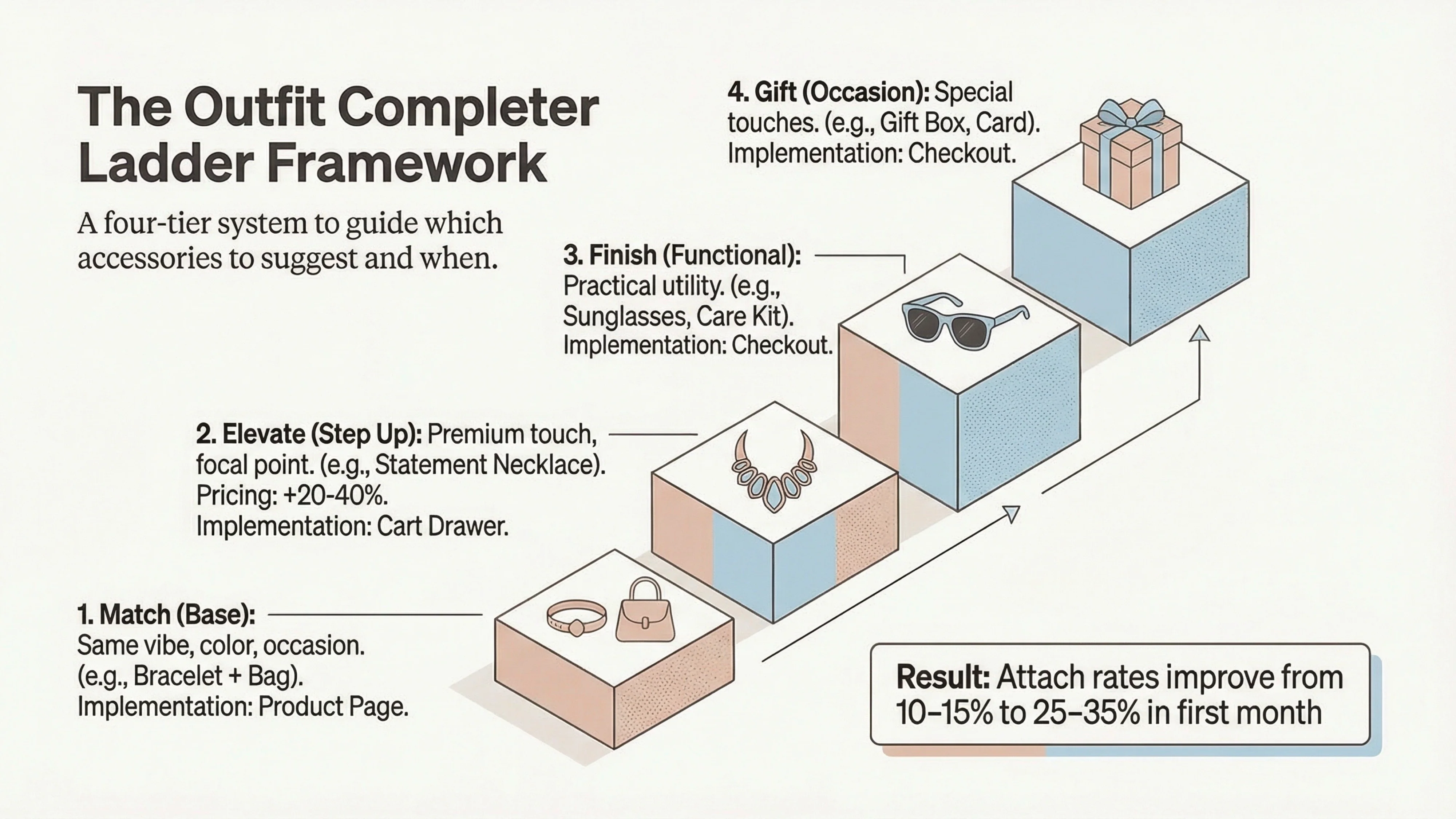
Start with accessories that match the style, color, or occasion of the hero garment. If the customer is buying a black cocktail dress, suggest gold hoop earrings or a black clutch. The goal is visual coherence—accessories that feel like they belong together.
Example: A customer adds a bohemian maxi dress to her cart. The Match tier suggests a beaded bracelet and a woven crossbody bag in earth tones.
Rule: One hero item → two match-level completers (e.g., earrings + bracelet, or bag + scarf).
Once the basic match is in place, offer an accessory that upgrades the perceived value of the outfit. This could be a statement necklace, a leather belt, or a premium hair accessory. The Elevate tier is about adding a focal point that makes the outfit feel more curated and expensive.
Example: A customer buying a simple white blouse is shown a gold layered necklace and a silk scrunchie. These items elevate the outfit from basic to polished.
Rule: Elevate items should be priced 20 to 40 percent higher than Match items to create a clear value distinction.
The Finish tier includes practical items that complete the outfit functionally: a hair clip, a jewelry care kit, a tote bag for the beach, or a pair of sunglasses. These items are not purely decorative—they solve a problem or add utility.
Example: A customer buying a swimsuit is offered a straw beach bag and a UV-protection sunglasses case.
Rule: Finish items should feel like no-brainers—low friction, high utility, easy to say yes to.
The Gift tier is optional but powerful for special occasions. Offer gift wrapping, a greeting card, or a gift box for customers who are buying for someone else. This tier can also include limited-time seasonal items like holiday ornaments or Valentine's Day accessories.
Example: A customer buying a dress in early December is offered a gift box and a handwritten card option at checkout.
Rule: Gift options should be presented at cart or checkout, not on the product page, to avoid cluttering the initial decision.
The beauty of the Outfit Completer Ladder is that it gives you a clear merchandising logic. You do not need to guess which accessories to cross-sell. You simply ask: What matches? What elevates? What finishes? What gifts?
A typical OCL implementation looks like this:
This tiered approach prevents decision fatigue while maximizing the chance that a customer adds at least one accessory. In our experience at Branvas, stores using the OCL see attach rates improve from 10 to 15 percent to 25 to 35 percent within the first month.
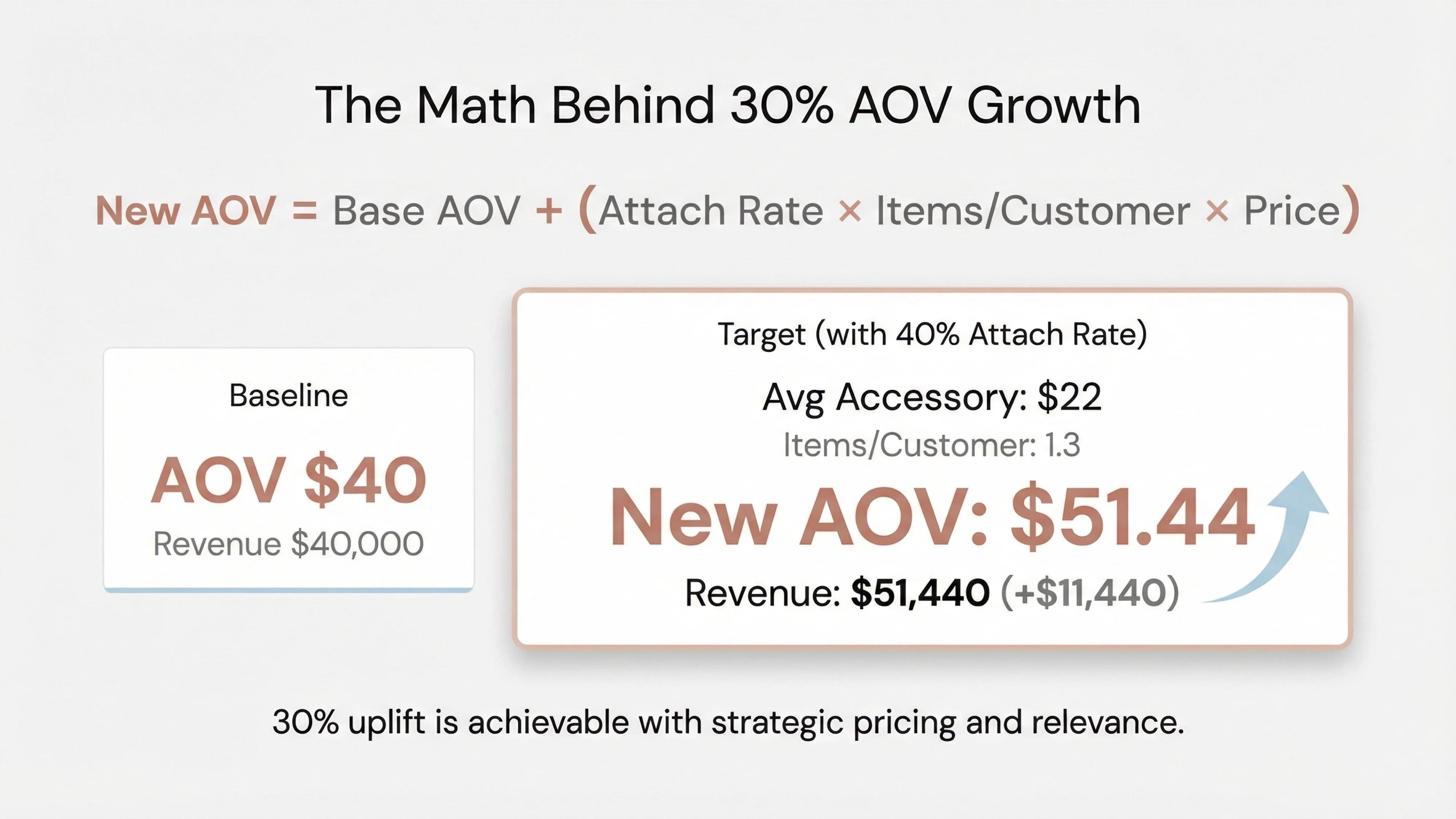
Let's make the 30 percent AOV increase concrete with real numbers. Understanding the math behind the uplift will help you set realistic expectations and measure success.
Now assume you implement the Outfit Completer strategy and achieve the following:
Here is the math:
That is a 13.5% increase in AOV with a 25% attach rate.
Now let's push it further. If you increase the attach rate to 35% and the average accessory price to $20:
That is a 21% increase in AOV.
To hit the 30% target ($52 AOV), you would need:
The calculation:
That is a 28.6% increase, rounding to 30%.
Use this simple framework to estimate your own uplift:
New AOV = Base AOV + (Attach Rate × Items per Customer × Average Add-On Price)
This math is not theoretical. A 2025 case study from Rebuy showed that brands using smart cart and post-purchase upsells achieved a 19.1% increase in AOV, with 13.2% of all orders including a Rebuy-powered add-on [4]. The key is not to aim for perfection on day one—start with a 15 to 20 percent attach rate and optimize from there.
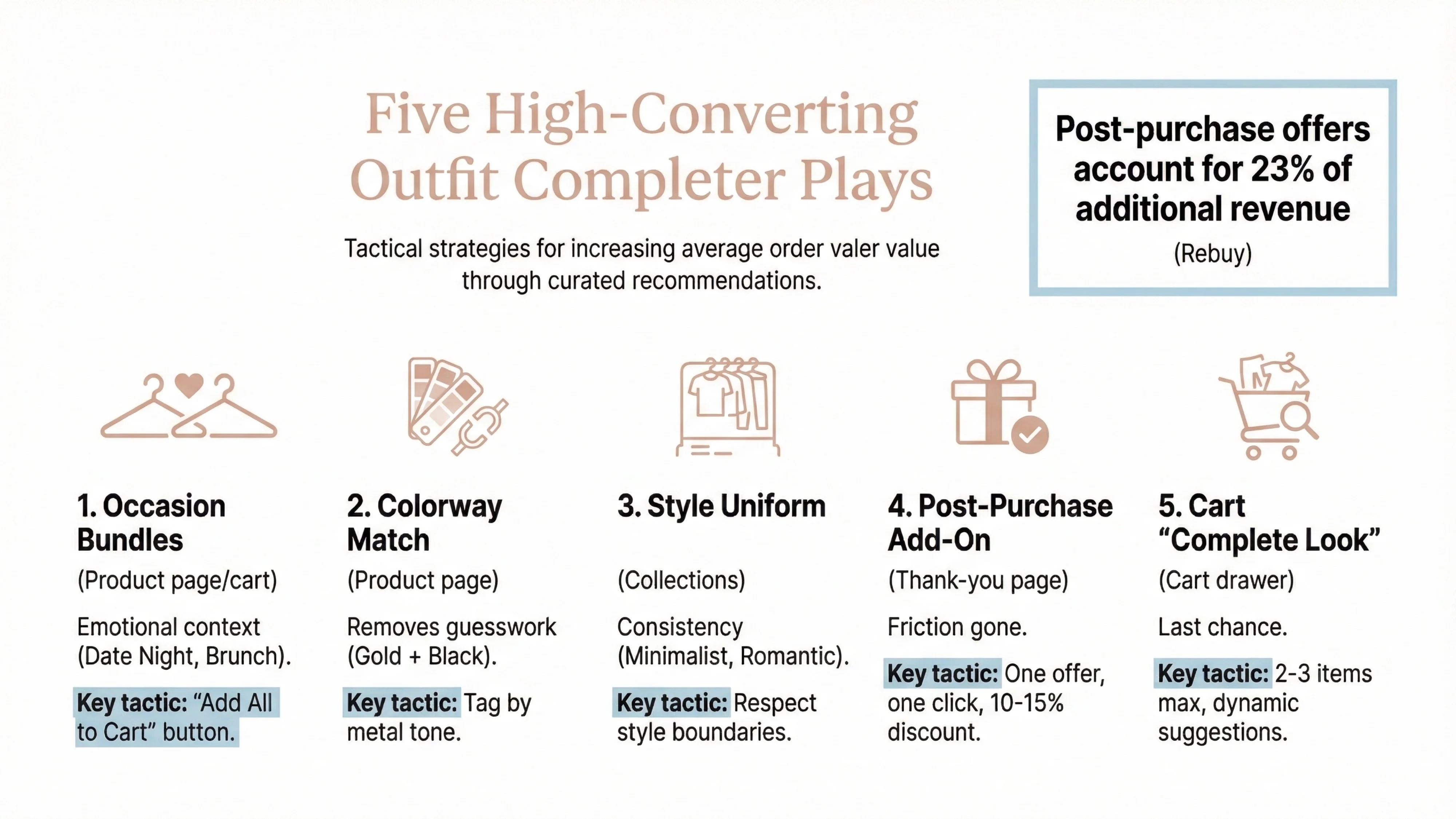
Now that you understand the framework and the math, let's get tactical. Here are five proven plays you can implement immediately to increase AOV using the Outfit Completer strategy.
Where it appears: Product page, cart drawer
Why it converts: Occasion-based bundling taps into the emotional context of the purchase. Instead of saying "you might also like," you say "Complete Your Date Night Look." This frames the cross-sell as a solution, not a suggestion.
How to implement: Create curated bundles for 3 to 5 key occasions. For each hero garment, tag it with an occasion (e.g., "Date Night," "Brunch," "Beach Day"). Then build a bundle widget on the product page that shows 2 to 3 matching accessories with a single "Add All to Cart" button.
What to avoid: Do not create too many occasions. Stick to 3 to 5 that align with your brand and customer base. Too many options create decision fatigue.
Example: A floral midi dress tagged "Brunch" is paired with a straw hat, gold hoop earrings, and a crossbody bag. The bundle is titled "Brunch Ready in 3 Clicks."
Where it appears: Product page
Why it converts: Colorway matching removes the guesswork. Customers do not have to wonder if the gold necklace will clash with the silver dress. You tell them exactly what works.
How to implement: Tag your accessories by metal tone (gold, silver, rose gold) and color family (black, white, earth tones, pastels). Use conditional logic to show only accessories that match the hero garment's colorway.
What to avoid: Do not show mismatched colors. A single off-brand suggestion can break trust and reduce conversion.
Example: A black cocktail dress is paired with gold drop earrings and a gold chain necklace. The widget says "Perfect Gold Accents for This Dress."
Where it appears: Product page, collections page
Why it converts: Style-conscious shoppers want consistency. If they are buying a minimalist linen dress, they do not want to see bohemian beaded jewelry. They want clean, simple accessories that match their aesthetic.
How to implement: Tag your products by style (minimalist, romantic, streetwear, boho, etc.). Build collections and cross-sell widgets that respect these style boundaries.
What to avoid: Do not mix styles. A romantic lace dress should never be paired with streetwear accessories.
Example: A minimalist white linen dress is paired with a simple gold bar necklace and a leather tote. The widget says "Complete Your Minimalist Look."
Where it appears: Thank-you page (post-purchase)
Why it converts: The customer has already committed. The friction of "should I buy?" is gone. A well-timed post-purchase offer feels like a bonus, not a sales pitch. Rebuy data shows post-purchase offers can convert at 13.6% and account for up to 23% of additional revenue [4].
How to implement: Use a post-purchase upsell app (like Rebuy, Zipify, or CartHook) to show a single, highly relevant accessory on the thank-you page. Offer a small discount (10 to 15%) to sweeten the deal. Make it one-click to add.
What to avoid: Do not show multiple options. One offer, one click. Too many choices kill conversion.
Example: A customer just bought a dress. The thank-you page shows a matching necklace with the message: "Add This Necklace for 15% Off – One Click, Same Shipment."
Where it appears: Cart drawer or cart page
Why it converts: The cart is the last chance to increase order value before checkout. A "Complete the Look" block shows accessories that match what is already in the cart, making the add-on feel like a natural next step.
How to implement: Use a smart cart app (like Rebuy Smart Cart or Slide Cart) to dynamically show 2 to 3 accessories based on cart contents. Use the Outfit Completer Ladder to decide which tier to show (Match, Elevate, or Finish).
What to avoid: Do not clutter the cart with too many options. Two to three items max. Make the "Add to Cart" button prominent.
Example: A cart contains a dress and a pair of shoes. The "Complete the Look" block shows a matching clutch and a pair of earrings with the message: "Finish Your Outfit."
Most merchants think the fastest way to increase AOV is to offer a discount: "Spend $75, get 15% off." While this can work in the short term, it trains customers to wait for sales and erodes your brand's perceived value. Discounting is the lazy AOV lever.
Bundling, on the other hand, is the premium lever. When you bundle accessories with a hero garment, you are not reducing price—you are increasing perceived value. The customer feels like they are getting a complete, curated outfit, not a discount. This is especially important in fashion, where brand perception and aspiration drive purchase decisions.
A 2025 luxury fashion market report found that 61 percent of consumers globally express a preference for ethical sourcing and exclusivity over discounts [3]. McKinsey's State of Fashion 2026 report echoes this, noting that consumers are seeking value in the form of quality, sustainability, and experience—not just lower prices [1].
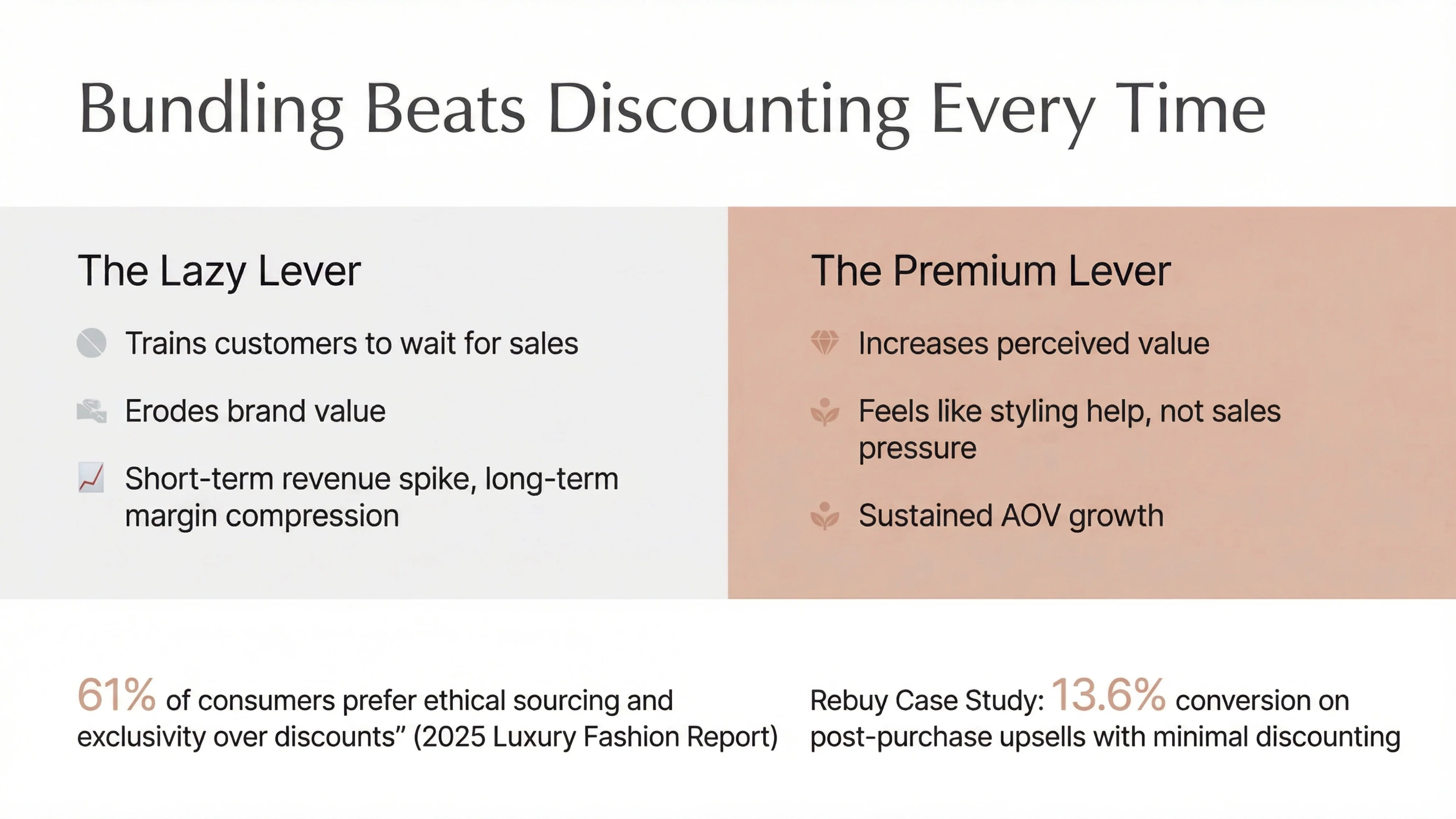
In our experience at Branvas, stores that rely on discounting to increase AOV see short-term revenue spikes but long-term margin compression. Stores that rely on bundling see sustained AOV growth without sacrificing margin. The difference is in the framing: discounts say "we need to move inventory," while bundles say "we want to help you look great."
Consider the data. Rebuy's 2025 case study showed that post-purchase upsells with minimal discounting (10 to 15%) converted at 13.6 percent and accounted for 23 percent of additional revenue [4]. The key was relevance, not price. Customers were willing to pay full price for accessories that matched their purchase.
The takeaway: If you want to increase AOV without damaging your brand, focus on occasion-led bundling and accessory completion, not blanket discounts. Save discounts for customer acquisition and retention, not AOV optimization.
Now let's get into the practical setup. Here is how to implement the Outfit Completer strategy on Shopify in 30 minutes or less.
Before you can cross-sell accessories, you need to know what you have. Export your product catalog and filter by product type: jewelry, bags, hats, scarves, belts, etc. Identify which accessories have the highest margins and the best visual appeal. These will be your primary completers.
Use Shopify's product tagging system to categorize your products. Add tags like:
This tagging structure will power your cross-sell logic.
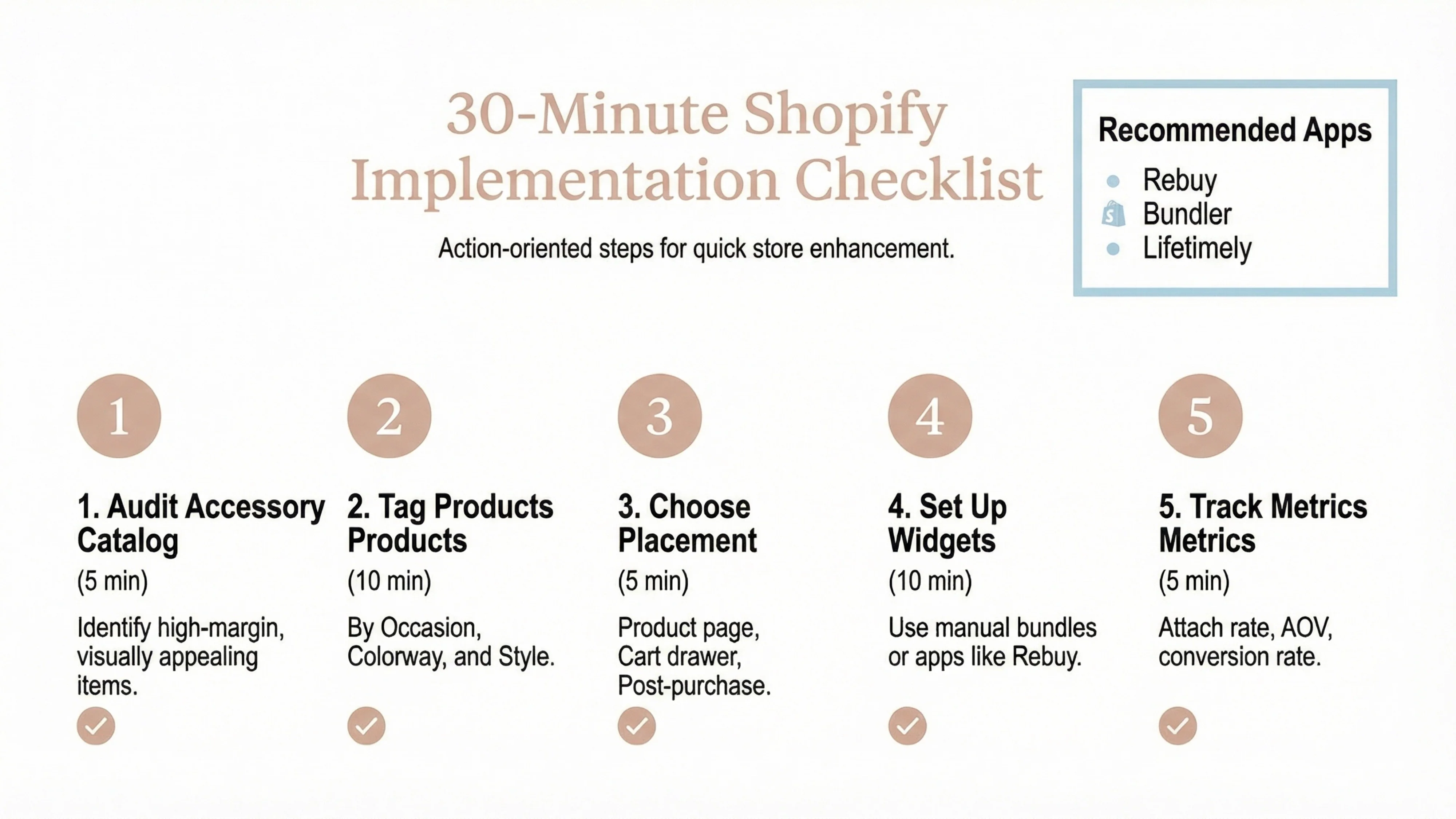
Decide where you want to show cross-sell offers:
You do not need all three on day one. Start with product page and cart, then add post-purchase once you have baseline data.
Option A: Manual Bundles (Free)
Use Shopify's native product recommendations or manually curate "Frequently Bought Together" sections on product pages. This requires no apps but is less dynamic.
Option B: Bundle Apps (Paid)
Install an app like Rebuy, Bundler, or Frequently Bought Together. These apps use AI to suggest relevant accessories based on cart contents, purchase history, and product tags.
Option C: Shopify Bundles (Free)
Shopify's native Bundles app allows you to create fixed-price bundles. This is ideal for occasion-based bundles (e.g., "Date Night Bundle").
Keep it visual and simple:
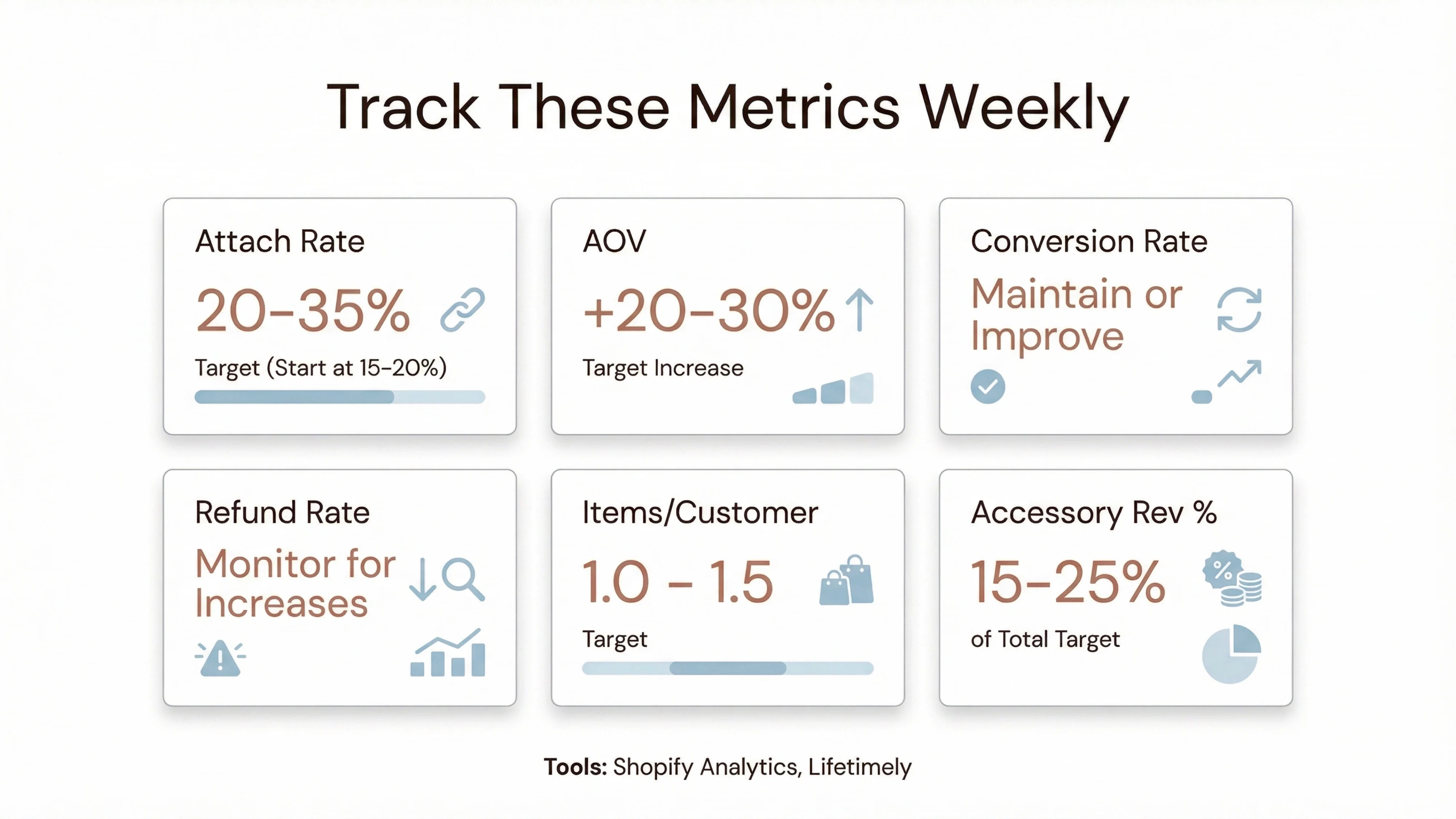
Track these metrics weekly:
Use Shopify Analytics or a tool like Lifetimely to monitor performance.
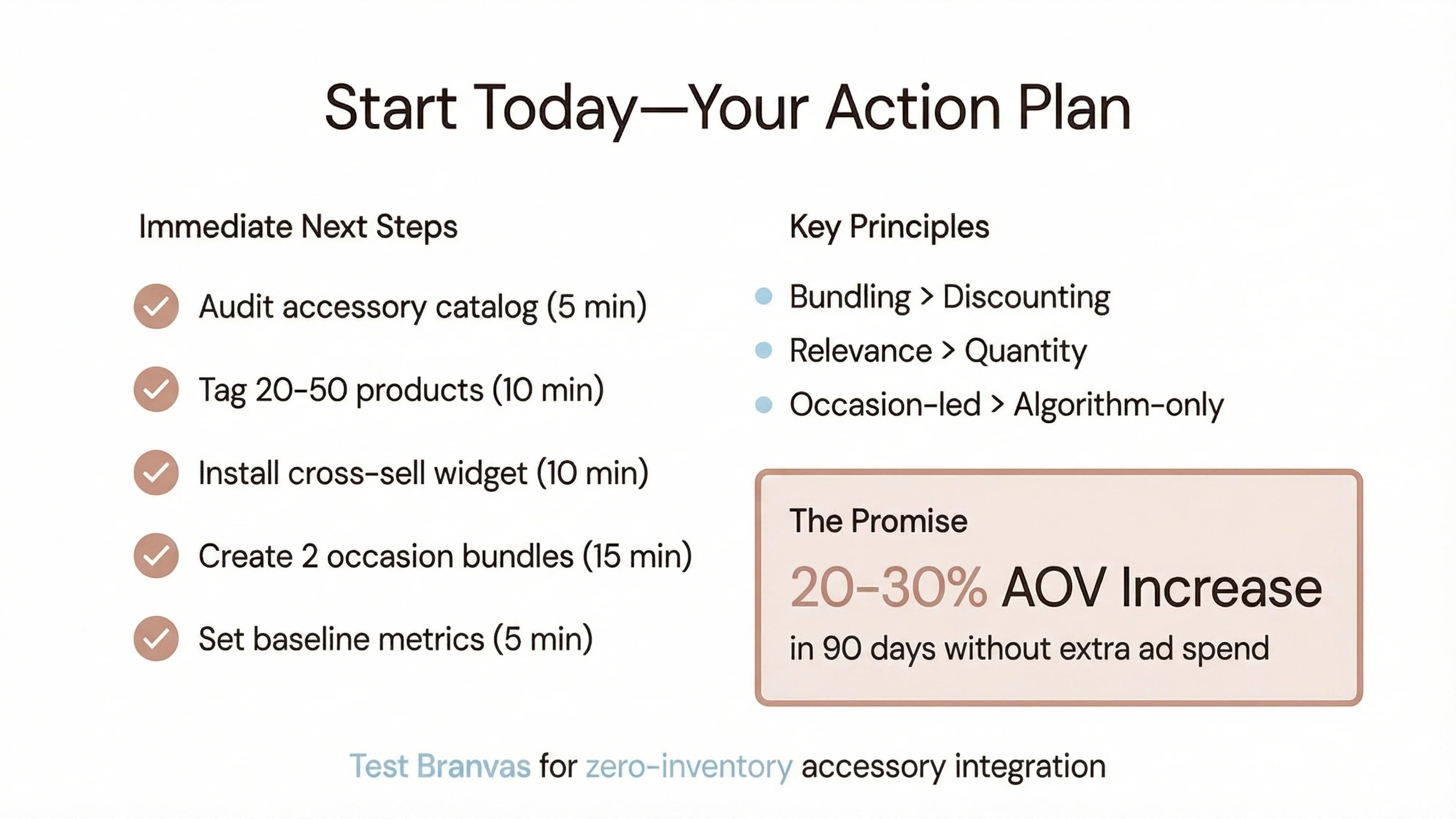
✅ Export and audit accessory catalog (5 min)
✅ Tag 20 to 50 products by occasion, colorway, style (10 min)
✅ Install a cross-sell app or set up manual bundles (10 min)
✅ Create 2 to 3 "Complete the Look" widgets on top-selling product pages (5 min)
✅ Set baseline metrics: current AOV, attach rate, conversion rate (5 min)
One of the biggest barriers to increasing AOV with accessories is operational complexity. More SKUs mean more inventory, more supplier relationships, more shipping logistics, and more customer service issues. For lean fashion brands, this can feel overwhelming.
This is where Branvas offers a unique solution. Branvas provides a curated catalog of matching jewelry and accessories that integrate seamlessly with your existing product line—without requiring you to hold inventory or manage fulfillment.
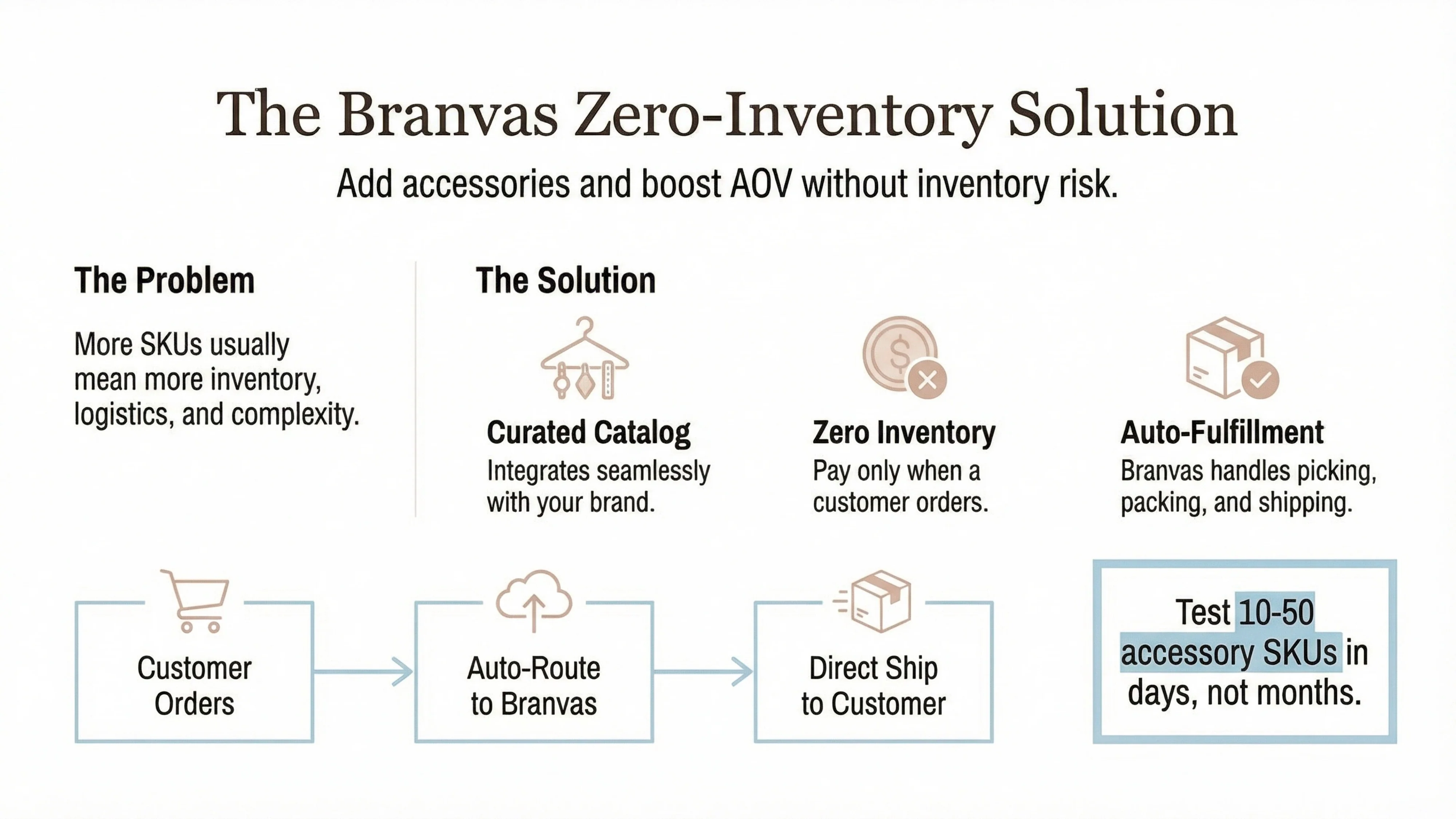
Here is how it works. You already sold the dress. Let Branvas auto-fulfill the matching earrings. Pure profit, no extra shipping work. When a customer adds a Branvas accessory to their cart, the order is automatically routed to Branvas for fulfillment. The accessory ships directly to the customer in brand-ready packaging, often in the same shipment window as your hero garment.
The advantage is threefold:
This model is especially powerful for fashion stores that want to test the Outfit Completer strategy without committing to a full accessory line. You can add 10, 20, or 50 accessory SKUs to your store in a matter of days, start cross-selling immediately, and measure the AOV impact before making any inventory investment.
If you want to test this strategy without holding inventory, Branvas can help. We work with fashion brands to integrate high-margin accessories that complete the look and increase AOV—without adding operational complexity.
Here is a phased rollout plan to implement the Outfit Completer strategy and measure results over three months.
Goal: Get your first cross-sell widgets live and establish baseline metrics.
Tasks:
Success metric: 15 to 20% attach rate on products with cross-sell widgets.
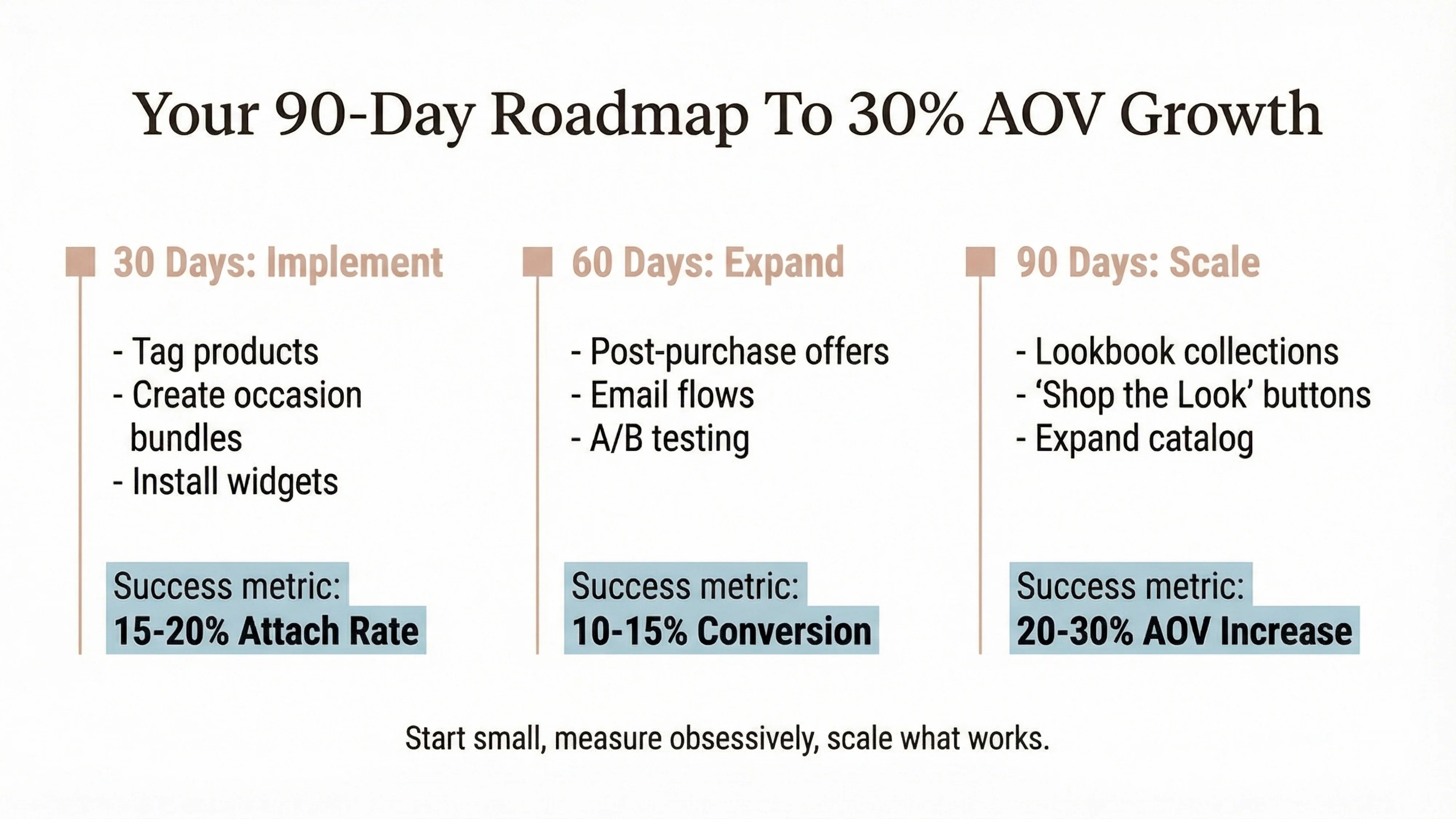
Goal: Expand cross-sell touchpoints to post-purchase and email.
Tasks:
Success metric: 10 to 15% conversion rate on post-purchase offers; 5 to 8% conversion rate on email offers.
Goal: Scale the strategy and create a self-serve shopping experience.
Tasks:
Success metric: 25 to 35% attach rate; 20 to 30% AOV increase from baseline.
By the end of 90 days, you will have a fully operational Outfit Completer system that runs on autopilot. The key is to start small, measure obsessively, and scale what works.
The most effective way to increase average order value on Shopify without ads is through strategic cross-selling and bundling. Focus on offering complementary accessories at key touchpoints: product pages, cart, and post-purchase. Use occasion-based bundles (e.g., "Date Night Look") and ensure accessories match the style and color of the hero garment. Track your attach rate and aim for 20 to 30 percent of customers adding at least one accessory. This approach requires no additional ad spend and can increase AOV by 20 to 30 percent within 90 days.
The best cross-selling strategies for fashion stores are occasion-led and style-consistent. Instead of generic "customers also bought" recommendations, frame cross-sells around specific use cases like "Complete Your Brunch Look" or "Date Night Ready." Use the Outfit Completer Ladder framework: Match (same vibe), Elevate (premium touch), Finish (functional), and Gift (occasion). Place cross-sell widgets on product pages, in the cart drawer, and on post-purchase thank-you pages. Prioritize accessories like jewelry, bags, and scarves, which have high margins and low shipping costs.
Bundles do not reduce conversion rate if they are relevant, well-designed, and non-intrusive. The key is to present bundles as styling help, not sales pressure. Use clear visuals, simple CTAs like "Add All to Cart," and limit choices to 2 to 3 items. Avoid cluttering the product page with too many options. Data from Rebuy shows that smart cart and post-purchase bundles can increase AOV by 19 percent without negatively impacting conversion [4]. The secret is relevance: only show accessories that genuinely complete the outfit.
A good attach rate for accessories in fashion ecommerce is 20 to 35 percent. This means that for every 100 orders, 20 to 35 customers add at least one accessory to their purchase. If you are just starting with cross-selling, aim for 15 to 20 percent in the first 30 days. Luxury fashion brands with strong merchandising can achieve attach rates above 40 percent. According to a 2025 luxury fashion market report, the average accessory attach rate in digital channels is approximately 0.4 items per order, or roughly 40 percent [3]. Focus on increasing both the percentage of customers who attach and the number of accessories per attaching customer.
You can add accessories to your catalog without holding inventory by using a dropshipping or fulfillment partner like Branvas. These services provide a curated catalog of jewelry and accessories that integrate with your Shopify store. When a customer orders an accessory, the fulfillment partner handles picking, packing, and shipping. You only pay when a sale is made, eliminating inventory risk. This model allows you to test the Outfit Completer strategy and measure AOV impact before committing to a full accessory line. It is ideal for lean fashion brands that want to increase AOV without adding operational complexity.
[1] McKinsey & Company. (2025, November 17). The State of Fashion 2026: When the rules change. https://www.mckinsey.com/industries/retail/our-insights/state-of-fashion
[2] Shopify. (2025, September 18). Average Order Value (AOV): Formula, Benchmarks and 7 Ways to Increase It (2026). https://www.shopify.com/blog/average-order-value
[3] Industry Research Biz. (2025, December 15). Luxury Fashion Market Size, Share, Growth, and Industry Analysis, By Type (Clothing, Footwear, Accessories), By Application (Male, Female, Children), Regional Insights and Forecast to 2035. https://www.industryresearch.biz/market-reports/luxury-fashion-market-107100
[4] Rebuy Engine. (2025, March 14). The MOSH strategy that had finance asking 'What magic is this?'. https://www.rebuyengine.com/case-studies/mosh
[5] Deloitte. (2025, September 4). Rewired retail: Winning the future of fashion. https://www.deloitte.com/us/en/Industries/consumer/articles/future-of-fashion-omnichannel-strategies.html