


Most suppliers ship products. Few ship your brand. This 2026 checklist shows how to evaluate jewelry dropshipping suppliers using blind shipping, custom packaging, Shopify sync, and brand-ready criteria.
Published:
January 29, 2026
Author:
Yi Cui
Most "suppliers" can ship product. Few can ship your brand.
This distinction has never mattered more. In 2026, the jewelry dropshipping landscape is crowded with suppliers who promise "hands-free fulfillment" and "zero inventory risk." But when the package arrives at your customer's door, the truth reveals itself. Is it a branded experience that builds loyalty and commands premium pricing? Or is it a generic transaction that screams "commodity dropshipping"?
The difference is what we call brand-ready dropshipping—a model where your supplier doesn't just process orders, but actively preserves and amplifies your brand equity at every touchpoint. This matters because customers no longer judge brands solely by products. They judge them by packaging, unboxing experiences, delivery speed, visual consistency, and post-purchase support. When any of these elements fail, your brand pays the price in returns, chargebacks, and lost customer lifetime value.
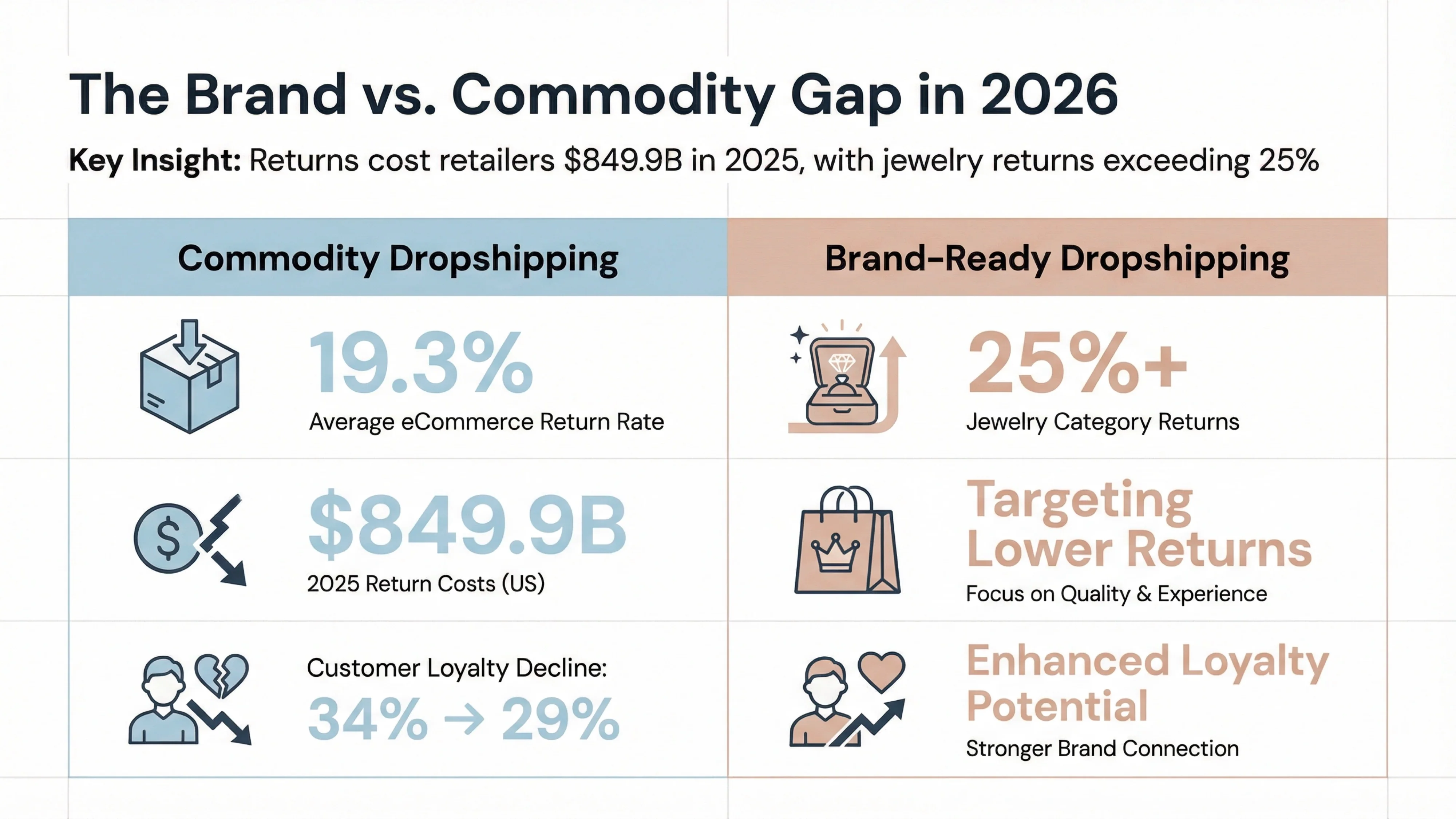
Consider the data: eCommerce return rates now average 19.3%, with jewelry and fashion categories often exceeding 25% [1]. Returns cost US retailers $849.9 billion in 2025 alone, with a 35% spike in January following the holiday season [1]. Meanwhile, consumer loyalty has declined from 34% in 2024 to just 29% in 2025, meaning brands must work harder than ever to offer unique, trust-building experiences [2]. At the same time, research shows that when consumers touch premium packaging twice, they are 50% more likely to purchase; touch it four times, and that likelihood jumps to 90% [3]. People report 95% more positive emotions with premium packaging compared to standard materials [3].
These are not abstract statistics. They are the operational realities that separate thriving jewelry brands from struggling dropshippers. The problem is not "finding a supplier." The problem is finding a supplier that preserves brand equity through blind shipping, custom packaging, consistent visual assets, reliable Shopify sync, and transparent operational processes.
This article is your definitive 2026 checklist for evaluating brand-ready jewelry dropshipping suppliers. You will learn a proprietary framework for assessing suppliers, a 100-point scoring rubric to test them, a downloadable Supplier Scorecard template, and a contrarian insight that challenges conventional dropshipping wisdom. By the end, you will know exactly what "brand-ready" means in 2026—and how to find (or build) a supplier relationship that protects your brand instead of diluting it.
Brand-ready jewelry dropshipping is a fulfillment model in which your supplier acts as an invisible extension of your brand, handling product sourcing, inventory, fulfillment, and logistics without any visible trace of their involvement reaching your customer. More importantly, the supplier actively supports your brand identity through custom packaging, professional visual assets, consistent product presentation, and reliable operational processes that meet or exceed customer expectations.
This stands in sharp contrast to commodity dropshipping, where the supplier's role is purely transactional: they ship a product, often with their own branding, generic packaging, inconsistent photos, and minimal integration with your store. Commodity dropshipping optimizes for speed and low cost. Brand-ready dropshipping optimizes for customer experience and brand equity.
Why does this distinction matter in 2026? Because customers now expect seamless, premium experiences across all touchpoints—and they punish brands that fail to deliver. According to Shopify's 2026 eCommerce trends report, "brands are finding more ways to engage with real people in a genuine way," and consumers are "craving experiences that create genuine connections" [2]. McKinsey's State of the Consumer 2025 report confirms that consumer tolerance for friction and inconvenience continues to decrease, while expectations for service, speed, reliability, and easy returns are rising [4].
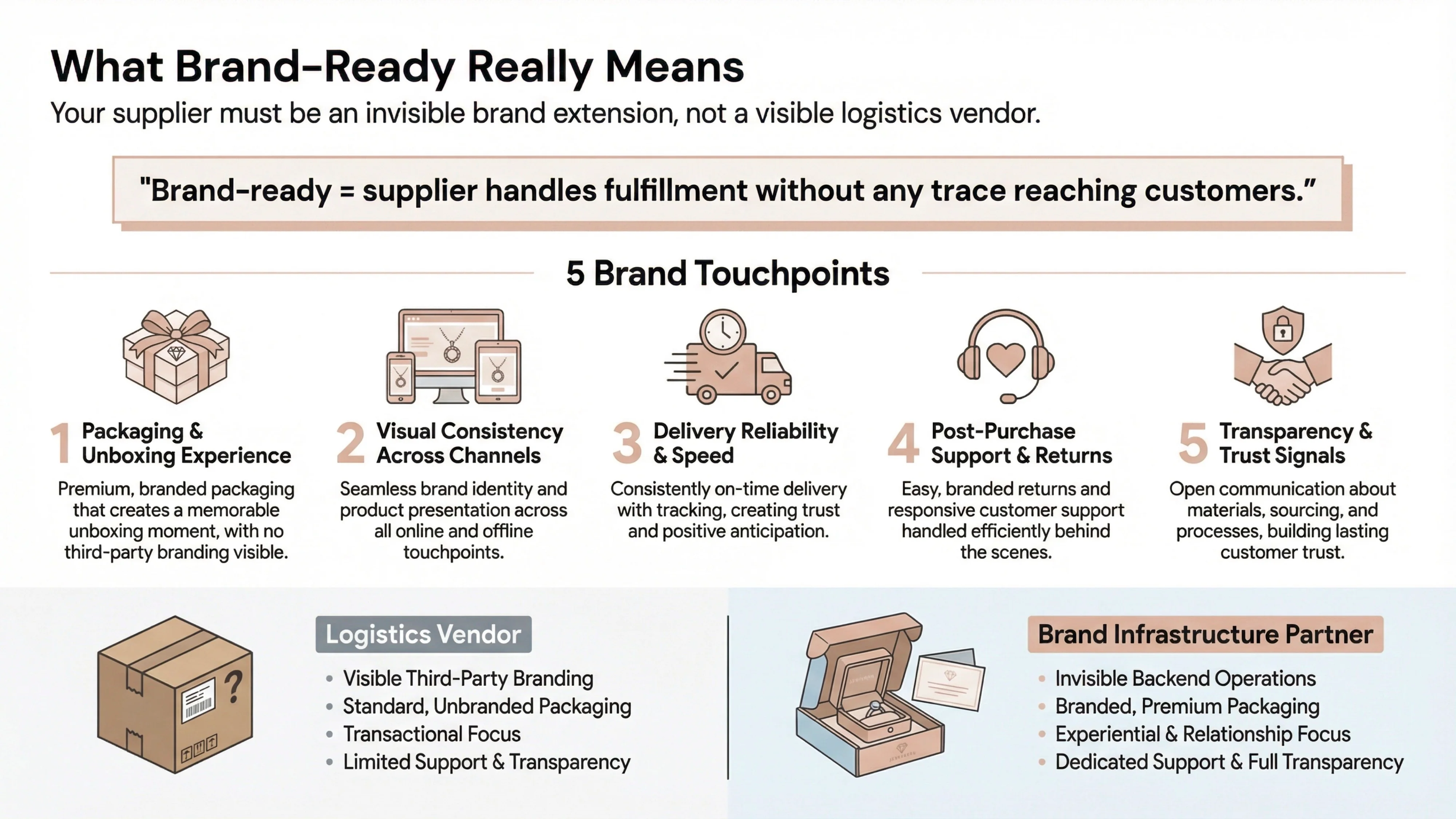
In practical terms, customers judge jewelry brands on:
In 2026, brand-ready jewelry dropshipping is not a luxury—it is a baseline requirement for competing in a market where trust, convenience, and experience determine customer lifetime value. The suppliers who understand this are brand-infrastructure partners. The ones who do not are logistics vendors.
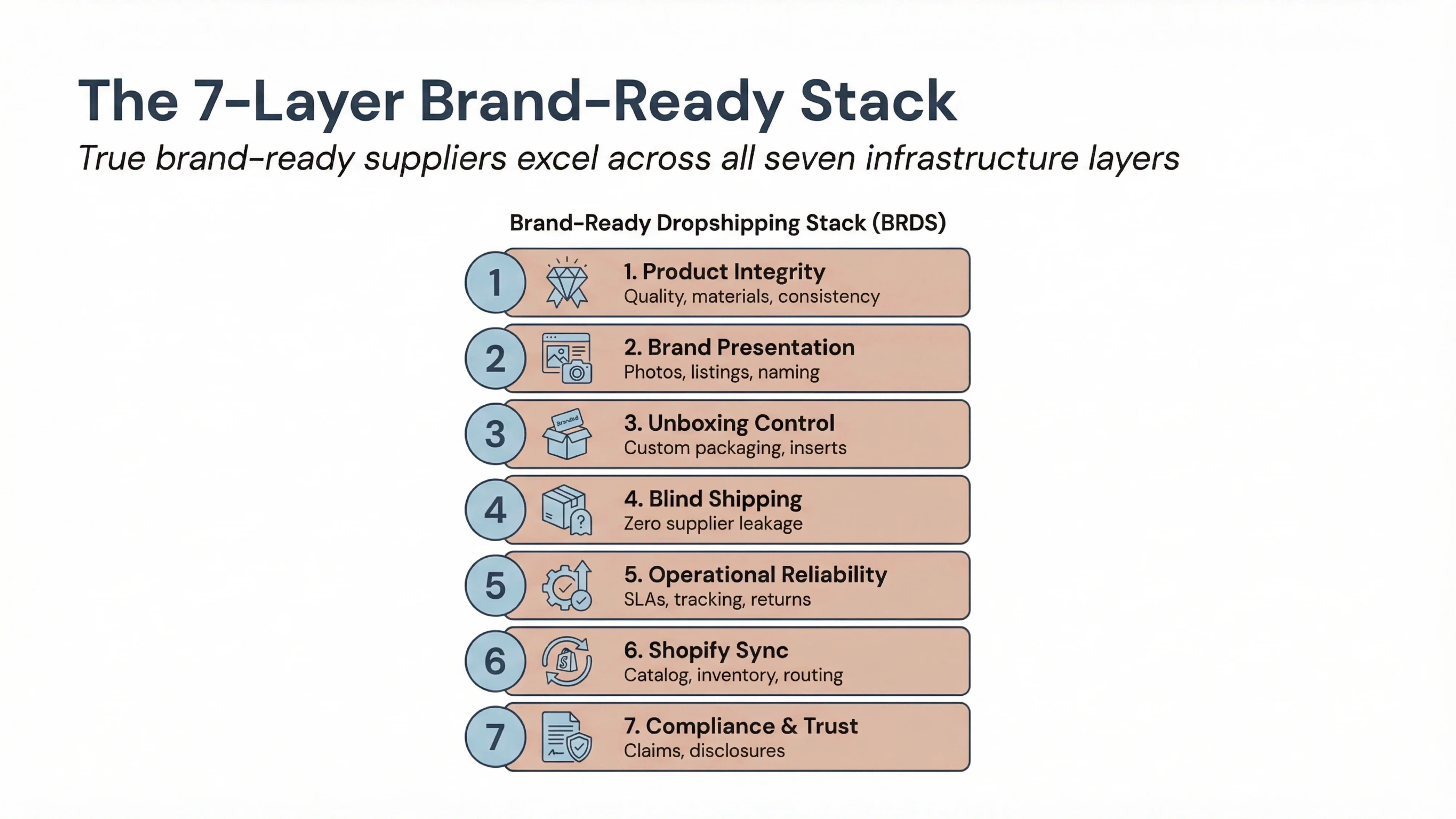
To move beyond simplistic "best supplier" lists, we developed a proprietary framework for evaluating jewelry dropshipping partners: The Brand-Ready Dropshipping Stack (BRDS). This model helps you assess whether a supplier is a logistics vendor or a brand-infrastructure partner. True brand-ready suppliers provide robust solutions across all seven layers of the stack.
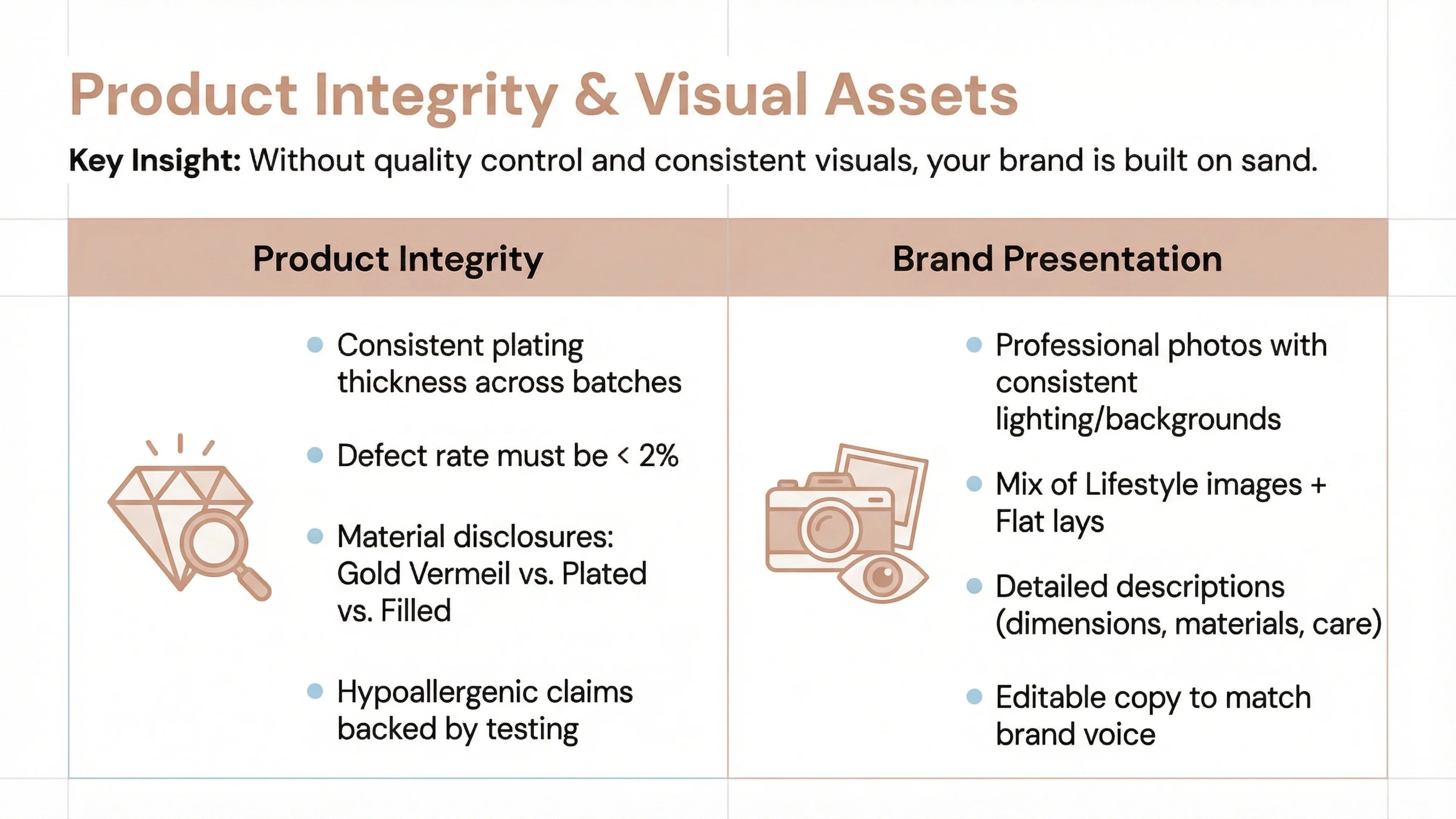
What it is: Access to a curated catalog of high-quality jewelry with reliable stock depth, consistent materials (e.g., 18K gold vermeil, sterling silver, hypoallergenic posts), and rigorous quality control processes that prevent defects, tarnishing, and breakage.
Why it matters: Without product integrity, your brand is built on a weak foundation. A single batch of tarnished earrings or broken clasps can trigger a wave of returns, negative reviews, and chargebacks. Quality control is not just a supplier responsibility—it is a brand protection mechanism.
How to validate it: Order samples from multiple SKUs. Test for material consistency, plating quality, clasp durability, and packaging condition. Ask the supplier about their QC process: Do they inspect every item? What is their defect rate? How do they handle quality issues?
Common failure modes: Inconsistent plating thickness, clasps that break after a few wears, posts that cause allergic reactions, products that arrive damaged due to poor packaging. Suppliers who source from multiple factories without centralized QC are high-risk.
What it is: Professional product photography (consistent lighting, backgrounds, angles), high-quality lifestyle images, detailed product descriptions, and naming conventions that align with your brand voice.
Why it matters: Visual assets are your primary sales tool in eCommerce. Inconsistent or low-quality images signal low brand value and reduce conversion rates. Customers cannot touch or try on jewelry online—they rely entirely on photos and descriptions to make purchase decisions.
How to validate it: Review the supplier's product catalog. Are photos professionally shot with consistent styling? Are there multiple angles, close-ups, and lifestyle shots? Can you use these images directly, or will you need to reshoot everything? Check if the supplier provides editable descriptions or if you will need to write copy from scratch.
Common failure modes: Stock photos from multiple sources with inconsistent backgrounds, poor lighting, pixelated images, generic descriptions that do not match your brand tone, missing dimensions or material details.
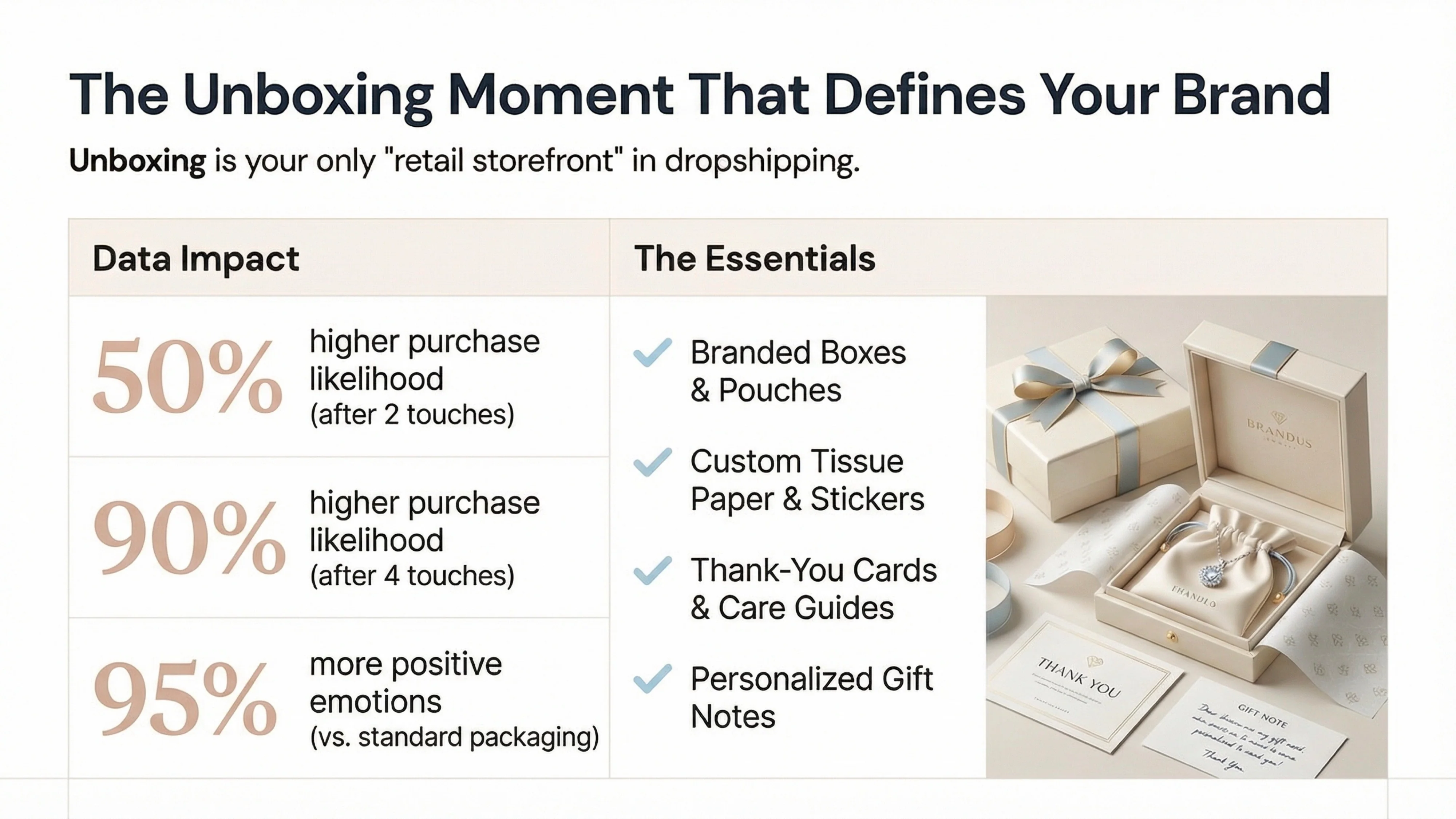
What it is: The ability to ship products in branded packaging—custom boxes, pouches, tissue paper, thank-you cards, logo stickers—with optional gift notes, care instructions, and promotional inserts.
Why it matters: Unboxing is your only "retail storefront" in dropshipping. Research shows that premium packaging increases purchase likelihood by 50% after two touches and 90% after four touches [3]. People report 95% more positive emotions with premium packaging versus standard materials [3]. In 2026, unboxing is not just a "nice-to-have"—it is a brand differentiator and loyalty driver.
How to validate it: Ask the supplier: Do you offer custom packaging? What are the minimums and lead times? Can I include branded inserts, care cards, or gift notes? What does the default packaging look like? Order a sample to see the actual unboxing experience.
Common failure modes: Suppliers who ship in plain poly mailers with no branding, who require 1,000+ unit minimums for custom packaging, who charge excessive fees for inserts, or who promise custom packaging but deliver inconsistent results.
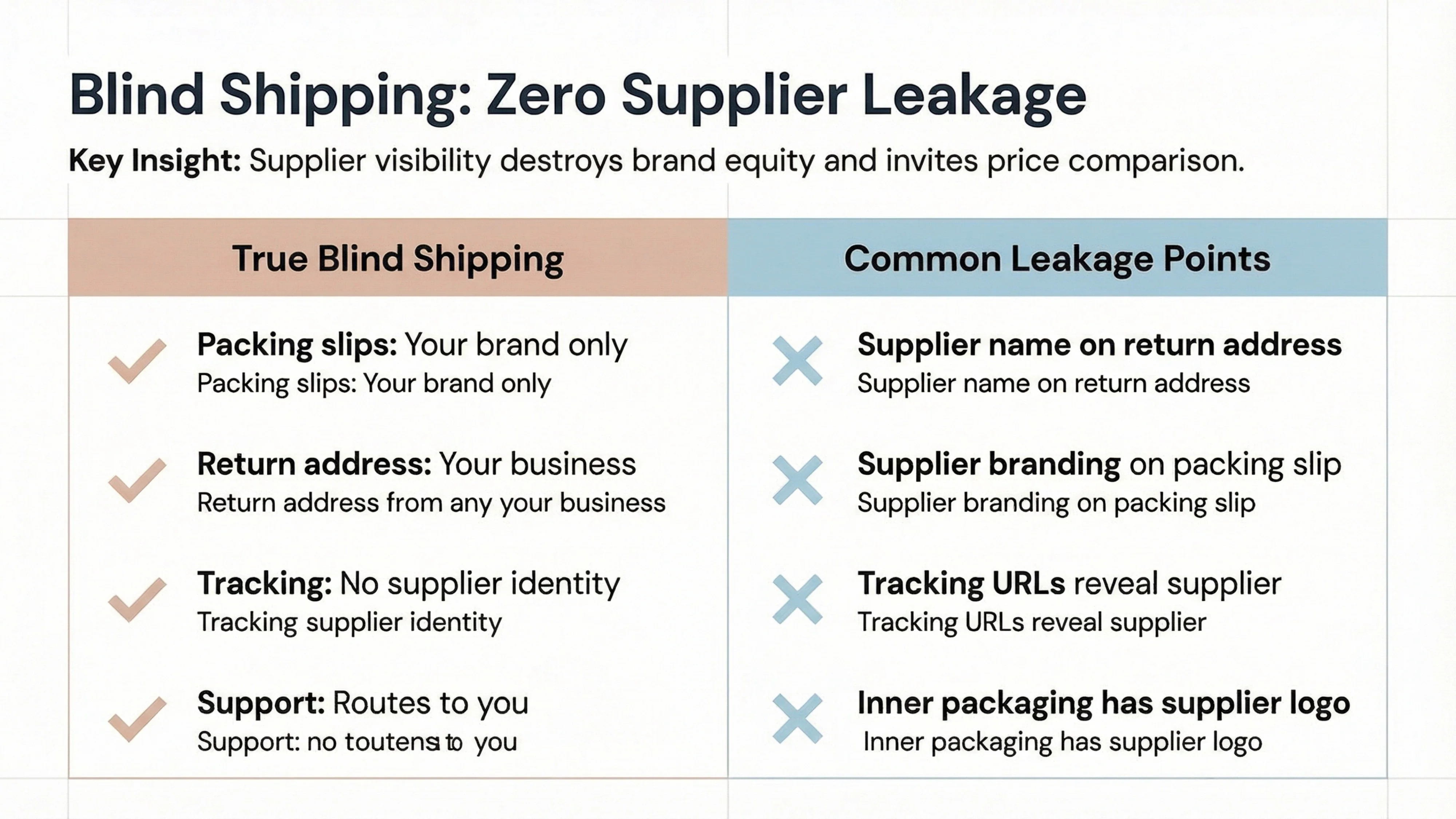
What it is: A fulfillment process in which the supplier's name, branding, and contact information never appear on the package, packing slip, return address, or tracking page. The customer sees only your brand.
Why it matters: Supplier leakage destroys brand equity. If a customer receives a package with another company's name or logo, they immediately perceive your brand as a middleman—not a real business. This erodes trust, invites price comparison, and increases the likelihood of chargebacks or disputes.
How to validate it: Ask the supplier: Is your shipping truly blind? What appears on the packing slip, return address, and tracking page? Can I use my own return address? Order a sample and inspect every element of the package and tracking information.
Common failure modes: Supplier name on return address, supplier branding on packing slip, tracking pages that reveal supplier identity, return labels that route to supplier warehouse instead of your address. Some suppliers claim "blind shipping" but leak their identity through tracking URLs or customer service contact info.
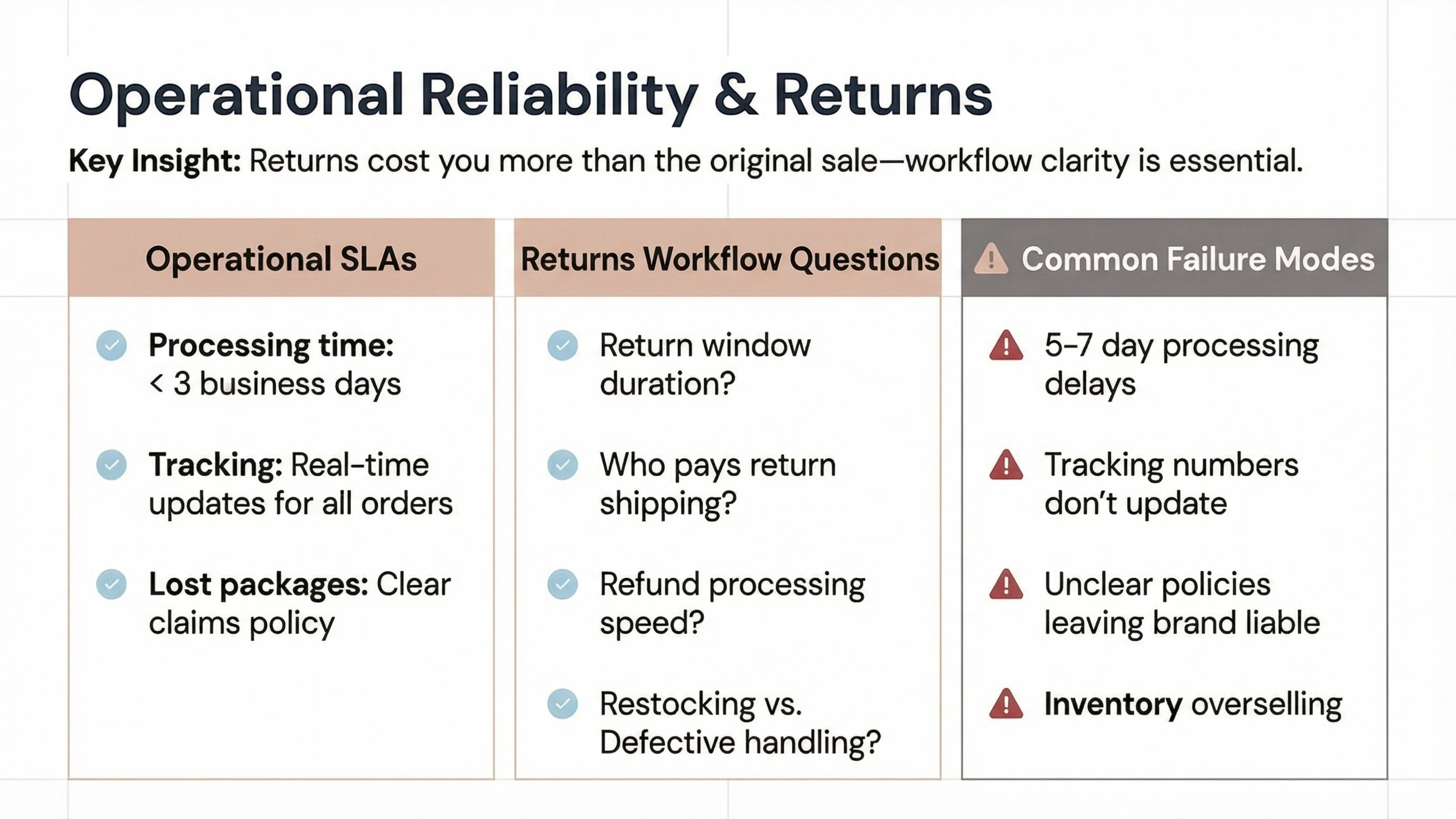
What it is: Consistent processing times (e.g., 1-3 business days), accurate tracking updates, transparent communication about delays or stockouts, and a clear returns workflow that defines who pays shipping, how refunds are processed, and how returned inventory is handled.
Why it matters: Operational reliability is the backbone of customer trust. Late shipments, missing tracking numbers, and confusing return processes generate support tickets, negative reviews, and lost customers. Returns now represent 19.3% of eCommerce orders, with a 35% spike in January [1]. A supplier who cannot handle returns efficiently will cost you more in refunds, chargebacks, and brand damage than you save on product costs.
How to validate it: Ask the supplier: What is your average processing time? What happens if an item is out of stock? How do you handle lost packages? What is your returns policy—who pays return shipping, and how quickly are refunds processed? Test their responsiveness by placing a sample order and tracking the entire fulfillment cycle.
Common failure modes: Orders that sit in "processing" for 5-7 days, tracking numbers that do not update, suppliers who go silent when issues arise, unclear return policies that leave you liable for all costs, inventory systems that oversell and create backorders.
What it is: Seamless, real-time integration between the supplier's system and your Shopify store, enabling automatic product imports, inventory synchronization, order routing, and status updates without manual intervention.
Why it matters: Manual order entry and inventory management are not scalable. They create errors (wrong addresses, duplicate orders, overselling), consume hours of labor, and prevent you from focusing on marketing and growth. Shopify sync is the engine of a hands-free operation—it eliminates friction and ensures operational efficiency.
How to validate it: Ask the supplier: Do you have a native Shopify app or API integration? How often does inventory sync (real-time, hourly, daily)? Can I bulk-import products with descriptions, images, and variants? What happens when an item goes out of stock—does my store update automatically? Test the integration with a few products and place test orders to verify order routing and status updates.
Common failure modes: Suppliers who require CSV uploads and manual order forwarding, inventory that syncs once per day (leading to overselling), integrations that break frequently, missing variant support (e.g., ring sizes, chain lengths), order status updates that lag by 24-48 hours.
What it is: Accurate material disclosures (e.g., "18K gold vermeil over sterling silver" vs. misleading "fine jewelry" claims), allergy considerations (nickel-free posts, hypoallergenic materials), transparent policies on warranties and defects, and adherence to FTC guidelines on endorsements and material claims.
Why it matters: Misleading claims trigger chargebacks, FTC complaints, and legal liability. Customers who develop allergic reactions or receive products that do not match descriptions will leave negative reviews and dispute charges. Compliance is not just about avoiding lawsuits—it is about building trust and reducing friction.
How to validate it: Review the supplier's product descriptions and material claims. Are they specific and accurate? Do they provide certifications or test reports for hypoallergenic materials? Ask about their policy on defects and warranties. Check if their claims comply with FTC guidelines.
Common failure modes: Suppliers who call gold-plated items "fine jewelry," who do not disclose nickel content, who make unverifiable claims about "hypoallergenic" materials without testing, who refuse to provide material certifications, who have no clear defect or warranty policy.
This section provides a scannable, actionable checklist for evaluating brand-ready jewelry dropshipping suppliers. Use this as a field guide when vetting potential partners.
QC Standards
Consistent Plating/Vermeil Claims
Material Disclosures
Consistent Lighting/Background
Model Shots vs. Flat Lays
Listing Copy Consistency
What Blind Shipping Really Includes
Common Gotchas
Boxes, Pouches, Cards, Logo Placement
Gift Notes
Minimums and Lead Times
Processing Times, Tracking, Lost Packages
Returns Workflow and Who Pays
Customer Support Handoff
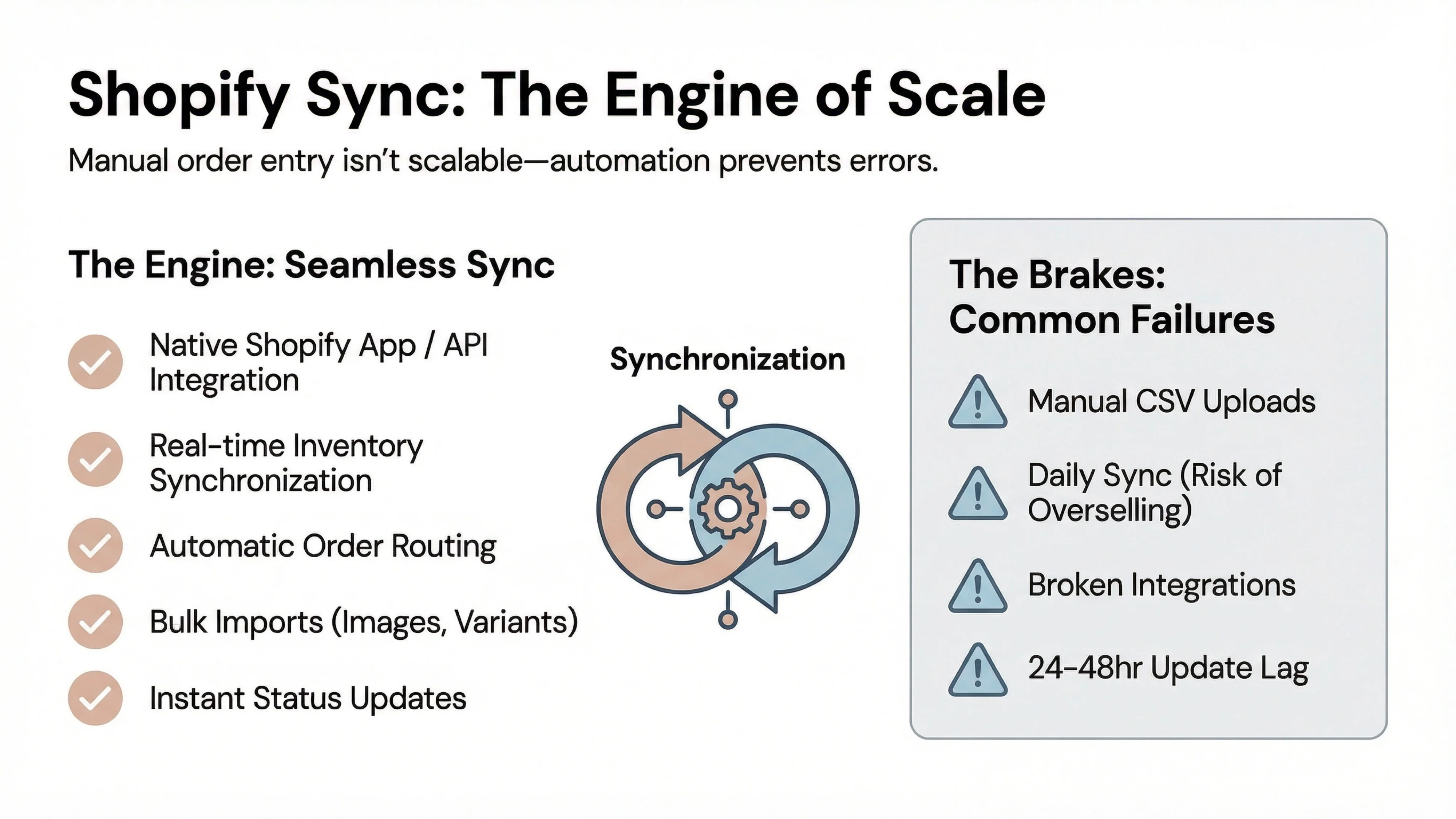
Product Feed Quality
Variants
Inventory Behavior
Order Routing and Status Updates
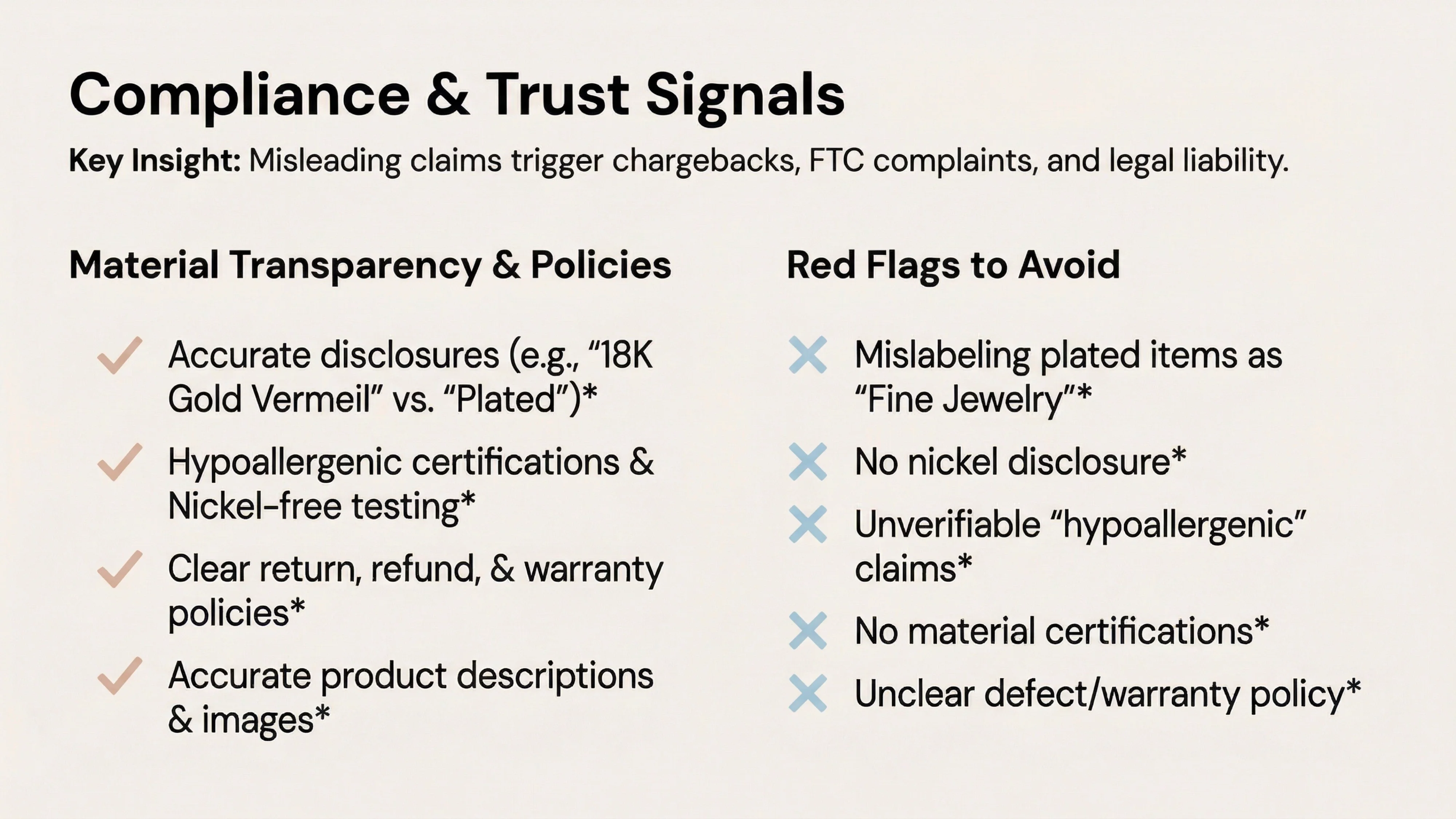
Avoid Misleading "Fine Jewelry" Claims
Allergy/Nickel Considerations
Policies That Reduce Chargebacks
Use this rubric to objectively evaluate potential brand-ready jewelry dropshipping suppliers. Each category is weighted based on its impact on brand equity and operational efficiency.
|
Category |
Weight (Points) |
What "Good" Looks Like |
How to Test/Verify |
|---|---|---|---|
|
Product Integrity |
15 |
Consistent quality, accurate material specs, defect rate <2%, clear QC process |
Order 5-10 samples from different SKUs; inspect for defects, consistency, and packaging quality |
|
Brand Presentation |
15 |
Professional photos with consistent lighting/backgrounds, lifestyle images, detailed descriptions |
Review product catalog; assess photo quality, consistency, and description accuracy |
|
Custom Packaging |
20 |
Branded boxes/pouches available with reasonable minimums (<500 units), inserts supported, premium unboxing experience |
Request packaging samples; ask about minimums, lead times, and customization options |
|
Blind Shipping |
15 |
Zero supplier leakage on packing slip, return address, tracking page, or customer-facing materials |
Place sample order; inspect all packaging, tracking, and customer communications |
|
Operational Reliability |
15 |
Processing time <3 days, tracking provided for all orders, clear returns policy, responsive support |
Place test orders; track fulfillment speed, communication quality, and issue resolution |
|
Shopify Sync |
10 |
Native Shopify app or API, real-time inventory sync, automatic order routing, variant support |
Test integration with 10-20 products; place test orders and verify sync accuracy |
|
Compliance & Trust |
10 |
Accurate material disclosures, hypoallergenic options disclosed, no misleading claims, clear policies |
Review product listings and policies; ask for certifications or test reports |
|
TOTAL |
100 |
A supplier must score at least 70 points to be considered brand-ready. Suppliers scoring below 70 are logistics vendors, not brand-infrastructure partners.
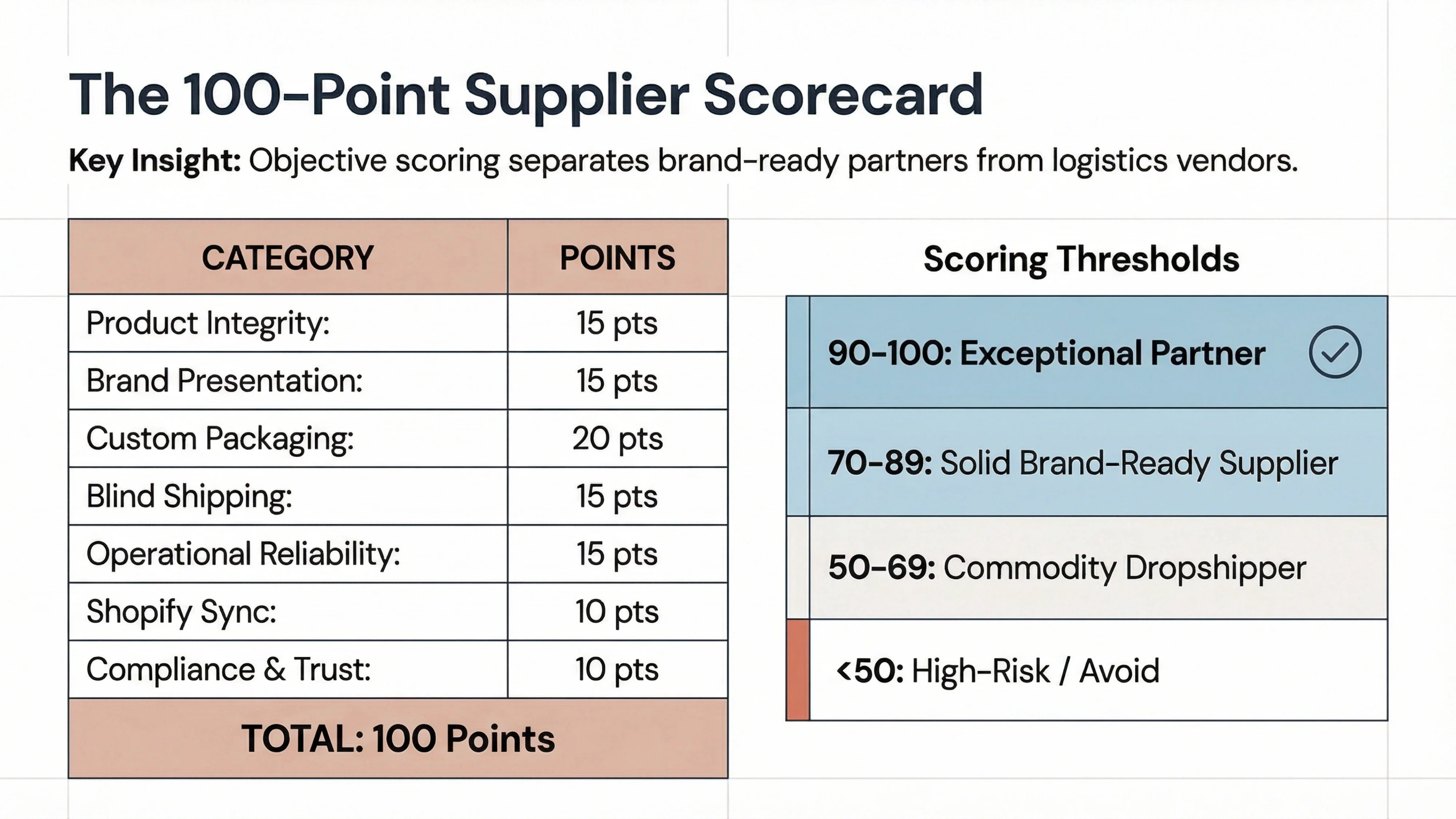
Certain failures are automatic disqualifiers, regardless of total score:
To make supplier evaluation systematic and repeatable, we have created a Supplier Scorecard Template that you can use to assess every potential partner. This template includes all scoring categories, verification steps, and decision criteria from the rubric above.
Supplier Information
Scoring Categories (with checkboxes and notes)
For each category, the template includes:
Final Score & Decision
Download the Supplier Scorecard (Google Sheet)
Use this template to systematically evaluate every jewelry dropshipping supplier. Score them across all seven layers of the Brand-Ready Dropshipping Stack, identify red flags, and make confident decisions. [Download Now]
Most founders approach supplier selection as a logistics problem: Who ships fastest? Who has the lowest prices? Who integrates with Shopify?
This is backwards.
Your supplier is a brand decision, not a logistics decision. The supplier you choose determines whether your brand is perceived as premium or generic, whether customers return for repeat purchases or leave negative reviews, and whether you can command $50 for a pair of earrings or get stuck competing on price at $12.
Here is the contrarian truth: The cheapest supplier is the most expensive after refunds and brand damage.
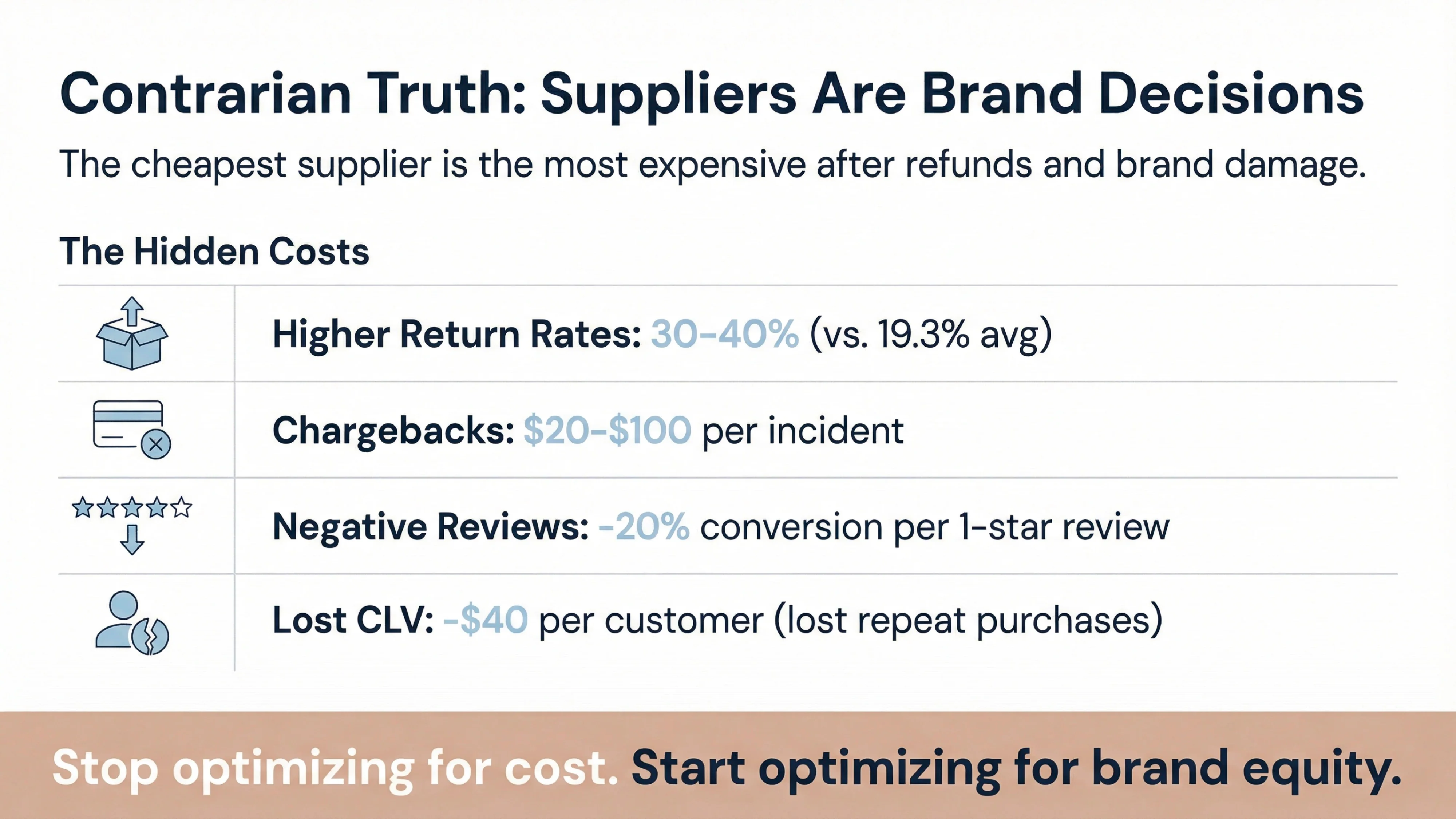
Consider the real cost of a "cheap" supplier:
The data supports this thesis. Research from Staci shows that premium packaging increases purchase likelihood by 50% after two touches and 90% after four touches, and people report 95% more positive emotions with premium packaging [3]. McKinsey research confirms that packaging is a consumer's first interaction with a product and directly impacts repeat purchases [5]. Shopify's 2026 trends report emphasizes that brands must work harder than ever to offer unique experiences, as consumer loyalty has dropped to 29% in 2025 [2].
In 2026, the brands that win are not the ones with the cheapest suppliers—they are the ones with brand-ready suppliers who protect and amplify brand equity at every touchpoint. This is why Shopify sync is a brand feature, not a tech feature. It ensures that your customers see consistent inventory, accurate product information, and reliable fulfillment—all of which build trust. This is why unboxing is your only "retail storefront" in dropshipping—it is the moment when your brand promise meets reality.
The contrarian insight: Stop optimizing for cost. Start optimizing for brand equity. The suppliers who understand this are your competitive advantage.
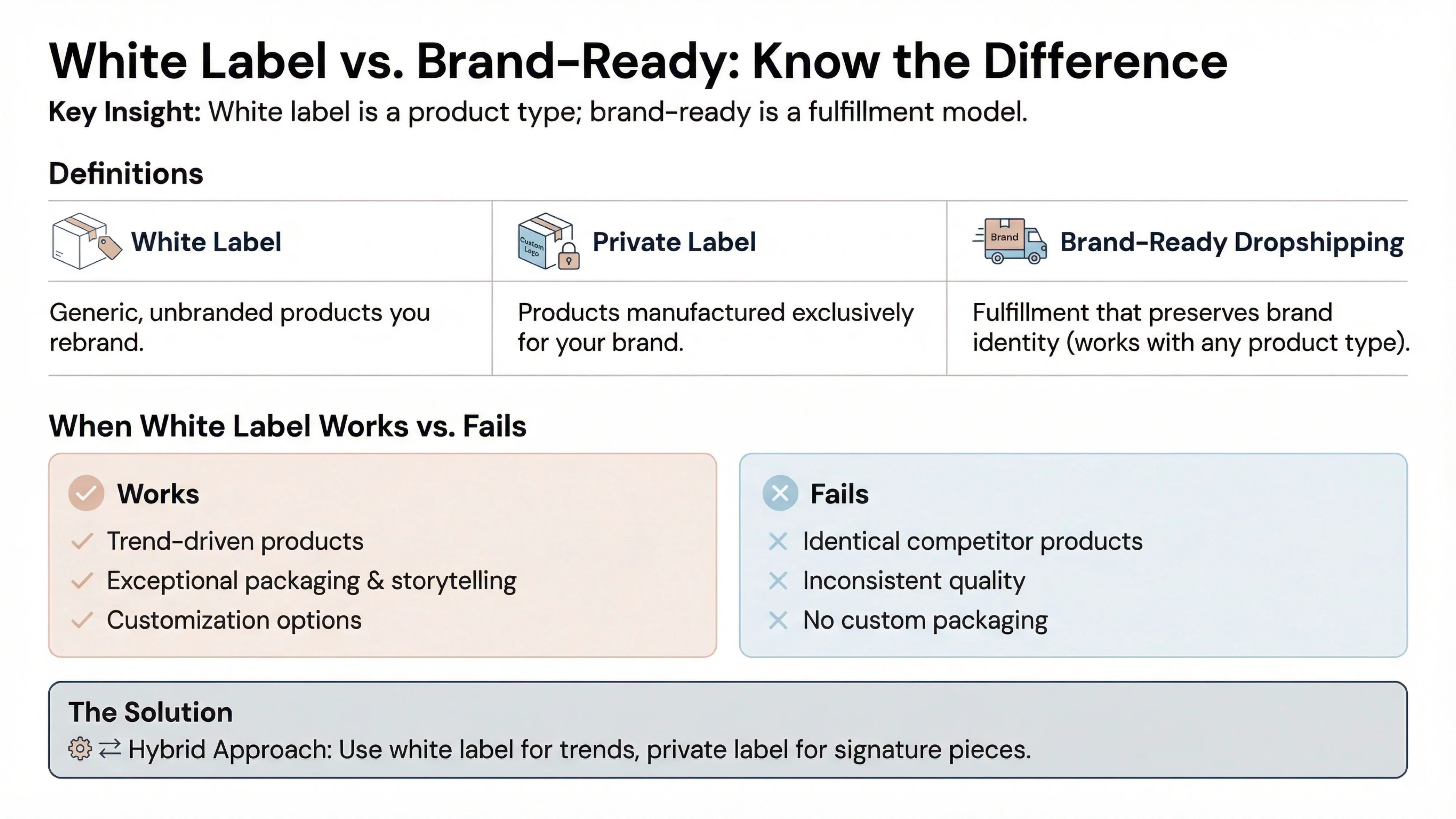
The term white label jewelry dropshipping is often used interchangeably with "brand-ready dropshipping," but they are not the same—and understanding the difference is critical.
White label refers to generic, unbranded products that you rebrand and sell under your own label. The supplier manufactures or sources the product, but it carries no branding until you add yours. White label is common in supplements, skincare, and commodity goods where the product itself is not differentiated.
Private label refers to products that are manufactured exclusively for your brand, often with custom designs, formulations, or specifications. Private label products are unique to your brand and cannot be sold by competitors.
Brand-ready dropshipping is a fulfillment model, not a product type. It means the supplier handles fulfillment in a way that preserves your brand identity—through blind shipping, custom packaging, and consistent presentation—regardless of whether the product is white label, private label, or simply curated from existing inventory.
White label jewelry dropshipping works when:
White label jewelry dropshipping becomes a liability when:
The core risk of white label jewelry dropshipping is commoditization. When your product is identical to competitors, customers have no reason to choose you—unless you compete on price, which erodes margins and prevents reinvestment in brand-building. McKinsey research on private brands shows that retailers who invest in exclusive, differentiated products can command higher margins and build customer loyalty [6]. The same principle applies to jewelry dropshipping: exclusivity and differentiation create brand equity; generic goods do not.
Instead of relying solely on white label products, consider a hybrid approach:
In 2026, white label jewelry dropshipping is not inherently good or bad—it depends on how you use it. If you treat it as a shortcut to avoid brand-building, you will struggle. If you use it strategically as part of a broader brand-ready fulfillment model, it can be a valuable tool.
At Branvas, we built our platform specifically to solve the brand-ready dropshipping problem. We have seen too many jewelry founders struggle with suppliers who promise "hands-free fulfillment" but deliver generic packaging, inconsistent quality, and supplier leakage that destroys brand equity.
Our approach is different. We provide a brand-ready system out of the box, designed to score highly across all seven layers of the Brand-Ready Dropshipping Stack:
Product Integrity: We curate a catalog of over 3,000 SKUs in gold vermeil, sterling silver, and hypoallergenic materials, with consistent quality control and material transparency.
Brand Presentation: Every product includes professional photography with consistent lighting and backgrounds, plus lifestyle images and detailed descriptions that you can customize to match your brand voice.
Custom Packaging: We offer branded packaging options with reasonable minimums, including custom boxes, pouches, thank-you cards, and care instructions. Our goal is to make your unboxing experience feel premium, not generic.
Blind Shipping: All orders ship with your brand name only—no Branvas branding on packing slips, return addresses, or tracking pages. Your customers see only your brand.
Operational Reliability: Orders process within 1-3 business days, with tracking provided for all shipments. We have a clear returns policy and responsive support to handle issues quickly.
Shopify Sync: Our native Shopify app enables real-time inventory sync, automatic order routing, and bulk product imports with full variant support.
Compliance & Trust: We provide accurate material disclosures, hypoallergenic options, and transparent policies to reduce chargebacks and build customer trust.
We encourage you to use the Supplier Scorecard template (above) to evaluate Branvas—or any supplier—objectively. Here is how we recommend testing us:
If you want to evaluate a supplier quickly, start with a sample order and use the scorecard—Branvas is built for that workflow. We believe that brand-ready dropshipping should be transparent, systematic, and measurable. That is why we support founders who want to test us rigorously before committing.
[Start your free trial and order samples today]
Brand-ready dropshipping is a fulfillment model in which your supplier acts as an invisible extension of your brand, handling product sourcing, inventory, and fulfillment without any visible trace of their involvement reaching your customer. The supplier actively supports your brand identity through custom packaging, professional visual assets, consistent product presentation, blind shipping, and reliable operational processes. This contrasts with commodity dropshipping, where the supplier's role is purely transactional and often includes supplier branding, generic packaging, and minimal integration with your store.
Blind shipping in jewelry dropshipping means that the supplier's name, branding, and contact information never appear on the package, packing slip, return address, or tracking page. The customer sees only your brand. True blind shipping includes: packing slips with your brand name only, return addresses that show your business or a neutral address (not the supplier warehouse), tracking pages that do not reveal supplier identity, and customer service contact info that routes to you, not the supplier. Blind shipping is essential for preserving brand equity and preventing customers from perceiving your business as a middleman.
Yes, many brand-ready jewelry dropshipping suppliers offer custom packaging options, including branded boxes, pouches, tissue paper, thank-you cards, and care instructions. However, minimums and lead times vary widely. Some suppliers require 1,000+ unit minimums for custom packaging, while others offer lower minimums (e.g., 250-500 units). When evaluating suppliers, ask about minimums, lead times, customization options (logo placement, insert support, gift notes), and whether custom packaging is integrated into their standard fulfillment process or requires special handling. Custom packaging is critical for creating a premium unboxing experience that builds brand loyalty and justifies higher prices.
White label jewelry refers to generic, unbranded products that you rebrand and sell under your own label. The supplier manufactures or sources the product, but it carries no branding until you add yours. White label products are not exclusive—other brands may sell identical items. Private label jewelry refers to products manufactured exclusively for your brand, often with custom designs, formulations, or specifications. Private label products are unique to your brand and cannot be sold by competitors. White label is faster and cheaper to launch but offers less differentiation. Private label requires higher investment but creates brand exclusivity and defensibility.
Use a systematic evaluation framework like the Brand-Ready Dropshipping Stack (BRDS) to assess suppliers across seven layers: Product Integrity, Brand Presentation, Unboxing Control, Blind Shipping, Operational Reliability, Shopify Sync, and Compliance & Trust. Order samples from 5-10 SKUs to test product quality, packaging, and blind shipping. Review the supplier's product catalog for photo quality and description accuracy. Test their Shopify integration by importing products and placing test orders. Ask detailed questions about QC processes, return policies, custom packaging minimums, and material disclosures. Use the 100-point Supplier Scorecard to objectively score each supplier and identify red flag disqualifiers. A supplier must score at least 70 points to be considered brand-ready.
[1] "The $850 Billion Problem: eCommerce Return Trends 2025," Ordoro Blog, January 2, 2026. https://blog.ordoro.com/2026/01/02/ecommerce-return-trends-2025-2/
[2] "2026 Ecommerce Trends: How Brands Are Planning Ahead," Shopify Blog, January 9, 2026. https://www.shopify.com/blog/ecommerce-trends-predictions
[3] "The Psychology of Unboxing – and Why It Matters for 2026," Staci UK, September 22, 2025. https://uk.staci.com/the-psychology-of-unboxing-and-why-it-matters-for-2026/
[4] "State of the Consumer 2025: When disruption becomes permanent," McKinsey & Company, June 9, 2025. https://www.mckinsey.com/industries/consumer-packaged-goods/our-insights/state-of-consumer
[5] "McKinsey delves into the 'untapped potential' of unboxing experiences," Packaging Europe, March 19, 2025. https://packagingeurope.com/news/mckinsey-delves-into-the-untapped-potential-of-unboxing-experiences/12612.article
[6] "A turning point for private brands: How retailers can seize the opportunity," McKinsey & Company, November 4, 2024. https://www.mckinsey.com/industries/retail/our-insights/a-turning-point-for-private-brands-how-retailers-can-seize-the-opportunity